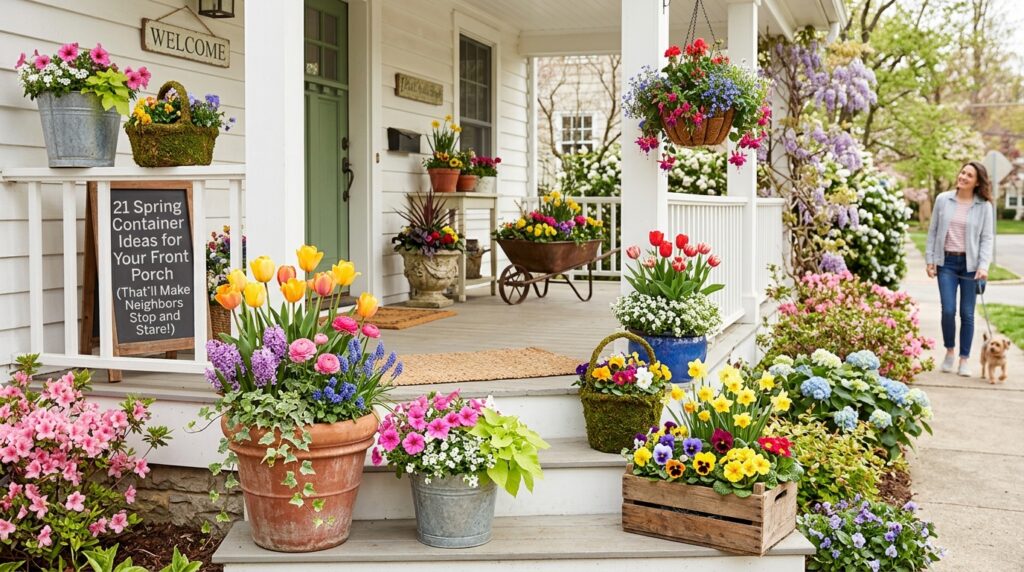
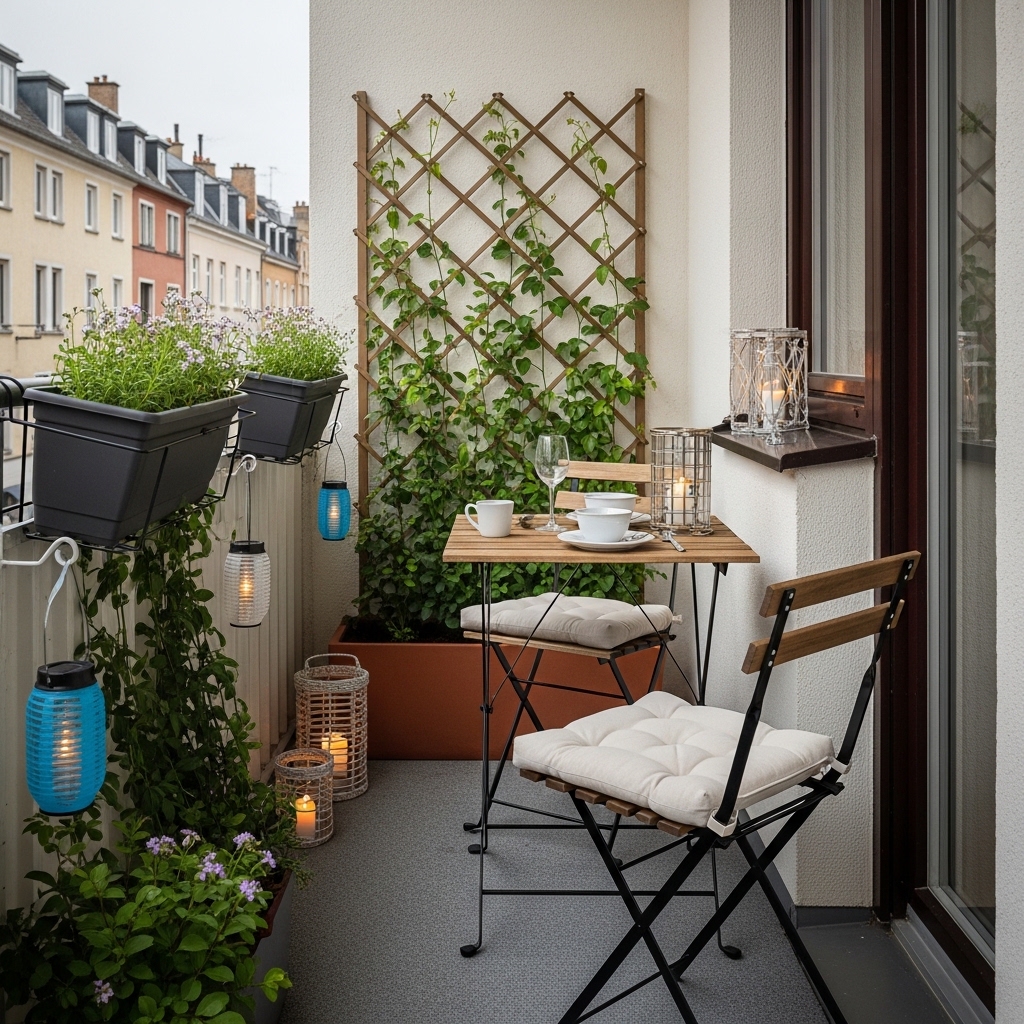
Have you ever walked past a gap between buildings, a forgotten side return, or a cramped corner of your garden and thought “what on earth do I do with that?” Those neglected, tucked-away spaces are actually some of the most exciting secret garden opportunities hiding in plain sight — and with the right ideas, they can become the most magical, talked-about spots in your entire outdoor space. We’re talking hidden seating nooks, mysterious moonlit pathways, fragrant walled enclosures, and green tunnels that make you feel like you’ve stepped into another world entirely. Ready to unlock the hidden potential of every forgotten corner? Let’s dive in!
At a Glance
- Secret garden design works best in forgotten, overlooked, or awkward spaces — side returns, narrow alleyways, walled corners, and shaded spots are all perfect candidates for transformation.
- Using structure, enclosure, and layered planting creates the sense of mystery and discovery that defines a truly memorable secret garden, even in a very small space.
- Fragrant plants, low lighting, and sound elements like water features amplify the sensory experience and make hidden garden spaces feel genuinely enchanting after dark as well as by day.
- Even a balcony, rooftop, or courtyard can be designed with secret garden principles — enclosure, intimacy, and considered planting are the key ingredients regardless of size.
- The most successful hidden garden spaces combine a strong design concept (cottage, moonlit, jungle, walled) with practical planting choices that suit the specific light, soil, and exposure conditions of the space.
1. The Walled Green Tunnel Entrance
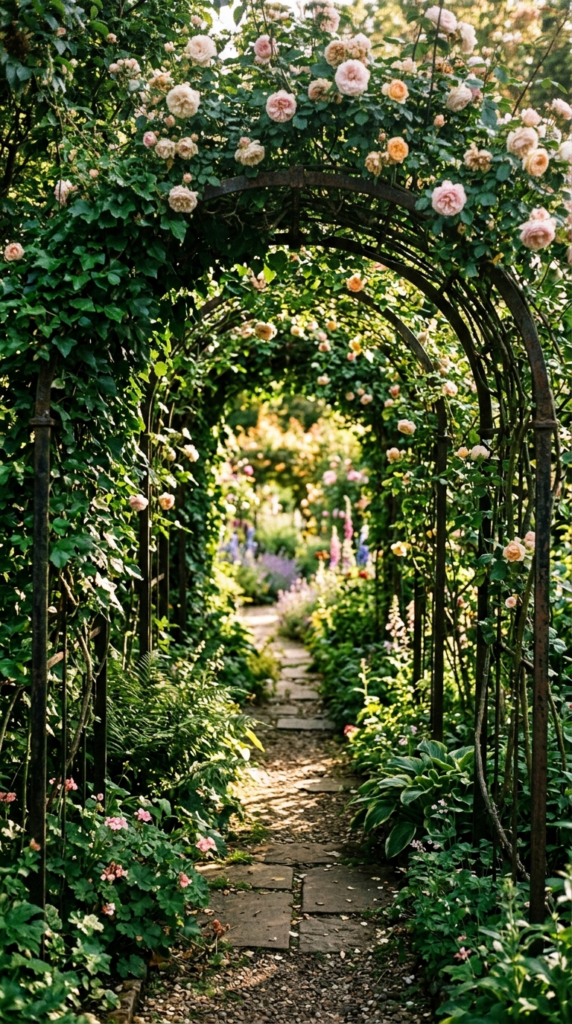
Here’s the deal: nothing signals “something magical is ahead” quite like a green tunnel entrance that you have to pass through to reach a hidden space. The tunnel creates a moment of transition — a deliberate pause between the ordinary world and the secret one — and that psychological shift is the whole magic of secret garden design.
The secret is using a metal or timber pergola framework and training fast-growing climbers over it densely enough that the sides and ceiling fully close in. Rosa ‘Veilchenblau’, climbing hydrangeas, and wisteria are all perfect — they grow vigorously, cover frameworks quickly, and produce stunning seasonal flowers that turn the tunnel into a fragrant, blooming passageway.
💡 Pro Tip: Keep the tunnel slightly narrower than feels comfortable — around 80–90cm wide rather than a full metre. The mild sense of enclosure as you walk through heightens the drama of emerging into the open secret garden beyond. Restraint in width = maximum impact in experience.
Underplant the tunnel floor with shade-tolerant ground covers like Pachysandra, sweet woodruff, or creeping thyme that release fragrance as you brush past them — engaging all the senses simultaneously makes the transition feel truly immersive.
- Metal tunnel frameworks last 15–20 years and support heavy climbers
- Wisteria creates the most dramatic flowering tunnel but needs 3–5 years to establish
- Roses + Clematis combined give you two distinct flowering seasons from the same structure
- Annual climbers like Nasturtium and Sweet Peas fill gaps quickly in the establishment years
Check out our climbing plants for pergolas and tunnel structures guide for the best species combinations. The Royal Horticultural Society has excellent pergola construction advice at rhs.org.uk.
A green tunnel entrance transforms any garden — it’s the single design move that most dramatically signals that something extraordinary is waiting beyond!
2. The Moonlit White Garden Enclosure
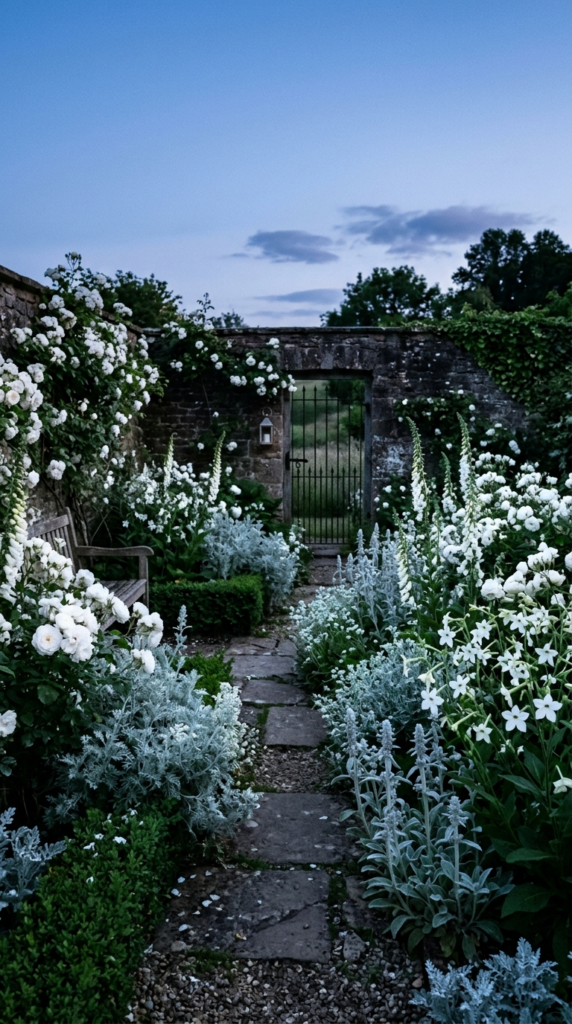
White gardens — made famous by Vita Sackville-West’s legendary White Garden at Sissinghurst — are among the most breathtaking garden design concepts ever conceived, and they’re absolutely achievable in a hidden corner of almost any garden. The key is enclosure: a white garden needs walls, hedges, or trained climbers on frames to contain and amplify its luminous effect.
White and silver plants have a genuinely magical quality at dusk and in moonlight — they seem to glow from within as ambient light fades, making them spectacular for evening gardens in a way that no colored planting scheme can match. Plant your hidden white garden and experience it after 9pm on a summer evening — it will genuinely take your breath away.
The planting palette is everything here: white roses (Rosa ‘Iceberg’ or ‘Climbing Snowflake’), white Foxgloves, Nicotiana sylvestris for that intoxicating night fragrance, silvery Stachys byzantina, Artemisia ‘Powis Castle’, and white-flowered Clematis climbing the walls. Layer heights from tall climbers down to ground-hugging silver Lamb’s Ears.
💡 Pro Tip: Include at least 3–4 night-fragrant white plants in your moonlit garden — Nicotiana, white Jasmine, Night-Scented Stock, and Phlox paniculata all release their scent in the evening. The combination of luminous white flowers and heady evening perfume is an experience unlike anything else in gardening.
Explore our white garden planting guide for enclosed spaces for the full plant list and design framework.
A moonlit white garden in a hidden enclosure is one of those garden experiences that stays with people forever — create one and it will become the most loved spot in your entire outdoor space!
3. The Overgrown Cottage Nook
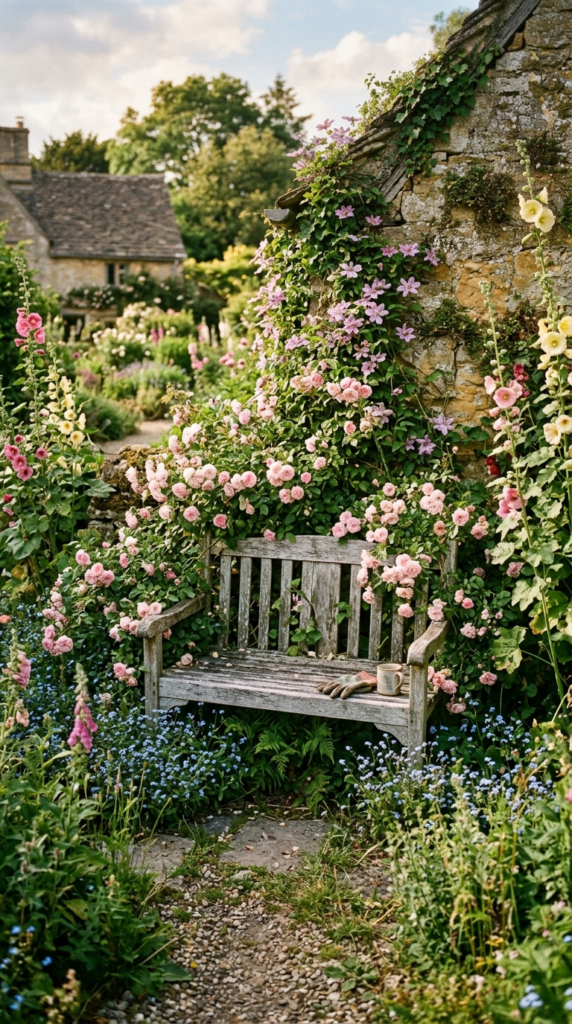
Here’s the thing: the most romantic and atmospheric secret garden spaces often look like they’ve been abandoned to nature for years — and you can deliberately design that beautiful, overgrown cottage feeling from scratch. The “accidental” look is, in fact, a very intentional design strategy.
The secret is layering plants that self-seed and spread — Foxgloves, Aquilegia, Forget-me-nots, and Welsh Poppies will colonize every gap and crack in your hidden nook, filling it with that beautiful soft randomness that makes cottage gardens feel like they happened organically over decades rather than being planted last spring.
Weathered materials are non-negotiable here — a new wooden bench needs to be painted or treated to look aged. Reclaimed stone or brick, distressed metal, moss-covered terracotta, and old wooden salvage pieces all contribute to the atmosphere of a garden that time forgot.
Anchor the space with a large, vigorous rambling rose like Rosa ‘Rambling Rector’ or ‘Kiftsgate’ trained over an old fruit tree, a rustic arch, or a crumbling wall — these grow with wild abandon and produce cascades of small, scented flowers that define the overgrown cottage aesthetic more than any other plant.
| Plant | Role | Spread | Self-Seeds? |
| Rosa ‘Rambling Rector’ | Structural climber | 4–6m | No |
| Aquilegia vulgaris | Mid-height filler | 60cm | Yes — freely |
| Digitalis purpurea | Vertical drama | 1.2m | Yes — prolifically |
| Forget-me-not | Ground carpet | 30cm | Yes — everywhere |
| Welsh Poppy | Gap filler | 40cm | Yes — enthusiastically |
Read our designing a cottage secret garden from scratch guide for the layering approach. The National Trust has gorgeous cottage garden inspiration at nationaltrust.org.uk.
Embrace the beautiful, controlled chaos of the cottage nook — the less perfect it looks, the more magical it actually feels!
4. The Fern Grotto & Shaded Dell
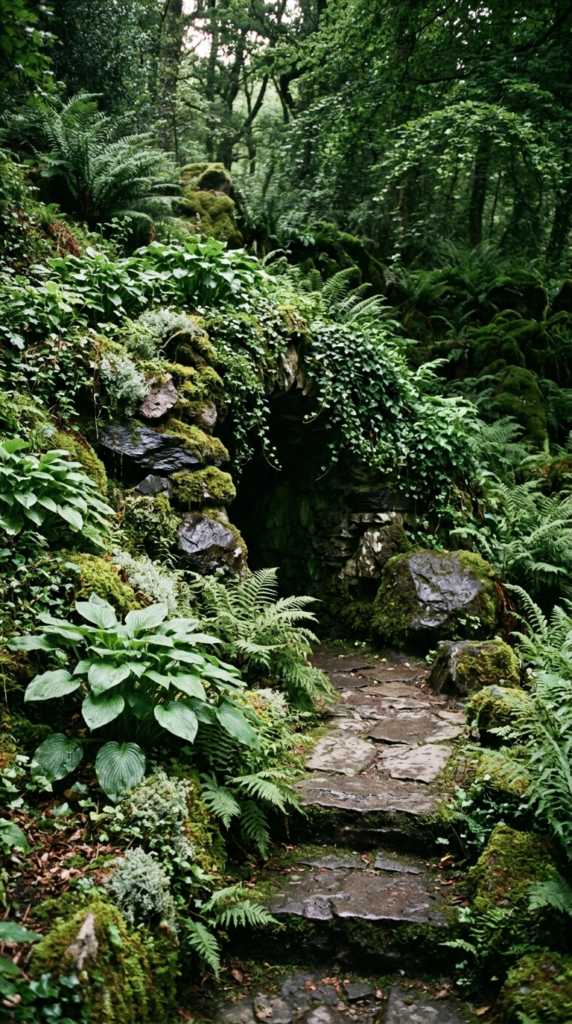
Shaded, damp, north-facing corners that most gardeners despair of are, in fact, the perfect conditions for a fern grotto — one of the most atmospheric and ancient-feeling hidden garden spaces you can create. Lean into the darkness rather than fighting it!
Ferns are the soul of the grotto — use large, architectural species like Dryopteris wallichiana (Wallich’s Wood Fern) for drama, Matteuccia struthiopteris (Shuttlecock Fern) for its stunning vase shape, and ground-covering Blechnum spicant to carpet the floor. Layer them at different heights against mossy boulders and draped ivy for a genuinely primordial atmosphere.
💡 Pro Tip: Introduce living moss deliberately by blending moss with buttermilk and painting it onto rocks, old terracotta, and shaded stone surfaces. It takes a few weeks to establish but the result — a fully moss-covered grotto — looks like it’s been there for centuries. This is one of the most transformative cheap tricks in hidden garden design.
Sound is crucial in a grotto — the addition of a small, simple water feature (even a tiny recirculating pump with water trickling over pebbles) adds the sound of running water to the cool, green dimness and creates an atmosphere that is profoundly calming and mysterious.
Explore our shade garden planting for fern grottos and dells for the full species list and design approach.
A fern grotto turns your most challenging shaded corner into your most magical space — it’s the alchemy of good garden design at its very best!
5. The Secret Seating Nook Behind Hedging
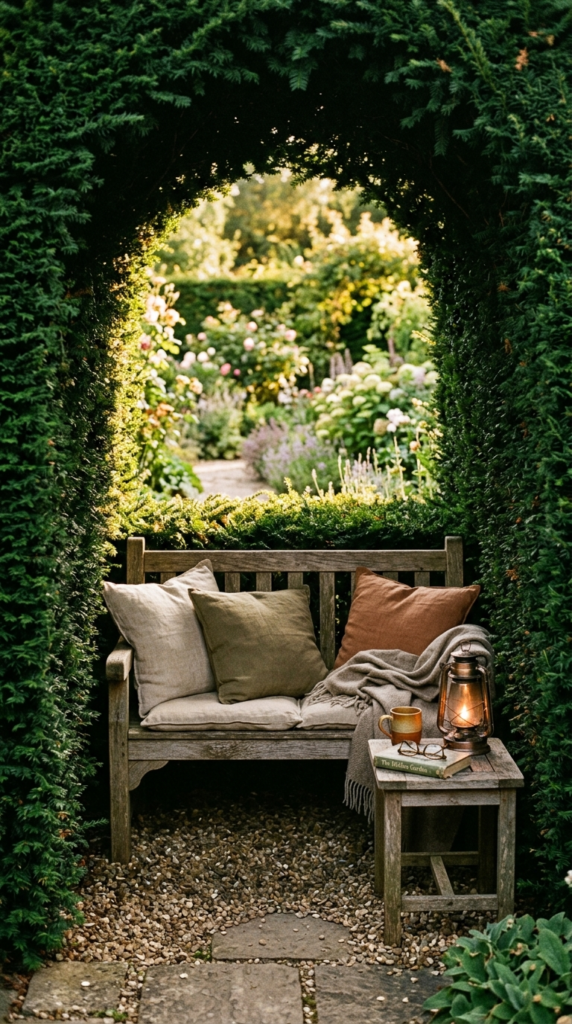
The hedge nook is perhaps the ultimate secret garden idea — the creation of a fully enclosed outdoor room within a living green wall that gives you complete privacy, enclosure, and the feeling of a space that exists entirely outside the normal world.
The technique is simple but takes patience: plant a dense hedging species in a U-shape or three sides of a square, then clip it to create a clean recess as it matures. Yew (Taxus baccata) is the classic choice — it clips to razor precision, creates impenetrably dense enclosure, and lasts for centuries. Hornbeam grows faster and retains its russet winter leaves. Holly gives you year-round density and festive winter berries.
The interior of your hedge nook deserves the same care as any interior room — a beautiful bench, outdoor cushions in weather-resistant fabric, a small side table, storm lanterns for evening use, and perhaps a small planted container inside the space for a living focal point.
💡 Pro Tip: Cut a narrow, deliberately low entrance into your hedge nook — around 1.5m high rather than full height. Having to duck slightly as you enter amplifies the sense of entering a secret, private world and makes the space feel even more removed from everything beyond the hedge. It’s a small detail with enormous atmospheric impact.
Read our how to create a hedge garden room or nook for planting distances and clipping schedules.
Your own perfectly private outdoor room, walled in living green — this is the secret garden idea that people dream about most, and it’s completely achievable!
6. The Hidden Water Feature Garden

Here’s the deal: water transforms a hidden garden more than almost any other single element — it adds sound, movement, light reflection, and a primordial sense of calm that plants alone can’t create. Even the smallest hidden space becomes something extraordinary with a well-placed water feature at its heart.
The secret is choosing a water feature whose scale matches the space. A huge fountain in a tiny hidden garden overwhelms and dominates. A small, trickling stone lion’s head wall fountain, a simple rill channel cut through paving, or a mossy millstone with a recirculating pump are all perfectly scaled for intimate hidden spaces.
Plant around your water feature with moisture-loving species that amplify the lush, watery atmosphere — Astilbe for feathery summer plumes, Yellow Flag Iris (Iris pseudacorus) for architectural vertical form, creeping Jenny (Lysimachia nummularia) to trail into and around the water’s edge, and large-leaved Ligularia for dramatic foliage impact.
At night, a simple submersible LED light in your water feature creates an extraordinary rippling light effect on surrounding walls and planting — the hidden water garden after dark is an experience of rare beauty.
| Water Feature Type | Size | Cost | Maintenance |
| Wall-mounted fountain | Small | Low-medium | Low |
| Millstone with pump | Small-medium | Medium | Very low |
| Rill channel | Any | Medium-high | Low |
| Wildlife pond | Large | Low-medium | Medium |
| Container pond | Very small | Very low | Low |
Explore our hidden garden water features guide for installation and planting advice. The Wildlife Trusts has excellent garden pond creation resources at wildlifetrusts.org.
Water turns a hidden garden into something genuinely magical — add it and watch the whole space come alive in a way that nothing else can match!
7. The Sunken Garden Hideaway

A sunken garden is one of the most dramatic and classically beautiful hidden garden ideas — and even a modest drop of just 40–60cm below the surrounding ground level creates a profound sense of enclosure, privacy, and separation from the world above.
The genius of the sunken design is that you don’t need tall walls or hedges to create enclosure — the earth itself becomes your wall. Low retaining walls of stone, brick, or railway sleepers hold the banks, and the surrounding planting at ground level creates a complete green parapet above your hidden sunken world.
💡 Pro Tip: Sunken gardens are naturally more sheltered from wind than ground-level spaces — they create their own warm microclimate that can be 2–3 degrees warmer than the surrounding garden. Use this to your advantage by growing slightly tender plants that wouldn’t survive elsewhere, and enjoy the windless stillness that makes sunken spaces feel so uniquely calm.
The planting style inside a sunken garden can be anything you choose — formal clipped structure with a central urn or statue works beautifully with the classical architecture of the sunken form. A wilder, more romantic planting of roses, Peonies, and delphiniums in the warmer protected microclimate creates something altogether more dreamy.
Read our sunken garden design guide for small spaces for excavation, drainage, and planting advice.
Descending those few steps into a sunken garden is one of the most satisfying moments in any garden visit — create that moment in your own outdoor space!
8. The Side Return Jungle Corridor

That narrow, awkward side return running along the side of your house is one of the most overlooked and most transformable hidden spaces in urban gardens. Most people ignore it entirely or use it for bin storage — but with the right planting and a few key design moves, it becomes the most surprising and exciting passage in your home.
The key is going completely tropical and maximalist with the planting — the narrow corridor benefits from big, bold, jungle-scale leaves that make the space feel deliberately lush rather than accidentally cramped. Fatsia japonica with its enormous glossy palmate leaves, Bamboo for fast vertical screening and movement, and climbing Hydrangea petiolaris for the shaded wall are the three structural pillars of the urban side return jungle.
Overhead festoon lights strung from wall to wall at height transform the evening side return into something genuinely cinematic — the warm amber bulbs glowing through an overhead canopy of leaves is one of the most beautiful small-garden moments you can create.
Dark paving (slate, charcoal porcelain, or black resin-bound gravel) amplifies the drama of the jungle planting rather than fighting it — light paving makes a jungle corridor feel faded and weak. Go dark, go bold, and watch the whole thing come to life.
Explore our side return garden transformation ideas for the full urban jungle corridor approach.
Your side return is a secret garden waiting to be discovered — stop ignoring it and start transforming it today!
9. The Rooftop Sky Garden Hideaway

Here’s the thing: a rooftop can become the most secretive garden space in an entire building when you design it with screening, enclosure, and intimate scale rather than trying to showcase the view at every point. The secret sky garden is about creating a sheltered, private room above the city that feels removed from it entirely.
The challenge of rooftop gardens is wind — and the solution is using tall, wind-tolerant screening plants in raised planters along the perimeter to create a protective green wall. Bamboo in deep planters, Cordyline australis in bold groupings, and structural ornamental grasses like Miscanthus all handle exposed rooftop conditions while creating the tall screening that makes a hidden sky garden possible.
💡 Pro Tip: On a rooftop, weight distribution is critical — always consult a structural engineer before adding heavy planters, water features, or hardscaping. Use lightweight growing media (perlite-enriched mixes, growbags) and lightweight fibreglass or resin pots rather than terracotta or concrete. A beautiful rooftop garden built incorrectly is a genuine structural risk.
Once your screening is established, furnish the inner space as you would any outdoor room — a low daybed, scatter cushions in outdoor fabric, a small fire pit or chiminea, and good lighting for evening use. The contrast between the intimate, furnished inner space and the hidden urban world just beyond the planted screens is genuinely thrilling.
Read our rooftop secret garden design guide for weight, drainage, and planting advice specific to elevated spaces.
The city is all around you, but in your rooftop sky garden hideaway, it simply doesn’t exist — that’s the power of a truly designed secret space!
10. The Wildflower Meadow Hidden Clearing

A wildflower meadow clearing hidden within a larger garden is one of the most romantically beautiful and ecologically valuable secret garden spaces you can create — a circular island of wild abundance that you stumble upon through a gap in the surrounding planting and feel instantly transported to a completely different world.
The secret is the contrast between the path in and the clearing itself — the approach through tall, dense planting (even just overgrown borders or a grass path cut through long grass) makes the emergence into an open, sun-filled wildflower clearing feel genuinely dramatic and surprising.
Annual wildflower mixes establish in a single season and deliver an extraordinary show — but for a permanent wildflower meadow, sow a native perennial mix on poor, low-nutrient soil (wildflowers hate rich conditions), add Yellow Rattle (Rhinanthus minor) to suppress competitive grasses, and cut annually in late autumn rather than regularly throughout the season.
The bench placement matters enormously in a wildflower clearing — position it centrally so you’re surrounded by flowers on all sides, rather than at the edge where half the experience is looking at the back of the surrounding planting. Sit at the center of your wildflower world, not on its edge.
Explore our creating a wildflower meadow clearing in your garden for sowing, management, and species selection advice. Plantlife has brilliant UK wildflower meadow resources at plantlife.org.uk.
A wildflower clearing is the secret garden idea that gives back to wildlife as much as it gives to you — plant it and watch nature arrive almost immediately!
11. The Potager Kitchen Garden Enclosure

The enclosed kitchen garden — or potager — is the hidden garden idea where beauty and productivity come together in the most satisfying possible way. A walled or hedged kitchen garden is one of the great pleasures of gardening: a private, fragrant space where food growing is elevated to a genuine art form.
The secret of a beautiful potager is formal structure with informal planting — clipped low hedges of box or lavender create the geometric framework of the beds, but inside those crisp lines you plant with gorgeous abundance and a free hand. Vegetables, herbs, cut flowers, and fruit all belong together in a potager, interplanted in combinations that are both productive and visually extraordinary.
💡 Pro Tip: Include at least one standard trained tree at the center of your potager — a standard gooseberry, bay tree, or rose trained as a lollipop gives height, a clear focal point, and a vertical element that anchors the whole design. Without a centerpiece, even a beautifully planted potager can feel flat and directionless.
Espalier fruit trees trained flat against the enclosing walls are the ultimate potager element — they maximize fruiting in a small space, look spectacular in flower and in fruit, and give the walled enclosure that profoundly satisfying sense of complete intentionality in every square centimeter.
Read our designing an enclosed potager kitchen garden for bed layout, structure planting, and productive planting combinations.
A potager is where gardening becomes fully realized as a creative practice — productive, beautiful, and deeply, deeply satisfying to spend time in!
12. The Children’s Secret Garden Den

Every child deserves a secret garden of their own — a hidden corner of the outdoor world that belongs entirely to them, where the plants grow tall enough to create real enclosure and the space feels genuinely separate from the adult world. This is one of the most meaningful garden projects you can undertake for a child.
The secret is using fast-growing, child-friendly plants that establish a sense of enclosed magic in a single growing season. Sunflowers planted in a circle grow to 2m in 3 months and create instant walls. Runner beans and sweet peas trained up a simple wigwam of bamboo canes create a living tent. Nasturtiums scramble over everything and are edible — children love picking and eating them.
The structural den element is crucial — whether it’s a simple wooden arch draped in climbers, a rustic A-frame structure, a raised platform hidden under a tree, or a willow dome woven on site, there needs to be something solid that the planting frames and the child can sit inside rather than simply in front of.
Let your child make decisions about their secret garden — what goes in it, how it’s decorated, what rules govern it. The ownership and agency are as important as the planting itself, and a garden a child has designed themselves is one they’ll care for and return to again and again.
| Fast-Growing Child-Friendly Plants | Height | Season | Edible? |
| Sunflowers ‘Giant Russian’ | 2–3m | Summer | Seeds yes |
| Runner Beans | 2m+ | Summer | Yes |
| Sweet Peas | 1.5–2m | Summer | No |
| Nasturtiums | Trailing | Summer | Flowers & leaves |
| Pumpkins | Sprawling | Summer | Yes |
Explore our designing a children’s secret garden from scratch for age-appropriate planting and structure ideas.
A child’s secret garden is one of the most powerful gifts you can give — the memories made in that small green world will last an entire lifetime!
13. The Evening Lantern Garden

Here’s the deal: most gardens are designed entirely for daytime — and that means the most atmospheric, magical version of your secret garden goes completely unseen. An evening lantern garden is specifically designed to be experienced after dark, and what it does to a hidden space at night is genuinely extraordinary.
The formula is layered light at multiple heights: festoon lights or hanging lanterns overhead, small solar spike lights set low within the planting, candles in storm lanterns on ledges and tabletops, and perhaps a single well-placed uplighter casting dramatic shadows upward through a key structural plant.
Night-fragrant plants are the essential companion to your evening lighting — Nicotiana sylvestris for its tall, white, intensely fragrant flowers, Night-Scented Stock (Matthiola bicornis) for its evening perfume that is almost overwhelmingly beautiful, white Jasmine trained on the surrounding walls, and Phlox paniculata for its sweet summer evening scent.
💡 Pro Tip: Use warm white (2700K) bulbs exclusively in your evening garden — cool white or daylight bulbs kill the magic completely. Warm amber light makes green foliage glow, white flowers become luminous, and the whole space takes on a quality that feels like a stage set designed specifically for you.
Read our evening garden lighting and night-scented plant guide for the complete lantern garden design approach.
Experience your secret garden at 10pm on a warm summer night and you will never see a garden the same way again — the evening is when it truly comes alive!
14. The Living Archway Secret Garden Reveal

We’re ending on the single most powerful secret garden design move available to any gardener — the living archway that frames and reveals a hidden garden beyond. A well-placed arch covered in flowering climbers is essentially a picture frame for your secret garden, and the moment you see it, you understand immediately that something beautiful and private exists just beyond.
The secret is what you see through the arch — the framed view into the hidden garden needs to be as carefully composed as any painting. A bench catching the light, a stone urn overflowing with planting, a single beautiful tree in perfect position — whatever sits in the center of your archway view becomes the invitation, the promise, and the heart of the whole secret garden experience.
Climbing roses combined with Clematis are the classic living arch combination because they extend the flowering season — early Clematis (Group 1) flowers in spring before the roses peak, the roses take over in early summer, and late-flowering Clematis (Group 3) continue right through to autumn. One arch, three seasons of extraordinary bloom.
💡 Pro Tip: Plant your archway climbers on the outside of the arch legs, not the inside — this encourages growth up and over the framework toward the light rather than inward. It seems counterintuitive but produces a much fuller, more naturally draped coverage. Train stems horizontally along the lower framework to encourage flowering along the full length rather than just at the top.
The path leading through the arch should be slightly narrower than the arch itself — the frame being larger than the passage amplifies the sense of portal and threshold, making the transition into the secret garden feel more significant and special.
| Climber | Flowering Period | Fragrance | Hardiness |
| Rosa ‘New Dawn’ | June–Sept | Strong | Very hardy |
| Wisteria sinensis | May–June | Intense | Very hardy |
| Clematis ‘Nelly Moser’ | May–June, Sept | None | Very hardy |
| Clematis ‘Étoile Violette’ | July–Sept | Light | Very hardy |
| Lonicera periclymenum | June–Sept | Intense | Very hardy |
Explore our climbing plants for garden arches and secret garden entrances for the complete species guide and training techniques. The RHS has excellent arch planting guidance at rhs.org.uk.
A living arch is the punctuation mark that completes every secret garden — it’s the invitation, the promise, and the most beautiful entrance your garden will ever have!
Frequently Asked Questions
How small can a space be and still work as a secret garden?
There’s genuinely no minimum size for a secret garden — the concept is about enclosure, atmosphere, and the feeling of discovery rather than square footage. Even a 2m x 2m corner can become a genuinely magical secret space with the right structural planting, a simple seat, and considered design. The key ingredients are enclosure on at least three sides (using plants, walls, or screening), a deliberate entrance that signals the transition into the space, and enough planting to make the interior feel lush and removed from everything beyond it.
What are the best fast-growing plants for creating secret garden enclosure quickly?
For quick enclosure, bamboo in containers is the fastest structural screening plant available — certain varieties grow 1–2m in a single season. Leyland cypress hedging establishes quickly but can become problematic long-term. Better long-term choices include hornbeam (faster than yew, retains winter leaves), Portuguese laurel (evergreen, dense, reliable), and pleached trees (lime, hornbeam, or apple trained on frameworks) which give instant height with a more refined, architectural quality. For living arch and tunnel coverage, Russian vine is the fastest climber but extremely vigorous — better managed choices are Clematis montana and climbing hydrangea for shadier situations.
How do I create a secret garden feel on a completely flat, open plot?
Flat, open gardens are actually wonderful candidates for secret garden design — they simply require you to introduce enclosure from scratch rather than working with existing topography or structures. The most effective approach is creating a series of garden rooms within the plot using hedging, trellising, trained trees, or woven willow screens to divide the space into separate enclosed areas. Each room can have its own character, planting palette, and mood, and moving between them creates exactly the sense of discovery and revelation that defines secret garden design.
Can I create a secret garden on a rented property without making permanent changes?
Absolutely! Containerized screening plants (bamboo, ornamental grasses, tall standard trees) create enclosure without any permanent installation. Freestanding trellis panels weighted with container-planted climbers can be assembled and disassembled easily. Even temporary willow hurdle screening creates an immediate secret garden atmosphere. Focus on portable structure and container planting rather than built infrastructure, and you can create a remarkably convincing hidden garden space that moves with you when you leave.
What lighting works best for a secret garden space?
Warm amber festoon lights (2700K bulbs, ideally dimmable) strung overhead create the most universally flattering and atmospheric secret garden effect. Solar-powered spike lights set low within the planting add depth without wiring. Storm lanterns with real candles on ledges and tabletops add the living flicker element that no electric light can truly replicate. For permanent installations, low-voltage LED garden lighting on a timer with uplighting aimed at key structural plants creates drama without harsh brightness. Avoid cool white or blue-toned lights entirely — they undermine the warmth and magic that good secret garden lighting should create.
A Few Final Thoughts
The most exciting thing about secret garden design is that the space itself doesn’t have to be extraordinary — it just has to be designed with intention, enclosure, and a genuine sense of discovery. Every forgotten side return, shaded corner, rooftop, and awkward gap between buildings holds the potential for something truly magical, and now you have fourteen beautiful ideas to unlock that potential wherever you find it. Whether you start with a simple living archway that frames a hidden view, or commit fully to a sunken garden or moonlit white enclosure, every one of these ideas transforms ordinary outdoor space into something that makes people catch their breath. Secret gardens aren’t just design projects — they’re experiences, memories, and places that hold a very particular kind of magic that no other garden space can replicate. Now go make it happen! 🌿