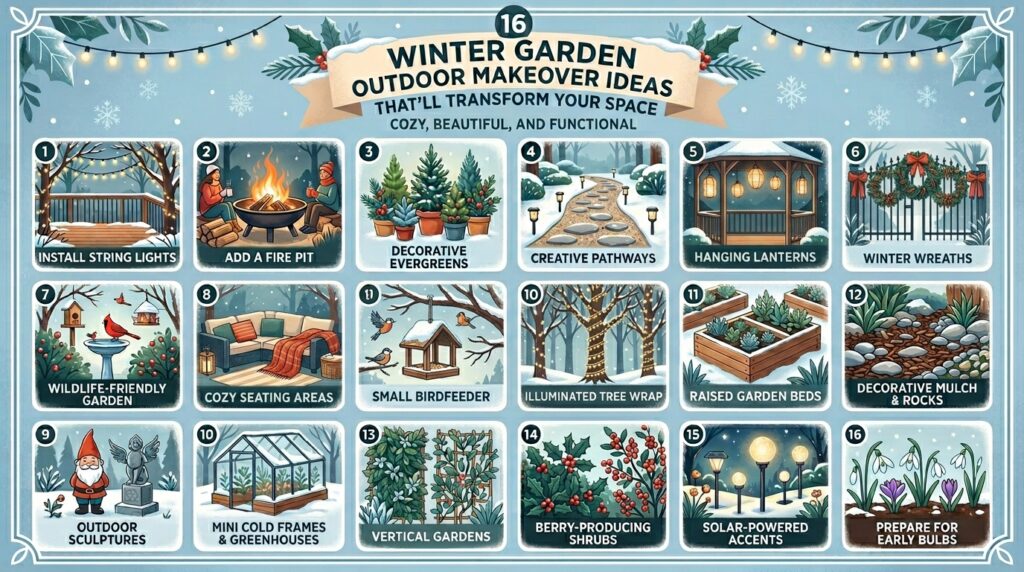
Does your outdoor space turn into a sad, forgotten wasteland the moment October hits? You are absolutely not alone — but here’s the truth: a winter garden outdoor makeover doesn’t require a huge budget, a massive plot, or a professional landscaper to pull off something genuinely stunning. With the right lighting, smart planting choices, cozy furniture upgrades, and a few clever design moves, your balcony, patio, or garden can look better in winter than it does in summer. We’re talking frost-kissed container displays, glowing lantern arrangements, weatherproof lounging setups, and outdoor spaces so inviting you’ll actually want to be outside in January. Ready to completely rethink your winter outdoor space? Let’s dive in!
At a Glance
- A successful winter garden outdoor makeover combines layered lighting, frost-hardy planting, weatherproof furniture, and smart hardscaping to create an outdoor space that’s genuinely usable and beautiful all season long.
- Balconies and small urban spaces are some of the easiest outdoor areas to transform for winter — their compact scale means a few well-chosen elements have enormous visual and functional impact.
- Layered lighting — overhead festoon lights, lanterns at ground level, and uplighters within planting — is the single highest-impact change you can make to any winter outdoor space for minimal cost.
- Choosing weatherproof furniture with the right textiles (outdoor cushions, fleece throws, heated seating options) extends the usable season of any outdoor space by weeks or even months.
- Container planting using the thriller-filler-spiller method with frost-hardy species can deliver professional-looking displays that last from October through to March with minimal maintenance.
1. Layer Your Outdoor Lighting for Maximum Winter Magic
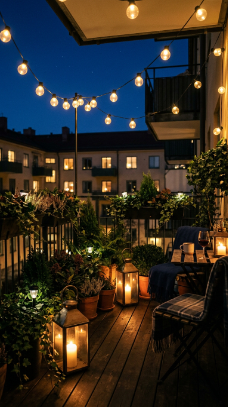
Here’s the deal: outdoor lighting is the single highest-impact, lowest-effort winter garden makeover move available to you — and most people are massively underusing it. A well-lit outdoor space in winter feels warm, inviting, and genuinely magical in a way that no amount of daytime planting can match.
The secret is thinking in three distinct layers. Overhead lights (festoon strings, hanging lanterns, or a simple pergola-mounted canopy of warm bulbs) create the ceiling of your outdoor room. Mid-level lights (wall-mounted lanterns, tabletop storm glasses, candle hurricanes) create the social layer. Low-level lights (solar spike lights in containers, ground-level LED strips along decking edges, pathway pebble lights) anchor the floor and give depth.
💡 Pro Tip: Always use warm white bulbs at 2700K — never cool white or daylight. Warm amber light makes winter foliage glow, turns frost into sparkle, and wraps the whole space in a quality of light that feels genuinely cinematic. Cool white kills the magic stone dead. This is non-negotiable!
Festoon lights are the most versatile and affordable place to start — a single set of warm white festoon lights strung in a simple zigzag overhead transforms even the barest balcony into somewhere people want to gather. Use outdoor-rated cables and bulbs specifically — never bring indoor fairy lights outside in winter.
- Festoon strings: best for overhead canopy effect, wide spacing for drama
- Storm lanterns: best for tabletop and floor-level warm glow
- Solar spike lights: best for illuminating container plants from within
- LED strip lighting: best for decking edges, steps, and architectural features
- Uplighters: best for dramatic plant and wall feature illumination
Check out our outdoor winter lighting guide for balconies and patios for wiring, placement, and product recommendations. Lights4fun has an excellent outdoor festoon lighting setup guide at lights4fun.co.uk.
Get the lighting right first and every other element of your winter garden makeover will look twice as good — it’s the foundation everything else builds on!
2. Create a Focal Point with a Fire Pit or Chiminea
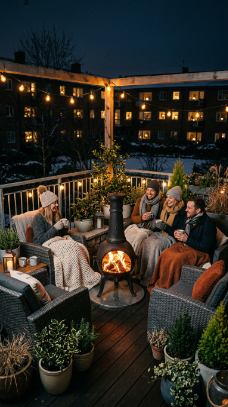
Nothing transforms an outdoor space in winter quite like a source of real flame — the warmth, the light, the primal comfort of fire draws people outside even on cold evenings and instantly makes any outdoor space feel like a destination rather than a corridor you rush through to get back inside.
Chimineas are perfect for smaller balconies and patios — their tall, narrow form concentrates heat forward and upward rather than radiating in all directions, making them far more efficient (and neighbour-friendly) than open fire pits in compact urban spaces. Cast iron chimineas retain heat beautifully and look spectacular with age. Clay chimineas are more affordable but need covering or storing when not in use to prevent frost cracking.
For larger patios and garden spaces, a proper fire pit — whether a simple steel bowl on legs or a built-in stone-surround feature — becomes the natural gathering point that organizes your entire outdoor seating arrangement around it. People cluster around fire instinctively — use that to your advantage when planning your furniture layout.
💡 Pro Tip: Place your chiminea or fire pit on a heat-resistant mat or stone slab rather than directly on composite decking or wooden boards — the radiant heat from below can warp or damage surfaces over time even when the flame itself is contained. Safety first, style always!
| Heat Source | Best For | Fuel | Balcony Safe? |
| Cast iron chiminea | Small patios, balconies | Wood, smokeless fuel | Check weight limits |
| Clay chiminea | Patios, gardens | Wood | Yes (lightweight) |
| Steel fire pit bowl | Medium-large patios | Wood, charcoal | With caution |
| Gas fire table | Any size, apartments | Gas canister | Yes |
| Bioethanol fire bowl | Balconies, small spaces | Bioethanol | Yes — no smoke |
Explore our choosing the right fire feature for small outdoor spaces guide for balcony weight limits and safety advice.
Add fire to your winter garden makeover and your outdoor space stops being somewhere you leave — it becomes somewhere you stay!
3. Invest in Truly Weatherproof Furniture
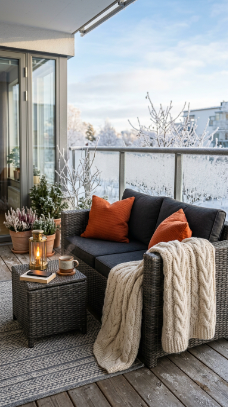
Here’s the thing: the right furniture is what separates a winter outdoor space you actually use from one you only admire through the window. And the biggest mistake people make is buying summer furniture and hoping it survives winter — it doesn’t, it looks terrible, and it makes the whole space feel abandoned.
True all-weather rattan (high-density polyethylene weave over a powder-coated aluminium frame) is the gold standard for year-round outdoor furniture — it handles frost, rain, and UV without warping, fading, or rusting, and it looks genuinely stylish rather than utilitarian. Teak is the premium timber choice — it naturally contains oils that repel moisture and prevent cracking, and it weathers to a gorgeous silver-grey patina over time.
The textile layer matters just as much as the frame — outdoor cushions filled with quick-dry foam and covered in solution-dyed acrylic fabric (like Sunbrella) resist water, mould, and UV fading simultaneously. Pair them with heavyweight outdoor throws in wool or acrylic-wool blend for genuine warmth rather than purely decorative layering.
Scale your furniture to your space honestly — a large corner sofa on a small balcony leaves no room to move and makes the space feel claustrophobic. A compact two-seater sofa with a side table on a small urban balcony is infinitely more liveable and visually proportionate.
Read our all-weather outdoor furniture guide for balconies and small patios for material comparisons and sizing advice.
Great outdoor furniture is an investment — buy it once, buy it right, and your winter outdoor space becomes genuinely liveable for years to come!
4. Build a Thriller-Filler-Spiller Winter Container Display
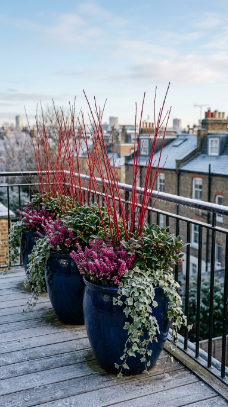
The thriller-filler-spiller method applied to winter containers is the formula behind every professional-looking seasonal outdoor display — and once you understand it, every container you ever plant will look like it was designed by a garden stylist. Pretty cool, right?
Your thriller is your tallest, most dramatic plant — the one that gives height and makes people look twice. Red-stemmed dogwood (Cornus alba ‘Sibirica’) delivers those astonishing scarlet stems that look almost artificially bright against frost and snow. A dwarf conifer or Phormium gives year-round architectural drama. Your fillers are mid-height workhorses that give body and color — Skimmia japonica for berries, winter heather for long-lasting flowers, ornamental kale for sculptural texture.
Your spillers are the trailing plants that cascade over the container edge and soften the whole composition — trailing ivy, silver Dichondra, or creeping Ajuga all work beautifully. Without spillers, even a well-planted winter container looks slightly stiff and unfinished.
💡 Pro Tip: Plant your thriller one-third from the edge rather than dead center — it creates a far more dynamic, natural-looking composition than symmetrical central planting. It’s a small adjustment that makes an enormous visual difference and instantly gives your containers that designer-styled quality.
- Use containers minimum 35–40cm diameter for a thriller-filler-spiller combo
- Group containers in odd numbers (3 or 5) for a more editorial display
- Match pot materials across your display for cohesion — all terracotta, all dark ceramic, or all rattan-effect for a professional look
- Insulate container roots with bubble wrap under the soil in hard freezes
Explore our complete thriller-filler-spiller winter container guide for plant combinations and pot sizing.
Master this one formula and your winter containers will look genuinely extraordinary every single season — it’s the most valuable skill in container gardening!
5. Add an Outdoor Rug to Define Your Space
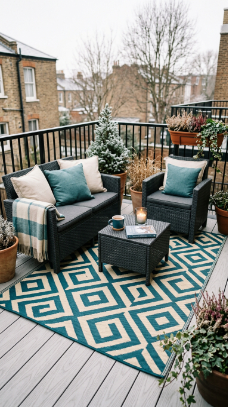
Here’s the deal: an outdoor rug might be the most underrated winter garden makeover element there is. It does something that no plant, no lighting, and no furniture piece can do on its own — it defines the boundaries of your outdoor living space, gives it the visual warmth and cosiness of an interior room, and instantly makes your balcony or patio look deliberately designed rather than accidentally furnished.
The secret is choosing a genuinely weatherproof outdoor rug — not a cheap indoor rug optimistically moved outside. Look for polypropylene flatweave rugs specifically rated for outdoor use: they resist mould, handle rain and frost without deteriorating, dry rapidly, and can be hosed clean in minutes. Natural fibre rugs (jute, sisal, coir) are not outdoor-suitable in wet climates regardless of what they look like — they rot quickly.
Scale matters enormously — your outdoor rug should be large enough that all your furniture legs sit on the rug rather than around it. A too-small rug that only catches the front legs of your furniture makes the whole arrangement look tentative and small. Go bigger than feels comfortable and watch the whole space feel larger and more grounded.
Bold geometric patterns in muted, nature-adjacent colors — deep teal, terracotta, warm ochre, slate grey — work exceptionally well in winter outdoor spaces, adding visual interest without competing with your planting.
Read our choosing the right outdoor rug for balconies and small patios for material, sizing, and maintenance advice.
An outdoor rug is the quickest route from “furniture on a balcony” to “outdoor room” — it’s one of the most impactful and affordable changes you can make!
6. Install a Vertical Garden Wall for Winter Greenery
🖼️ IMAGE PROMPT: A realistic wide lifestyle outdoor photo of a dark-painted exterior garden wall covered in a modular vertical planting system filled with evergreen ferns, trailing ivy, Skimmia, and winter heather in a lush living wall installation, lit from below by warm uplighters on a crisp winter evening. Color palette of deep forest green, silver-green frost, charcoal dark wall, warm amber uplighter glow, and vivid heather pink. Mood: urban, lush, dramatic transformation. Photography style: wide eye-level. Background: soft blurred dark garden and warm apartment windows.
A vertical garden wall solves one of the most common small outdoor space problems in one move — it gives you the lush, abundant planting impact of a full garden border without using a single centimeter of precious floor space. For balconies and small urban patios, this is genuinely transformative.
Modular pocket planting systems (fabric or plastic wall-mounted pockets in a frame) are the most accessible and affordable way to create a living wall — they attach to any fence, wall, or railing with simple fixings and can be planted with evergreen trailing and mounding plants for a year-round display. Free-standing modular living wall systems work brilliantly on balconies where you can’t fix to walls.
For a winter-specific living wall, focus on hardy evergreen species that keep their looks through cold and frost — trailing ivy varieties, small-leaved Euonymus, winter heather (Erica carnea), and Skimmia japonica for berry interest all perform excellently in a vertical planting context.
💡 Pro Tip: Irrigation is the biggest challenge with vertical gardens — the plants at the top tend to dry out faster while the bottom stays wetter. Either install a simple drip irrigation system along the top row, or water from the top and allow it to trickle down through the system. Check moisture levels at the top row weekly — that’s your indicator for the whole wall.
| Vertical Garden System | Best For | Price Point | Irrigation Needed? |
| Fabric wall pockets | Small balconies, fences | Low | Yes — weekly |
| Modular plastic panels | Any wall or fence | Medium | Yes — drip ideal |
| Timber pallet planter | Rustic gardens, patios | Very low (DIY) | Yes — manual |
| Freestanding tower planter | Balconies, no-fix spaces | Medium | Yes — regular |
| Trellis + pot hooks | Climbers + small pots | Low | Variable |
Explore our vertical garden wall guide for small outdoor spaces for system comparisons, planting lists, and installation guides.
A vertical garden wall turns a bare fence or exterior wall into your most dramatic design feature — it’s the winter makeover move that makes the biggest visual impact per square centimeter!
7. Create a Cosy Outdoor Heating Zone
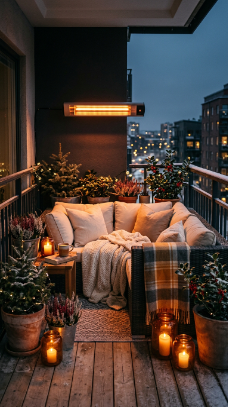
Here’s the thing: beautiful lighting and stunning plants will make your winter outdoor space look incredible — but outdoor heating is what makes it actually feel incredible and keeps you out there past 6pm in November. The right heating solution is what separates a winter garden you photograph from one you genuinely live in.
Wall-mounted electric infrared heaters are the best all-round solution for balconies and small patios — they heat people and surfaces directly rather than trying to warm the air (which disappears instantly outside), they’re instant-on, require no fuel storage, have no emissions, and modern designs are genuinely attractive as architectural features. Halogen infra-red heaters are the most affordable entry point. Carbon fibre infrared is more efficient, quieter, and produces a more even heat.
Freestanding gas patio heaters (the classic mushroom shape) are effective for larger spaces but bulky, require gas canister storage, and the design is widely considered dated. Gas fire tables are a far more stylish gas option — they combine the heater and a beautiful fire feature in one piece of furniture.
For balconies with weight restrictions, a small tabletop bioethanol burner paired with quality wool throws can create a surprisingly effective and beautifully styled heating zone without any fixed installation or heavy equipment.
Read our outdoor heating options for balconies and small patios for a full comparison of running costs, heat output, and installation requirements.
Get the heating right and your winter outdoor space stops being seasonal — it becomes a genuine year-round room that you use every single week!
8. Refresh Your Balcony Floor with New Decking Tiles
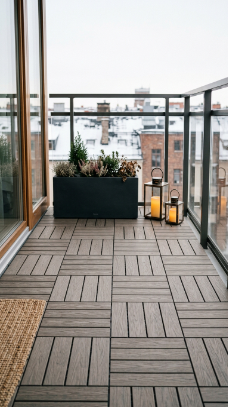
A tired, stained, or cracked balcony floor undermines even the most beautiful plant displays and furniture — and replacing it is far easier and more affordable than most people realize thanks to interlocking decking tiles that require zero tools, no fixings, and can be laid over almost any existing surface in an afternoon.
Composite wood-effect interlocking tiles are the current gold standard — they look genuinely like real timber, require zero maintenance, don’t splinter, don’t rot, handle frost and wet weather without issue, and come in a wide range of tones from pale ash to deep charcoal. They sit on rubber feet that allow drainage underneath and can be cut to fit around obstacles with a simple handsaw.
Porcelain paving tiles in interlocking format are even more durable and look extraordinarily sophisticated — large-format grey or stone-effect porcelain gives a contemporary minimalist floor that elevates everything placed on top of it. They’re heavier than composite tiles so check balcony weight limits first.
💡 Pro Tip: Choose your decking tile tone to contrast with your container colours rather than match them — pale ash decking with dark charcoal pots creates more visual drama than both in the same tone. Deep charcoal decking with warm terracotta pots and vivid winter plants is one of the most striking winter balcony colour combinations available.
Explore our interlocking balcony decking tiles — the complete buyer’s guide for material comparisons, weight specifications, and installation tips.
A new floor transforms the whole character of a balcony — it’s the makeover foundation that everything else sits on, literally!
9. Introduce Evergreen Structural Shrubs in Statement Pots
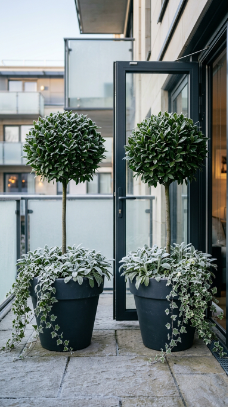
Evergreen structural shrubs in beautiful containers are the backbone of any serious winter garden makeover — they provide year-round form, scale, and presence that seasonal planting alone can never deliver. Think of them as the furniture of your outdoor planting scheme: everything else arranges around them.
Standard bay trees (Laurus nobilis trained as lollipops) flanking an entrance or door are a timeless classic for excellent reason — they’re evergreen, architectural, wonderfully fragrant when the leaves are brushed, and completely frost-hardy. Box balls (Buxus sempervirens) in large pots give geometric precision. Architectural Phormium in dark containers delivers year-round drama. Olive trees in large terracotta pots bring Mediterranean character that’s surprisingly cold-tolerant in sheltered positions.
The pot choice for structural shrubs deserves as much thought as the plant itself — a beautiful plant in the wrong pot is a missed opportunity. Large fibreglass pots (which look like stone, concrete, or lead but weigh a fraction of the real material) are perfect for balconies. Dark glazed ceramic and brushed concrete pots work beautifully for contemporary spaces.
Underplant your structural shrubs with trailing ivy, silvery Stachys, or winter Cyclamen to soften the base of the stem and connect the plant visually with the container — it’s the finishing detail that separates a truly polished display from one that’s merely good.
Check out our evergreen structural shrubs for year-round container impact for the full species guide. The RHS has excellent bay tree and topiary care advice at rhs.org.uk.
Structural evergreens are the investment pieces of outdoor plant styling — buy them well, pot them beautifully, and they’ll define your outdoor space for years!
10. String a Weatherproof Outdoor Canopy or Sail Shade
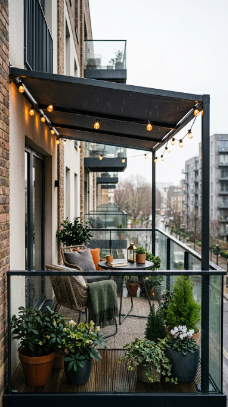
Here’s the deal: one of the biggest reasons people stop using their outdoor space in winter is rain — not cold. You can rug up against cold, you can heat against cold, but rain sends everyone inside without a second thought. A weatherproof outdoor canopy solves that completely and turns a seasonal space into a genuinely all-weather outdoor room.
Tensile sail shades in waterproof fabric (look for PVC-coated polyester or HDPE fabric specifically rated for year-round use) can cover a surprising amount of space with minimal structure. For balconies, a wall-attached awning is the cleanest solution — it folds flat against the wall when not in use and deploys in seconds. For patios, a freestanding canopy gazebo in powder-coated aluminium with a waterproof polycarbonate or fabric roof gives four-season coverage without any wall fixings.
Festoon lights strung underneath your canopy create a spectacular effect — the canopy roof reflects and concentrates the warm light downward, amplifying the cosy enclosed feeling enormously. Add a side screen or outdoor curtain panel on the windward side for complete weather protection on exposed balconies.
💡 Pro Tip: Choose dark-coloured canopy fabric (charcoal, navy, forest green) rather than white or cream for winter use — dark tones absorb heat from winter sunshine and make the sheltered space noticeably warmer underneath. Light colours reflect heat away and can look washed out against grey winter skies.
Explore our weatherproof outdoor canopy guide for balconies and patios for attachment methods, fabric ratings, and wind resistance specifications.
A canopy transforms your outdoor space from seasonal to year-round — rain is no longer a reason to go inside, and that changes everything!
11. Style a Winter Lantern & Candle Arrangement

A beautifully styled lantern arrangement is the simplest, most affordable, and most immediately impactful winter outdoor styling move there is — and most people completely underestimate how much atmospheric work a group of well-placed lanterns can do in an outdoor space after dark.
The secret is grouping in odd numbers at varying heights — three storm lanterns of different sizes clustered together on a table or step always looks more intentional and beautiful than a single lantern placed alone or two lanterns at matching height. The variety of heights creates visual rhythm; the odd number creates natural balance.
Surround your lanterns with seasonal natural materials — pine cones, fir or holly branches, Skimmia berries, dried Hydrangea heads, or a few sprigs of rosemary — to create an arrangement that feels organic and seasonal rather than just functional. The contrast of warm living candlelight against natural winter materials is extraordinarily beautiful.
Storm lanterns with wide openings are far more practical in outdoor conditions than enclosed lanterns with small apertures — you can light the candles easily and the air circulation keeps them burning reliably even in light wind. For genuinely exposed positions, switch to flame-effect LED candles that look convincingly real but aren’t extinguished by wind.
Read our winter outdoor lantern and candle arrangement guide for grouping principles, height ratios, and weatherproof candle recommendations.
A great lantern arrangement costs almost nothing and transforms the atmosphere of your outdoor space on winter evenings — it’s pure magic for minimal effort!
12. Paint or Stain Your Outdoor Walls and Fences
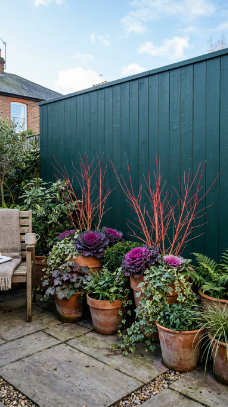
Talk about a game-changer — painting or staining your outdoor fence or wall is the most dramatic and affordable single-day transformation in the entire winter garden makeover toolkit. A fresh coat of deeply colored exterior paint turns a tired backdrop into a bold design feature that makes every plant, pot, and light placed in front of it look ten times better.
Deep, saturated colors work magnificently in winter gardens — forest green, deep teal, charcoal grey, navy blue, and inky black all create extraordinary backdrops for winter planting. These dark, rich tones make frost-kissed foliage pop, make warm lighting glow more intensely, and give small outdoor spaces a sophisticated, gallery-like quality.
Exterior masonry paint for rendered walls and exterior wood stain or fence paint for timber fencing both work brilliantly — ensure you choose products specifically rated for outdoor use with good frost and moisture resistance. Most dark exterior paints cover in one coat over a previously painted surface and two coats on raw or light-coloured surfaces.
💡 Pro Tip: Paint the back wall or fence only rather than all surrounding surfaces — a single boldly colored backdrop behind your main container display creates a dramatic focal point without making the space feel closed in. Think of it as creating a feature wall for your outdoor room, exactly as you would indoors.
Check out our painting outdoor walls and fences for garden impact for color selection, paint product recommendations, and preparation advice.
One weekend, one tin of paint, and your outdoor space looks like it had a complete professional redesign — this is the highest-impact low-cost makeover move bar none!
13. Build a Simple DIY Raised Bed for Winter Edibles
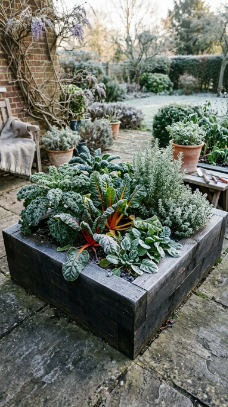
A compact raised bed on your patio or large balcony is the winter garden makeover addition that keeps on giving — long after the aesthetic upgrades have settled in, your raised bed is actively producing fresh vegetables, herbs, and salad leaves that make every single meal better. Productive and beautiful!
Sleeper-style raised beds from dark-stained softwood, railway sleeper timber, or corten steel are the most attractive options — they look architectural and intentional rather than temporary and apologetic. For balconies, lightweight timber raised bed kits in stackable sections are perfect — they’re modular, can be built to exactly the right size, and don’t impose excessive weight loads on the structure beneath.
Fill with a quality topsoil and compost mix (50/50 is ideal) and plant with the best winter edibles — curly kale, rainbow chard, winter spinach, pak choi, and hardy herbs like rosemary, thyme, and flat-leaf parsley will give you harvests from October right through to April with minimal care.
The visual impact of a well-planted raised bed in winter is genuinely striking — the deep green and vivid colored foliage of winter vegetables against dark-stained timber, on a frost-touched patio, is exactly the kind of image that makes people stop scrolling on Instagram. Productive gardens are beautiful gardens!
| Winter Crop | Container/Bed Depth | Harvest Time | Frost Hardy? |
| Curly Kale | 30cm+ | Ongoing — cut & come | Yes, to -15°C |
| Rainbow Chard | 25cm+ | Ongoing — cut & come | Yes, to -6°C |
| Winter Spinach | 20cm+ | 6 weeks from sowing | Yes, to -8°C |
| Rosemary | 30cm+ | Year-round | Yes, to -15°C |
| Flat-leaf Parsley | 20cm+ | Year-round | Yes, to -10°C |
Explore our DIY raised bed winter kitchen garden guide for construction, soil mix, and planting schedules.
A raised bed turns your winter outdoor space into something genuinely purposeful — and pulling fresh kale from your own patio on a January morning is one of gardening’s greatest pleasures!
14. Accessorise with Outdoor Cushions, Throws & Textiles
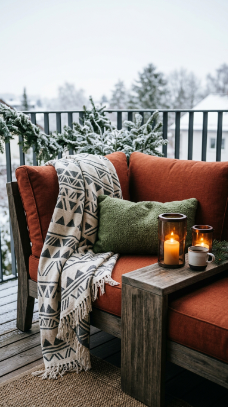
Here’s the deal: outdoor textiles are the finishing layer that transforms a functional outdoor space into a genuinely cosy, inviting winter room — and they’re the most affordable, most impactful, and most easily changed element in any outdoor makeover. Get the textiles right and everything else falls into place.
The secret is layering — just as you would indoors. Start with outdoor cushions in your base color (deep charcoal, navy, or forest green anchor a space beautifully). Add a contrast lumbar cushion in a warmer accent tone (rust, mustard, burnt orange, or deep berry). Finish with a heavyweight outdoor throw draped naturally and casually rather than folded perfectly — the artful looseness looks more inviting and more editorial than anything neatly arranged.
Quality matters enormously with outdoor textiles in winter — cheap cushions go flat, absorb water, and develop mildew within weeks of autumn rain. Invest in solution-dyed acrylic fabric cushion covers (Sunbrella and similar brands) filled with quick-dry foam — they look as good in March as they did in October and simply hose clean if they get dirty.
Color selection for winter outdoor textiles should lean into the season rather than fight it — deep, warm, jewel tones (rust, mustard, berry, deep teal) feel far more appropriate and beautiful in a winter outdoor context than the pastel and bright tones that work in summer. Think of dressing your outdoor space the way you’d dress yourself in winter: rich, warm, and layered.
Read our outdoor cushion and textile guide for year-round balconies for fabric specifications, color palettes, and care advice.
The right outdoor textiles make the difference between a space that looks styled and a space that feels lived in — and feeling lived in is the whole point!
15. Plant a Fragrant Winter Border or Container Collection
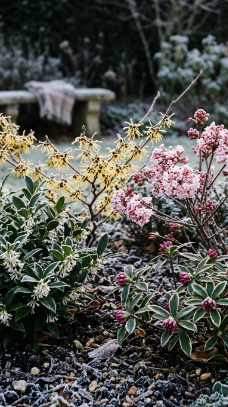
Most people think winter gardens can only be looked at — but the most extraordinary winter garden makeovers engage the sense of smell as powerfully as sight, and winter actually contains some of the most intoxicatingly fragrant plants in the entire gardening calendar.
Sarcococca hookeriana (Christmas Box) is one of winter’s greatest secrets — tiny, almost invisible white flowers that release a vanilla-honey fragrance so powerful it perfumes an entire garden on a cold morning. Plant it near your door or seating area where you’ll encounter the scent every time you step outside. It’s evergreen, shade-tolerant, and completely frost-hardy.
Witch Hazel (Hamamelis) produces those extraordinary spidery flowers directly on bare branches from December through February — the scent is warm, slightly spiced, and remarkable. It’s slow to establish but magnificent once mature, and those bare winter branches studded with yellow, orange, or red flowers are among the most beautiful sights in any winter garden.
💡 Pro Tip: Place your fragrant winter plants at nose height where possible — in raised containers, on steps, or in elevated planters near seating areas. Fragrance at ground level in a large garden can disappear into the air before you notice it. At seating height on a balcony or patio, it wraps around you completely and makes the experience genuinely sensory rather than just visual.
Daphne odora ‘Aureomarginata’ (one of the few Daphne varieties that’s reliably hardy) produces clusters of intensely fragrant pink flowers from January onwards and makes a perfectly scaled container plant for a balcony or small patio seating area. Viburnum x bodnantense ‘Dawn’ gives you pale pink flowers on bare stems with a sweet clove-like fragrance from October right through to March.
Explore our fragrant winter plants for outdoor spaces for the full sensory planting guide. The Royal Botanic Gardens Kew has excellent winter fragrant plant profiles at kew.org.
A winter garden that smells extraordinary as well as looks beautiful is one of the most sophisticated and memorable outdoor experiences you can create — plant for scent this season!
16. Create a Welcoming Balcony or Patio Entrance Zone
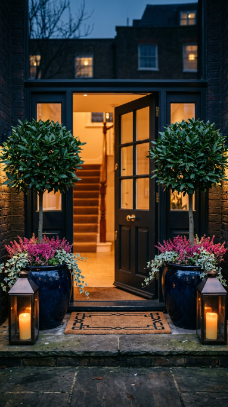
Here’s the thing: the entrance to your outdoor space — whether it’s the balcony door, the patio gate, or the back door threshold — sets the tone for everything beyond it, and investing even a small amount of thought and budget into a well-styled entrance zone transforms the entire experience of your outdoor space from the very first step.
The classic and timeless symmetrical entrance uses matching elements on both sides of the doorway or entrance — a pair of identical pots with matching standard bay trees, flanked by matching lanterns, on a quality doormat. Symmetry reads as considered and welcoming instantly, at almost any scale, and it requires just two good pots, two good plants, and two good lanterns to execute beautifully.
A quality outdoor doormat is the surprisingly important detail that most people overlook — a handsome coir mat with a clean geometric pattern or a simple woven outdoor mat in a dark tone adds the finishing ground-level detail that makes an entrance feel truly complete. It also signals immediately that this is a space that’s cared for and lived in.
Scale your entrance planting to the height of your doorway — the flanking plants should reach approximately two-thirds of the door height to create proper visual proportion. Shorter plants look lost; taller plants can feel oppressive. Two-thirds height is the Goldilocks zone.
Read our styling a welcoming outdoor entrance for every season for proportion guides, plant combinations, and entrance lighting ideas.
Your outdoor entrance is the first impression of everything beyond it — get it right and the whole space feels instantly more considered, more beautiful, and more genuinely yours!
Frequently Asked Questions
How do I start a winter garden outdoor makeover on a tight budget?
The highest-impact, lowest-cost changes are painting or staining your fence or wall (a single tin of deep-colored exterior paint costs very little and creates extraordinary transformation), adding a set of warm white festoon lights overhead, and grouping a few storm lanterns with candles on your table or steps. These three moves together cost very little and can completely change the atmosphere of an outdoor space. Add a bag of winter bedding plants like pansies and heather in your existing pots and you’ve transformed the whole space for a genuinely small investment.
What are the best plants for a winter balcony makeover that will last through frost?
The most reliable frost-hardy balcony plants are curly kale and ornamental kale (hardy to -15°C), winter heather (Erica carnea, hardy to -15°C), Skimmia japonica for berries (hardy to -10°C), trailing ivy varieties (hardy to -20°C), red-stemmed dogwood (Cornus alba, hardy to -20°C), and hardy Cyclamen coum for delicate winter flowers (hardy to -15°C). Combining these in a thriller-filler-spiller arrangement gives you a display that genuinely lasts from October through to March with minimal care.
How do I keep outdoor furniture looking good through winter without storing it all away?
Invest in quality furniture covers — properly fitted, waterproof furniture covers in breathable fabric protect even good-quality rattan and timber furniture through harsh winters without requiring storage. For cushions, store them in a weatherproof cushion storage box or bag rather than leaving them out permanently — bringing them in during heavy rain and hard frosts extends their life significantly. Teak furniture benefits from an annual treatment with teak oil before winter, while powder-coated aluminium and composite rattan need only an occasional wipe-down.
Can I create a cosy winter outdoor space on a small apartment balcony?
Absolutely — in fact, small balconies often respond most dramatically to winter makeover investment because every element you add has maximum visual impact in a compact space. Focus on a compact weatherproof two-seater sofa or a pair of folding outdoor chairs, a string of overhead festoon lights, two or three good winter container plants in beautiful pots, a small tabletop heat source (bioethanol burner or tabletop chiminea), and a quality outdoor rug to define the space. Those six elements on a small balcony create a genuinely cosy, beautifully styled outdoor room.
How do I protect container plants on an exposed balcony in hard frosts?
Wrap the outside of pots with bubble wrap, hessian, or horticultural fleece to insulate the root zone — it’s the roots rather than the top growth that are most vulnerable to freezing in above-ground containers. Group pots together against the most sheltered wall of your balcony to create a beneficial microclimate. Throw a sheet of garden fleece loosely over the top growth on nights when temperatures are forecast to drop below -8°C or -10°C, then remove it the following morning. Move the most tender plants just inside the door during the absolute coldest spells if possible.
A Few Final Thoughts
Your outdoor space deserves to be beautiful, cosy, and genuinely usable in winter just as much as in July — and as these 16 ideas prove, a winter garden outdoor makeover doesn’t require a huge investment or a total redesign to achieve something truly extraordinary. Whether you start with a bold wall colour, a string of warm festoon lights, a well-planted container trio, or a set of quality weatherproof cushions, every single change you make builds toward an outdoor space that reflects the season rather than hiding from it. The secret to a stunning winter outdoor space is the same as any great garden: intention, layering, and the confidence to commit to your choices rather than playing it safe. Now go make it happen — your winter garden is waiting! 🌿