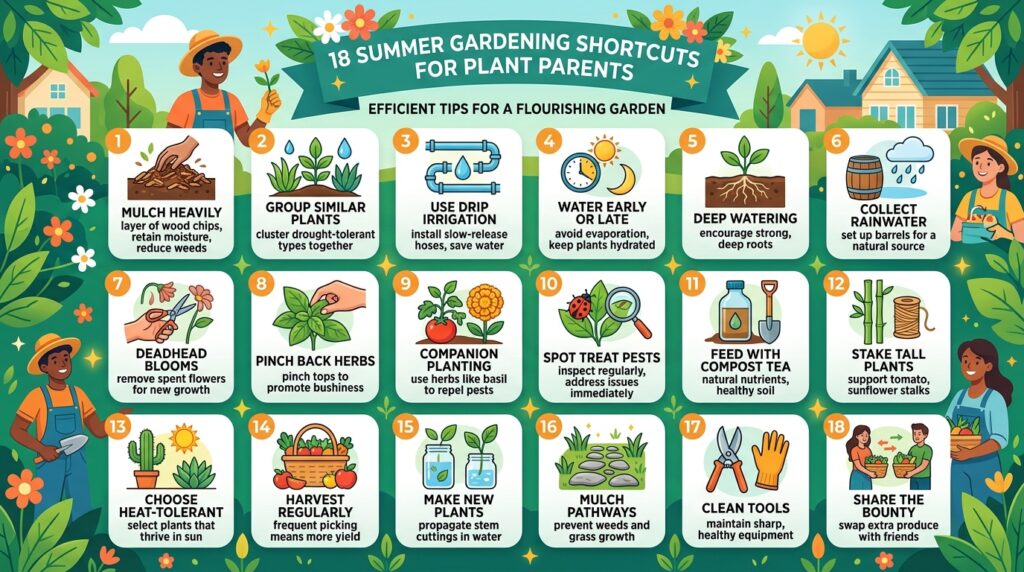
Summer is here, and your plants are absolutely thriving — but so is your to-do list. Between watering schedules, wilting herbs, and that balcony that refuses to look Pinterest-worthy, it can feel like a full-time job. Here’s the good news: smart plant parents work smarter, not harder. These 18 summer gardening shortcuts are going to change the way you think about caring for your green babies. Ready to find out?
At a Glance
- Self-watering containers can cut your watering time in half — perfect for hot summer days when soil dries out fast.
- Grouping plants together creates a microclimate that keeps humidity up and stress down.
- Mulching your containers and beds means less weeding, less watering, and more time sipping lemonade.
- A single slow-release fertilizer application at the start of summer feeds your plants for months.
- Deadheading spent blooms takes just minutes and keeps your flowering plants producing all season long.
1. Use Self-Watering Planters for Set-It-and-Forget-It Summer Hydration
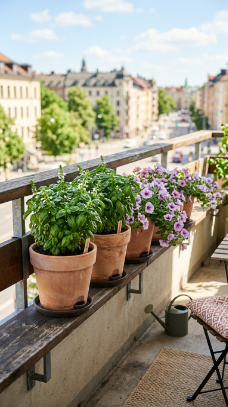
Here’s the deal: the number one summer gardening mistake is inconsistent watering — and self-watering planters solve that instantly.
These clever containers have a built-in water reservoir at the base. Plants drink what they need, when they need it. You just top up the reservoir every few days instead of watering daily.
They’re especially clutch for container gardening on balconies, where pots heat up fast and dry out even faster. Herbs, tomatoes, and flowering annuals absolutely love them.
Pro Tip: Look for self-watering planters with an overflow hole — this prevents root rot during heavy rain. Fill the reservoir in the morning so water warms slightly before roots absorb it.
Check out our guide on the best containers for balcony vegetable gardens for more container picks.
For a deep dive into how reservoir planters work, The Sill’s plant care guides are a fantastic resource.
You’ve totally got this — smarter watering starts with smarter containers!
2. Mulch Your Pots and Beds to Lock In Summer Moisture
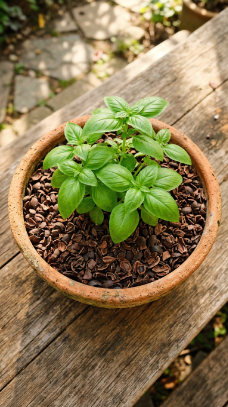
Mulching isn’t just for garden beds — and this is one of the most underrated summer gardening shortcuts out there!
A 1–2 inch layer of organic mulch (think bark chips, cocoa shells, or even pebbles) on top of your container soil does three things at once: it slows evaporation, regulates soil temperature, and suppresses weeds.
In summer, bare soil in a pot can lose moisture within hours on a hot day. Mulch acts like a cozy blanket that keeps the good stuff in.
Learn more about container mulching techniques for summer on our blog.
The RHS guide to mulching breaks down the best mulch types for different garden setups.
A little mulch goes a long, long way — your plants will thank you!
3. Switch to Slow-Release Fertilizer for Hands-Off Summer Feeding
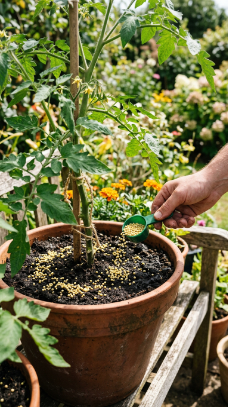
The secret is: one application of slow-release fertilizer at the start of summer can feed your plants for up to six months. No weekly liquid feeding. No forgetting. No drama.
These pellets or granules break down gradually with watering and heat, delivering a steady nutrient supply right when your plants are in peak growth mode.
Look for formulas with a balanced NPK ratio (like 14-14-14) for most flowering and foliage plants, or go higher in phosphorus for blooms and fruiting crops.
Pro Tip: Work the granules gently into the top inch of soil rather than leaving them on the surface — this speeds up nutrient release and prevents them from washing out during watering.
Pair this with our advice on summer feeding schedules for container plants for maximum results.
Gardeners’ World has a great breakdown on when and how to feed different plant types.
Talk about a game-changer for busy plant parents!
4. Group Plants Together to Create a Natural Humidity Microclimate
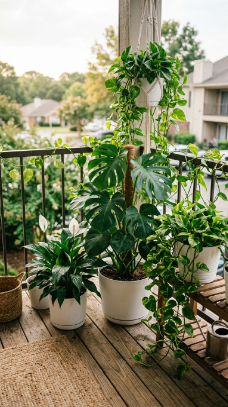
Here’s the thing: plants actually help each other! When you group your pots together, their collective transpiration raises the humidity around them — which is exactly what tropical and leafy plants crave in dry summer heat.
This shortcut requires zero budget and zero effort. Just scoot your containers closer together. Humidity-loving plants like ferns, calatheas, and peace lilies especially benefit from this arrangement.
Bonus: grouped plants are easier and faster to water in one go, and they look absolutely lush styled together.
Check out how to arrange balcony plants for visual impact for styling inspiration.
The University of Maryland Extension covers why humidity matters for indoor and patio plants.
Cluster your plants up and watch them flourish together!
5. Deadhead Spent Blooms in Just 5 Minutes a Day
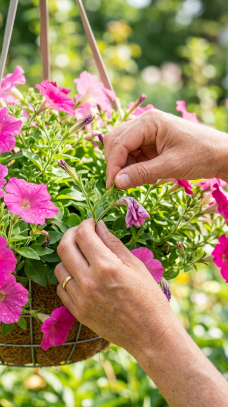
Deadheading — removing spent flowers — is the fastest way to keep your blooming plants producing all summer long. And honestly? It’s kind of therapeutic.
When a flower fades, the plant starts putting energy into making seeds. Snip it off and the plant refocuses that energy into making more blooms. Do a quick pass every couple of days and your petunias, geraniums, and marigolds will flower non-stop.
No fancy tools needed — just your fingers or a small pair of snips or scissors. Make it a 5-minute morning habit with your coffee.
| Plant | How to Deadhead | Frequency |
| Petunias | Pinch below the base of the flower | Every 2–3 days |
| Marigolds | Snap off at the stem | Weekly |
| Geraniums | Remove the entire flower stalk | Weekly |
| Roses | Cut above the next 5-leaf set | After each bloom |
Read more on summer blooming plant care for a full maintenance guide.
BBC Gardeners’ World explains deadheading in a clear, beginner-friendly way.
Five minutes a day keeps the blooms in play!
6. Use Ice Cubes for Slow, Mess-Free Orchid and Fern Watering
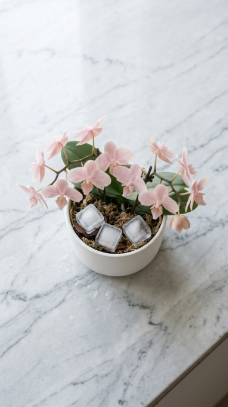
This trick sounds too simple to work — but it absolutely does. Placing 2–3 ice cubes on the soil of orchids and delicate ferns once a week delivers a slow, gentle trickle of water as they melt.
This prevents overwatering (the number one orchid killer) and eliminates the mess of trying to water those fiddly pots in the sink. The slow melt mimics a gentle rain rather than a sudden flood.
It works brilliantly for mounted and potted orchids, as well as ferns, succulents in terracotta, and any plants that like to dry out between waterings.
Pro Tip: Use room-temperature or slightly melted ice if you’re in a very hot climate — ice-cold water can shock tropical orchid roots. Leave the cubes out for 5 minutes before placing them.
See our complete guide to watering orchids and tropical plants correctly for more tips.
The American Orchid Society has expert advice on orchid hydration needs.
Such a genius little hack — your orchids are going to love it!
7. Try Wicking Systems for Vacation-Proof Plant Watering
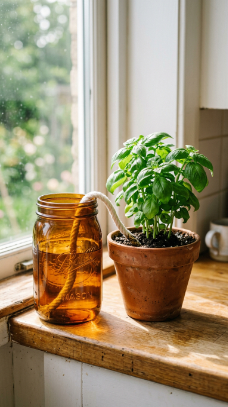
Going on summer vacation? Don’t come home to a plant graveyard! A DIY wicking system keeps your plants hydrated while you’re away using just a jar of water and some cotton cord.
Thread one end of a thick cotton wick into the soil and submerge the other end in a water-filled container. Capillary action does the rest — water slowly travels up into the soil, keeping it consistently moist for up to a week.
It works best for medium-water plants like pothos, herbs, peace lilies, and ferns. Not ideal for succulents or cacti that prefer dry conditions.
Read our full post on keeping plants alive while on vacation for more DIY solutions.
University of California Cooperative Extension has excellent resources on water conservation in home gardens.
Never cancel a vacation because of your plants again!
8. Build a Mini Herb Garden With Vertical Pocket Planters
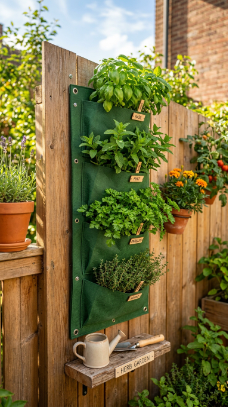
Here’s the deal: vertical pocket planters are the ultimate summer gardening shortcut for small spaces. Mount one on a fence or wall and suddenly you have a full herb garden without giving up an inch of floor space.
These fabric or felt pockets are lightweight, affordable, and dry out quickly — which is actually great for herbs like rosemary, thyme, and oregano that prefer well-draining soil.
Fill yours with your most-used culinary herbs so dinner upgrades are literally right outside your door. Fresh mint for iced tea? Yes, please!
Pro Tip: Line the back pockets with a thin layer of plastic to protect your fence or wall from moisture. Water from the top down and let gravity do the work.
Explore our guide to balcony herb gardens for beginners for setup ideas.
Gardeners’ World’s herb growing guide covers the best herbs for summer containers.
Fresh herbs on demand — how is that not the dream?!
9. Repurpose Household Items as Quirky Summer Planters
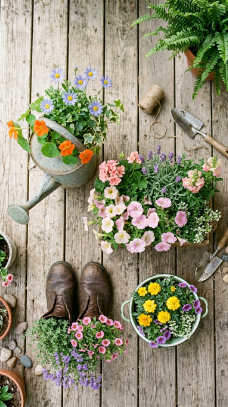
Who says you need to buy planters? Upcycled containers are one of the most fun and free summer gardening shortcuts around. Colanders (great drainage!), tin cans, old boots, wooden crates — they all make fabulous planters.
Drill or punch drainage holes in the bottom of anything watertight, add quality potting mix, and you’re ready to plant. Colanders are particularly brilliant since they already have built-in drainage.
This approach adds personality and charm to your outdoor space while keeping costs at zero. It’s also a great activity to do with kids!
See our roundup of creative upcycled planter ideas for tons of inspiration.
RHS’s sustainable gardening tips include great ideas for eco-friendly planting.
Get creative — your garden should look as unique as you are!
10. Use a Timer on Your Drip Irrigation for Zero-Effort Watering
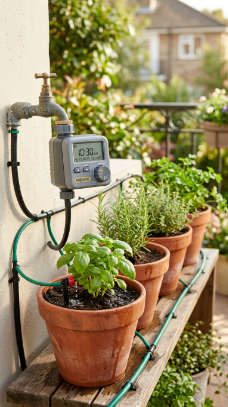
Automated drip irrigation sounds fancy, but starter kits are surprisingly affordable and take about an hour to set up. Pair one with a programmable tap timer and your plants get watered every single day — whether you remember or not.
This is a total game-changer for container garden collections of 10 or more pots, especially through heatwave weeks when missing even one watering can stress plants badly.
Most kits include tubing, emitters, and connectors you can customize to reach every single pot. Set it in the morning, walk away, done!
Pro Tip: Set your timer to water in early morning (6–8am) — this reduces evaporation and gives leaves time to dry before nighttime, preventing fungal issues.
Our post on setting up drip irrigation for balcony gardens walks you through setup step by step.
University of Florida IFAS Extension has excellent resources on efficient irrigation for home gardens.
Automate the boring stuff and enjoy your summer!
11. Create a Spooky Halloween Fairy Garden With Summer Succulents
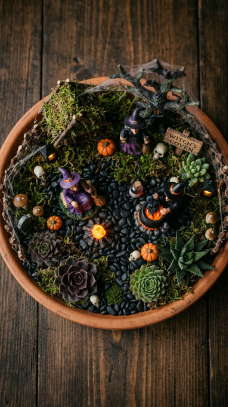
Plan ahead while your succulents are thriving this summer — a Halloween fairy garden is the most fun seasonal project you can create with your cuttings! Start propagating now and you’ll have a full miniature spooky garden ready for October.
Use a shallow dish or wooden tray as your base. Arrange succulent rosettes alongside tiny witch figurines, miniature pumpkins, and spiderweb accents. Add black pebbles and dark moss for that perfect witch’s garden vibe.
The best part? Succulents love the same neglect that a busy Halloween season demands — they’ll stay looking great with minimal care.
- Base container: Wide, shallow tray or terracotta saucer (at least 3 inches deep)
- Succulents to use: Echeveria, Haworthia, small Aloe, String of Pearls
- Spooky elements: Mini cauldrons, witch figurines, tiny gravestones, black sand
- Finishing touches: Dried moss, cobweb string, mini LED lights
Explore how to build a fairy garden in a container on our site.
The Sill’s succulent care guide ensures your tiny garden stars survive in style.
Pretty cool, right? Summer prep for Halloween fun!
12. Pinch Back Herbs Regularly to Keep Them Bushy and Productive
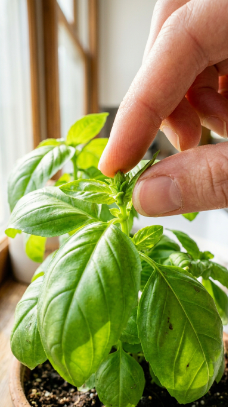
Here’s the thing: pinching back herbs is the simplest trick to get a full, bushy plant instead of a sad, leggy one. All you do is pinch off the top two sets of leaves from each stem — that’s it!
This encourages the plant to produce two new stems from each pinch point, doubling its productivity over time. Basil, mint, lemon balm, and oregano especially love this treatment.
Do it every 1–2 weeks and you’ll never run out of fresh herbs all summer. Bonus: whatever you pinch off goes straight into tonight’s dinner. Zero waste!
Pro Tip: Always pinch above a leaf node (the point where leaves meet the stem). Never remove more than one-third of the plant at once, or you’ll stress it out.
See our complete guide to growing herbs in containers for more herb care hacks.
Gardeners’ World’s guide to harvesting herbs covers the best techniques for each variety.
Pinch, harvest, repeat — this is the herb garden loop you want!
13. Add a Witch’s Garden Corner With Dark Foliage and Seasonal Decor
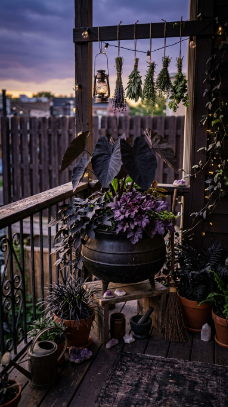
If you love dramatic, moody aesthetics, a witch’s garden corner is your summer project. This is basically a dark-themed container garden using plants with deep, jewel-toned, or near-black foliage — and it looks utterly stunning.
Think black elephant ears (Colocasia), dark heuchera, purple basil, black sweet potato vine, and velvet-leafed plants. Add a small cauldron as a planter, some hanging dried herbs, and a couple of mystical figurines for full effect.
This is also a brilliant way to ease into spooky decor before Halloween — you can add seasonal touches in October while keeping the living plants all summer.
Read about creating moody container garden displays on our blog.
Royal Horticultural Society’s dark foliage plant guide has loads of dramatic plant ideas.
Dark, dramatic, and absolutely gorgeous — go for it!
14. Use Coffee Grounds as a Free Summer Fertilizer Boost
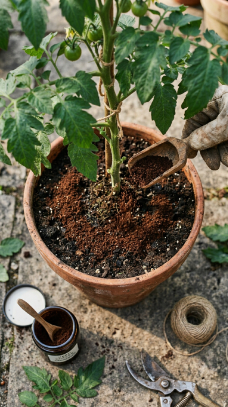
Don’t throw those used coffee grounds away! Sprinkled lightly around acid-loving plants, they provide a gentle nitrogen boost and improve soil texture — completely free.
Plants like blueberries, tomatoes, roses, hydrangeas, and most leafy herbs love slightly acidic conditions. A thin dusting of grounds every couple of weeks can perk them right up during summer’s heavy-feeding period.
Keep it light — too much creates a crust that repels water. Mix a tablespoon or two into the top inch of soil rather than piling it on top.
Learn more about organic fertilizer shortcuts for summer containers on our site.
Penn State Extension offers research-backed info on organic soil amendments for home gardening.
Free fertilizer from your morning brew? Talk about a win!
15. Try Companion Planting to Naturally Repel Summer Pests
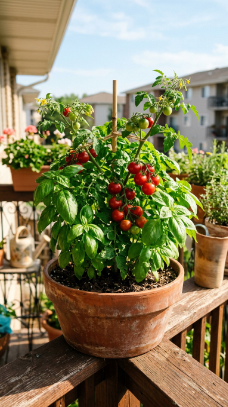
Here’s the deal: companion planting is nature’s own pest control — and it requires zero chemicals. Certain plants actively repel bugs that would otherwise attack your summer crops.
Basil planted near tomatoes is the classic combo — it deters aphids and whiteflies. Marigolds planted around the edge of any container garden repel nematodes, aphids, and even rabbits. Nasturtiums act as a sacrificial trap crop, luring aphids away from your prized plants.
This strategy works beautifully in container and balcony gardens where pest pressure can be intense. It smells amazing too!
| Companion Pair | What It Repels |
| Basil + Tomatoes | Aphids, whiteflies |
| Marigolds + Vegetables | Nematodes, aphids |
| Lavender + Roses | Aphids, moths |
| Nasturtiums + Any crop | Aphids (trap crop) |
Explore companion planting for container gardens on our full guide.
University of Minnesota Extension has excellent research-backed companion planting info.
Plant smart, garden easy — that’s the summer vibe!
16. Create a Miniature Fairy Garden With Seasonal Summer Charm
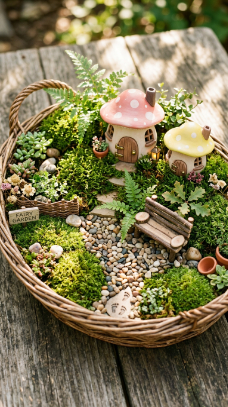
A miniature fairy garden is one of the most creative summer gardening shortcuts for instant outdoor charm — and it comes together in an afternoon! These tiny landscapes work in baskets, old wheelbarrows, vintage suitcases, or shallow planters.
Use slow-growing ground covers like baby tears, creeping thyme, or mind-your-own-business as your lawn. Add tiny figurines, pebble paths, driftwood bridges, and a small mirror as a “pond” for maximum fairy-tale effect.
Seasonal summer container gardens like these are magical as patio centerpieces, gifts, or even table décor for garden parties.
Pro Tip: Use a mix of texture heights — a low creeping ground cover, a mid-height fern, and one taller focal plant. This creates the illusion of a real landscape in miniature.
Get inspired by our complete fairy garden how-to guide for step-by-step instructions.
Gardeners’ World’s feature on fairy gardens lists the best tiny plants for miniature landscapes.
Tiny garden, massive charm — you’re going to love making this!
17. Use Shade Cloth to Protect Sun-Sensitive Plants From Summer Scorch
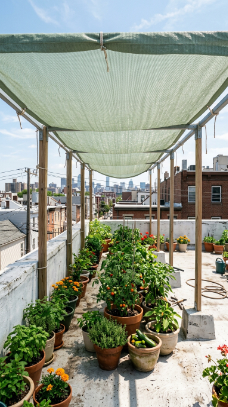
If your plants are looking fried, stressed, or bleached in peak summer sun, a simple shade cloth is the fix. A 30–50% shade cloth can drop leaf temperature by several degrees and prevent sun scorch on sensitive foliage.
Ferns, hostas, impatiens, begonias, and many tropical foliage plants prefer filtered light rather than direct blazing sun. In a balcony or rooftop container garden, shade cloth can be the difference between thriving and surviving.
Even a light muslin sheet or frost fleece repurposed as shade fabric works in a pinch. Just drape it over a simple bamboo frame above your plants during the hottest part of the day.
Read our post on protecting container plants from summer heat for more heat-stress solutions.
Cooperative Extension at University of Arizona has detailed research on heat management for container plants in hot climates.
Give your shade-lovers what they need — cool, filtered, happy conditions!
18. Propagate in Summer for Free New Plants All Year Long
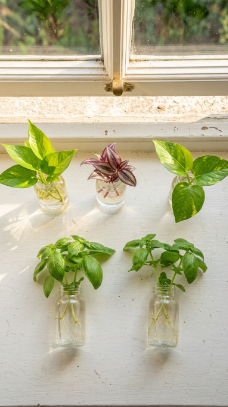
The best summer gardening shortcut of all? Free plants. Summer is the absolute prime time for propagating because warmth and long light hours supercharge root development.
Snip a 4–6 inch cutting just below a leaf node from healthy plants like pothos, tradescantia, basil, succulents, or begonias. Pop it in a glass of water or moist perlite and put it in a bright spot. In 2–3 weeks: new roots, new plant, zero cost.
This is how you grow your indoor plant collection endlessly, fill up your Halloween fairy garden with propagated succulents, share plants with friends, and replace anything that didn’t survive the summer heat.
Pro Tip: Change the water in propagation jars every 2–3 days to keep it oxygenated and prevent bacterial buildup. Roots form fastest in bright indirect light — not direct sun, which can overheat the water and stress the cutting.
Our guide to summer plant propagation for beginners covers every method in detail.
The Sill’s propagation guide is a clear, beginner-friendly walkthrough.
More plants, zero dollars — that’s the best summer deal going!
Frequently Asked Questions
What are the easiest summer gardening shortcuts for beginners?
Start with grouping your plants for natural humidity and switching to slow-release fertilizer — both require zero skill and deliver immediate results. Deadheading and pinching back herbs are also beginner-friendly 5-minute habits that make a huge difference. Self-watering containers are the best investment you can make for low-maintenance summer care.
How do I keep container plants alive during a summer heatwave?
Move heat-sensitive plants to a shadier spot, add a layer of mulch to the top of pots to slow evaporation, and water in the early morning. A drip irrigation timer is worth every penny during heatwaves. Group pots together to raise humidity and consider shade cloth for any plants showing signs of sun scorch.
What’s the best fertilizer for summer container gardens?
Slow-release granular fertilizer is the most convenient option — one application feeds plants for 3–6 months. For quick results, a balanced liquid fertilizer (10-10-10 or similar) every two weeks works well for heavy-feeding plants like tomatoes and flowering annuals. Always water before fertilizing to prevent root burn.
When should I start planning a Halloween fairy garden?
Start in mid-to-late summer so you have time to propagate succulents and source miniature figurines without rushing. Summer is ideal because succulents grow actively and you can build up a great collection of rosettes from cuttings. By early October, your spooky miniature garden will be fully established and ready to display.
Can I use household items to cut summer gardening costs?
Absolutely! Used coffee grounds make a free nitrogen-rich fertilizer for acid-loving plants. Cotton string from the kitchen makes perfect wicking systems. Colanders, tin cans, and wooden crates are brilliant upcycled planters. Ice cubes from the freezer slow-water your orchids for free. Summer gardening shortcuts are often hiding in plain sight around your home!
A Few Final Thoughts
Summer is meant to be enjoyed — and smart summer gardening shortcuts mean you can have the lush, thriving, gorgeous garden you want without spending every spare minute maintaining it. Whether you’re setting up a drip timer, propagating free plants, building a whimsical miniature fairy garden, or styling that moody witch’s garden corner, every shortcut here is designed to give you more garden, less grind. The best plant parents aren’t the ones who work the hardest — they’re the ones who work the smartest. Try even three or four of these ideas this season and you’ll see a real difference in how your plants look and how you feel about caring for them. Your green space deserves to thrive, and so do you. Now go make it happen!