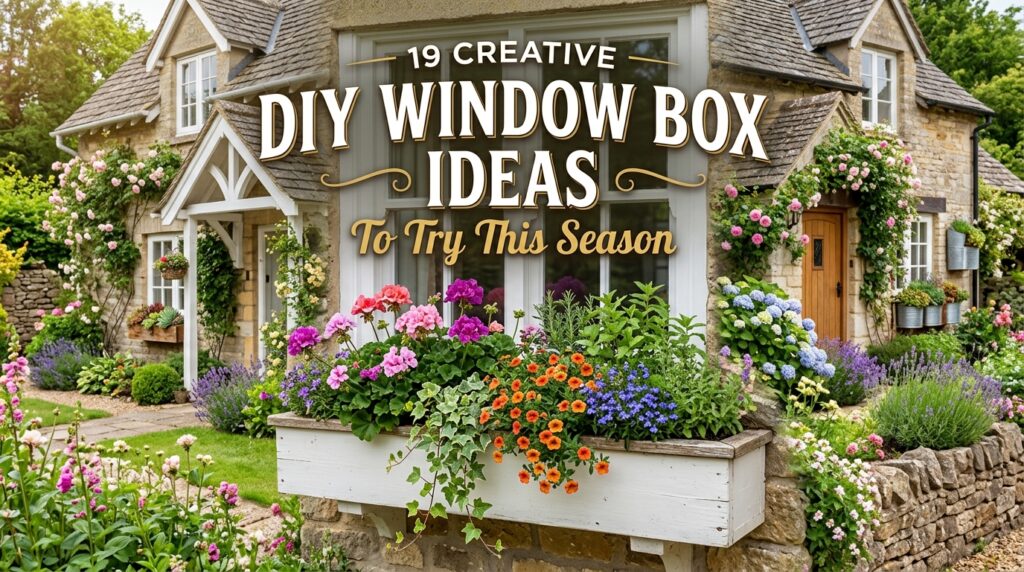
You walk past a house with window boxes absolutely exploding with color, texture, and life — and you feel that familiar pang of “why doesn’t my place look like that?” Here’s the thing: window boxes are genuinely one of the highest-impact, lowest-footprint garden upgrades you can make, and the DIY versions are almost always more beautiful, more personal, and more interesting than anything you can buy off a shelf. Whether you’re working with a sunny south-facing sill, a shady apartment ledge, or a front porch railing that’s crying out for some life, there’s a creative DIY window box idea in this list that was practically made for your space. Let’s dive in!
At a Glance
- A single well-planted DIY window box can completely transform the exterior of a home in an afternoon for under $30 in materials.
- Cedar, pine, and upcycled pallet wood are the three best materials for DIY window box builds — lightweight, workable, and naturally weather-resistant.
- The thriller-filler-spiller planting formula works in window boxes exactly as it does in containers — use it every single time for professional-looking results.
- Window boxes need secure mounting — always use appropriate brackets rated for the combined weight of box, soil, and plants, and check fixings before every new season.
- From succulent troughs to edible herb boxes, fairy garden displays to seasonal swap systems, window boxes are genuinely one of the most versatile garden formats available.
1. Classic Cedar Window Box with Drainage Tray
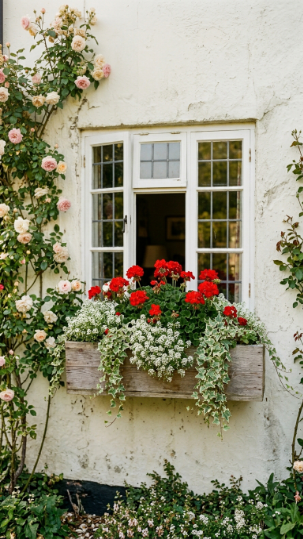
The classic cedar window box is the gold standard of DIY window box projects for genuinely good reason — cedar is naturally rot-resistant, beautifully aromatic, and ages into a gorgeous silver-grey patina that looks even better than fresh-cut wood. This is the box you build once and enjoy for a decade.
Cut 1-inch cedar planks into two long sides, two short ends, and a base with pre-drilled drainage holes every 6 inches along its length. Assemble with exterior wood screws (no nails — they work loose with seasonal moisture expansion) and sand all exterior edges smooth. Attach a matching cedar drainage tray to the base on small rubber feet that create a 1cm air gap — this prevents moisture from transferring to the sill and dramatically extends the box’s lifespan.
Plant the classic red geranium, trailing ivy, and white alyssum combination for a look that’s stood the test of time beautifully — or use this solid workhorse of a box to showcase any planting scheme your imagination can devise.
💡 Pro Tip: Before filling with soil, brush the inside of your cedar box with undiluted PVA wood glue and let it dry completely. This internal sealer prevents moisture from saturating the wood from the inside out, and easily adds 3–4 years to the box’s functional life without affecting drainage or plant health at all.
Get more ideas at classic cedar window box DIY build guide and check out Gardeners’ World’s window box planting guide.
Build it beautifully once, enjoy it for years — this is the one to start with!
2. Painted Ombre Window Box
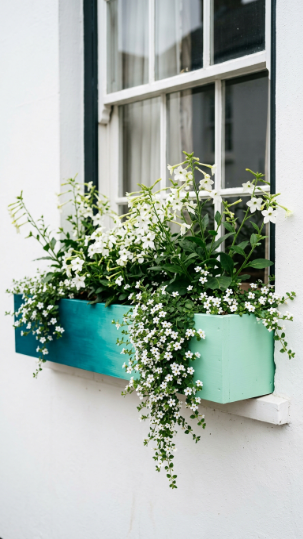
Here’s the deal: the box itself is part of the design — and painting a window box in a deliberate ombre gradient from deep teal to soft mint, or dusty rose to pale blush, turns a functional planter into a genuine exterior art piece before a single plant goes in.
Build or source a basic pine window box, sand thoroughly, and prime with exterior wood primer. Apply your darkest color at one end using exterior masonry or outdoor wood paint, then blend progressively lighter shades toward the other end using a dry brush technique. Three to four tones of the same color family creates the most convincing gradient — blend while each layer is still slightly wet for seamless transitions.
Choose white or pale flowering plants — nicotiana, white bacopa, cream calibrachoa — to plant against the colored box so the gradient paintwork remains the undisputed star rather than competing with vivid blooms.
Browse painted ombre window box DIY ideas and visit the RHS guide to painting and finishing wooden garden planters.
When the box itself is art, even a single plant becomes a composition!
3. Succulent Trough Window Box
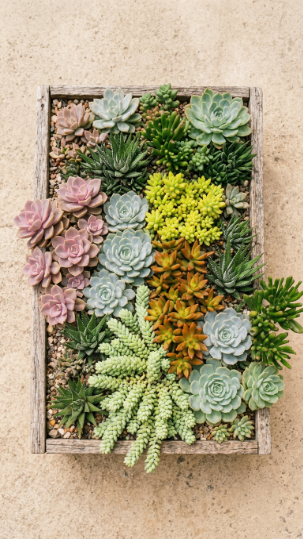
A succulent trough window box is the most low-maintenance creative window box idea on this entire list — plant it once in spring, and it will look spectacular through every season with almost zero intervention beyond occasional watering. The mosaic-style planting of different succulent varieties in deliberate color blocks looks like living art installed on your windowsill.
Build a shallow trough (6 inches deep is plenty for succulent roots) from cedar planks and fill with a gritty succulent mix: 50% quality potting mix and 50% horticultural grit or perlite for the sharp drainage succulents demand. Plant in deliberate blocks — a section of dusty rose echeveria, a sweep of silver sedum, a row of deep green haworthia — for a color-block pattern that reads beautifully from street level.
The trailing sedum varieties — Sedum morganianum or creeping stonecrop — are the window box succulent secret weapon: they cascade beautifully over the front edge, softening the box frame while the rosette varieties provide the structural interest above.
💡 Pro Tip: Top-dress the entire succulent trough with a thin layer of fine horticultural grit or decorative pea gravel after planting. It prevents soil splash on lower leaves during rain, dramatically improves drainage around the vulnerable crown of each plant, and gives the finished trough a clean, polished aesthetic that elevates the whole display.
Explore succulent trough window box DIY ideas and read The Sill’s guide to succulent container arrangements.
Plant it once, admire it forever — the window box for genuinely busy people!
4. Upcycled Pallet Wood Window Box
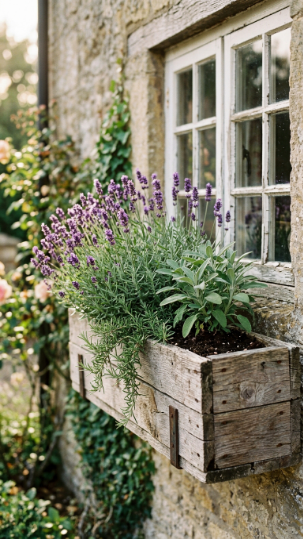
The upcycled pallet wood window box has genuine character that no new-cut timber can replicate — the weathered grain, the occasional nail hole, the silver-grey patina of reclaimed wood all tell a story that makes this box look like it belongs exactly where it is, as if it’s always been there.
Source heat-treated pallets (look for the HT stamp) from garden centers, building suppliers, or online listings. Disassemble carefully with a pry bar and mallet, selecting the most characterful planks for the visible exterior faces and straighter boards for the structural base and ends. Pre-drill all fixing points to prevent splitting in weathered wood.
Plant with herbs that complement the rustic aesthetic — lavender, sage, trailing rosemary, and thyme — for a farmhouse herb window box that looks genuinely artisan and smells absolutely incredible every time you open the window above it.
Browse upcycled pallet wood window box DIY ideas and check out Gardeners’ World’s guide to upcycled garden planter projects.
Reclaimed, characterful, and completely free — the most soulful window box of all!
5. Herb and Edible Flower Window Box Kitchen Garden
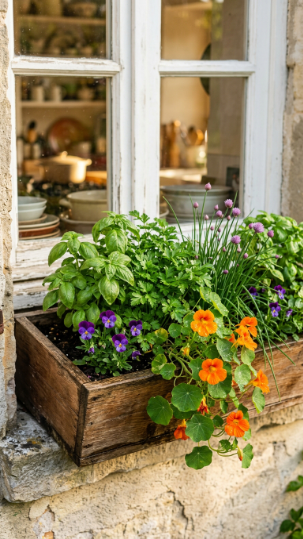
Here’s the thing: a window box directly outside your kitchen window that you can harvest through an open sash is one of the most genuinely useful and deeply satisfying garden setups imaginable. Fresh basil, chives, parsley, and edible nasturtiums — all within arm’s reach while you’re cooking. It’s the ultimate edible window box kitchen garden.
Build the box deep enough for generous root space — 8 to 10 inches deep for herbs, which need more room than purely ornamental annuals. Plant in distinct sections: a generous basil cluster in the sunniest spot, flat-leaf parsley in the middle, chives and thyme toward the edges, and let nasturtiums and violas fill the gaps and trail over the front for color and edible flowers.
The trick to keeping an edible window box productive all season is harvesting regularly — the more you cut, the more vigorously the plants grow. Neglected herb boxes become leggy and bitter; harvested ones stay bushy, productive, and beautiful simultaneously.
💡 Pro Tip: Plant a second identical box inside on the kitchen windowsill in late summer and bring it indoors as temperatures drop — you get a seamless handover from outdoor to indoor herb supply with zero gap in fresh herb availability through autumn and winter.
Discover edible herb and flower window box kitchen garden ideas and visit University of Minnesota Extension’s guide to edible window box gardening.
Reach through the window, harvest your dinner — the most useful box on this list!
6. Fairy Garden Window Box
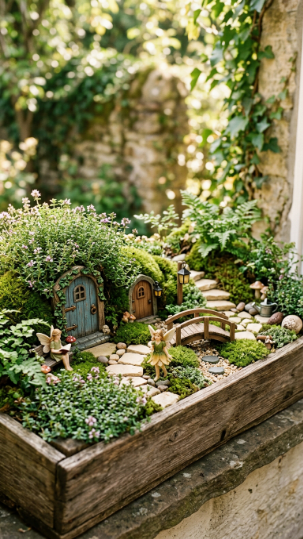
A fairy garden window box is the creative window box idea that stops absolutely everyone in their tracks — children and adults equally. A wide, shallow box planted with creeping thyme, cushion moss, and baby succulents, then populated with a complete miniature world of tiny doors, stone pathways, wooden bridges, and fairy figurines becomes living, breathing storytelling that makes your home’s exterior genuinely magical.
Use a trough-style box at least 24 inches long to give yourself enough space to build a proper narrative landscape — a mossy path leading to a tiny cottage door, a stone bridge over a pebble stream, a fairy sitting under a miniature tree fern. The longer the box, the richer the story you can tell.
Swap out the miniature seasonal accessories to keep the scene fresh — autumn leaves and tiny pumpkins in October, miniature Christmas decorations in December, spring flowers and tiny Easter eggs in April. The plants stay; the story evolves.
Browse fairy garden window box DIY ideas and read The Sill’s guide to miniature garden container planting.
The window box that makes every passerby stop and smile — pure magic!
7. Industrial Steel and Reclaimed Wood Window Box
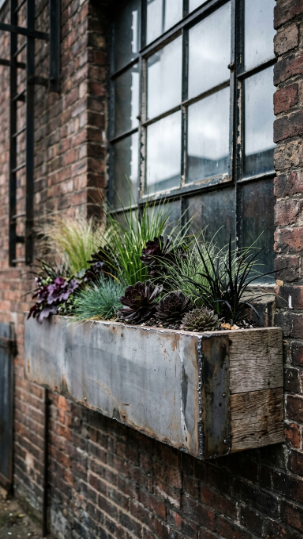
For the industrial-aesthetic home — exposed brick, steel-framed windows, warehouse conversions — a window box that combines reclaimed wood with folded raw steel panels creates a genuinely architectural exterior feature that complements the building rather than softening it into cottage-garden territory.
Source thin mild steel sheet from a metal supplier and have it cut to your box dimensions — or use a simple pair of metal shears for straight cuts. The raw oxidizing edges are part of the aesthetic, not a flaw. Rivet or bolt the steel front panel to a structural timber back frame, and use reclaimed hardwood for the visible side panels.
Plant with bold architectural choices that suit the industrial aesthetic: black mondo grass (Ophiopogon planiscapus ‘Nigrescens’), dark-leafed sedums, steel-grey festuca grasses, and spiky agave. The plant palette echoes the material palette — dark, graphic, and deliberately uncompromising.
💡 Pro Tip: Apply a coat of clear exterior lacquer to the steel panel if you want to freeze the patina at its current stage — or leave it completely untreated and allow the oxidation to continue evolving over months and years into an ever-richer, more complex surface. Both choices are valid; the uncoated version becomes increasingly beautiful with time.
Explore industrial steel and wood window box DIY ideas and check out Gardeners’ World’s contemporary window box design guide.
Raw, considered, and completely unlike any other window box in the street!
8. Trailing Flower Cascade Window Box
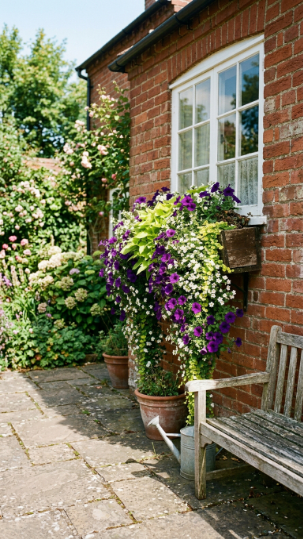
The trailing cascade window box is the arrangement that passersby genuinely photograph from the pavement — trailing petunias, bacopa, and sweet potato vine allowed to grow to their full dramatic potential, spilling 18 inches or more below the box in flowing curtains of color and texture that look almost impossibly lush.
The secret is resisting the urge to cut back trailing plants as they reach full length. Most gardeners instinctively trim cascades that start to look long — but the most spectacular window box displays are precisely the ones where the gardener let the trailers grow freely and fully. Length equals drama. Drama equals impact.
Use a deep, well-fertilized box — trailers need serious root volume and consistent feeding to maintain long cascades. Add a slow-release granular fertilizer at planting and liquid-feed weekly with a balanced feed once plants are actively growing.
Browse trailing flower cascade window box arrangement ideas and visit the RHS guide to trailing window box plants.
Let them trail, let them cascade, let them be magnificent — don’t cut back!
9. Seasonal Swap Window Box System
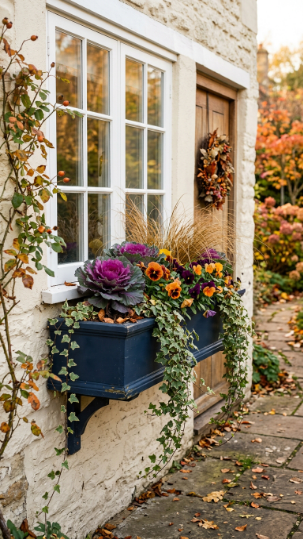
The smartest long-term window box investment is building one beautifully made, beautifully painted permanent box and committing to replanting it four times a year with seasonally appropriate plants. Same box, same position, endlessly evolving display — it’s the system that keeps your home’s exterior looking considered and current through every single season.
Build the box in painted MDF or exterior-grade plywood — smoother than solid timber and perfect for taking paint cleanly. Paint in a deep, timeless shade that suits your home: navy, forest green, charcoal, or deep terracotta. The box color becomes your permanent design statement; the plants are the seasonal wardrobe.
Spring: bulbs and pansies. Summer: trailing annuals and geraniums. Autumn: ornamental kale, grasses, and ivy. Winter: evergreen foliage, cyclamen, and decorative twigs. Four distinct looks, one permanent, beautiful box.
💡 Pro Tip: Use a removable plastic liner tray inside your permanent box — replanting becomes a clean, quick swap of the whole liner rather than disturbing the box’s mounting. This also protects the painted timber from constant soil moisture, keeping your painted finish pristine for years longer than direct-soil planting.
Discover seasonal swap window box system ideas and read Gardeners’ World’s year-round window box planting guide.
One box, four seasons, always stunning — the smartest window box decision you’ll make!
10. Vintage Enamel Window Box Display
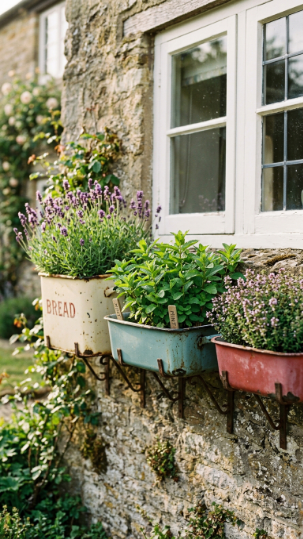
A collection of mismatched vintage enamelware — old bread bins, roasting pans, colanders, and stock pots — mounted as a trio of window boxes creates an exterior display with extraordinary character and charm. Thrift stores, car boot sales, and online vintage marketplaces are the hunting grounds for these beautiful objects, and the hunt is genuinely half the pleasure.
The variety of enamelware sizes and shapes creates a naturally asymmetric display that looks collected over years rather than assembled in an afternoon. Mount at slightly varied heights for additional visual interest — not perfectly level, but deliberately offset by a few centimetres each way.
Drill drainage holes in each piece (a masonry bit on a slow speed works on enamel without cracking), line with hessian, and plant with herbs that complement the nostalgic farmhouse aesthetic: lavender, mint, lemon balm, and chamomile.
Browse vintage enamelware window box display ideas and check out the RHS guide to upcycled container herb planting.
Every piece has a story — your window box display becomes a living archive!
11. Vertical Herb Ladder Window Box System
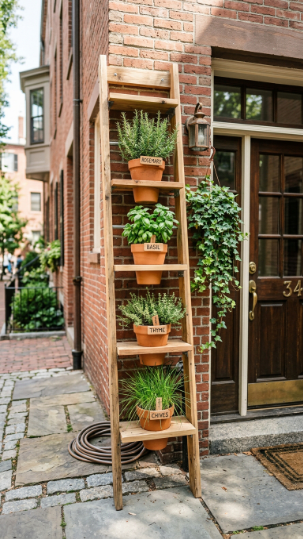
Here’s the deal: if you want multiple window boxes but have only one suitable wall space, a vertical ladder system with shelving at four different heights solves the problem elegantly. It’s a freestanding structure that leans against the wall, requiring no drilling into brickwork, while providing four independent planting levels in the footprint of a single window box.
Build from treated timber uprights with cedar shelf brackets at 12-inch height intervals. Each shelf holds a standard window box tray. Lean the whole system against the wall and anchor with two small L-brackets at the top for stability — lightweight, renter-friendly, and completely repositionable.
Plant each shelf as a dedicated herb station with a theme: top shelf for sun-hungry Mediterranean herbs (rosemary, sage, thyme); lower shelves for cooler-preference herbs (parsley, chives, coriander, mint). Your entire culinary herb collection in one compact, beautifully stacked vertical arrangement.
💡 Pro Tip: Add small drip trays under each window box shelf and connect them with a thin channel routed along each upright — water from the top shelf drains into a channel that directs it to the next shelf down, creating a gravity-fed cascade irrigation system that waters all four levels from a single pour at the top.
Explore vertical ladder window box system DIY ideas and visit Iowa State University Extension’s guide to vertical herb container systems.
Four levels of herbs, one wall space, zero drilling — complete vertical genius!
12. Coastal Driftwood Window Box
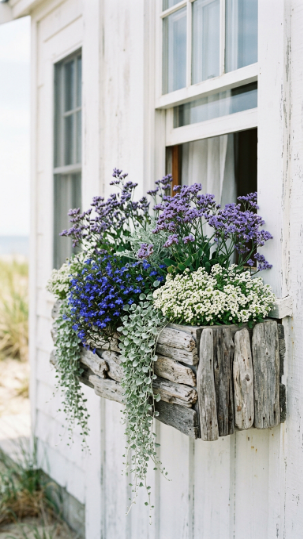
A driftwood-clad window box is the coastal garden equivalent of a statement piece of furniture — it brings texture, story, and seaside character to any home near the coast, and equally to any home inland whose owner simply loves the coastal aesthetic.
Build a basic structural pine box, then clad the exterior faces with driftwood pieces collected from the beach or purchased from craft suppliers — vary the piece sizes and orientations deliberately for a naturalistic rather than too-regular pattern. Attach with exterior wood glue and small panel pins, fitting pieces closely together like a three-dimensional jigsaw.
Plant with coastal-inspired species that reference the seaside palette: sea lavender (Limonium), blue lobelia, white alyssum, and trailing silver dichondra whose coin-shaped leaves perfectly echo beach pebbles in their cool metallic tone.
Browse coastal driftwood window box DIY ideas and read Gardeners’ World’s guide to coastal container planting.
Every piece of driftwood has traveled — your window box carries the whole story of the sea!
13. Chalkboard-Painted Herb Window Box
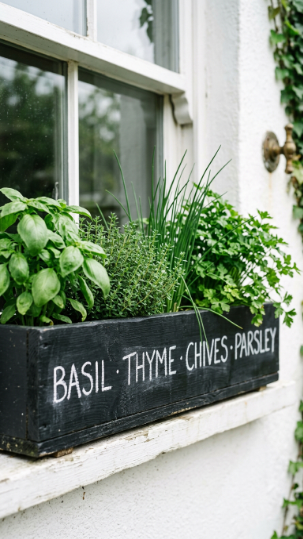
The chalkboard-painted herb window box is brilliantly clever — the entire outer face of the box is painted in exterior chalkboard paint, and you write the name of each herb directly on the front of the box in white chalk exactly below where it grows. The labeling is part of the design, and it’s infinitely updatable as you swap plants through the season.
Use exterior-grade chalkboard paint (standard blackboard paint is interior only and weathers badly outdoors) and apply two coats to a smooth exterior-plywood box. Season the surface by rubbing a stick of white chalk across the whole face and wiping it off before writing your first permanent labels — this prevents the ghost of your first writing from showing through future updates.
The matte black finish makes herb foliage pop with extraordinary vibrancy — bright green basil and parsley against flat black is a color pairing of genuinely striking graphic impact that looks both modern and completely timeless.
💡 Pro Tip: Use a chalk pen rather than ordinary chalk sticks for your herb labels — the slightly thicker, crisper line produced by a chalk pen is significantly more legible and weather-resistant than standard chalk, and holds beautifully through several rainstorms before needing a refresh.
Discover chalkboard herb window box DIY ideas and check out the RHS guide to decorative herb container planting.
Label it, plant it, rewrite it seasonally — the most functional beautiful box!
14. Wildflower Meadow Window Box
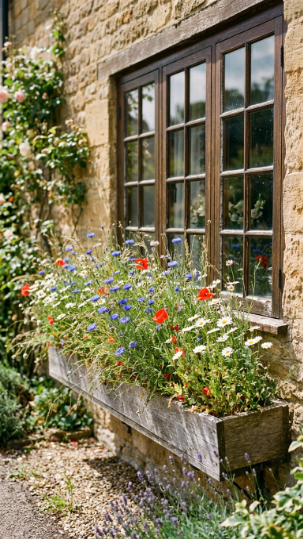
A wildflower meadow window box is the most naturalistic and ecologically generous creative window box idea on this list — and the most beautifully effortless-looking, despite being one of the easiest to plant. Scatter a native wildflower seed mix into a deep, lean-soiled box (wildflowers actually prefer poorer soils — too rich and you get all leaves, no flowers), water it in, and then largely leave it alone.
Cornflowers, poppies, ox-eye daisies, field scabious, and native grasses create a loose, romantic, abundantly natural display that looks completely different from every other conventional window box on the street. It moves in the breeze with that loose, uncontrolled quality that formal planting never quite achieves.
Use a deliberately lean, gritty growing medium — mix standard potting compost 50/50 with horticultural sand or fine grit. Rich soil produces lush foliage but surprisingly few flowers in wildflower species adapted to thin meadow conditions.
Browse wildflower meadow window box DIY ideas and visit Gardeners’ World’s wildflower container planting guide.
Wild, natural, and completely, joyfully alive with bees and butterflies!
15. Copper-Topped Window Box with Living Roof Edge
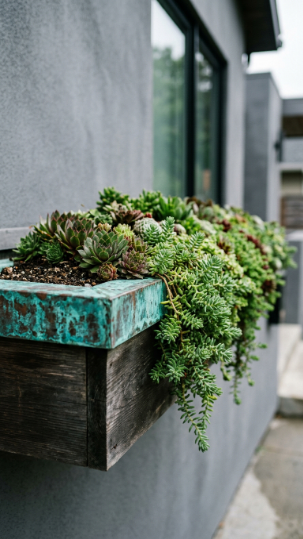
Talk about a game-changer — capping the top edges of a window box with thin copper sheet trim creates a living box that becomes more beautiful with every passing month as the copper oxidizes from bright gold through rich brown to the most gorgeous verdigris green. The copper patina and the living plants literally grow into each other visually as the box ages.
Cut thin-gauge copper sheet to the width of your box top edge and fold over the rim with pliers, securing with copper tacks. The copper extends slightly inward into the planting area — as sedum and sempervivum grow and cascade over the copper edge, the boundary between the metal and the plant disappears into one seamless living surface.
Plant exclusively with drought-tolerant, spreading plants — sedums, sempervivums, and creeping thyme — that suit the copper’s natural associations with rock garden and alpine aesthetics.
💡 Pro Tip: Apply liver of sulfur solution to the copper before installation if you want to skip the months of waiting for natural oxidation and jump straight to the rich brown mid-patina stage immediately. Full verdigris develops naturally over the subsequent months outdoors regardless of the starting point.
Explore copper-trimmed window box DIY ideas and read the RHS guide to alpine and sedum container planting.
Metal and plant, aging together beautifully — sophisticated and completely original!
16. Halloween and Seasonal Spooky Window Box
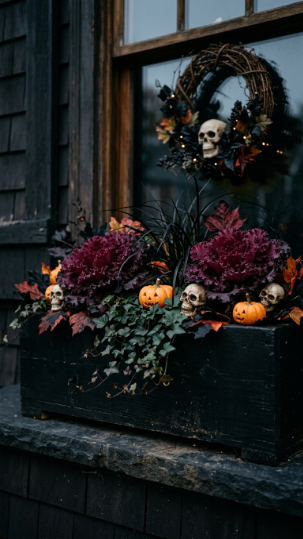
Here’s the thing: a Halloween-themed window box that uses real plants as the foundation of the display is infinitely more striking than one built purely from artificial decorations — the living plants give the whole arrangement genuine presence and weight that plastic props simply can’t replicate.
Paint a window box in matte black exterior paint, plant with deep burgundy ornamental kale, trailing dark ivy, and black mondo grass, then dress with tiny carved mini pumpkins, small skull ornaments, preserved dark autumn leaves, and lengths of artificial spider web draped along the front edge.
The real plants do the heavy lifting of the display; the seasonal accessories provide the Halloween narrative. When October ends, simply remove the decorations and replant with winter evergreens — the black box transitions beautifully into a sophisticated winter display with minimal effort.
Browse Halloween seasonal window box DIY ideas and check out Gardeners’ World’s seasonal window box decoration ideas.
Spooky, beautiful, and anchored in real living plants — the best Halloween display on the street!
17. Monochromatic Green Foliage Window Box
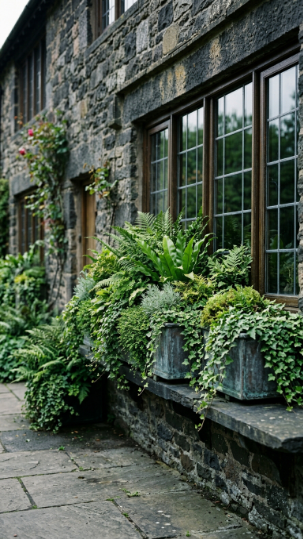
The all-green foliage window box is a design choice that communicates extraordinary confidence — using no flowers at all, relying entirely on the extraordinary variety of greens, textures, and leaf forms available in foliage plants to create a display of genuine sophistication.
Mix every texture of green available: the bold, glossy fronds of hart’s tongue fern; the delicate lacy texture of lady fern; the cascading softness of creeping jenny; the minute, moss-like density of mind-your-own-business; the silver-green shimmer of helichrysum trails. The textural variety within a single color story is endlessly rich.
This arrangement is perfect for shaded north-facing windows where flowering plants struggle — foliage plants tolerate shade beautifully, and the absence of light actually intensifies the depth of green in the leaf colors.
💡 Pro Tip: Add one or two variegated foliage plants — white-edged ivy or silver-splashed heuchera — as the tonal accent that prevents an all-green scheme from feeling flat. Variegation provides the brightness and contrast that flowers would normally supply, entirely within the green family.
Discover monochromatic green foliage window box ideas and visit The Sill’s guide to foliage-only container arrangements.
Every shade of green, every texture imaginable — the window box that needs no flowers!
18. Scented Night Garden Window Box
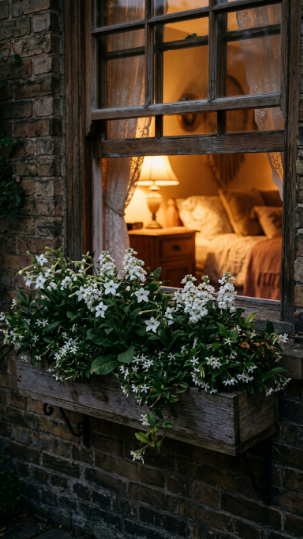
A scented night garden window box positioned below a bedroom window is one of the most genuinely luxurious home garden upgrades imaginable — lie in bed with the window cracked open on a warm evening and the fragrance of night-scented stock, white nicotiana, and jasmine drifts in like the most natural, beautiful aromatherapy in the world.
These plants are specifically adapted to release their fragrance after dark — during the day they’re relatively scentless, but as evening falls and temperatures drop, they open their fragrance fully in what is honestly one of the most extraordinary sensory experiences a garden can provide.
Build the box with excellent drainage — night-fragrant plants like nicotiana and stock are susceptible to root rot in consistently wet conditions. A mix of quality potting compost with 20% added perlite gives the free-draining conditions these plants prefer.
Browse scented night garden window box ideas and read Gardeners’ World’s guide to night-scented plants for containers.
Open your bedroom window at dusk — this is the window box that changes everything!
19. Self-Watering Reservoir Window Box Build
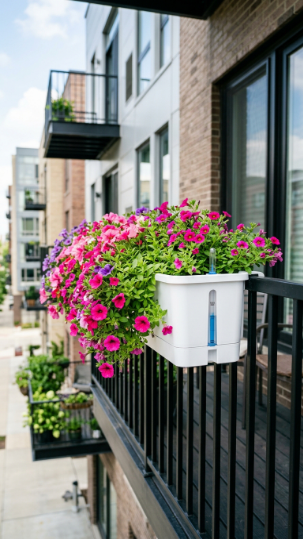
Here’s the most genuinely practical creative window box idea on this entire list — a DIY self-watering reservoir window box that waters your plants automatically from below through capillary action, reducing your watering commitment from daily to once or twice a week even in summer heat.
Build the double-chamber system from two nested plywood or plastic boxes: an outer structural box that serves as the water reservoir and an inner planting box with wicking holes in its base suspended just above the reservoir floor on small cleats. Fill the reservoir through a vertical fill tube that extends from the reservoir floor up through the planting medium to the surface. Add a simple float indicator — a wine cork on a wooden skewer — in the fill tube to show the water level at a glance.
The capillary wick system draws water from the reservoir up into the planting medium continuously, keeping roots at consistent moisture levels that produce significantly healthier, more productive plants than the feast-and-famine cycle of conventional top watering.
💡 Pro Tip: Add a small overflow hole drilled at the maximum reservoir fill level on the side of the outer box — this prevents the reservoir from overfilling during heavy rain and drowning roots from below, which is the one failure mode of reservoir systems that the overflow hole completely eliminates at zero cost.
Explore self-watering reservoir window box DIY build ideas and check out Cornell University Extension’s guide to sub-irrigation container systems.
Water it twice a week, harvest blooms every day — the ultimate smart window box!
Frequently Asked Questions
What wood is best for building a DIY window box?
Cedar is the undisputed champion for DIY window box builds — naturally rot-resistant, lightweight, and it develops a beautiful silver-grey patina outdoors without painting or treating. Western red cedar is the most widely available variety. For a more budget-friendly option, exterior-grade pine treated with non-toxic wood preservative performs very well. Avoid MDF and standard interior plywood — both delaminate rapidly in outdoor moisture exposure even when painted. For painted boxes, exterior-grade birch plywood takes paint cleanly and holds up well with a thorough primer and two coats of quality exterior paint.
How do I stop window boxes from rotting at the base?
The three key rot prevention strategies are: first, always drill generous drainage holes every 4–6 inches along the base — standing water is the primary cause of base rot. Second, mount the box on rubber feet or wooden cleats that create a 1–2cm air gap between the box base and the windowsill, allowing airflow underneath. Third, line the inside of the box with a removable plastic liner or paint the interior with undiluted PVA wood glue as a moisture barrier. Combining all three approaches routinely extends window box life to 8–12 years even without repainting or retreating.
How do I safely mount a window box without damaging my walls?
Always use purpose-made window box brackets rated for at least double the expected weight of your filled box — a 24-inch window box filled with moist potting mix and plants typically weighs 15–25kg. For brick and masonry walls, use masonry wall plugs and stainless steel screws at minimum 6cm depth. For timber-frame walls, fix into the structural studs — not just the cladding. For renters who cannot drill, railing-mounted boxes with adjustable bracket systems are the safe alternative. Always check all fixings at the start of each growing season, as freeze-thaw cycles can work fixings loose over winter.
What are the best plants for shaded north-facing window boxes?
Shaded window boxes have a genuinely rich plant palette available. The best performers for low-light window boxes include fuchsia (spectacular in trailing forms), impatiens (prolific flowering in shade), begonias, ferns, heuchera, ivy, and mind-your-own-business. For edible shaded window boxes, parsley, chives, mint, and lemon balm all tolerate north-facing positions well. The all-green foliage approach — mixing varied leaf textures in every shade of green — is often the most sophisticated solution for deeply shaded positions where flowering plants bloom too sparsely to look their best.
How often should I fertilize window box plants through the season?
Window box plants need more feeding than garden bed plants because the restricted soil volume limits available nutrients and frequent watering leaches them out faster. Add a slow-release granular fertilizer at planting time to provide background nutrition. From the point that plants begin actively growing, supplement with a balanced liquid feed weekly — switch to a high-potash tomato-type feed when flowering plants are actively blooming to maximize flower production. Stop feeding in September as plants wind down for autumn. Without consistent feeding, window box plants become visibly tired and under-performing by midsummer — feeding is genuinely the most important maintenance step most gardeners overlook.
A Few Final Thoughts
There you have it — 19 genuinely creative DIY window box ideas that prove your windows have been quietly sitting there as the most under-utilized canvas on your entire home’s exterior. Whether you build the romantic scented night garden box below your bedroom window, create a magical fairy garden world below the front door, or simply build a beautiful cedar classic and master the thriller-filler-spiller formula for the very first time, the result is always the same: an exterior that stops people, makes them smile, and tells them something real and lovely about the person who lives inside. Window boxes are the rare garden project where the effort-to-impact ratio is almost unfairly generous — a few hours, a modest budget, and the right plants genuinely transform how your home looks and feels from the street. Your windows are waiting, your plants are ready — now go make the most beautiful window boxes your neighborhood has ever seen!