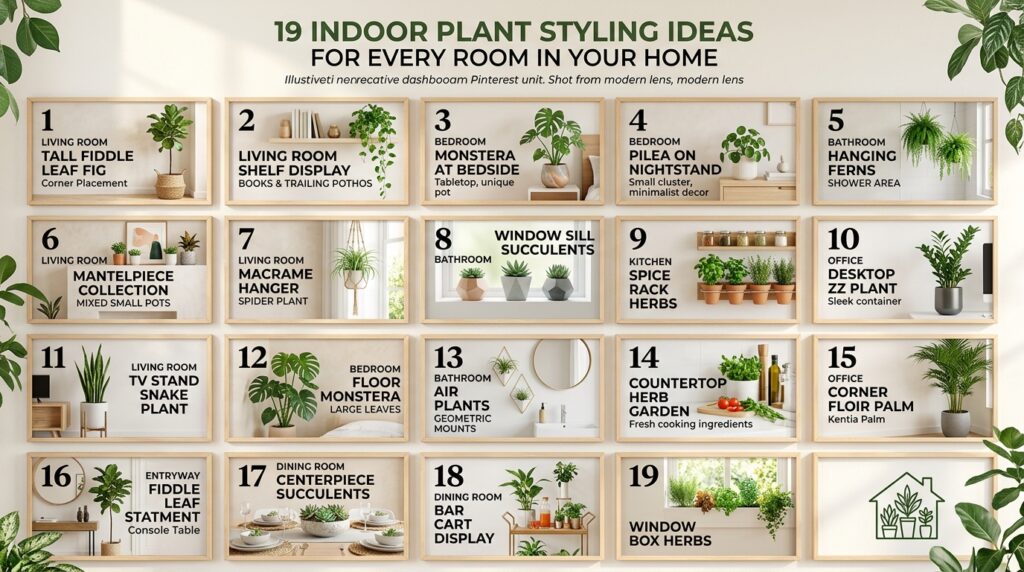
Your home could be a lush, living sanctuary — and the only thing standing between you and that dream is knowing which plant goes where. Indoor plant styling isn’t just about buying a pretty pot and hoping for the best; it’s about understanding light, scale, texture, and mood to create spaces that feel genuinely alive and deeply personal. Whether you’re decorating a sun-drenched kitchen or a dim hallway, the right plant in the right spot is pure interior magic. Ready to transform every room in your home? Let’s dive in!
At a Glance
- Indoor plant styling works best when you match a plant’s light, humidity, and size requirements to the specific conditions of each room rather than decorating with whatever looks prettiest at the garden center.
- Grouping plants of varying heights, textures, and leaf shapes creates a more professional, editorial look than spacing single plants evenly around a room.
- The bathroom and kitchen are often the most overlooked rooms for plant styling, yet they offer some of the best humidity and indirect light conditions for tropical houseplants.
- Using statement pots, plant stands, and hanging planters is just as important as the plant itself — the vessel, height, and placement all contribute equally to the final effect.
- Even the darkest rooms in your home can support living greenery with the right shade-tolerant species and a little creative placement strategy.
1. The Living Room Statement Floor Plant
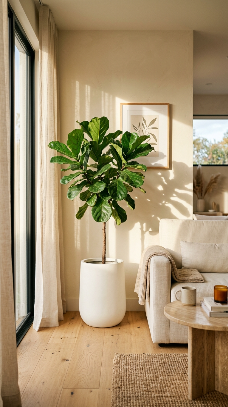
The living room is where your boldest plant styling decisions happen — and nothing makes a statement quite like a large floor plant anchoring a corner or framing a sofa. This is your chance to go big, go architectural, and genuinely transform a room.
The secret is choosing a plant whose scale genuinely commands the space rather than getting lost in it. A Fiddle Leaf Fig (Ficus lyrata), a tall Monstera deliciosa, or a dramatic Bird of Paradise (Strelitzia reginae) all deliver that magazine-worthy impact that smaller plants simply can’t.
💡 Pro Tip: Place your large floor plant in a corner that receives bright indirect light, then angle it slightly outward toward the room — this encourages growth toward the light AND positions the best side of the plant to face your seating area. Turn it a quarter turn every few weeks for even growth.
Pot choice matters enormously here — a statement floor plant deserves a statement pot. Tall cylinder pots in matte ceramic, textured concrete, or woven rattan all work beautifully. Avoid shiny glazed pots for large plants; they can look cheap at scale.
- Fiddle Leaf Fig: bright indirect light, dramatic sculptural leaves
- Bird of Paradise: bright direct light, paddle-shaped architectural leaves
- Monstera deliciosa: medium indirect light, iconic split leaves
- Rubber Plant (Ficus elastica): medium indirect light, glossy deep burgundy leaves
Check out our choosing the right floor plant for your living room guide for scale and proportion tips. Architectural Digest has stunning living room plant styling inspo at architecturaldigest.com.
One confident, well-placed floor plant does more for a living room than ten smaller ones scattered randomly — commit to the statement!
2. Living Room Shelf Styling with Trailing Plants
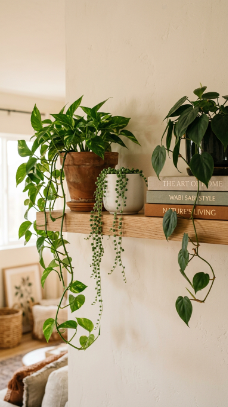
Here’s the deal: trailing plants on shelves are one of the most effortlessly stylish things you can do in a living room, and they’re forgiving, fast-growing, and nearly impossible to kill. The long cascading vines soften hard shelf edges and add organic movement to what could otherwise be a static display.
Golden Pothos (Epipremnum aureum) is the undisputed king of shelf trailing — it grows in almost any light condition, produces beautiful heart-shaped leaves, and trails enthusiastically down even from the highest shelf. String of Pearls (Senecio rowleyanus) is the quirkier, more editorial choice with those distinctive bead-like leaves.
Style your trailing plants alongside books, ceramics, and art objects rather than in isolation — the mix of organic trailing vines against curated objects is what gives that perfectly imperfect editorial look.
💡 Pro Tip: Let your trailing plants grow long rather than cutting them back constantly — a shelf plant with trails reaching 60–80cm down the wall looks genuinely spectacular and makes the room feel like a living magazine set.
Explore our shelf plant styling guide for living rooms for more curated shelfie ideas.
The beauty of shelf trailing plants is that they look better the less you interfere — just let them grow and admire the results!
3. Kitchen Herb Garden Window Display
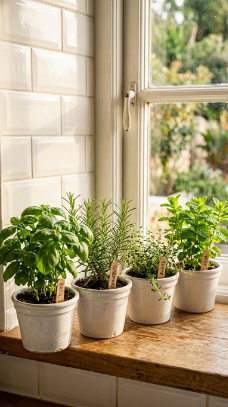
Your kitchen windowsill is prime real estate for the most functional plant display in the whole home — a lineup of fresh culinary herbs that you actually use every day. Styling and practicality combined? That’s the dream!
The secret to a beautiful kitchen herb display is uniformity in the pots paired with variety in the plants. Choose matching ceramic pots in white, terracotta, or matte black, then pack them with your most-used herbs — basil, rosemary, thyme, mint, and flat-leaf parsley are the kitchen essentials.
Arrange them by height, smallest at the front — it creates a natural tiered display even on a flat windowsill. Taller rosemary and sage at the back, compact thyme and trailing mint at the front.
Keep herbs trimmed regularly — harvesting is maintenance with herbs, and frequent cutting encourages bushy, productive growth rather than leggy stems. A neglected herb looks sad; a regularly harvested one looks lush.
| Herb | Light Needed | Water Needs | Best Pot Size |
| Basil | Full sun | Moderate-high | 15cm+ |
| Rosemary | Full sun | Low | 20cm+ |
| Thyme | Full sun | Low | 15cm+ |
| Mint | Partial sun | High | 20cm+ (alone!) |
| Flat-leaf Parsley | Partial sun | Moderate | 20cm+ |
Read our indoor kitchen herb garden setup guide for variety selection and care tips. The Herb Society of America at herbsociety.org has brilliant growing resources.
A beautiful herb windowsill is the one plant display that literally pays for itself every single week — grow it and love it!
4. Bathroom Tropical Spa Styling
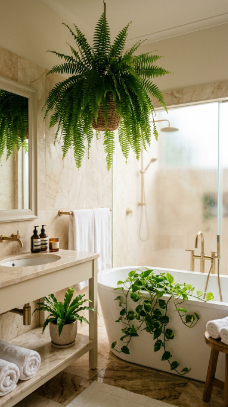
Your bathroom is secretly the best room in the house for tropical plants — all that steam from showers creates exactly the warm, humid microclimate that moisture-loving tropicals absolutely thrive in. Stop under-decorating your bathroom!
Ferns are the ultimate bathroom plant — Boston Ferns, Bird’s Nest Ferns, and Asparagus Ferns all love the humidity and can handle the lower light levels typical of many bathrooms. Peace Lilies are another perfect choice, handling low light brilliantly while purifying the air.
💡 Pro Tip: Install a simple ceiling hook and hang a lush macramé hanging planter with a Boston Fern or trailing Pothos above the bathtub. It creates that instant five-star hotel spa feeling and uses ceiling space that’s otherwise completely wasted.
Trailing plants over the bathtub edge is one of the most dramatic and beautiful bathroom styling moves — a long trail of Golden Pothos or Heartleaf Philodendron draped softly over a freestanding bath is genuinely breathtaking.
Explore our best plants for bathroom styling guide for humidity-lovers that thrive in steam.
Turn your bathroom into a personal spa retreat with plants — it costs almost nothing and the effect is absolutely transformative!
5. Bedroom Calming Green Corner
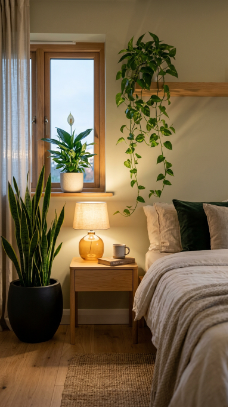
Here’s the thing: plants in the bedroom aren’t just decorative — they genuinely improve the quality of your sleep environment by softening the room’s acoustics, adding living texture, and (in some cases) improving air quality. The bedroom deserves plants as much as any room in the house.
The key is choosing calming, low-fuss species that won’t stress you out with demanding care routines. Snake Plants (Sansevieria) are perfect — they’re tolerant of low light, require minimal watering, and their upright architectural form looks incredibly smart in a bedroom setting.
Peace Lilies are another bedroom superstar — their gentle white flowers add a serene, spa-like quality, and they visibly droop when thirsty (and perk right back up after watering), making them brilliant communicators that even the most forgetful plant parent can manage.
Keep your bedroom plant display restrained and intentional — this isn’t the room for a maximalist jungle. Two or three well-chosen plants in beautiful pots will create calm. Overdoing it creates visual noise.
- Snake Plant: architectural, air-purifying, tolerates neglect
- Peace Lily: calming white flowers, shade-tolerant, self-signaling
- ZZ Plant (Zamioculcas): ultra-low maintenance, glossy dark leaves
- Lavender: fragrant, calming, needs a sunny windowsill
Check out our bedroom plant styling for better sleep environments for more restful room ideas.
Your bedroom should feel like a retreat — and the right plants make that transformation remarkably easy to achieve!
6. Home Office Desk Plant Productivity Display
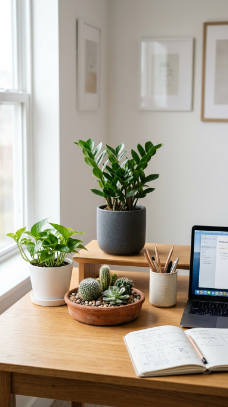
Desk plants are more than decoration — studies show that having living plants in your field of vision while working genuinely reduces stress, improves focus, and boosts creativity. Your home office setup should absolutely include greenery.
The secret is keeping desk plants compact — you don’t want something competing with your screen for attention or toppling over your keyboard. Small Pothos, compact succulents, a single-stem Monstera cutting, or a mini ZZ Plant are all perfect desk-scale choices.
💡 Pro Tip: If your home office has limited natural light, a small grow light disguised as a stylish desk lamp is a total game-changer. It keeps your plants healthy and happy while adding useful task lighting to your workspace — two problems solved at once!
Grouping three small plants at the corner of your desk (rather than one in the center) keeps your working area functional while still creating a genuine green moment. Vary the heights using small wooden risers or stacked books.
Explore our home office plant styling ideas and discover the NASA Clean Air Study results for air-purifying plant science.
A well-planted desk is a more productive desk — invest in a few good desk companions and feel the difference!
7. Hallway Drama with Tall Architectural Plants
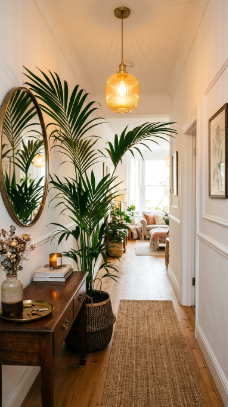
Your hallway is the first impression of your entire home — and most people completely ignore it when it comes to plant styling. A single, well-chosen tall architectural plant in a hallway transforms the arrival experience from ordinary to genuinely memorable.
Kentia Palms (Howea forsteriana) are the ultimate hallway plant — they’re elegantly tall and narrow (perfect for tight spaces), extremely tolerant of low light, and they radiate that boutique hotel lobby energy that makes guests immediately feel they’ve arrived somewhere special.
The secret is using a beautiful tall basket or ceramic planter that echoes the style of your hallway decor. A Kentia in a cheap plastic pot looks nothing like the same plant in a gorgeous woven rattan or dark glazed ceramic planter. The vessel is doing half the work.
If your hallway has a console table, pair a medium-height plant at table level with a tall floor plant alongside it for a layered effect that draws the eye upward and makes even low-ceilinged hallways feel taller.
| Plant | Max Height | Light Tolerance | Hallway Suitability |
| Kentia Palm | 2–3m | Low-medium | ⭐⭐⭐⭐⭐ |
| Cast Iron Plant | 60cm | Very low | ⭐⭐⭐⭐⭐ |
| Chinese Evergreen | 80cm | Low | ⭐⭐⭐⭐ |
| Dracaena marginata | 1.5m | Medium | ⭐⭐⭐⭐ |
Read our hallway plant styling for small spaces for narrow hallway solutions.
Never underestimate the hallway — one great plant there sets the tone for your entire home!
8. Dining Room Centerpiece Plant Styling
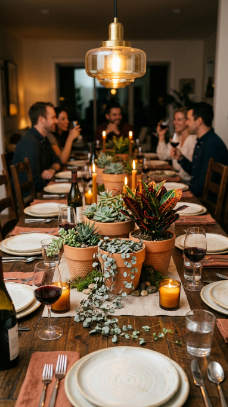
Here’s the deal: a plant centerpiece on the dining table is one of the most impactful and underused indoor styling moves. It adds life, color, and conversation to every meal without the cost and waste of cut flowers.
The secret is keeping your dining table plants low — nobody wants to talk to their dinner guests through a jungle. Clustering several small plants at varying heights below eye level creates a lush, abundant look while keeping the table sociable.
Succulents, small Crotons, and trailing String of Hearts (Ceropegia woodii) are all perfect dining table plants — they’re compact, low-maintenance, and incredibly beautiful up close, which is exactly the perspective your guests will have.
💡 Pro Tip: Use a long, shallow wooden or marble tray to corral your dining table plants together — it makes the arrangement look intentional, prevents water marks on the table, and makes it easy to lift the whole display off when you need the full table for a big meal.
Explore our dining table plant centerpiece ideas for seasonal swap-out inspiration.
A living centerpiece elevates every meal from ordinary to something that feels genuinely special — it’s the easiest dinner party upgrade you’ll ever make!
9. Children’s Room Playful Plant Styling
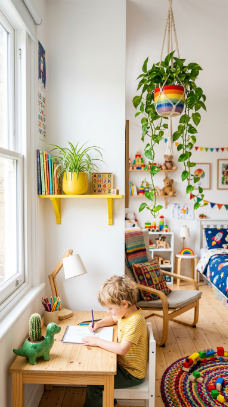
Plants in children’s rooms are a wonderful opportunity to make growing things fun and interactive — and they’re more achievable than most parents think. The key is choosing non-toxic, virtually indestructible plants that can handle the odd overwatering session from enthusiastic small helpers.
Spider Plants (Chlorophytum comosum) are absolute perfection for kids’ rooms — they’re fast-growing, completely non-toxic, produce fun little “baby” plants on runners that children love, and they tolerate irregular watering with cheerful resilience.
Use fun, character-filled pots — animal-shaped planters, painted terracotta, or brightly colored ceramics make plants feel like part of the room’s playful story rather than adult decor that’s been dropped into a kids’ space.
Getting children involved in watering and care builds a lifelong connection with growing things — give them a small watering can and make plant care part of the weekly routine from the earliest age.
- Spider Plant: non-toxic, fun runners, very easy
- Boston Fern: non-toxic, lush, loves humidity
- Areca Palm: non-toxic, tropical, architectural
- Christmas Cactus: non-toxic, flowers twice a year, easy
⚠️ Always double-check toxicity before introducing any plant to a child’s room — the ASPCA’s plant toxicity database at aspca.org is also useful for households with pets.
Check out our safe indoor plants for children’s rooms guide for a fully vetted non-toxic plant list.
Plants in a child’s room spark curiosity, teach responsibility, and bring so much life to the space — it’s one of the loveliest things you can do for their environment!
10. Dark Room & Low-Light Corner Solutions
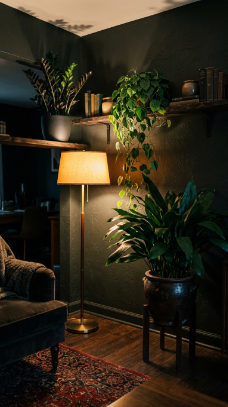
Think your dark corner is a plant-free zone? Absolutely not — some of the most beautiful and dramatic plants actively prefer low-light conditions, and styling a dark room with the right species creates a moody, sophisticated interior that brighter spaces can’t achieve.
Cast Iron Plants (Aspidistra elatior) are legendarily low-light tolerant — they were the go-to Victorian parlor plant precisely because gas-lit rooms offered almost no useful light and Cast Irons survived regardless. They’re indestructible, architectural, and deeply elegant.
💡 Pro Tip: In genuinely dark spaces (no windows, only artificial light), position your plants near the light source rather than against the wall. A plant beside a warm floor lamp gets meaningful light from the bulb itself — it’s not ideal, but it can genuinely sustain the most shade-tolerant species.
ZZ Plants (Zamioculcas zamiifolia) are another dark-room star — those incredibly glossy, almost lacquered-looking leaves actually reflect available light, making them appear even more lush in dim conditions. They’re also drought-tolerant, which suits rooms you might visit less frequently.
Explore our low-light indoor plants complete guide for the full range of shade-tolerant species.
Dark corners aren’t a limitation — they’re an invitation to create a dramatically moody, beautifully styled plant moment that light-filled rooms simply can’t replicate!
11. Kitchen Island Hanging Herb Display
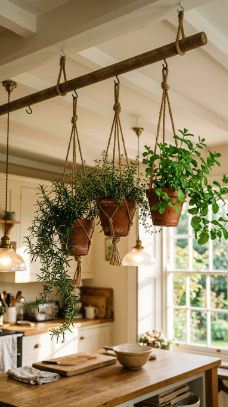
Take your kitchen herb display to the next level with a hanging herb rack above your kitchen island — it’s functional, incredibly beautiful, and frees up precious counter space at the same time. Talk about a game-changer!
The simplest version is a wooden dowel or copper pipe suspended from the ceiling with matching rope or chain, from which you hang terracotta pots at varying heights. The result looks artisan, intentional, and deeply satisfying in a kitchen setting.
Trailing herbs like rosemary, thyme, and creeping mint are perfect for this setup — they naturally cascade over pot edges, adding movement and beauty to the display as they grow. Flat-leaf parsley adds a more upright, contrasting texture.
Use matching pots for a curated look (terracotta or matte white work beautifully), or deliberately mismatched vintage ceramics for a more eclectic, collected-over-time feeling. Either approach works — what matters is the intentionality behind the choice.
Read our DIY hanging herb rack for kitchens for a step-by-step installation guide.
A hanging herb display makes every cooking session more joyful — fresh herbs at arm’s reach, beautiful to look at, and grown by you!
12. Home Library & Reading Nook Plant Styling
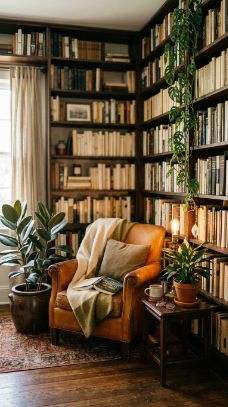
A home library or reading nook and plants are a deeply natural combination — both invite you to slow down, breathe deeply, and be present. The right plants woven through a bookshelf display create a space that feels genuinely alive and endlessly inviting.
The secret is using smaller trailing plants like Monstera adansonii, Scindapsus pictus (Satin Pothos), or Heartleaf Philodendron to weave organically through and around book spines rather than sitting in front of them. The vine threading between books looks spectacular and completely organic.
A large, dramatic Rubber Plant or dark-leaved Fiddle Leaf Fig beside your reading armchair creates a beautiful green companion for reading hours — there’s something deeply satisfying about reading surrounded by living things.
💡 Pro Tip: Train trailing shelf plants using small, discreet plant clips attached to the shelf edges — you can guide the vines wherever you want them to grow, creating a fully customized, living bookshelf installation over time.
Explore our bookshelf plant styling ideas for more ways to weave greenery into your shelving display.
Books and plants belong together — build yourself a reading nook that feels like the most beautiful room in the whole world!
13. Staircase & Vertical Wall Plant Display
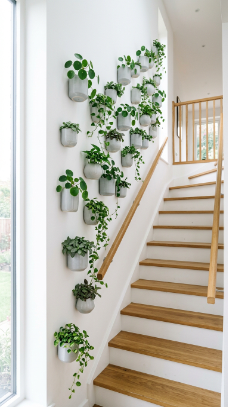
Here’s the deal: your staircase wall is one of the most dramatically underutilized spaces in the home for plant styling. A rising arrangement of wall-mounted planters ascending with the staircase creates a stunning botanical installation that makes every trip upstairs a genuinely delightful experience.
Wall-mounted ceramic planters in matching or complementary styles look most intentional — arrange them at staggered heights that follow the staircase angle, with trailing plants that cascade down between them for a connected, lush effect.
The plants that work best here are small-scale trailers and architectural compact species — Pilea peperomioides (Chinese Money Plant) for its coin-shaped leaves, Fittonia for vivid nerve-leaf color, and small Pothos cuttings for reliable trailing growth.
This approach also works on a plain feature wall in a living room or hallway — the same principle of a rising or organized arrangement of wall-mounted planters turns an empty wall into a living artwork that changes and grows over time.
| Wall Planter Style | Best For | Plant Choices |
| Ceramic wall pockets | Small trailing plants | Pothos, Fittonia, Pilea |
| Hanging test tubes | Propagations & cuttings | Any stem-cutting plant |
| Mounted wooden shelves | Small pots | Succulents, air plants |
| Macramé wall hangers | Medium trailers | Tradescantia, Scindapsus |
Read our vertical plant wall display ideas for home interiors for full installation guides.
Turn your staircase into a botanical journey — it’s one of those styling moves that makes people stop, look up, and audibly react when they see it!
14. Sunroom & Conservatory Jungle Styling
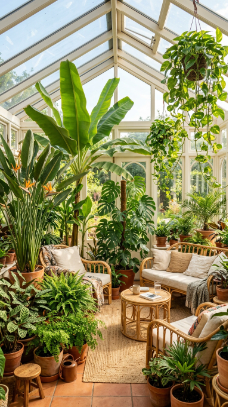
If you’re lucky enough to have a sunroom or conservatory, you have the most extraordinary plant styling opportunity in any home — the chance to create a genuine indoor jungle where tropical plants grow at their absolute best with maximum light, warmth, and humidity.
The key to sunroom jungle styling is layering at every height — tall floor plants like Banana Plants (Musa) and Bird of Paradise at the back, medium floor plants and moss poles in the middle, and low-growing ferns, Calatheas, and ground covers at the front. Every vertical level should be occupied with greenery.
💡 Pro Tip: Install misting systems or humidity trays in your sunroom — the combination of maximum light and consistent humidity creates growing conditions that turn slow-growing tropicals into fast-growing showstoppers. You’ll be genuinely amazed at the difference.
Don’t be afraid of density in a sunroom jungle — this is the one room where maximalist plant styling is not just acceptable but actively desirable. Plants grouped closely together create their own beneficial microclimate of raised humidity and temperature stability.
Explore our sunroom indoor jungle styling guide for the complete layering approach. Kew Gardens has incredible tropical plant growing resources at kew.org.
A sunroom jungle is the ultimate destination in indoor plant styling — if you have the space, go completely wild with it and never look back!
15. Minimalist Single-Specimen Styling
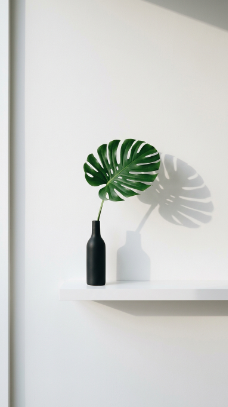
Here’s the thing: sometimes the most powerful plant styling statement is a single, perfect specimen in an extraordinary pot against a bare wall. Minimalist plant styling is a genuine art form — and it’s far harder to do well than filling a room with plants.
The secret is choosing a plant with inherently sculptural qualities — a single large Monstera leaf in a tall vase, a perfectly shaped mature Fiddle Leaf Fig in a beautiful ceramic, or a solitary Agave in a rough concrete pot all work because the plant itself is the art.
Background matters enormously in minimalist plant styling — your specimen needs a clean, uncluttered backdrop that lets it breathe and be seen. A bare white or deep charcoal wall, a clear window behind (for the silhouette effect), or a textured plaster surface all create the perfect stage.
This approach works brilliantly in modern, Japandi, or Scandi-styled interiors where restraint and intention are the governing principles. One extraordinary plant in one extraordinary pot says more than twenty average plants arranged without thought.
Read our minimalist plant styling for modern interiors guide for the single-specimen approach.
Less is genuinely more when you choose the right single plant — trust the power of one perfectly placed specimen!
16. Propagation Station Display
.
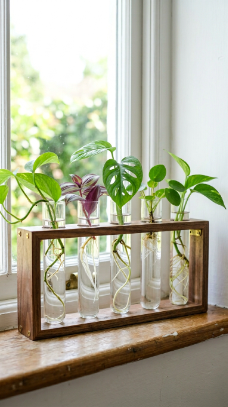
A propagation station isn’t just a growing technique — it’s one of the most beautiful and unique plant displays you can create in your home. A row of clear glass vessels holding plant cuttings in water, with visible white roots threading down through the glass, is genuinely captivating to look at.
The secret is using matching or complementary glass vessels — test tubes in a wooden rack, matching bud vases, apothecary bottles, or repurposed vintage glassware all create a beautiful, cohesive display. Mix heights, diameters, and shapes for visual interest.
💡 Pro Tip: Position your propagation station on a bright windowsill — the cuttings need light to root successfully AND the backlit glass-and-water effect in sunlight is one of the most beautiful things in any plant-filled home. Form and function in perfect harmony.
Change the water weekly to prevent algae build-up and keep the glass looking pristine. A few drops of activated charcoal in the water keeps it clear and prevents bacterial growth around the roots.
Explore our complete propagation station setup guide for vessel ideas and which plants root best in water.
A propagation station turns the science of plant growing into art — it’s the display that plant-obsessed visitors will stand and stare at every single time!
17. Balcony & Outdoor-Indoor Blurred Boundary
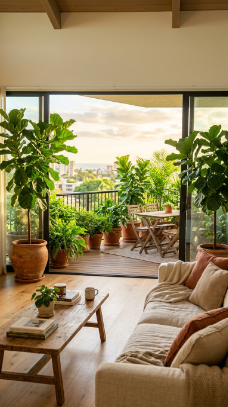
One of the most sophisticated indoor plant styling moves is using plants to deliberately blur the boundary between your interior and your outdoor balcony or garden — creating a visual flow of greenery that makes both spaces feel larger, more connected, and more immersive.
The technique is simple: place large indoor plants framing your balcony door or window on the inside, and echo their color, size, or pot style with outdoor container plants immediately outside. Your eye travels from inside green to outside green without interruption.
Large indoor floor plants like Fiddle Leaf Figs, Olive trees (which can move inside in winter), or Bamboo in tall pots work brilliantly as the inside anchor of this scheme. Match them with similarly scaled outdoor plants in coordinating pots on the balcony side.
This approach is particularly magical in small apartments — the visual extension of greenery from a compact interior out to a balcony makes the whole living space feel dramatically larger than it actually is. Pretty cool, right?
Read our indoor-outdoor plant styling for apartments for the full technique.
Blur those boundaries and watch your home feel twice the size — plants are the best visual architecture available!
18. Maximalist Plant Corner: The Indoor Jungle Vignette
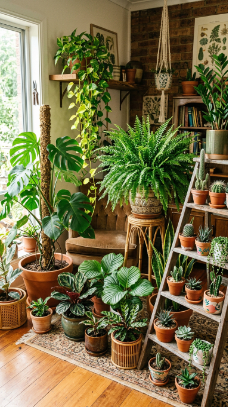
If minimalism isn’t your thing, a maximalist indoor jungle corner is the opposite extreme — and it’s completely spectacular when done with intention. The goal is abundance, layers, and the feeling of stepping into a living botanical world.
The secret to a great jungle corner is varying every dimension — vary heights (floor, shelf, hanging, ceiling), vary leaf sizes (giant Monstera next to tiny Fittonia), vary textures (smooth succulents next to feathery ferns), and vary pot materials (terracotta, rattan, ceramic, concrete) for a beautifully collected, never-decorator-chosen feeling.
💡 Pro Tip: Anchor your jungle corner with one statement tall plant (at least 120cm+) and build everything else around it. Without a visual anchor, a dense collection becomes chaotic. With one, it becomes a curated jungle. That one anchor plant is doing more work than you realize.
Moss poles for climbing Monsteras and Philodendrons add vertical height while keeping footprint small — they’re the jungle corner’s secret weapon for going big without taking over the whole room.
Explore our how to create an indoor jungle corner for the layering framework that makes dense collections look designed rather than accidental.
Go big, go bold, go green — your indoor jungle corner is the room feature that will define your entire home’s personality!
19. Seasonal Plant Styling Swap — Keeping It Fresh Year-Round
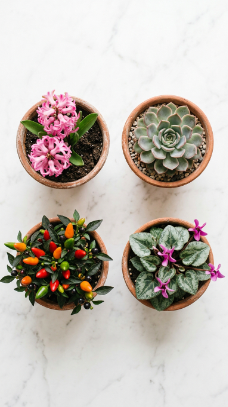
Here’s the deal: the truly skilled indoor plant styler doesn’t just set it and forget it — they swap and refresh their plant displays seasonally to keep their home feeling alive, current, and responsive to the time of year. This is what separates great plant styling from simply owning houseplants.
The concept is simple: maintain a core of permanent structural plants (your statement floor plant, your shelf trailers, your bathroom ferns) that stay year-round, and swap a few seasonal accent plants in key spots four times a year. The accent spots are your dining table, windowsills, coffee table, and entrance.
Spring brings Hyacinth bulbs, Narcissus, and early flowering Primulas. Summer transitions to bold Caladiums, tropical Anthuriums, and colorful Crotons. Autumn introduces ornamental Peppers, Cyclamen, and copper-toned Carex grasses. Winter brings all the festive plant displays, Hellebores, and fragrant paperwhite Narcissus.
This approach means your home never looks stale and you’re always working with plants that are at their absolute seasonal best rather than struggling against the wrong season.
| Season | Accent Plants | Mood |
| Spring | Hyacinth, Narcissus, Primula | Fresh, hopeful, fragrant |
| Summer | Caladium, Anthurium, Croton | Bold, tropical, vibrant |
| Autumn | Ornamental Pepper, Cyclamen | Warm, cozy, harvest |
| Winter | Paperwhite Narcissus, Hellebore | Festive, fragrant, elegant |
Read our seasonal indoor plant styling calendar for a complete year-round swapping guide.
Treat your home like a living, breathing, ever-changing gallery — and your plant styling will always feel fresh, exciting, and completely yours!
Frequently Asked Questions
How do I match plants to the light conditions in each room?
Start by observing where natural light falls in each room throughout the day. South-facing rooms get the most direct sun and suit sun-loving plants like succulents, cacti, and herbs. East and west-facing rooms offer bright indirect light — perfect for Monsteras, Pothos, and most tropical foliage plants. North-facing rooms get the least light and need the most shade-tolerant species like ZZ Plants, Cast Iron Plants, and Peace Lilies. Always check a plant’s light requirements before buying and match to your room honestly rather than optimistically.
What’s the best way to style plants in a small apartment?
Focus on vertical space rather than floor space — wall-mounted planters, hanging plants from ceiling hooks, and tall plant stands all add greenery without claiming precious square footage. Choose trailing plants on high shelves for maximum visual impact with minimal footprint. A single large statement plant in a beautiful pot always looks more intentional and sophisticated than many small plants scattered around, so resist the urge to fill every surface and choose a few key pieces that genuinely elevate the space.
How often should I repot my indoor plants to keep them looking their best?
Most indoor plants benefit from repotting every 1–2 years, typically in spring when growth is accelerating. Signs a plant needs repotting include roots escaping from drainage holes, the plant drying out unusually quickly after watering, or the plant appearing to sit very high in the pot with visible root mass above the compost line. When repotting for styling purposes, go up only one pot size at a time — too large a pot can cause root rot by holding excessive moisture in the unused compost.
Are there any indoor plants that are safe for both pets and children?
Yes — several beautiful and easy-care plants are non-toxic to both cats, dogs, and children. Spider Plants, Boston Ferns, Areca Palms, Calatheas, Christmas Cacti, and Bamboo Palms are all considered pet and child-safe. Always verify on the ASPCA’s official plant toxicity database before introducing any new plant to a home with pets or young children, as toxicity information can vary by species and individual animal sensitivity. When in doubt, keep all plants out of reach regardless of toxicity status.
How do I create a cohesive plant styling look without spending a fortune?
The most affordable approach is to start with a few fast-growing, easy-to-propagate plants like Pothos, Tradescantia, and Spider Plants — buy one, propagate many, and fill your home over a season from a single purchase. Invest your budget in beautiful pots rather than expensive plants, since the vessel often contributes more to the visual impact than the plant itself. Thrift stores and online marketplaces are goldmines for interesting ceramics and unusual containers at a fraction of garden center prices. Consistency in pot material or color palette ties everything together even when the plants themselves are varied.
A Few Final Thoughts
Indoor plant styling is one of the most personal, rewarding, and endlessly evolving creative pursuits you can invest in for your home — and as you’ve just discovered, there are infinite ways to bring living greenery into every single room beautifully. The secret, as always, is matching the right plant to the right place and giving it a pot and position that let it genuinely shine. Whether you’re building a maximalist jungle corner, a serene minimalist bedroom display, or a functional kitchen herb window, the principles are the same: observe your space, respect the light, and style with intention. Your home deserves to feel alive, layered, and completely, unmistakably yours. Now go make it happen! 🌿