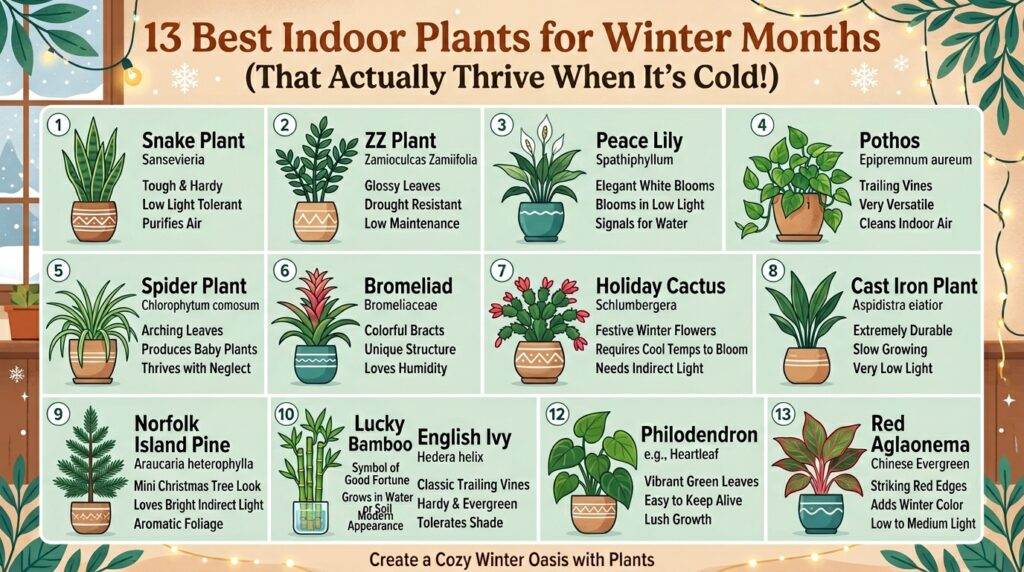
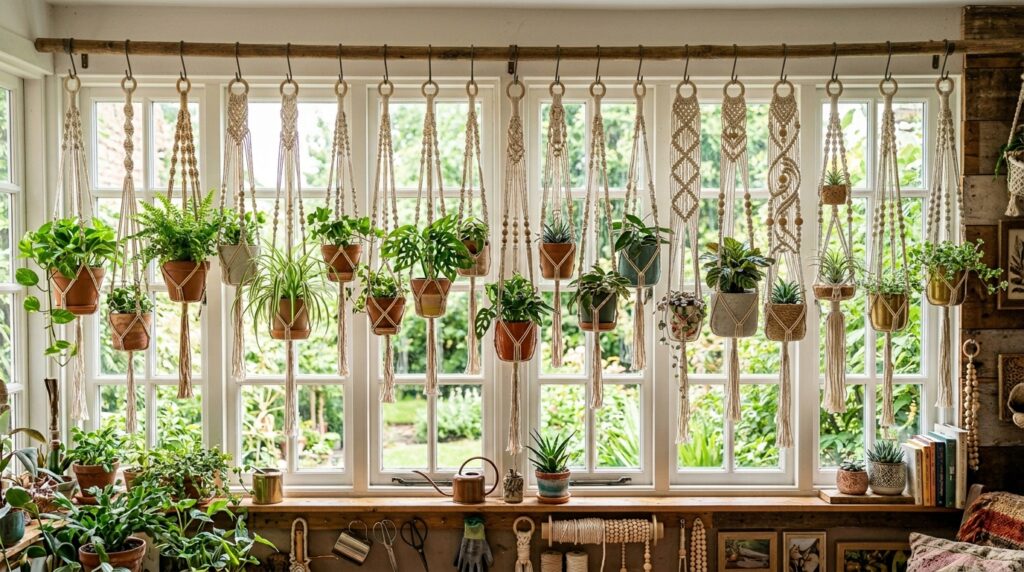
There’s something quietly transformative about a plant suspended in a window — the light catching through the leaves, the rope casting soft shadows on the wall, the whole thing moving very gently when someone opens a door. If you’ve ever wanted to fill your windows with that kind of living, textural beauty without spending a fortune on ready-made pieces, you’re in exactly the right place. These 20 DIY macrame plant hangers for windows cover every skill level, aesthetic, and plant type you could want — from your first simple single-hanger to ambitious multi-tiered displays. Ready? Let’s explore all 20 of them.
Why DIY Macrame Plant Hangers for Windows Are Worth Your Time
A window hanger solves one of the most common indoor plant challenges: where do you put plants when every surface, shelf, and windowsill ledge is already full? Suspending plants in front of a window uses vertical space that almost everyone ignores completely — and it places your plants precisely where they’ll receive the maximum light available in a room, which directly improves their health and growth.
The cost argument is equally compelling. A single purchased macramé plant hanger retails for £15–£40 in most home décor shops. The materials to make one — a skein of cotton rope and a small metal ring — cost £3–£5. Make ten hangers and the saving is substantial; more importantly, you control the length, the knot pattern, the colour, and the pot size to fit your specific window exactly.
A lesser-known fact that surprises many beginners: the weight capacity of a correctly knotted macramé hanger made from 5mm cotton rope is typically 5–8kg — more than sufficient for any houseplant pot you’d realistically hang. The limiting factor is almost always the ceiling hook or curtain rail, not the rope itself.
This craft is genuinely ideal for apartment dwellers, renters who can’t install shelving, and anyone who wants to add warmth and personality to a window without any power tools or permanent changes.
At a Glance
- A basic square-knot macramé hanger can be completed in under 45 minutes with zero prior craft experience, using nothing more than rope and a wooden ring.
- Trailing Tradescantia zebrina changes colour — becoming more intensely purple and silver — when hung in a bright south or west-facing window, making the hanger and plant a single living artwork.
- Hanging three macramé planters at staggered heights in a single window creates a layered green display that reads as far more complex and designed than its actual making time suggests.
- The knot pattern you choose directly affects drainage: open spiral knots allow a pot to be lifted out for watering far more easily than tight square-knot nets, which grip the pot and make removal fiddly.
- Cotton rope macramé hangers degrade in outdoor UV conditions within one season but last for years indoors — making them ideal exclusively for window and interior plant display.
1. The Classic Single-Strand Spiral Hanger
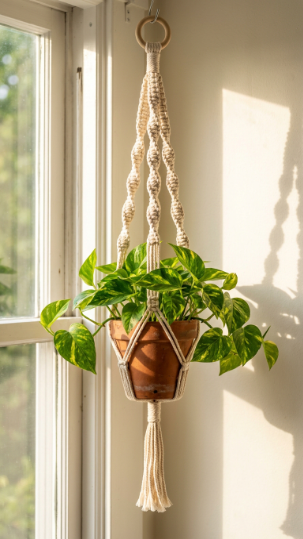
The spiral hanger is the entry point for every macramé beginner — a single repeating half-hitch knot creates a twisting, elegant pattern with almost no technique required.
You need 8 lengths of 5mm natural single-strand cotton rope, each 3m long, folded in half and attached to a 4cm wooden or metal ring with lark’s head knots. This gives you 16 working strands. Work a series of spiral half-hitch knots for 25–30cm down the hanger, then divide strands into four groups of four and work a square-knot gathering net to hold the pot, finishing with a wrapped gathering knot and tassel at the base.
The total rope required for a hanger supporting a 12–15cm pot is approximately 24m — beginner guides that suggest less will produce a hanger that’s too short to hang attractively in a standard ceiling-to-sill space. Aim for a finished length of 60–80cm from ring to tassel for most window applications.
The expert insight: use a comb to brush out the tassel fibres for a full, professional finish. Unbrushed tassels look unfinished; a brushed tassel triples in apparent volume and elevates the entire piece instantly.
💡 Pro Tip: Tape the ends of your rope lengths with masking tape before starting — this prevents the cotton from fraying as you work and makes threading through knots significantly less frustrating for beginners.
Learn more about beginner macramé plant hanger patterns for window display and find pothos care and light requirements from The Sill.
Your first spiral hanger is proof that beautiful handmade things are closer than you think.
2. DIY Macrame Plant Hanger for Windows with Air Plants
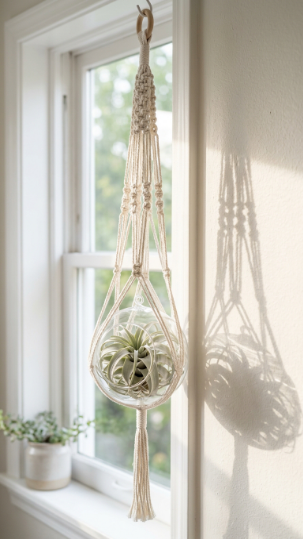
Air plants in glass globes create the most minimal and architectural of all window macramé displays — no soil, no pot drainage, no mess, and a striking geometric contrast between the glass and the knotted cotton.
Use a fine 3mm cotton cord rather than the thicker 5mm rope for this project — the delicacy of the cord matches the lightness of the glass globe and air plant perfectly. Make a simple gathered-strand hanger: fold six lengths of 2m cord in half through a brass ring, work 15cm of alternating square knots, then gather and tie around the neck of the glass globe using a wrap knot, allowing the globe to sit securely in the knot cup.
Tillandsia xerographica (silver-curled rosette, 10–15cm diameter) and T. caput-medusae (smaller, with curling tentacle-like leaves) are both ideal globe candidates. They require no water inside the globe — remove for a 20-minute soak in room-temperature water once a week, shake to remove excess water, then allow to dry completely before returning to the globe.
Position in a bright south or east-facing window with 4–6 hours of bright indirect light — direct glass-concentrated sun can overheat air plants and cause tip burn within days.
Discover air plant display ideas in macramé and glass globe hangers and read Tillandsia care guidance from Missouri Botanical Garden.
A white cord and glass globe hanger in a bright window is the kind of detail that makes a room feel genuinely curated.
3. Boho Feather-and-Fringe Window Hanger
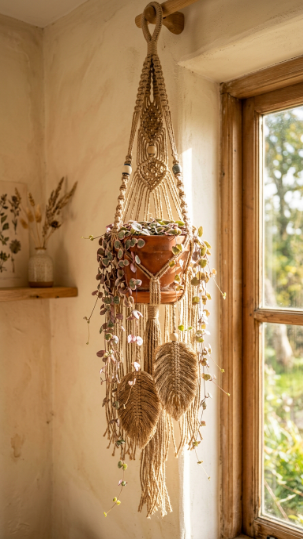
A boho-style hanger with fringe and woven feather elements turns a functional plant hanger into a textile wall installation — the plant becomes one component of a larger decorative composition.
For this project, use 4mm natural jute rope. The feather shapes are worked using a specific technique: cut 20 short lengths of rope (15cm each), fold and attach densely onto a single base cord using reverse lark’s head knots, then trim the ends in a leaf or feather shape with scissors — sharp fabric scissors give a far cleaner edge than craft scissors. Position the feather elements midway down the hanger, flanking the pot-holding section.
The long fringe at the base is created by leaving multiple strands unworked below the gathering knot, brushing them out fully, and trimming to a graduated V-shape. Ceropegia woodii (string of hearts) is the ideal plant for this style: its fine, heart-shaped leaves on thread-like pink stems echo the delicate fringe without competing visually.
String of hearts requires a bright window with 3–5 hours of direct sun and allows the soil to dry completely between waterings — every 10–14 days in a 10cm pot is usually appropriate.
💡 Pro Tip: Lightly steam the finished jute fringe with a garment steamer held 15cm away — this straightens the natural kinks that jute develops during storage and gives the fringe a clean, deliberate appearance rather than a tangled one.
Read about string of hearts care and boho macramé window hanger styling and find Ceropegia care guidance from Missouri Botanical Garden.
A boho fringe hanger transforms a simple plant into a textile art piece — and takes no more time than a plain design.
4. Geometric Diamond-Pattern Window Macramé
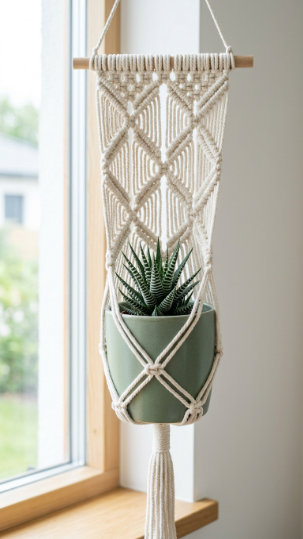
The diamond pattern — formed by alternating square knots at offset positions — is the first intermediate macramé technique that genuinely looks complex but requires only one knot type.
Use 5mm cotton rope, 16 working strands. After the initial gathering section, work a row of four square knots (one per group of four strands). Drop down 4cm and work three square knots, offset by two strands each side — this creates the first row of the diamond. Continue: two offset square knots, then one central square knot closes the diamond. Repeat the diamond pattern two to three times down the length of the hanger for visual rhythm.
The spacing between knot rows determines how open or closed the diamond appears — 3cm spacing creates a tight, dense diamond; 5–6cm creates a more open, airy pattern. For window display, the open version allows light to pass through the pattern and cast decorative shadows on the wall behind, which is a significant part of the aesthetic appeal.
Haworthia fasciata (zebra plant, 8–12cm) is excellent for this style: its compact size fits neatly into the diamond holding net without overwhelming the pattern.
Best plants for geometric diamond hangers:
- Haworthia fasciata — compact, drought-tolerant
- Aloe vera (small) — architectural, low maintenance
- Gasteria — wide leaves, tolerates low light
- Echeveria elegans — rosette shape shows beautifully
Learn how to work the alternating square knot diamond pattern for window hangers and read haworthia care from The Sill.
Once you’ve mastered the diamond pattern, every other decorative macramé technique becomes significantly easier to understand.
5. DIY Macrame Plant Hanger for Windows Using Dyed Rope
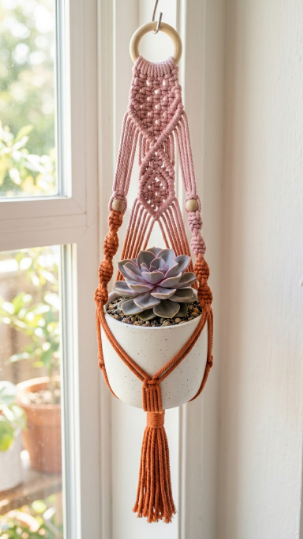
Dip-dyeing cotton rope before knotting adds an ombre colour dimension to a DIY macrame plant hanger for windows that store-bought pieces rarely achieve — and it uses simple Dylon fabric dye from any craft shop.
Dissolve Dylon fabric dye in a tall bucket of hot water. Hold the rope skeins at the top and lower the bottom portion into the dye bath for 15–20 minutes for a deep solid colour at the base. For an ombre effect, gradually pull the rope upward during the last 5 minutes of the dye time, so less rope remains submerged — this creates a natural gradation from deep to pale. Rinse thoroughly, squeeze out excess water, and allow to dry completely before knotting.
The best colour combinations for window display: terracotta to pale blush (warm south-facing windows), indigo to pale blue (cooler north-east windows where the blue light enhances the tone), and sage green to natural cream (for a botanical, nature-inspired aesthetic). Pair the hanger colour with a contrasting pot — the visual relationship between rope, pot, and plant is the complete composition.
💡 Pro Tip: Dye several skeins in the same bath simultaneously for a consistent colour match — re-dyeing a second skein separately rarely produces an identical result, and mismatched colour across a multi-hanger display looks unintentional rather than artful.
Find ombre dyed macramé hanger tutorials and succulent window display ideas and read echeveria and succulent care guidance at BHG.
Dip-dyed rope transforms a functional hanger into a colour-blocked piece of textile art.
6. Minimalist Single-Knot Window Hanger for Trailing Ferns
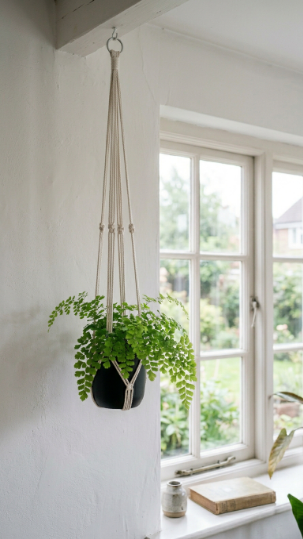
A single-wrap minimal hanger — just four strands and one knot — is the fastest DIY macrame plant hanger for windows and the most effective design for showing off the plant itself rather than the knotwork.
Cut four lengths of 6mm braided cotton rope at 2.5m each. Fold in half through a 5cm metal ring. Bring all eight strand ends together 40cm below the ring and secure with a single tightly wound wrap knot (wrap one working strand around the remaining strands 15–20 times, then thread the end back up through the coil). Allow the strands to splay naturally below the wrap knot to form an open cup that cradles the pot base.
This minimal style is particularly well-suited to small windows, where an elaborate knot pattern would overwhelm the space. The design also works beautifully in multiples: three identical minimal hangers at slightly different heights in a single window frame create a clean, contemporary hanging garden with strong visual repetition.
Adiantum raddianum (maidenhair fern) thrives in the higher humidity near a window and tolerates the lower light of north or east-facing windows — the only genuinely common fern suitable for indoor window display without supplemental light.
Learn about minimal macramé hanger designs and maidenhair fern window care and find fern care and light requirements from Missouri Botanical Garden.
Sometimes the most striking thing you can do is get out of the plant’s way entirely.
7. Triple-Tier Window Hanger Display
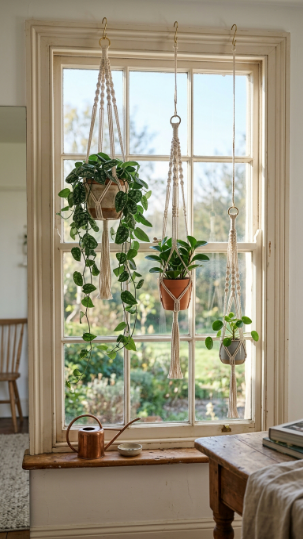
A tiered triple display in one window multiplies visual impact without multiplying materials — three simple hangers at 30cm intervals of height create the effect of a living green curtain.
The key to a successful tiered window display is variation in three dimensions: height (stagger each hanger by 25–35cm), pot size (use a larger pot at the top and smaller ones descending), and plant texture (combine a trailing plant, a rosette or bushy form, and a compact upright to create visual rhythm). All three hangers can be identical in knot pattern — the plant variety carries the visual interest.
Hang all three from a single tension curtain rod installed inside the window recess (no drilling required), using separate S-hooks to adjust each hanger’s height independently. A tension rod rated to 5kg minimum is essential — the combined weight of three planted pots in wet compost is typically 2–4kg.
Scindapsus pictus ‘Argyraeus’ (satin pothos, silvery spotted leaves) for the top position maximises the trailing cascade. Peperomia caperata (ripple peperomia) for the middle adds dense texture. Pilea peperomioides (Chinese money plant) at the base provides a sculptural upright form.
💡 Pro Tip: Photograph your window display monthly — what feels static day-to-day shows remarkable growth in a comparison shot, and it helps you notice when a plant has outgrown its hanger or pot before it becomes a problem.
Read about tiered macramé window plant displays and multi-hanger arrangements and find Scindapsus and peperomia care at The Sill.
Three simple hangers in one window is all it takes to make that window the focal point of the entire room.
8. Macramé Hanger with Integrated Shelf for Small Pots
🖼️ IMAGE PROMPT: A realistic close-up photograph of a macramé hanger with a 20cm round wooden disc integrated as a shelf halfway down, holding two small 8cm clay pots — one with Crassula ovata jade plant and one with a small cactus — with a trailing Chlorophytum comosum in the lower hanging section. Lighting: soft bright diffused natural light. Color palette: natural rope, pale wood disc, jade green, pale green spider plant. Mood: practical, creative, botanical. Photography style: eye-level close-up. Background: white wall. Style tags: photorealistic, 8K, botanical photography,
quality, no people.
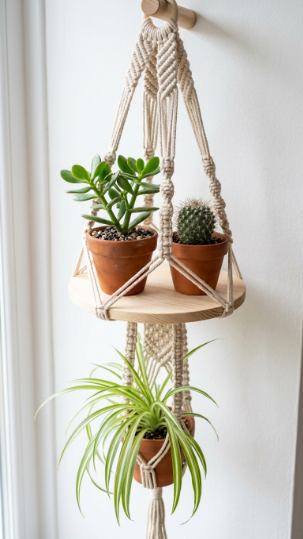
A macramé hanger with a built-in wooden disc shelf houses multiple small plants in a single hanging piece — a surprisingly space-efficient design that suits crowded south-facing windows beautifully.
Source a wooden craft ring or slice 20cm in diameter (available at craft stores or online). Drill six evenly spaced 5mm holes around the circumference. Thread the macramé working strands through alternate holes as you work — this integrates the disc structurally into the hanger rather than simply tying it on, which is far more stable for the weight of multiple pots.
Work a standard square-knot hanger above the disc for the hanging section, and add a secondary hanging net below the disc for a larger pot. The disc surface can hold two or three 8–10cm pots side by side — place a small silicone mat or cork sheet on the disc surface to protect against water marks and prevent pot bases from slipping.
This design works best with plants at different growth stages: an established trailing plant below the disc, and propagation-stage small plants on the disc surface itself, so the whole piece tells the story of the collection growing together.
Explore macramé hanger with wooden shelf designs for window plant displays and find spider plant and jade plant care guidance at BHG.
A hanger with a built-in shelf is the most three-dimensional DIY macramé plant hanger for windows you can make.
9. Recycled T-Shirt Yarn Window Hanger
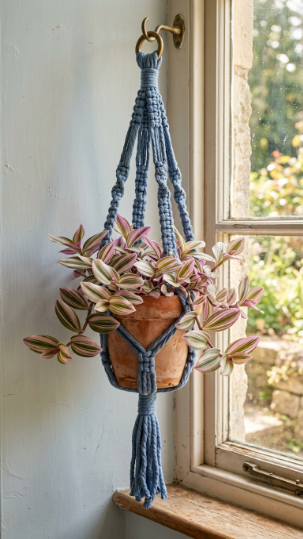
T-shirt yarn macramé hangers are the most tactile and sustainably made of all DIY macrame plant hangers for windows — the thick, stretchy yarn creates a completely different aesthetic from cotton rope and uses otherwise discarded fabric.
Cut old T-shirts into 2.5–3cm wide continuous strips — cut in a spiral around the body of the shirt rather than across it to produce one long length per shirt. The stretch of jersey fabric means you work with only four to six strands rather than the sixteen used for cotton rope, as each strand is much thicker. Use 5–6m per strand for a finished hanger of 60–70cm.
The limited number of working strands makes T-shirt yarn ideal for large gathering knots and simple designs — the chunky scale reads beautifully even from a distance, which suits a window position where the hanger is often viewed across the full width of a room. The slight natural stretch in the yarn also means the pot sits more securely than in rigid rope hangers.
Tradescantia fluminensis ‘Nanouk’ (pink and green striped leaves) is a perfect colour pairing with blue-toned T-shirt yarn. It requires bright indirect light, weekly watering in a 12–14cm pot, and benefits from the higher ambient humidity typical near a window.
Best plants for chunky T-shirt yarn hangers:
- Tradescantia ‘Nanouk’ — striking colour, fast growing
- Epipremnum aureum — tolerant of varied light
- Chlorophytum comosum — lightweight, fast trailing
- Plectranthus (Swedish ivy) — bushy, aromatic leaves
Read about T-shirt yarn macramé hangers and sustainable window plant display and find tradescantia care guidance from Gardeners’ World.
A T-shirt yarn hanger gives old fabric a second life as something genuinely beautiful — sustainability and decoration in a single knot.
10. DIY Macrame Plant Hanger for Windows with Beads
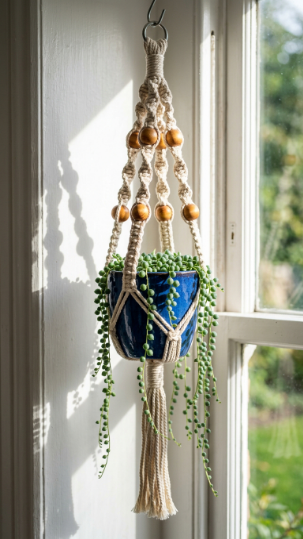
Wooden beads threaded onto the working strands before knotting add a dimensional, handcrafted quality to window hangers that immediately signals a skilled and considered maker.
Choose beads with a hole diameter of at least 6mm to thread onto 5mm rope — a tighter hole means forcing and fraying. Natural wooden beads (unvarnished, 15–20mm diameter) are the most versatile; they complement every pot and plant colour without competing. Thread one to three beads onto each strand group before working the next section of knots — the beads sit between knot sections naturally, held in place by the knots above and below.
Work beads into the spiral or square-knot section at regular intervals (every 10cm is a reliable rhythm), or cluster beads together at the pot-holding section for a jewellery-like accent. For a more modern approach, use ceramic beads in a single contrasting colour that echoes the pot colour.
Senecio rowleyanus (string of pearls) creates a memorable visual pun alongside round wooden beads — the spherical bead shapes echo the perfectly round succulent leaves cascading below the pot. Grow in bright direct sun for 3–4 hours daily; allow the compost to dry completely between waterings.
💡 Pro Tip: Apply a small dab of clear-drying wood glue to each bead’s knot contact point — this prevents beads from shifting position over time as the cotton rope relaxes slightly under the weight of the plant.
Explore bead macramé plant hanger tutorials and trailing succulent window display ideas and find string of pearls care from The Sill.
Beaded hangers prove that the details in a handmade piece create a quality no manufactured version can replicate.
11. Linen Cord Hanger for a South-Facing Herb Window
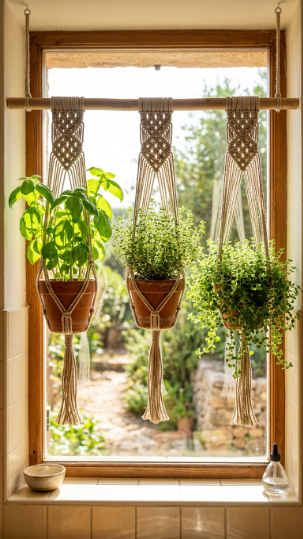
holding a terracotta pot planted with a different culinary herb — basil, thyme, and trailing thyme — with herb leaves backlit by strong midday sun. Lighting: strong bright midday sun backlighting the herb leaves. Color palette: natural linen, terracotta, vivid herb green. Mood: functional kitchen garden, warm and Mediterranean. Photography style: eye-level lifestyle. Background: warm cream kitchen tiles. Style tags: photorealistic, 8K, botanical photography, magazine quality, no people.
Linen cord hangers in a sunny kitchen window create a functional herb display that is simultaneously the most beautiful and the most useful arrangement a kitchen window can hold.
Natural linen cord (4mm, unbleached) has a warmer, more organic texture than cotton rope and a slight natural stiffness that helps simple hangers maintain their shape better in the higher humidity of a kitchen environment. Use the same basic spiral or square-knot construction as cotton rope — linen works identically but produces a slightly more rustic, less polished finish that suits a kitchen aesthetic perfectly.
A south-facing kitchen window with 5–6 hours of direct sun is ideal for basil (Ocimum basilicum), thyme (Thymus vulgaris), and trailing thyme (Thymus serpyllum) — all require full sun to produce the essential oils responsible for their flavour. Hang each herb in a 10–12cm terracotta pot with drainage, watering every 2–3 days in summer.
The practical advantage of window-hung kitchen herbs: they’re at eye level and arm’s reach while cooking, which means you actually use them rather than forgetting they exist on a lower shelf.
💡 Pro Tip: Never hang herbs directly in front of a window that opens inward — the daily opening and closing will knock pots repeatedly and damage both plant and hanger. Install a ceiling hook 15–20cm back from the window frame instead.
Discover linen cord macramé hangers for kitchen herb window displays and find windowsill herb growing guidance at The Old Farmer’s Almanac.
A kitchen herb hanger is the rare project that makes your home more beautiful and your cooking more delicious simultaneously.
12. Upcycled Denim Window Plant Hanger
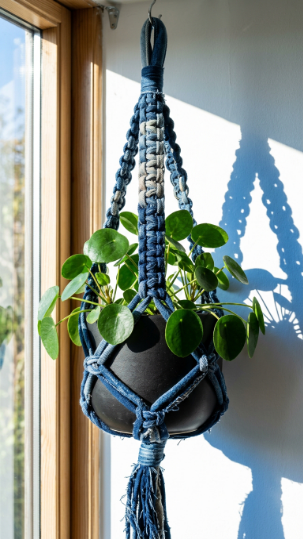
Upcycled denim macramé hangers are among the most graphic and contemporary-looking of all window plant hanger designs — and they consume fabric that would otherwise be sent to landfill.
Cut old denim jeans into continuous strips following the leg seam as a guide — 2cm wide strips produce a sturdy, flat strand that knots well. Unlike jersey T-shirt yarn, denim doesn’t stretch; this means it holds knot shapes crisp and architectural. Four double strands (eight total) folded through a black metal ring is the ideal starting point for a 14–16cm pot.
Work a series of tight alternating square knots — denim’s rigidity means knots stay exactly where you place them, allowing for very precise geometric patterns. The natural variation in denim colour across faded and dark sections creates tonal interest without any dyeing. Mix light and dark denim strips deliberately to control the pattern.
Pilea peperomioides (Chinese money plant) pairs beautifully with denim’s colour palette: its round, deep green leaves on slender stems create a graphic botanical contrast against the textile’s linear weave texture. It requires bright indirect light and watering every 7–10 days once the top 3cm of compost has dried.
Learn about upcycled fabric macramé hangers and contemporary window plant displays and find Pilea care from Gardeners’ World.
A denim hanger is proof that the most interesting materials for making things are often already in your wardrobe.
13. Copper Ring and Cotton Rope Geometric Window Hanger
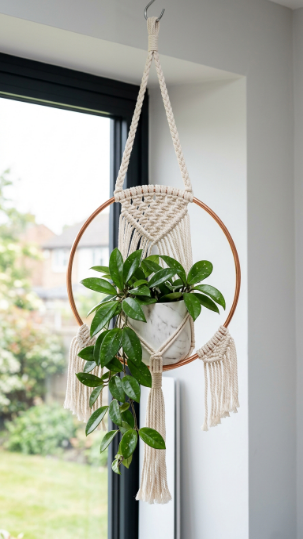
A copper ring integrated into a cotton rope macramé hanger adds a warm metallic accent that elevates the piece from handcraft to considered interior design object.
Source a 20cm copper ring from a craft supplier or plumbing supply shop (copper tube bent into a circle and soldered is a cost-effective alternative). To integrate the ring, work the hanger normally until mid-point, then pass all strands through the ring from the back and work the knot pattern around and through the ring itself — this traps the ring structurally rather than just hanging it decoratively.
Knotting across a ring requires a lark’s head mounting knot at the ring’s inner surface for each strand pair — work methodically around the circumference, spacing knots evenly. The finished piece shows the copper ring as a decorative window within the hanger, creating a circle of negative space that frames the view through the window behind.
Hoya carnosa (wax plant) is an excellent pairing for this design: its waxy, deep green leaves and clusters of porcelain-pale star flowers create a complementary contrast to the warm copper. It requires bright indirect light and minimal watering — every 14 days in summer, monthly in winter.
💡 Pro Tip: Apply a thin layer of clear lacquer spray to the copper ring before assembling the hanger — this prevents the natural oxidation that otherwise turns copper green within 2–3 months indoors where cooking steam or humidity is present.
Find copper ring macramé plant hanger tutorials and hoya window care guides and explore hoya growing guidance from Gardeners’ World.
A copper ring hanger is the kind of piece that makes guests ask where you bought it — and where you get to say you made it.
14. Long Cascading Hanger for High-Ceiling Windows
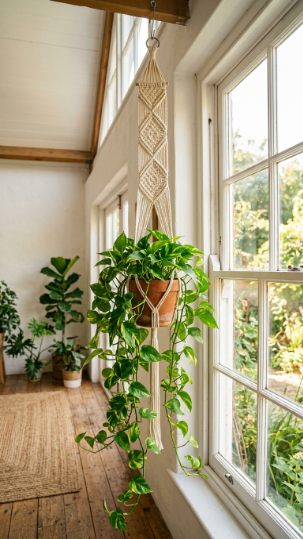
A long cascading hanger — 100–130cm from ring to tassel — is designed specifically for the tall sash and floor-to-ceiling windows where standard hanger lengths look oddly short and fail to fill the vertical space.
For a long hanger, scale all measurements proportionally from the standard pattern: use 4m rope lengths rather than 3m, and repeat the central decorative section (diamond or spiral) three times rather than once. A single repeat section typically adds 15–20cm of length; three repeats with spacing sections produces the 60–80cm central length a tall window requires. Use a heavier 6mm rope for long hangers — thinner rope at this scale becomes unpleasantly floppy.
Place a large pot — 16–18cm — at the base to provide visual weight proportional to the hanger’s length. Choose a trailing plant with long cascading stems: Epipremnum aureum vines reaching 40–50cm below the pot base create a genuinely dramatic effect, with the hanging pot becoming the mid-point of a living vertical composition rather than the terminal end.
The pro insight: measure your specific window height before cutting rope for a long hanger. The most common mistake is cutting based on a standard pattern without accounting for the actual ceiling hook position.
Learn about long macramé plant hangers for tall windows and high-ceiling spaces and find pothos long-form growing guidance from Penn State Extension.
A long cascading hanger finally gives a tall window the scale and presence it deserves.
15. Pastel Colour-Block Hanger for a Nursery Window
🖼️ IMAGE PROMPT: A realistic lifestyle photograph of a soft macramé hanger in blocked pastel tones — pale yellow upper section, mint green mid-section, blush pink lower section — holding a small white ceramic pot with a Chlorophytum comosum ‘Variegatum’ spider plant, in a soft bright nursery window. Lighting: soft bright diffused morning light. Color palette: pale yellow, mint green, blush pink, white ceramic. Mood: gentle, sweet,
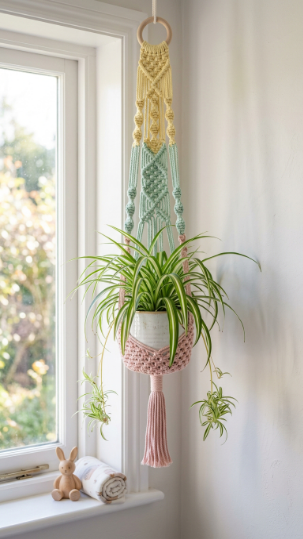
. Photography style: eye-level lifestyle. Background: soft pale wall with gentle shadow. Style tags: photorealistic, 8K, botanical photography, magazine quality, no people.
A colour-blocked pastel hanger made with three separate dyed sections of rope is the perfect DIY macrame plant hanger for windows in children’s rooms — cheerful, non-toxic when made with natural cotton and plant-based dyes, and displaying one of the safest houseplants available.
Create the colour blocks by making the hanger in three separate sections of pre-dyed rope, tied together with a gathering knot at each colour transition — this is technically simpler than attempting to dye a continuous rope in three sections. Use Dylon hand dye or natural botanical dyes: turmeric produces golden yellow, spinach produces muted green, and red cabbage produces a dusty lilac-blue (not pink — natural dyes have their own logic).
Chlorophytum comosum ‘Variegatum’ (spider plant) is genuinely one of the safest houseplants for a child’s room: non-toxic to children and pets, tolerates variable light and occasional missed waterings, and produces cascading baby plantlets on long runners that children find genuinely fascinating.
Spider plants grow well in bright indirect light (east or north-east window) and need watering every 7 days in summer, every 10–14 days in winter. The cascading plantlets develop on long arching runners and hang beautifully from a window hanger.
💡 Pro Tip: When using natural botanical dyes, add a tablespoon of white vinegar to the dye bath — this acts as a mordant that helps the dye bond to cotton fibres, significantly improving colour fastness compared to using the dye without a mordant.
Find nursery window plant hanger designs and child-safe houseplant guides and explore spider plant care from Missouri Botanical Garden.
A pastel hanger in a nursery window is one of those small decisions that makes a room feel truly finished.
16. Woven Wall-Pocket Hanger for Flat-to-Wall Installation
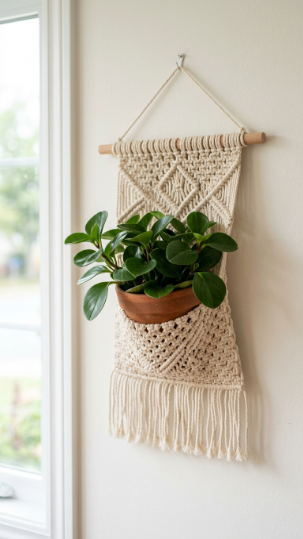
A flat-woven macramé wall pocket is a completely different design category from a hanging hanger — it mounts flat to the wall beside a window and uses weaving technique to create a woven vessel rather than a knotted sling.
Mount a 40cm wooden dowel horizontally on the wall using two cup hooks. Fold your rope strands over the dowel (use 20 strands of 4mm cotton rope at 1.8m each). Work rows of alternating square knots to produce a flat woven panel 20cm wide. After 15cm of flat weaving, divide the strands into two groups and work each group separately for 10cm — this creates the pocket opening. Bring both groups back together and work 5 more rows of alternating square knots to form the pocket base. Gather all strands with a wrap knot and trim the fringe evenly.
The finished pocket holds a 10–12cm pot securely in the woven pouch, with the plant visible from the front. Placing the wall pocket beside rather than in front of the window means the plant receives bright side-light — particularly suitable for Peperomia obtusifolia, which prefers bright indirect rather than direct sun.
Learn about flat macramé wall pocket hangers and window-adjacent plant displays and find peperomia care at The Sill.
A wall pocket beside a window is one of the most space-intelligent plant display solutions available in a small room.
17. Vintage Brass Hook and Natural Rope Window Hanger
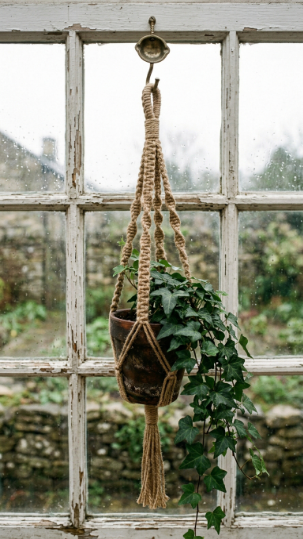
A vintage brass cup hook screwed directly into the window frame, combined with natural jute rope, creates the most character-rich and historically sympathetic DIY macrame plant hanger for windows — particularly beautiful in period properties.
Source vintage brass cup hooks from reclamation yards, antique markets, or online vintage suppliers — they are typically inexpensive (£1–£3 each) and come in a range of beautiful aged finishes from burnished gold to verdigris green. Screw directly into the window frame’s top rail using a manual screwdriver (pre-drilling a pilot hole prevents splitting older timber). Check tenancy terms before drilling if renting.
Natural undyed jute rope in 4mm thickness complements aged brass perfectly — the warm golden tones harmonise rather than contrast. Work a simple reverse-lark’s-head fringe hanger with very minimal knotwork to let the materials speak: an overworked knot pattern would compete with the beauty of the vintage brass and aged rope.
Hedera helix (English ivy) is the most historically appropriate plant for this setting: it tolerates the lower light of north-facing Victorian sash windows, grows consistently all year, and produces the kind of trailing cascade that amplifies the hanger’s length dramatically over a single season.
💡 Pro Tip: Treat jute hangers with a light spray of lemon oil every few months — this prevents the natural fibre from becoming brittle with age and extends the hanger’s indoor life by 1–2 years.
Explore vintage-style macramé plant hangers and antique window plant display ideas and find ivy care for indoor windows from Missouri Botanical Garden.
A brass hook and jute hanger in an old window is one of those combinations that feels like it has always been there — and perhaps should have been.
18. Statement Arch-Style Double Window Hanger
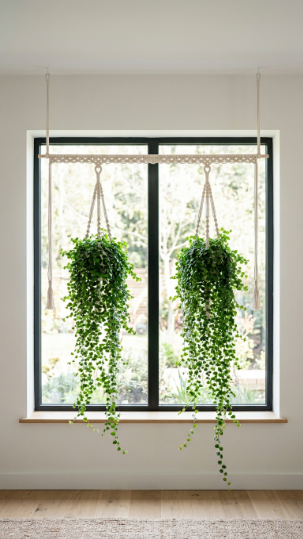
An arch-style double hanger spans two pots connected by a curved overhead rope element — it creates an architectural frame for a wide window that reads as a designed installation rather than two separate hangers.
Construct two standard single hangers (pot-holding section only) connected at their top rings by a 80–100cm length of thick 8mm rope shaped into an arch. The arch rope is attached to both rings and to the ceiling at its midpoint apex. The curvature is achieved by threading the arch rope through a rigid 4mm galvanised wire core — the wire bends to your desired arch shape and retains it permanently.
This design requires two ceiling hooks: one at the apex of the arch and two at the window frame for the vertical hangers, or a single horizontal curtain rod from which both hangers and the arch connection hang. The total span suits windows of 80–120cm width.
Choose two plants with compatible care requirements and complementary forms: Ficus pumila (creeping fig) in both pots produces a unified green canopy effect that connects the two hanging elements visually into a single arching composition.
Learn about double arch macramé window hangers and statement window plant installations and find Ficus care from Gardeners’ World.
An arch hanger doesn’t just display plants — it reframes the window itself as a piece of living architecture.
19. Monochrome Black Cord Hanger for a Modern Interior
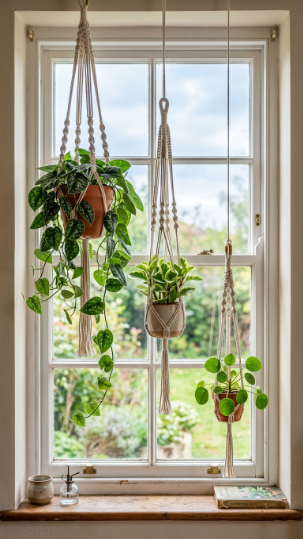
A black cotton cord hanger is the most striking contemporary departure from natural rope aesthetics — it works specifically in modern interiors where cream and natural tones would disappear against light walls.
Use 5mm matte black single-strand cotton cord (not polished or shiny — a matte finish photographs and reads visually as far more sophisticated than glossy black cord). Work a restrained square-knot pattern with wide spacing between knots to keep the design geometric and deliberate. Three square-knot gathering rows with 6–8cm spacing between each row creates the cleanest, most modern aesthetic.
Pair with a white or concrete-grey geometric ceramic pot — the high contrast between matte black cord and pale pot creates a graphic quality that functions as wall art. Choose a plant with strong architectural form and deep colour: Zamioculcas zamiifolia (ZZ plant) with its deeply glossy dark green leaves is perfect, tolerating the lower light levels typical of modern interior windows that may not face south.
ZZ plants require watering only every 2–3 weeks in summer and monthly in winter — their rhizomatous roots store water efficiently, making overwatering a far greater risk than underwatering.
💡 Pro Tip: Avoid washing black cotton cord hangers in direct sunlight to dry — UV fades matte black cotton to a patchy grey-brown unevenly, ruining the graphic quality of the piece. Dry in shade or indoors instead.
Read about monochrome macramé plant hangers for modern interior window displays and find ZZ plant care at The Sill.
A black cord hanger in a modern window is the plant display equivalent of a graphic design decision — bold, considered, and completely deliberate.
20. Seasonal Flowering Plant Hanger for a South Window
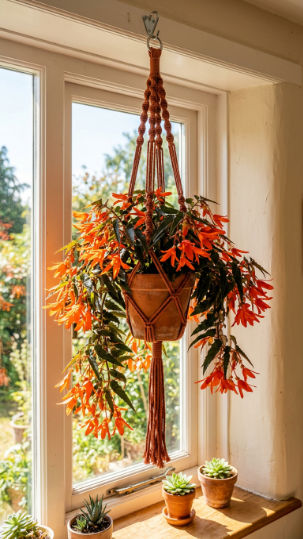
A seasonal flowering plant in a window hanger is the most transformative of all DIY macrame plant hangers for windows — replacing a trailing foliage plant with a flowering specimen for the summer season adds colour and life that foliage alone simply cannot.
Begonia boliviensis ‘Bonfire’ (cascading orange tubular flowers, summer through autumn) and Fuchsia trailing varieties are both outstanding candidates for a south or west-facing window hanger in summer. Both produce flowers on cascading stems that use the hanger’s height to full dramatic effect — a standard pot on a shelf could never display the same downward cascade.
Plant in a 12–14cm pot using a peat-free multipurpose compost with added water-retaining crystals — flowering plants in summer sun require watering every 1–2 days, and the crystals provide a buffer against the rapid drying that a window hanger’s exposed position accelerates. Feed with a high-potassium liquid fertiliser every week from the first bud formation.
Deadhead spent flowers every 3–4 days to maintain continuous blooming — the plant redirects energy from seed production to new flower formation when faded flowers are removed promptly.
Beginner vs. Advanced seasonal hanger planting:
- Beginner: Single begonia cultivar, standard terracotta pot, weekly feeding
- Advanced: Mixed Begonia and trailing Lobelia, self-watering insert in pot, bi-weekly feeding, monthly pot rotation for even sun exposure
Discover seasonal flowering plant hangers for south-facing window displays and find begonia care and container growing guidance at BHG.
A seasonal flowering hanger transforms a window differently every summer — it’s a project you’ll look forward to revisiting each year.
Getting Started With DIY Macrame Plant Hangers for Windows
The easiest possible starting point is the classic spiral hanger (section 1): one plant, one skein of 5mm cotton rope, one metal ring, and a ceiling hook. Buy a single 100m skein of natural cotton rope (£6–£8 from any craft shop), cut eight lengths at 3m each, and follow the lark’s head mount and spiral half-hitch instructions. Your first hanger will be complete in under an hour, imperfect in the way that makes handmade things beautiful, and genuinely functional immediately.
The most common beginner mistake is underestimating the importance of hook placement. A ceiling hook that sits directly above the window’s centre provides optimal light for the plant and the most balanced visual composition. Test the hook position with a temporary nail and a length of string before committing — the hook’s exact placement is more important to the finished result than the complexity of the knot pattern.
For your first purchase, keep it specific: one 100m skein of 5mm natural cotton rope, one 4cm metal ring, and one Epipremnum aureum (golden pothos) in a 12cm pot. Pothos tolerates a genuinely wide range of light conditions, requires watering only every 7–10 days, and trails attractively from the first week in its hanger.
Expect your first DIY macrame plant hanger for windows to look fully established and beautiful within 2–4 weeks as the plant settles and begins to trail naturally through and past the knot structure.
Frequently Asked Questions
What is the best rope for DIY macrame plant hangers for windows?
5mm single-strand natural cotton rope is the best all-round choice for beginners and experienced makers alike. It knots cleanly, holds its shape without slipping, and the natural cream colour suits every interior. For a softer, more delicate look use 3mm cord; for chunky statement pieces use 6–8mm rope. Avoid polypropylene or nylon rope — these are synthetic, don’t absorb dye well, and have a plasticky sheen that looks out of place in home interiors. Jute is a beautiful natural alternative but degrades faster in humid rooms; reserve it for dry rooms or temporary seasonal displays.
How much weight can a macrame hanger hold safely?
A correctly knotted hanger made from 5mm cotton rope can typically hold 5–8kg — far more than any realistic houseplant in a pot. The limiting factor is almost always the ceiling hook or curtain rod, not the rope itself. Use a hook rated for at least 5kg and screw it into a ceiling joist rather than just plasterboard — a joist-mounted hook safely holds 30–50kg, while a plasterboard-only hook may fail under as little as 2–3kg. For hanging from a curtain rod, use a tension rod rated 5kg minimum.
Why is my window plant in a macrame hanger drying out so fast?
Plants in window hangers dry out faster than pot plants on a surface because air circulates around all sides of the pot simultaneously, evaporating moisture from the drainage holes and pot walls as well as the soil surface. In summer, small terracotta pots in bright south-facing window hangers may need watering every day. Switching to a glazed ceramic pot (which doesn’t breathe through its walls), using water-retaining gel crystals mixed into the compost, or adding a drip irrigation emitter connected to a small reservoir are all effective solutions to rapid drying.
Can I use macrame hangers for plants in a bathroom window?
Yes — and a bathroom window is one of the best possible locations for certain plants in macrame hangers. The elevated humidity typical of bathrooms benefits moisture-loving plants significantly: ferns (Adiantum, Nephrolepis), Tradescantia, air plants (Tillandsia), and Epipremnum all thrive in bathroom conditions. However, use cotton rather than jute rope in bathrooms — jute absorbs moisture and develops mould quickly in persistently humid conditions, while cotton is far more resistant. Re-check the cotton hanger’s condition every 6 months for any signs of mildew at the knot points.
How do I water plants in macrame hangers without making a mess?
The cleanest approach is to remove the pot from the hanger, carry it to a sink, water thoroughly, allow it to drain completely for 10–15 minutes, then return it to the hanger. This prevents watermarks on walls and floors and ensures thorough saturation rather than partial surface watering. For pots too heavy or awkward to remove easily, use a long-necked watering can directed precisely at the soil surface (not the leaves), place a saucer inside the pot to catch drainage, and remove the saucer water after 30 minutes. Self-watering pot inserts — a reservoir with a wick — are an elegant permanent solution for frequently missed waterings.
A Few Final Thoughts
These 20 DIY macrame plant hangers for windows represent the full spectrum of what handmade window plant display can be — from a beginner’s first spiral hanger to an architectural arch installation, from a sustainable T-shirt yarn upcycle to a colour-blocked nursery piece. The truth that every experienced maker discovers is that even the simplest hanger changes a room more than expected: it draws the eye upward, fills a space that furniture never reaches, and gives a plant the light it actually needs to thrive. You don’t need a collection of twenty to make an impact — one well-placed hanger in the right window is enough to begin. Gather your rope, find your ring, and tie your first knot today. Your window has been waiting for exactly this.