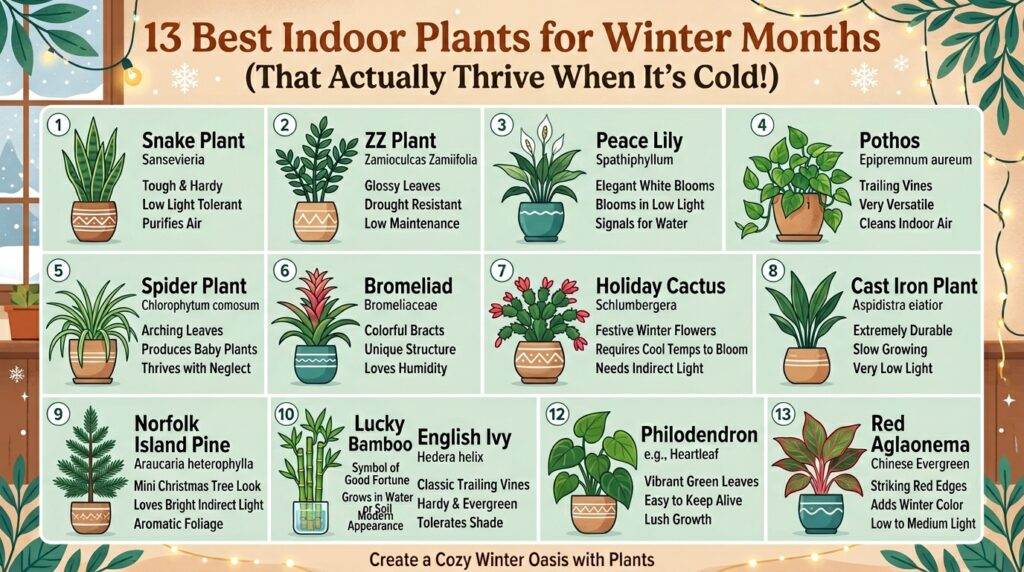
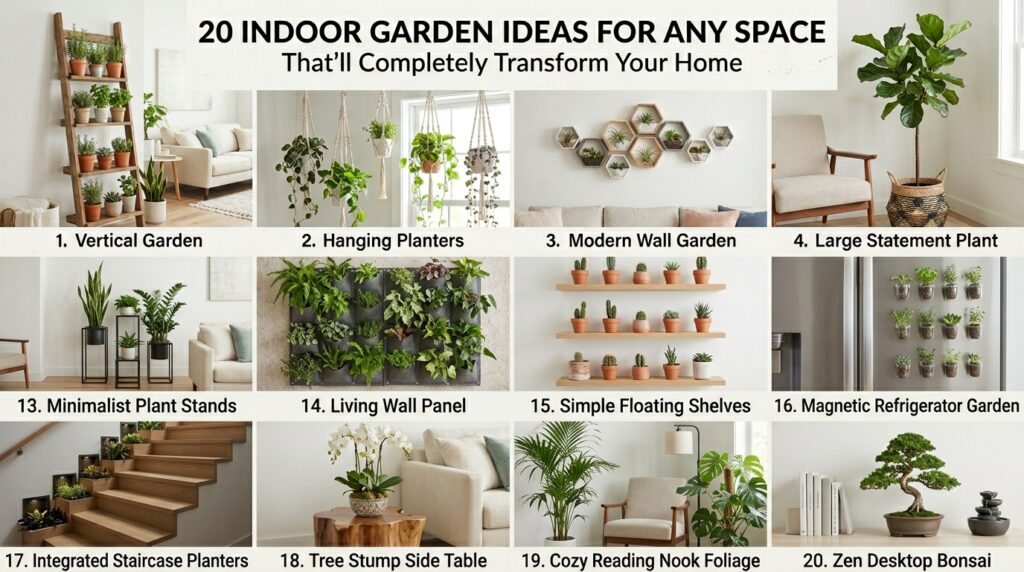
Have you been scrolling through stunning indoor garden photos thinking “that’s gorgeous but my apartment is tiny, my thumb is brown, and I have approximately zero DIY skills”? Here’s the truth that nobody tells you: indoor garden ideas don’t require a sprawling loft, a professional horticulturalist’s knowledge, or a carpenter’s toolkit to execute beautifully. They require the right ideas matched to your actual space, your actual lifestyle, and your actual skill level — and that’s exactly what this article delivers. From a single perfectly styled shelf to a full kitchen herb wall, from a bedroom trailing plant collection to a living room statement floor plant that changes the whole energy of the room, there’s an indoor garden idea in here for every home, every budget, and every level of plant experience. Ready to turn your home into the green sanctuary you’ve always wanted? Let’s dive in!
At a Glance
- Indoor garden ideas work in any space regardless of size — the key is choosing the right scale, the right plants, and the right system for your specific home, light conditions, and lifestyle.
- Vertical and overhead space is the most underused indoor gardening resource in small apartments — wall-mounted planters, hanging plants, and tiered shelving multiply your growing and display capacity without using a single centimeter of floor space.
- Low-maintenance, high-impact plants like Pothos, Snake Plants, ZZ Plants, and Heartleaf Philodendron are the foundation of every successful indoor garden — they thrive with minimal attention and look genuinely spectacular when styled well.
- Grow lighting technology has advanced dramatically — modern LED grow lights are affordable, energy-efficient, and attractive enough to use as interior design features, making genuinely productive indoor gardens possible in any room regardless of natural light.
- DIY indoor garden setups — from propagation stations to repurposed furniture planters — are achievable for complete beginners and produce results that look far more professional and expensive than the materials and effort invested suggest they should.
1. The Statement Floor Plant Corner
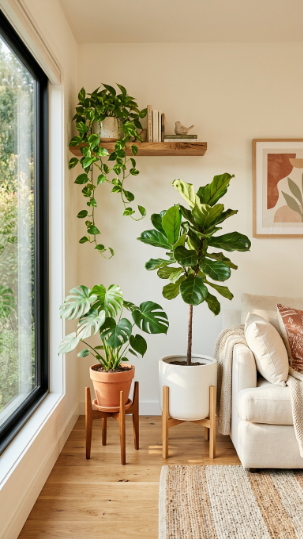
Here’s the deal: one large, well-placed floor plant does more for a room’s atmosphere than ten smaller plants scattered randomly around it — and building a statement floor plant corner is the indoor garden idea that delivers the most dramatic transformation for the most straightforward effort.
The secret is thinking in layers of height rather than placing a single plant. A tall floor plant (your drama piece — Fiddle Leaf Fig, Bird of Paradise, large Monstera, or Rubber Plant) anchors the corner at ceiling height. A medium plant on a wooden plant stand beside it fills the mid-level. A trailing plant on a shelf above adds the overhead element that makes the whole composition feel genuinely lush and designed.
The best statement floor plants for impact and relative ease of care: Fiddle Leaf Fig (Ficus lyrata) for those iconic large lobed leaves — needs bright indirect light and consistent care but rewards you with the most photographed plant silhouette in interior design. Bird of Paradise (Strelitzia reginae) for dramatic paddle-shaped leaves that reach toward light beautifully. Large Monstera deliciosa for those iconic split leaves that look spectacular against any wall color.
💡 Pro Tip: Rotate your statement floor plant a quarter turn every 2–3 weeks — plants naturally grow toward their light source, and without rotation, a floor plant develops a strong lean toward the window that becomes visually awkward within a few months. Regular rotation produces a symmetrically full plant that looks equally beautiful from every angle.
- Position floor plants in corners or against walls — they look more designed and intentional than plants floating in the middle of a room
- Dark pot colors (charcoal, navy, black) make green foliage pop more dramatically than white or neutral pots
- Plant stands elevate medium plants to create the height layering that makes a corner feel genuinely lush
- Leave breathing room between plants — touching foliage looks crowded; slight separation looks curated
Check out our building a statement floor plant corner — styling and plant selection guide for scale, proportion, and pot selection advice. Architectural Digest has stunning indoor plant styling inspiration at architecturaldigest.com.
One perfect floor plant corner transforms a living room from a room with furniture to a room with genuine character — invest in it and watch how the whole space changes!
2. The Trailing Plant Shelf Display
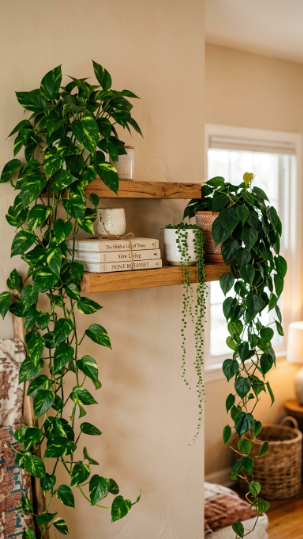
Trailing plants on shelves are the indoor garden idea that looks the most effortlessly stylish with the least intervention — because the plants themselves do most of the work, growing longer and more beautiful every week while you simply enjoy the results.
Here’s the thing: a shelf plant with 60–80cm of trailing vine reaching down the wall looks genuinely spectacular and magazine-worthy. The same plant trimmed back to the pot edge looks like a houseplant. The entire difference between “shelf plant” and “trailing shelf installation” is simply letting the plant grow without cutting it back — and that costs exactly nothing.
The best trailing plants for shelf display: Golden Pothos (Epipremnum aureum) is the undisputed champion — grows in almost any light, trails enthusiastically, and the heart-shaped leaves look beautiful at any length. Heartleaf Philodendron has similar trailing vigor with slightly more elegantly shaped leaves. String of Pearls (Senecio rowleyanus) is the quirky, editorial choice — those distinctive bead-like stems are unlike anything else and look extraordinary trailing from a high shelf.
The styling secret is mixing trailing plants with static objects — books, ceramics, candles, small sculptures — so the living vines appear to weave through a curated collection rather than sitting in isolation on an otherwise empty shelf.
💡 Pro Tip: Install your trailing plant shelf at ceiling height rather than mid-wall if your room allows — a plant trailing from near the ceiling creates a dramatically more impressive cascade than one trailing from a standard shelf height, and the additional length gives you weeks more trailing growth before it reaches the floor and needs redirecting.
Read our trailing plant shelf display guide — plants, styling and positioning for shelf height recommendations, trailing plant care, and styling principles.
A trailing plant shelf is the indoor garden idea that gets better every single week as the vines grow longer — set it up once and simply enjoy the show!
3. DIY Vertical Wall Planter
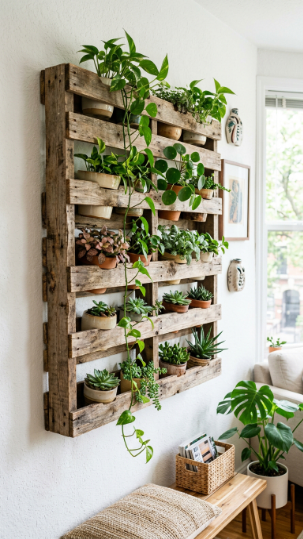
A DIY vertical wall planter is the indoor garden idea that solves the small apartment’s greatest challenge — wanting more plants without having more floor or surface space — in one creative, genuinely stunning installation that uses the one resource small apartments always have plenty of: wall space.
The simplest version is a reclaimed pallet mounted on the wall with small pots nestled between the slats — achievable in an afternoon with a few wall fixings and completely free if you can source a pallet from a local supplier. The result looks like a deliberately designed living wall installation because, essentially, it is.
More refined DIY approaches: wall-mounted timber dowel rods with small hanging pots suspended from them at different heights create a beautiful, airy display with a more contemporary aesthetic than a pallet. Modular pocket planter fabric panels (available cheaply online) mount on a single wall fixing and hold 20–30 small plants in individual pockets, creating an almost instant living wall.
Plant selection for vertical walls: choose compact, lightweight plants that won’t stress wall fixings — Pilea peperomioides (Chinese Money Plant) for its architectural coin-shaped leaves, Fittonia for vivid nerve-leaf color, small Pothos cuttings for reliable trailing, air plants (Tillandsia) mounted directly on the wooden surface with adhesive for a completely soil-free display.
💡 Pro Tip: Always use wall anchors rated for at least double the weight of your completed vertical planter including soil, pots, and plants — a full vertical planter loaded with moist compost is significantly heavier than it looks when empty. Drill into wall studs wherever possible for the most secure fixing, and never mount a heavy vertical planter on plasterboard alone without proper cavity fixings.
Explore our DIY vertical wall planter guide — pallet, dowel and pocket planter methods for construction methods, fixing specifications, and plant selection for different light levels.
A vertical wall planter turns your most abundant indoor resource — wall space — into your most spectacular indoor garden feature. It’s the small apartment solution that works brilliantly every time!
4. The Kitchen Herb Garden Window Setup
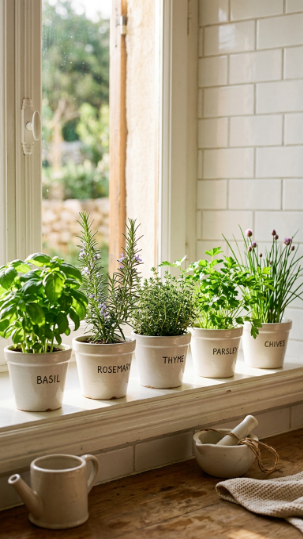
A kitchen herb garden is the indoor garden idea that pays back in a completely different currency from every other plant on this list — not just beauty but genuine, daily, delicious usefulness that makes every meal better and makes your kitchen smell extraordinary. And a beautifully styled kitchen herb setup on your windowsill is one of the most satisfying small-space indoor gardens possible.
The kitchen herb window formula: uniform white or terracotta pots (matching vessels create instant cohesion), your most-used herbs arranged by height (tallest at the back — rosemary, sage; medium in the middle — basil, flat-leaf parsley; smallest at the front — thyme, chives), and a simple drip tray or moisture mat beneath to protect the windowsill and simplify watering.
The herbs that perform best on a kitchen windowsill: Basil (needs the warmest, sunniest position — south-facing windowsill is ideal), Rosemary (drought-tolerant, fragrant when brushed, deeply happy on a warm sunny sill), Thyme (compact, constantly useful, completely unfussy), Flat-leaf parsley (tolerates some shade, consistently productive when regularly cut), Chives (virtually indestructible, regrows prolifically after cutting).
💡 Pro Tip: Grow basil in its own pot, always — basil is moisture-hungry and grows best with consistent watering, while Mediterranean herbs like rosemary and thyme actively prefer to dry out between waterings. Mixing them in the same pot means you’re perpetually either drowning your rosemary or stressing your basil. One pot per herb, or at minimum separate moisture-lovers from drought-toleraters.
| Herb | Light Needed | Water Frequency | Growth Speed |
| Basil | Full sun | Every 2–3 days | Fast |
| Rosemary | Full sun | Weekly | Slow |
| Thyme | Full sun | Weekly | Moderate |
| Flat-leaf Parsley | Partial sun | Every 3–4 days | Moderate |
| Chives | Partial sun | Every 3–4 days | Fast |
| Mint | Partial sun | Every 2–3 days | Very fast |
Read our kitchen herb garden window setup — the complete beginner’s guide for pot sizing, compost choice, and feeding schedules.
A kitchen herb garden is the indoor garden that improves your life in the most direct, daily, delicious way possible — plant one this weekend and start cooking with it immediately!
5. The Bathroom Tropical Plant Spa
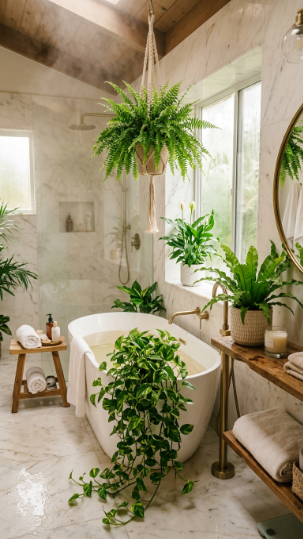
Here’s the deal: your bathroom is secretly the best room in your home for certain tropical plants — and most people have no idea. The warm humidity from showers creates exactly the tropical microclimate that ferns, Peace Lilies, and moisture-loving tropicals actively thrive in, and a beautifully planted bathroom feels genuinely like a private spa every single time you use it.
The bathroom as an indoor garden works on a simple principle: plants that hate the dry air of centrally heated rooms love the humid, warm environment of a regularly used bathroom. Boston Ferns (normally demanding plants in dry indoor conditions) become almost effortlessly easy in a steamy bathroom. Peace Lilies handle the low light of many bathrooms brilliantly and their gentle white flowers add a serene elegance.
The ceiling hanging element is what elevates a bathroom plant collection from “houseplants in a bathroom” to a genuine spa installation — a macramé hanging planter with a lush Boston Fern or trailing Pothos suspended above the bath creates an experience of being beneath a plant canopy every time you bathe, and it uses ceiling space that’s otherwise completely wasted.
Best bathroom plants by light level: bright bathroom (window with natural light): Bird of Paradise, Swiss Cheese Plant, fiddle leaf fig. Medium light: Boston Fern, Peace Lily, Heartleaf Philodendron. Low light bathroom: Cast Iron Plant, ZZ Plant, Sansevieria.
💡 Pro Tip: Rotate your bathroom plants to a brighter room for one week every month if your bathroom has limited natural light — this “light holiday” allows plants to photosynthesize fully and recover their vigor before returning to the bathroom environment. It’s a simple rotation system that keeps even shade-tolerant bathroom plants genuinely healthy rather than merely surviving.
Explore our bathroom tropical plant spa guide — plants, hanging and humidity care for the best species for every bathroom light condition and humidity level.
Transform your bathroom into a private tropical spa with the right plants — it costs almost nothing and the daily experience of bathing surrounded by lush greenery is genuinely extraordinary!
6. The DIY Propagation Station
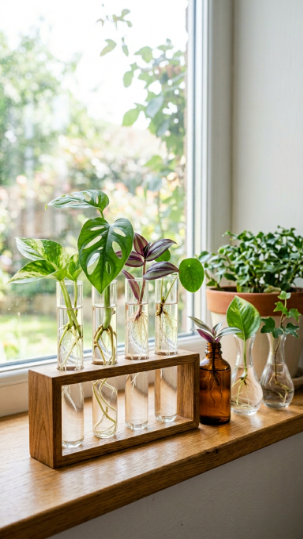
A DIY propagation station is simultaneously one of the most beautiful indoor garden displays you can create, one of the most addictively fascinating to maintain, and one of the most genuinely useful — because it’s constantly producing new plants for free from cuttings of plants you already own.
The visual magic of a propagation station is the clarity of the glass vessels and the visible root development — watching white roots thread down through clear water over 2–3 weeks is genuinely captivating, and the backlit effect of a propagation station on a bright windowsill (glass vessels, green cuttings, white roots, bright light) is one of the most beautiful things in any plant-filled home.
Building your propagation station: collect matching or complementary glass vessels — test tubes in a wooden rack (brilliant for a clean, scientific aesthetic), small bud vases, apothecary bottles, or repurposed jam and medicine jars. The key is grouping vessels at varied heights on a wooden board or rack for a composed display rather than scattered random bottles.
The best plants for water propagation: Golden Pothos roots in 1–2 weeks in water, almost without fail. Heartleaf Philodendron is similarly foolproof. Tradescantia (Spiderwort) roots so fast it’s almost instant. Monstera cuttings with a node root in 3–4 weeks and watching a Monstera node develop roots is deeply satisfying. Impatiens cuttings root in days.
💡 Pro Tip: Add a few drops of activated charcoal to your propagation water — activated charcoal keeps the water clear, prevents bacterial and algal growth that clouds the water and can harm developing roots, and extends the time between water changes from weekly to every 2–3 weeks. It’s available cheaply from aquarium suppliers and is one of the most useful small additions to a water propagation setup.
Read our DIY propagation station setup guide — vessels, plants and technique for vessel ideas, which plants root best in water, and how to pot up rooted cuttings successfully.
A propagation station is the indoor garden feature that makes plant people genuinely obsessed — it’s beautiful, it’s fascinating, and it turns one plant into five for the cost of a glass of water!
7. The Bedroom Calming Plant Collection
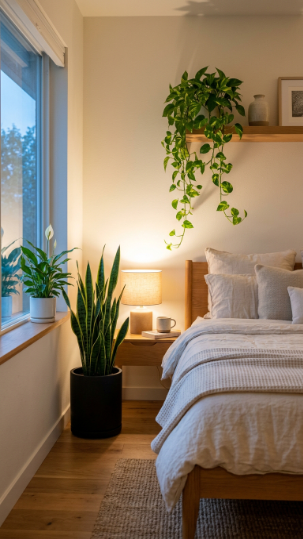
Plants in the bedroom are more than decoration — they soften acoustics, add living texture, lower perceived visual complexity, and (in the case of certain species) have been studied for potential air quality benefits. Most importantly, they create the feeling of a restorative, living sanctuary that makes a bedroom feel genuinely different from every other room in the home.
The key to great bedroom plant styling is restraint — this isn’t the room for a maximalist jungle. Two or three perfectly chosen plants in beautiful pots, positioned thoughtfully in relation to the bed and the light, create calm. Too many plants in a bedroom creates visual noise that works against the space’s purpose.
The ideal bedroom plant trio: one tall, architectural plant beside the bed or in a corner (Snake Plant for its striking upright form and extreme low-maintenance, or a slim Dracaena for softer elegance). One small, flowering plant on the windowsill (Peace Lily for its gentle white spathes and air-purifying reputation, or a compact Anthurium for longer-lasting color). One trailing plant on the headboard shelf or bedside shelf above the bed (Pothos or Heartleaf Philodendron, growing long and softening the space above where you sleep).
💡 Pro Tip: Choose plants for your bedroom based on your specific watering personality — if you travel frequently or are genuinely forgetful about watering, a bedroom Snake Plant or ZZ Plant that needs watering only once every 2–4 weeks is far better than a Peace Lily that droops dramatically when thirsty and becomes a source of guilt rather than calm. Match the plant to your lifestyle, not your aspirations.
Explore our bedroom plant collection — styling, species selection and care guide for the best plants for every bedroom light condition and maintenance preference.
The right bedroom plants make your most personal room genuinely restorative — calm, living, and deeply beautiful in the quietest possible way!
8. The Indoor Herb and Microgreen Growing Setup
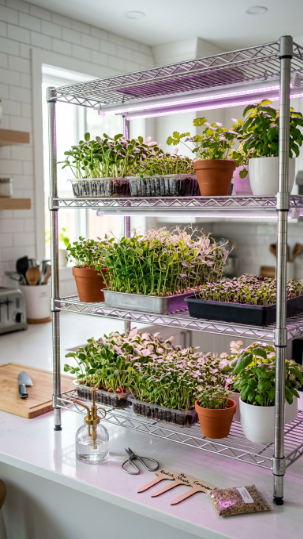
Here’s the thing: a microgreen and indoor herb growing setup is the most productive indoor garden you can build in the smallest footprint — a single tiered rack on your kitchen counter can produce fresh microgreens for salads and garnishes in 7–14 days from sowing, year-round, regardless of outdoor weather or season. It’s the indoor garden that feeds you.
Microgreens — the seedling stage of vegetables and herbs harvested just after the first true leaves develop — are extraordinarily nutritious (studies consistently show higher nutrient density than mature vegetables), incredibly fast-growing, and delicious. Sunflower shoots are sweet and crunchy. Radish microgreens have a vivid peppery kick. Pea shoots are sweet, tender, and among the most productive microgreens available.
The basic setup: a tiered wire rack with shallow growing trays (purpose-made microgreen trays or basic food storage trays with drainage holes drilled in), LED grow lights mounted under each shelf tier (modern strip grow lights are inexpensive, low-energy, and produce minimal heat), and a timer running the lights for 14–16 hours per day. Total cost for a complete setup is remarkably modest, and the ongoing cost is just seeds and compost.
Succession sowing in microgreens is the same principle as outdoor vegetable growing — sow a fresh tray every 5–7 days and you always have one tray ready to harvest while the next is growing.
💡 Pro Tip: Use coconut coir growing medium rather than standard compost for microgreens — coir is lightweight, holds moisture evenly, drains well, is pH-neutral, and has no weed seeds or soil pathogens that can cause damping-off in young seedlings. It’s the microgreen growing medium that professional indoor growers use and it produces consistently better results than potting compost for this application.
Read our indoor microgreen and herb growing setup guide — equipment, seeds and technique for rack sizing, grow light specifications, and the best microgreen varieties for beginners.
An indoor microgreen setup produces fresh, nutritious, homegrown food every single week regardless of the season — it’s the most productive indoor garden possible in the smallest imaginable space!
9. The Low-Maintenance Succulent and Cactus Collection
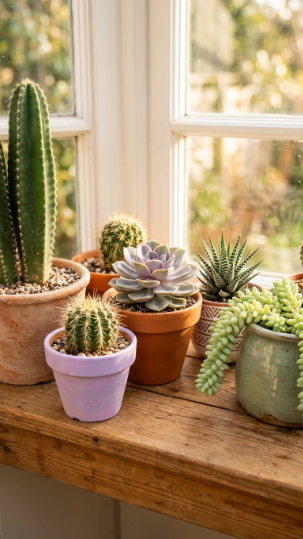
For anyone who has killed every plant they’ve ever owned and concluded that they simply cannot do this, a succulent and cactus collection is the gentle, low-pressure, genuinely beautiful indoor garden that changes that story permanently. These plants want you to mostly leave them alone — and that’s a plant-care instruction most busy people can actually follow.
Here’s the deal: succulents and cacti are the most forgiving indoor plants in existence — they store water in their leaves, stems, or roots, which means they genuinely prefer to dry out completely between waterings and actively suffer from the overwatering that kills most other houseplants. They thrive on neglect, bright light, and free-draining compost.
The collection approach produces far more visual interest than a single plant — grouping 5–9 plants of varied forms and heights on a bright windowsill creates a miniature landscape of extraordinary texture and variety. Combine rosette forms (Echeveria, Sempervivum), columnar forms (Cereus, Cleistocactus), trailing forms (String of Pearls, Sedum morganianum), and architectural geometric forms (Haworthia, Gasteria) for the most diverse and visually interesting display.
Pot styling for succulents: terracotta is the ideal material — it’s porous, which aids the free drainage and airflow around roots that succulents need, and warm terracotta tones complement the silver-green, blue-grey, and purple tones of many succulent varieties beautifully.
💡 Pro Tip: Water your succulents from below rather than above — place pots in a tray of water for 20–30 minutes, allowing the compost to absorb moisture from the drainage holes, then remove and allow to drain completely before returning to the display. Bottom watering reaches the roots most efficiently, prevents water sitting on the leaves (which can cause rot in rosette-forming succulents), and avoids the white mineral deposits that top watering leaves on terracotta pots.
Explore our succulent and cactus collection guide — display, care and propagation for the best species for beginners, arrangement principles, and propagation from leaves and offsets.
A succulent collection is the indoor garden that proves you don’t need to be a plant expert to have something genuinely beautiful — just bright light, free-draining compost, and the discipline to water less than you think you should!
10. The DIY Hanging Plant Ceiling Installation
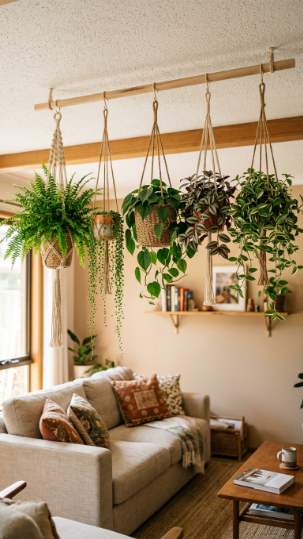
A ceiling plant installation is the indoor garden idea that uses the one space in every room that’s almost always completely empty — the ceiling — and creates something that is simultaneously a dramatic interior design statement and a genuinely extraordinary plant display.
The impact is completely disproportionate to the installation effort: a single ceiling-mounted rod or copper pipe with five plants hanging at varied heights creates a living canopy above your seating area that makes the room feel like it’s been completely transformed — as if a professional interior stylist spent a week on it rather than you spending an afternoon.
The installation options: a wooden dowel or copper pipe mounted between two ceiling hooks creates a horizontal hanging rail for multiple plants at varied heights. Individual ceiling hooks at different positions create a more scattered, organic installation. A macramé plant wall mounted high on the wall with the plants hanging outward creates the visual effect of a ceiling installation without requiring actual ceiling fixings.
The best plants for hanging installations: Boston Fern for lush, full hanging baskets that look spectacular at ceiling height. String of Pearls for those extraordinary cascading bead-like stems. Heartleaf Philodendron for fast-growing, reliable trailing growth. Tradescantia for vivid purple-and-green striped leaves that look beautiful from below. Burro’s Tail (Sedum morganianum) for sculptural trailing stems that photography beautifully.
💡 Pro Tip: Use lightweight pots and growing media for ceiling installations — heavy ceramic pots at ceiling height put significant stress on fixings and are dangerous if they fall. Use plastic nursery pots inside lightweight wicker or rope outer covers, and use a perlite-rich lightweight compost rather than standard heavy potting mix. Reduce risk and reduce weight simultaneously.
Read our DIY ceiling plant installation guide — rods, hooks and hanging plant selection for fixing methods, weight limits, and the best hanging plant combinations.
A ceiling plant installation transforms the volume of a room in a way that no floor or surface plant ever can — it creates a genuinely immersive plant experience that makes people look up and exhale with pleasure!
11. The Repurposed Furniture Planter
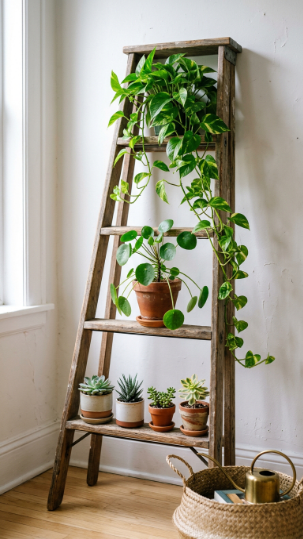
Repurposed furniture planters are the indoor garden idea that sits at the intersection of creativity, sustainability, and genuinely beautiful interior design — turning something old, discarded, or thrifted into a plant display that looks far more interesting and characterful than anything bought new specifically for the purpose.
Here’s the thing: the imperfection and history of repurposed furniture is exactly what makes it so beautiful as a plant display framework — a weathered ladder, an old wooden crate, a vintage suitcase, a retired bookcase with the back panel replaced by chicken wire for air plant mounting — all of these create displays with a personality and story that no purpose-built plant stand can replicate.
The best repurposed furniture plant display ideas:
Vintage wooden ladder: leaned against a wall, each rung holds plants at a different height — creates the perfect tiered plant display in a narrow footprint ideal for small apartments.
Old wooden crates stacked in an offset formation: creates a geometric shelving unit with the irregular arrangement making it look designed rather than accidental. Line with moss or coir before planting directly, or simply place pots inside.
Retired bookcase: remove some shelves, add grow lights underneath the remaining ones, and you have a fully functional indoor garden unit that’s also a piece of furniture.
Vintage suitcase: lined with plastic sheeting and drainage holes drilled in the base, filled with compost and planted with succulents or herbs — a conversation-starting planter that works beautifully as a coffee table centerpiece.
💡 Pro Tip: Line all repurposed wooden furniture used as direct planters with heavy-duty plastic sheeting (pond liner or bin bag material) before adding any compost or moisture — unsealed wood in contact with wet compost will rot within a single growing season, destroying your furniture planter. The plastic lining adds five seconds to the preparation and years to the lifespan.
Explore our repurposed furniture plant display ideas — the complete creative guide for preparation, lining, and styling guidance for every furniture type.
A repurposed furniture planter tells two stories simultaneously — the plant’s and the furniture’s — and that double narrative is what makes it endlessly more interesting than anything bought new!
12. The Air Plant and Driftwood Display
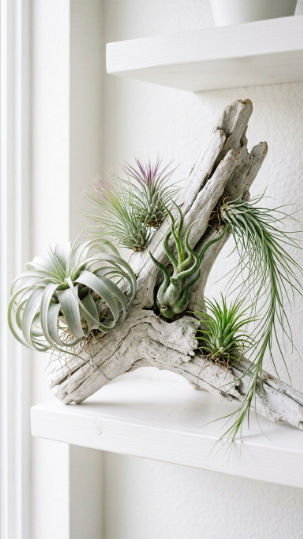
Air plants (Tillandsia) are the indoor garden’s greatest magic trick — living plants that grow without soil, absorbing moisture and nutrients from the air through their leaves, requiring nothing more than a weekly misting or fortnightly dunking in water, and producing a display that looks more like sculpture than horticulture.
Mounted on driftwood, rocks, cork bark, or sculptural wire frames, air plants create living artworks that sit on shelves, hang on walls, or perch on surfaces with no pot, no compost, and no mess — they’re the perfect indoor garden solution for people who love plants but hate the soil, watering, and maintenance complexity of conventional houseplants.
The driftwood display is the most beautiful air plant mounting approach — the pale, sculptural quality of driftwood complements the silvery, otherworldly quality of many Tillandsia species perfectly, and the combination of white-grey driftwood against a white wall creates a display with a quality of minimalist gallery art.
Mounting air plants on driftwood: use clear waterproof adhesive (E6000 or similar) or thin gauge craft wire looped gently around the base of the plant and twisted onto the driftwood — never use copper wire (toxic to Tillandsia) and never glue through the plant’s basal leaves into the growing point.
Care: mist 2–3 times per week or soak in water for 20–30 minutes fortnightly, shake gently to remove excess water from the base (trapped water causes basal rot), and keep in bright indirect light.
💡 Pro Tip: Tilt your air plants slightly downward when mounting them — any angle that allows water to drain away from the base after misting or soaking prevents the single most common air plant killer, which is water pooling in the base and causing rot. Even a 15–20° downward angle is sufficient to allow drainage and dramatically extends plant longevity.
Read our air plant and driftwood display guide — mounting, care and arrangement for mounting techniques, display arrangements, and care schedules for different Tillandsia species.
Air plants are the indoor garden’s great liberators — they prove that extraordinary plant displays don’t require soil, pots, or significant maintenance, just creativity and a misting bottle!
13. The Dark Room Plant Rescue Collection
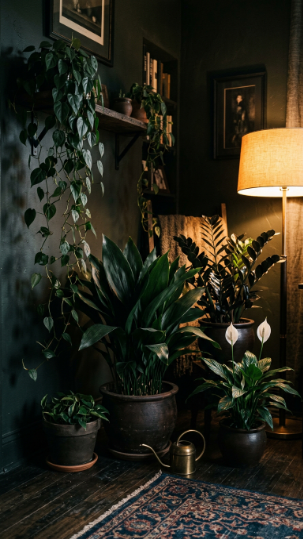
Here’s the deal: the darkest room in your home — the north-facing bedroom, the windowless hallway, the basement studio — is not a plant-free zone. It’s an invitation to discover a completely different palette of extraordinarily beautiful plants that not only tolerate low light but genuinely prefer the cool, dim conditions that defeat sun-loving species.
The shade-tolerant plant collection creates a moody, dramatic, deeply atmospheric indoor garden that’s actually impossible to achieve with light-loving plants — the rich, deep greens and near-black foliage of the best shade plants, lit by warm lamp light in a dark room, create an interior aesthetic of extraordinary sophistication.
The definitive low-light indoor plant list:
ZZ Plant (Zamioculcas zamiifolia) — those incredibly glossy, almost lacquered dark green leaves that reflect available light beautifully. Tolerates deep shade, extreme drought, and general neglect with absolute equanimity. The closest thing to an indestructible houseplant that exists.
Cast Iron Plant (Aspidistra elatior) — the legendary Victorian parlor plant that survived gas-lit rooms with minimal light. Deep green, architectural, and genuinely requiring almost nothing to thrive.
Heartleaf Philodendron — one of the most shade-tolerant trailing plants available, continuing to grow and trail in conditions that would stop almost any other plant.
Peace Lily (Spathiphyllum) — one of the few flowering plants that genuinely thrives in low light, producing elegant white spathes even in quite dark conditions.
💡 Pro Tip: In genuinely dark spaces, position plants as close to the light source as possible — even artificial light from a floor lamp or overhead fitting provides meaningful photosynthetic light for the most shade-tolerant species when the plant is within 50–80cm of the bulb. A ZZ Plant or Cast Iron Plant placed beside (not behind) a warm floor lamp is receiving useful light; the same plant on the opposite side of a dark room is not.
Explore our low-light indoor plant collection — the definitive dark room guide for light level assessment, species selection, and dark room styling advice.
Dark rooms aren’t a gardening limitation — they’re an aesthetic opportunity to create the most dramatically beautiful and atmospherically moody indoor plant displays imaginable!
14. The DIY Indoor Trellis Climbing Plant Wall
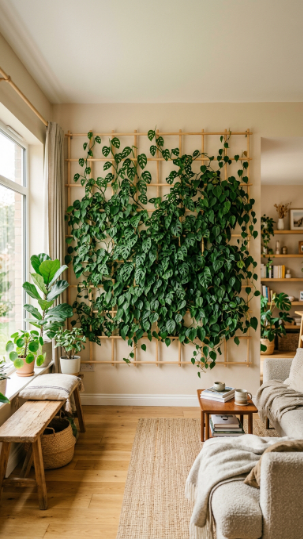
A DIY indoor trellis climbing plant wall is the indoor garden project that creates the most genuinely architectural, gallery-quality result from the simplest construction — a grid of bamboo canes or timber dowels fixed to the wall creates a framework that climbing and vining plants fill over a single growing season into a complete living wall installation.
The construction is almost embarrassingly simple: fix a grid of bamboo canes (approximately 20–25cm spacing horizontally and vertically) to your wall using small picture hooks or command strips at each intersection, or use a pre-made diamond or square timber trellis panel fixed flat against the wall. Plant your chosen climbers or trailers in a large floor pot or planter box beneath the trellis and train the stems onto the framework using small plant clips or soft jute ties.
The best indoor climbing plants for a trellis wall: Monstera adansonii (Swiss Cheese Vine) — the perforated, fenestrated leaves of this relative of the large Monstera look extraordinary covering a trellis surface. Heartleaf Philodendron — fast-growing, enthusiastic climber that covers a trellis in a single season. Scindapsus pictus (Satin Pothos) — silver-variegated leaves that look spectacular on a dark-painted trellis wall. Hoya carnosa — waxy leaves and (with enough light) extraordinary fragrant wax flower clusters.
💡 Pro Tip: Paint your trellis wall in a deep, dark color (charcoal, forest green, or dark blue) before installing the trellis — the contrast between the dark painted wall and the vivid green climbing plants creates a dramatically more beautiful effect than climbing plants against a white or cream wall. The plant colors pop, the trellis becomes less visible, and the whole installation looks like a deliberate design decision rather than a plant growing up a wall.
Read our DIY indoor trellis climbing plant wall — construction, plants and training guide for trellis construction methods, plant training techniques, and wall preparation advice. The RHS has excellent indoor climbing plant guidance at rhs.org.uk.
A trellis climbing plant wall is the indoor garden project that most completely transforms a room — from wall to living installation in a single growing season, with nothing but bamboo and a climbing plant!
15. The Windowsill Salad and Sprout Garden
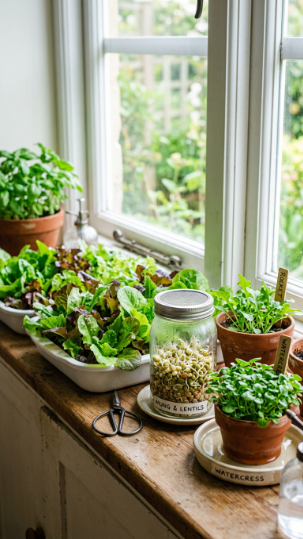
A windowsill salad and sprout garden is the most productive indoor food garden per square centimeter possible — producing genuinely fresh, genuinely nutritious, genuinely homegrown food on a windowsill that might be only 15cm deep and 60cm wide, year-round, for the cost of seeds and a little compost.
Cut-and-come-again salad leaves are the star of the windowsill food garden — sow a shallow tray with mixed salad seed (rocket, lettuce mix, mustard greens, baby spinach), grow to 8–10cm height, cut with scissors leaving 2–3cm above the compost, and the tray regrows for 2–3 more cuts before needing resowing. One shallow tray on a bright windowsill can produce enough salad for regular garnishes and additions throughout a week.
Sprouts in jars are the fastest food crop possible — mung beans, lentils, radish seeds, and alfalfa can be sprouted in a simple glass jar with a mesh lid (or muslin held with a rubber band) in 3–5 days with nothing but water. Rinse twice daily, drain completely, keep in indirect light, and harvest when the sprouts are 2–4cm long. Rich in enzymes, vitamins, and flavor.
Watercress grows beautifully in a shallow water tray on a bright windowsill — simply keep the tray topped up with fresh water and harvest continuously from the top growth.
💡 Pro Tip: Label every tray with the sowing date rather than just the plant name — for a succession sowing system to work efficiently, you need to know at a glance which tray was sown when and when it’s due for its next cut or resowing. A small wooden label with the date written in permanent marker, inserted at the end of each tray, takes 10 seconds and completely eliminates the guesswork that makes succession sowing harder than it needs to be.
Explore our windowsill salad and sprout garden — complete growing guide for seed selection, tray sizing, and cut-and-come-again technique for every crop type.
A windowsill salad garden turns a 15cm-deep kitchen windowsill into a genuinely productive food garden — fresh homegrown leaves for your salad every single week, 365 days a year!
16. The Minimalist Single-Specimen Statement
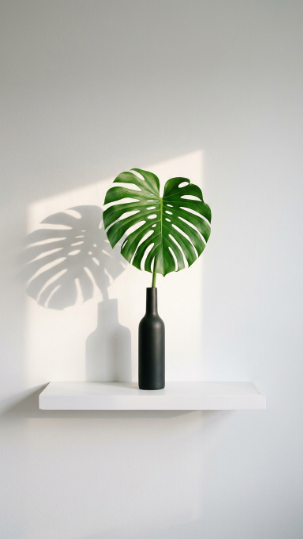
Here’s the thing: sometimes the most powerful indoor garden statement is the exact opposite of abundance — a single, extraordinary plant specimen in a perfect vessel against a bare wall, where the absence of everything else amplifies the beauty of the one thing present.
Minimalist single-specimen styling is one of the most challenging indoor garden approaches to execute well (restraint is harder than abundance) and one of the most spectacularly rewarding when it works — because the right plant in the right pot in the right position becomes genuinely indistinguishable from considered, expensive interior art.
The principle: choose a plant with inherently sculptural qualities — a large Monstera deliciosa with dramatically fenestrated leaves, a single-stem Fiddle Leaf Fig trained to a clear trunk with a canopy of large leaves above, a mature Sansevieria cylindrica with its architectural cylindrical leaves, or a single large Bird of Paradise whose paddle-shaped leaves read as almost abstract art at close distance.
The vessel choice is as important as the plant in minimalist styling — the pot must be exactly right in scale, material, and color. Matte ceramic, rough concrete, or aged terracotta in a scale that’s slightly smaller than feels comfortable (not the pot the plant is used to — one size smaller, with the plant slightly crowded) creates the relationship between plant and vessel that looks most considered and intentional.
💡 Pro Tip: Leave your single specimen plant against a bare, undecorated wall rather than surrounding it with art, objects, or other plants — the white space around a single specimen plant is the design element, not the empty space to fill. Resist every instinct to add “just one more thing” beside or above it. The breathing room IS the statement.
Read our minimalist single-specimen indoor plant styling guide for scale principles, vessel selection, and the art of restraint in indoor plant design.
One perfect plant in one perfect pot against one bare wall — it’s the indoor garden idea that proves less is genuinely, profoundly more when everything is chosen with absolute intention!
17. The Home Office Desk Plant Collection
Desk plants are proven productivity and wellbeing boosters — studies from multiple research institutions including the University of Exeter have found measurable improvements in focus, creativity, and psychological wellbeing from having living plants in a workspace. Beyond the science, the right desk plant collection makes your home office feel like a place you genuinely want to spend time in.
The desk plant design challenge is that your plants mustn’t compete with your screen, can’t create mess on a working surface, and need to be genuinely low-maintenance during busy work periods when plant care is the last thing on your mind. The solution: small, compact, slow-growing plants that ask almost nothing but deliver significant visual and atmospheric return.
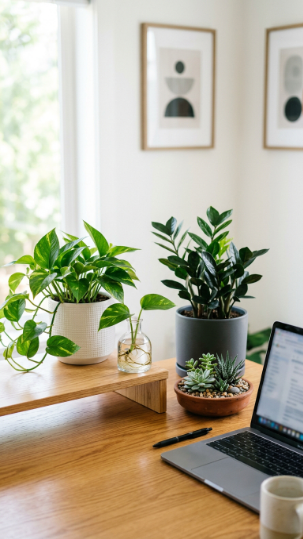
The ideal home office desk plant collection: a small Golden Pothos (trails elegantly from a desk riser without taking over), a compact ZZ Plant (handles the low light and irregular watering of a home office environment better than almost anything), a succulent or cactus in a beautiful small pot (needs almost no attention, adds living texture, and never outgrows its space quickly), and a single propagation vessel with a cutting in water (beautiful to look at, fascinating to observe, completely mess-free).
Desk plant heights: vary heights using a wooden desk riser or small stack of books under some plants — a flat collection of same-height plants at desk level looks static, while varied heights create visual rhythm and interest.
💡 Pro Tip: If your home office has limited natural light, a small LED grow light disguised as a stylish desk lamp solves two problems simultaneously — it keeps your plants genuinely healthy and productive rather than slowly declining, and it adds useful task lighting to your workspace. Modern grow-light desk lamps are genuinely attractive objects that look nothing like the utilitarian grow lights of a decade ago.
Explore our home office desk plant collection guide — plants, styling and grow lighting for desk-scale plant recommendations, riser styling, and grow light options. The University of Exeter’s workplace plant research is referenced at exeter.ac.uk.
The right desk plants make your home office a place of genuine creative nourishment — for your wellbeing as much as for the plants. Invest in both!
18. The Indoor Bottle Garden and Terrarium
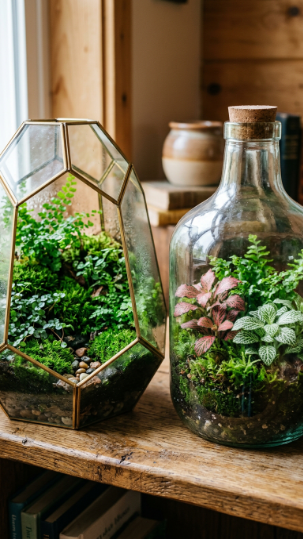
Terrariums and bottle gardens are the indoor garden idea that creates the most self-contained, most atmospherically magical, and most genuinely fascinating small plant world possible — a miniature ecosystem under glass that, when properly planted and sealed, can sustain itself with minimal intervention for months or years, creating a living artwork that changes slowly and subtly over time.
The closed terrarium — a glass vessel with a lid, sealed or nearly sealed — creates a self-sustaining water cycle: moisture evaporates from the plants and compost, condenses on the glass, and returns to the substrate, meaning a correctly planted closed terrarium can go weeks or months without watering. It’s the ultimate low-maintenance indoor garden.
Building a terrarium step by step: drainage layer of fine gravel or LECA at the base (2–3cm), activated charcoal layer above (1cm, prevents bacterial odors), then a rich, moisture-retentive compost layer (5–8cm). Plant with moisture-loving, compact, shade-tolerant plants — Fittonia for vivid nerve-leaf color, miniature ferns for soft texture, creeping moss for the ground layer, Peperomia varieties for compact foliage interest.
Geometric glass terrariums (available widely) create a more contemporary, architectural aesthetic than traditional round glass. Large glass bottles create a more traditional Wardian case-style bottle garden — planting through the bottle neck with long-handled tools is the satisfying challenge of this format.
💡 Pro Tip: Don’t seal a terrarium completely until you’ve observed it for two weeks — if condensation covers all four glass walls continuously, the terrarium is too wet and needs to be opened for a day to allow excess moisture to escape. If there’s no condensation at all after two weeks, it needs a small addition of water. The correct moisture level produces condensation on one or two walls in the morning that clears by afternoon — that’s your target balance.
Read our building a terrarium and bottle garden — complete beginner’s guide for vessel selection, planting technique, moisture management, and the best plants for enclosed growing.
A terrarium is a living world in a glass box — genuinely magical, genuinely self-sustaining, and genuinely unlike any other indoor garden experience!
19. The Staircase and Hallway Plant Gallery
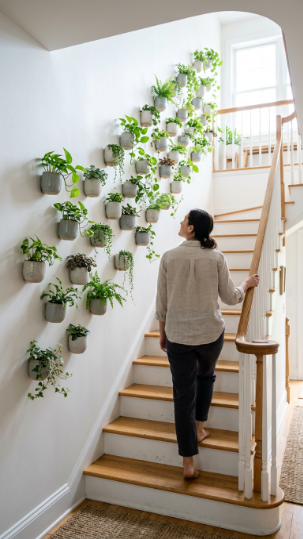
A staircase or hallway plant gallery is the indoor garden idea that transforms your most-used but most-neglected transitional space — the staircase and hallway — into a genuinely beautiful botanical installation that makes every journey through your home a pleasurable sensory experience rather than a purely functional transit.
Here’s the deal: staircases and hallways are among the most traveled spaces in any home, yet most people completely ignore them as planting opportunities. A rising arrangement of wall-mounted planters along a staircase wall, following the angle of the stairs, creates a botanical journey that makes your home feel like a curated, living space rather than a collection of functional rooms connected by corridors.
The staircase planting approach: wall-mounted ceramic or metal planters in a consistent style fixed at staggered heights that follow the stair angle create the most designed, cohesive effect. Trailing plants between the planters — their vines growing downward between mounting points — connect the individual planters visually into a continuous installation.
For narrow hallways: a single floating shelf at eye height running the full length of the hallway, with a continuous row of small plants in matching pots, creates a clean, gallery-quality display in a footprint of zero — no floor space, no obstruction, pure botanical gallery.
💡 Pro Tip: Use battery-operated LED strip lights mounted beneath your staircase shelf or above your wall-mounted planters — the plants are lit from below or above rather than relying on the typically poor staircase and hallway natural light, they look spectacular after dark as illuminated botanical installations, and the light genuinely helps maintain plant health in what are often the lowest-light spaces in any home.
Explore our staircase and hallway plant gallery guide — mounting, plants and lighting for fixing methods, plant selection for low-light transitional spaces, and lighting installation.
A staircase plant gallery makes every trip through your home a genuinely pleasurable experience — when did you last look forward to going upstairs?
20. The Maximalist Indoor Jungle Corner
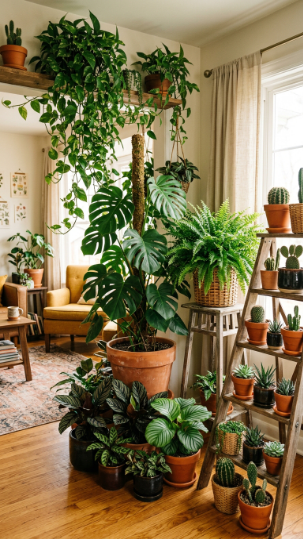
We’re finishing with the full vision — the maximalist indoor jungle corner that throws restraint entirely out of the window and creates the most abundantly, joyfully, unapologetically plant-filled indoor space imaginable. This is the indoor garden idea for people who love plants completely and want their home to show it.
Here’s the thing: a maximalist plant corner looks spectacular when it’s done with one organizing principle — vary everything except the pot material. Vary the plant height (floor to ceiling), vary the leaf size (giant Monstera beside tiny Fittonia), vary the texture (smooth succulents beside feathery ferns), vary the plant form (upright, trailing, cascading, architectural) — but keep your pot materials consistent (all terracotta, or all rattan, or all dark glazed ceramic). That single consistency creates cohesion in the apparent chaos and transforms a dense collection into a designed space.
Building the jungle corner: start with one tall anchor plant (minimum 120cm) — without a visual anchor, dense planting becomes chaos; with one, it becomes a curated jungle. Build upward with climbing plants on moss poles (Monstera, Philodendron). Fill outward with mid-height plants on stands and floor-level plants in large pots. Add hanging plants from ceiling hooks above the corner. Finish with small plants tucked into every remaining space.
💡 Pro Tip: Group plants closely together in your jungle corner rather than spacing them for individual visual clarity — plants growing close together create their own humidity microclimate, with each plant’s transpiration contributing to the moisture available to its neighbours. A jungle corner of closely grouped tropical plants is genuinely easier to care for than the same plants spread individually around a dry centrally heated room.
| Jungle Corner Layer | Plant Examples | Height Range |
| Ceiling/high | Hanging Pothos, String of Pearls | 180cm+ |
| Upper floor | Monstera on moss pole, Fiddle Leaf Fig | 120–180cm |
| Mid floor | Boston Fern on stand, Rubber Plant | 60–120cm |
| Low floor | Calathea, Peace Lily, Aglaonema | 30–60cm |
| Ground | Pilea, small ferns, Fittonia | 10–30cm |
Read our building a maximalist indoor jungle corner — the complete layering guide for the full layer-by-layer framework, pot selection, and humidity management for a dense plant collection.
A maximalist indoor jungle corner is the indoor garden idea that announces your values to every person who enters your home — that you love living things, that you choose beauty over minimalism, and that your home is genuinely, joyfully alive. There is nothing better!
Frequently Asked Questions
What are the best indoor garden ideas for a completely beginnerplant parent?
Start with the most forgiving plants and the simplest setups. A succulent and cactus windowsill collection (idea 9), a single trailing Pothos on a shelf (idea 2), or a ZZ Plant in a dark corner (idea 13) are all virtually impossible to kill and produce genuinely beautiful results with minimal knowledge or effort. The golden beginner rule: always underwater rather than overwater (the majority of indoor plant deaths are caused by overwatering, not underwatering), choose plants specifically matched to your actual light conditions rather than your wishful thinking, and start with two or three plants rather than twenty — mastering a small collection builds the confidence and knowledge to expand successfully.
How do I create an indoor garden in a room with almost no natural light?
First, assess what light you actually have — even a room described as “dark” typically has some ambient light from windows in adjacent rooms or hallways, and the shade-tolerant plants in idea 13 can genuinely thrive in surprisingly low light. For genuinely dark spaces, LED grow lights have transformed the possibilities — modern grow lights are attractive enough to use as interior design features and can sustain a wide range of plants in any room regardless of natural light. Start with ZZ Plants, Cast Iron Plants, and Heartleaf Philodendron for naturally very low light, and add a grow light if you want to expand your plant options or grow food indoors.
What’s the most low-maintenance indoor garden idea for a busy person who travels frequently?
The three lowest-maintenance indoor garden setups for people who travel are: a closed terrarium (idea 18), which is essentially self-watering and can be left for weeks once correctly established; a succulent and cactus collection (idea 9), which actively prefers to dry out completely between waterings and is genuinely fine for 2–4 weeks without attention; and ZZ Plants or Cast Iron Plants in any arrangement, which are the closest things to indestructible houseplants that exist. For any indoor garden when you travel, self-watering pots with internal water reservoirs are a worthwhile investment — they extend the watering interval of any plant significantly.
How do I stop my indoor garden from making my apartment look cluttered?
The key to an abundant indoor garden that looks curated rather than cluttered is consistency in pot styling — choose one or two pot materials (all terracotta, all white ceramic, or all dark glazed ceramic) and use them exclusively throughout your home. Inconsistent pot styles (a terracotta here, a plastic nursery pot there, a novelty animal-shaped pot somewhere else) create visual noise that makes even a small plant collection look messy. Also, group plants together rather than distributing them individually around a room — a thoughtfully composed group of five plants in one corner looks designed, while the same five plants scattered across a room look like houseplants placed randomly wherever there was a spare surface.
Can I grow food indoors without a garden or outdoor space?
Absolutely — and ideas 4, 8, and 15 in this article are entirely dedicated to exactly that. A kitchen windowsill herb garden provides fresh culinary herbs year-round. A microgreen growing rack produces nutritious fresh food in 7–14 days from seed. A windowsill salad tray provides cut-and-come-again leaves continuously. None of these require outdoor space, significant equipment, or specialist knowledge — just a bright windowsill, some seeds, and a little patience. The combination of all three setups on a single kitchen counter provides a genuinely meaningful contribution of fresh food to your diet, grown entirely indoors, year-round.
A Few Final Thoughts
Indoor garden ideas are ultimately about one thing: making your home feel alive — genuinely, beautifully, breathingly alive in a way that no furniture, no paint color, and no interior accessory can replicate. Whether you start with a single trailing Pothos on a high shelf that grows longer and more beautiful every week, or dive straight into a maximalist jungle corner that makes your living room feel like a botanical sanctuary, every plant you bring indoors and every creative garden idea you act on moves your home incrementally closer to the living, green, deeply personal space that most of us are instinctively drawn to but rarely give ourselves permission to fully create. The best indoor garden isn’t the most expensive or the most technically complex — it’s the one that’s genuinely matched to your space, your lifestyle, and the plants you actually love. Start with one idea from this list today. Add another next month. Let it grow. Now go make it happen! 🌿