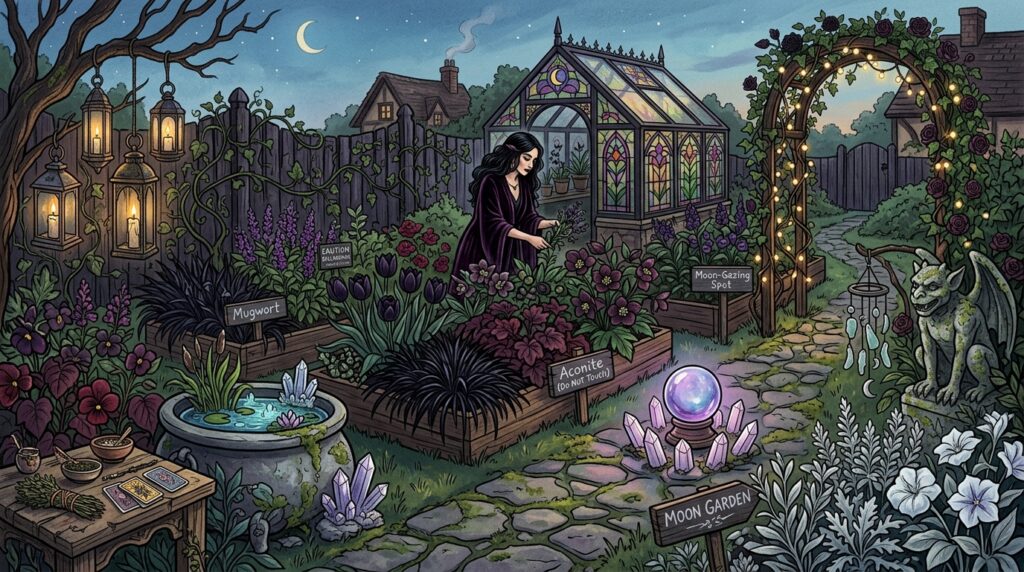
21 Witchy Garden Ideas for Magical Spaces (That Are Darkly Beautiful All Year)
Does your garden feel a little too… ordinary? Too cheerful, too predictable, too much like every other yard on the street? Because here’s the thing — some of us want a garden that feels like it belongs in a forest clearing at midnight, full of mystery, dark beauty, and the kind of atmosphere that makes people stop at the gate and stare. Witchy garden ideas are having a massive moment right now, and the results range from subtly atmospheric to full-on gothic spectacular. The secret is that the best magical garden spaces aren’t just Halloween decorations left out year-round — they’re genuinely beautiful, intentionally designed outdoor spaces built around dark foliage, atmospheric lighting, symbolic plants, and carefully chosen hardscape elements that create a mood unlike anything else in garden design. Ready to find out?
At a Glance
- Dark foliage plants — black mondo grass, near-black hellebores, deep purple smokebush, and dark heuchera — are the foundation of every genuinely witchy garden.
- Symbolic and folklore plants — mugwort, wormwood, foxglove, belladonna, and mandrake — add authentic botanical magic and incredible textural interest.
- Atmospheric lighting — iron lanterns, flickering candles, string lights through dark hedging — transforms any garden into something genuinely mysterious after dark.
- A witchy garden works in any size space — a dark container corner, a moody balcony, or a full gothic garden room all deliver the aesthetic powerfully.
- The best magical garden spaces layer texture, symbolism, scent, and structure to create atmosphere that works in every season, not just October.
1. Build Your Foundation With Black Mondo Grass

If you build your witchy garden on nothing else, build it on black mondo grass — because nothing else in the plant world delivers that pure, uncompromising darkness that a magical garden space needs at its foundation. Ophiopogon planiscapus ‘Nigrescens’ produces jet-black, needle-fine leaves that spread slowly into dense ground-covering clumps of genuine darkness.
It’s fully evergreen, completely hardy, and virtually indestructible — which makes it not just atmospherically perfect but practically ideal for a low-maintenance dark garden. Use it as ground cover beneath taller dark shrubs, edge a winding path with alternating clumps, or plant it in black ceramic containers for a focused desk of pure darkness.
The textural contrast between black mondo grass and silvery-leafed plants like artemisia or lamb’s ears beside it creates a light-versus-dark tension that’s incredibly compelling in a witchy garden setting.
🌿 Pro Tip: Black mondo grass spreads very slowly — plant it in generous clumps of five or seven plants rather than singles to get a meaningful ground-covering effect in a reasonable timeframe. Dividing established clumps in spring speeds the process considerably.
Explore dark foliage plant combinations in our winter border planting guide.
The RHS has a detailed Ophiopogon growing and care guide for dark garden borders.
Start with black mondo grass and every other witchy garden element has a perfect dark canvas to work against!
2. Plant the Witch’s Classic — Wormwood and Artemisia
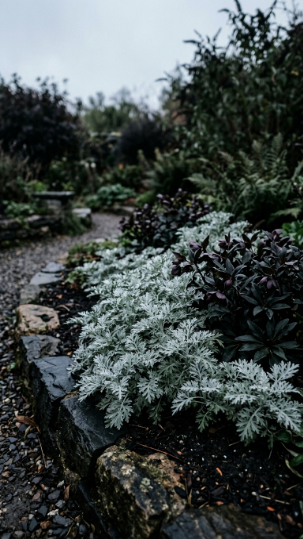
Wormwood (Artemisia absinthium) is one of the most historically loaded plants in witchcraft and folk magic — and it’s also one of the most strikingly beautiful plants you can grow. The deeply cut, intensely silver-grey foliage creates a ghostly, luminous presence in a dark garden that seems to glow at twilight and in moonlight in a way that’s genuinely extraordinary.
Here’s the deal: artemisia and wormwood are among the easiest silver plants to grow — they tolerate poor, dry soil, thrive in full sun, and ask almost nothing beyond occasional cutting back to prevent woodiness. The pungent, complex fragrance when you brush past the leaves adds a whole sensory dimension to the witchy garden experience.
In folklore, wormwood was used for protection, psychic enhancement, and summoning — and planted at the garden entrance, that symbolism translates into a powerful atmospheric statement that sets the tone for everything beyond.
| Artemisia Variety | Foliage | Height | Key Quality |
| A. absinthium | Silver-grey, deeply cut | 80cm | Classic wormwood, strongest scent |
| A. ‘Powis Castle’ | Fine silver filigree | 60cm | Most ornamental, non-invasive |
| A. ludoviciana | Broad silver-white | 90cm | Most vigorous, spreads freely |
| A. schmidtiana ‘Nana’ | Fine silver mound | 15cm | Perfect for edging and containers |
Explore silver and dark plant combinations in our year-round garden structure guide.
Gardeners’ World has a beautiful Artemisia growing and variety guide.
Plant wormwood at your garden gate and the witchy atmosphere begins before visitors even step inside!
3. Create a Moonlight Garden With White and Silver Plants
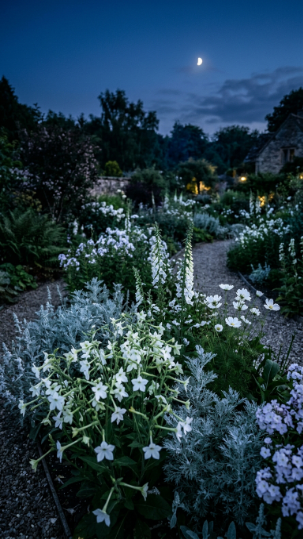
A moonlight garden — planted entirely with white flowers and silver foliage that glow luminously in low light and moonlight — is one of the most magical and sophisticated witchy garden ideas you can create. It’s the garden that looks almost ordinary by day and genuinely supernatural after dark.
Plant white nicotiana, white cosmos, pale foxgloves, silver artemisia, white phlox, and lamb’s ears in generous drifts and the result is a garden that seems to generate its own light at dusk and under the moon. The white flowers and silver leaves catch every photon of available light and reflect it back with an almost luminescent quality.
The secret is density — a moonlight garden needs enough white and silver planted in masses that the effect reads from a distance. A few scattered white flowers don’t achieve it; sweeping drifts of luminous plants do.
🌿 Pro Tip: Add white-flowering night-scented plants — white nicotiana and moonflower vine (Ipomoea alba) — because a moonlight garden should engage smell as powerfully as sight. The heavy, exotic fragrance that releases after dark adds a sensory layer that makes the experience genuinely enchanting.
Discover white and silver plant combinations in our winter flowering plant combinations guide.
The RHS covers white and silver garden planting schemes with variety recommendations.
Plant your moonlight garden this spring and experience summer evenings like never before!
4. Grow Foxgloves for Tall, Dramatic, Folklore-Loaded Beauty
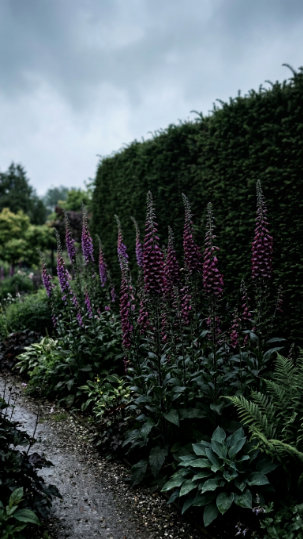
Foxgloves (Digitalis purpurea) are the quintessential plant of the witch’s garden — tall, dramatic, loaded with folklore, genuinely toxic, and extraordinarily beautiful. Those tall spires of tubular flowers spotted with dark interior markings have been associated with fairy folk, witchcraft, and forest magic for centuries throughout European traditions.
Look for the darkest varieties for maximum witchy garden impact — ‘Camelot Lavender’ produces deep purple-lavender spires, ‘Pam’s Choice’ has near-white flowers with dramatic dark purple spotting inside, and ‘Dalmation Purple’ delivers rich deep tones on compact plants perfect for smaller magical garden spaces.
Here’s the thing: foxgloves self-seed prolifically in the right conditions, gradually naturalizing through a dark garden border in the wild, spontaneous way that feels completely appropriate for a magical garden aesthetic. Once established, they maintain themselves.
Find tall dramatic plants in our winter border planting guide.
Gardeners’ World has a comprehensive foxglove growing and variety guide with safety information.
Plant foxgloves at the back of your witchy border and let them tower over everything in gothic splendor!
5. Install Iron and Rusted Metal Structures for Gothic Hardscape
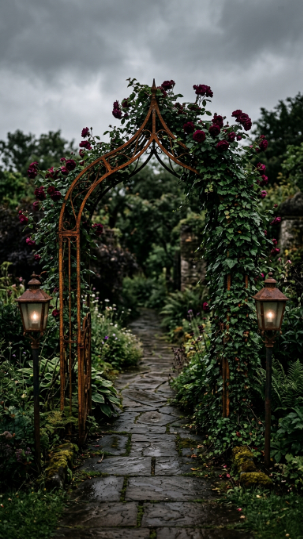
Iron and rusted metal hardscape — arches, obelisks, trellises, gates, and lantern holders — are the structural skeleton of a truly atmospheric witchy garden. The warm rust tones of weathering iron and the dark drama of painted wrought iron both communicate age, mystery, and a particular gothic romance that no other garden material replicates.
A rusted iron arch at the entrance to a garden section, draped with dark climbing roses or Clematis ‘Romantika’ (near-black flowers), creates a threshold moment — a deliberate passage from ordinary garden to magical space — that’s both practical and powerfully symbolic.
Talk about a game-changer! Iron structures age beautifully in a garden environment — they rust, they darken, they accumulate moss and lichen in ways that make them look increasingly atmospheric and intentional over years rather than degrading unattractively.
🌿 Pro Tip: Encourage moss growth on iron structures by painting them with a thin slurry of natural yogurt and water — the beneficial bacteria in the yogurt accelerate moss colonization on metal and stone surfaces, aging a new iron arch by several decades in a single season.
Explore structural garden elements in our year-round garden structure guide.
Gardeners’ World covers metal garden structures and climbing plant pairings beautifully.
A rusted iron arch changes the entire personality of your garden in a single installation!
6. Plant a Smokebush for Dark Purple Drama All Season
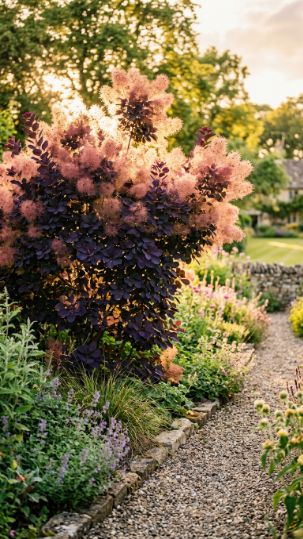
Cotinus coggygria ‘Royal Purple’ — smokebush — is one of the most dramatic shrubs available for a witchy garden and one that earns its space in every single season. The large, rounded leaves are a deep, rich purple-black that provides an extraordinary dark backdrop for lighter-colored plants, and in late summer those ethereal smoky pink-grey seed head plumes create an atmosphere of genuinely surreal beauty.
In autumn the leaves turn fiery crimson and scarlet before falling, and the bare winter structure is bold and graphic against a grey sky. This is a plant that genuinely delivers year-round drama in a single specimen.
Pretty cool, right? Hard prune smokebush in spring for maximum foliage color intensity — the more you cut back, the deeper and larger the new leaves, at the expense of the flowers and smoky plumes.
Explore dark shrubs for witchy gardens in our winter border planting guide.
The RHS has an excellent Cotinus growing and pruning guide for garden borders.
Plant smokebush and your garden gains a year-round dark anchor that nothing else matches!
7. Create a Cauldron Water Feature as a Focal Witchy Element
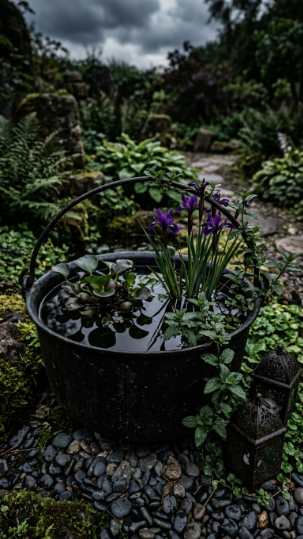
A black cast iron cauldron repurposed as a small water feature and planted with aquatic or marginal plants is one of the most iconic and impactful witchy garden ideas you can install — immediately recognizable as a deliberate magical aesthetic choice while also functioning as a genuine garden feature.
Fill it with water and plant with dark-leafed water hyacinth, miniature purple iris, water forget-me-not, and trailing water mint — the aromatic mint releasing its scent when touched adds a sensory dimension that deepens the atmospheric experience. Add a small submersible pump for gentle surface movement that catches light beautifully.
The symbolic weight of a cauldron as a garden centerpiece is unparalleled in the witchy garden repertoire — and placed at the intersection of garden paths or as the focal point of a dedicated magical garden room, it creates a scene that’s genuinely unforgettable.
🌿 Pro Tip: Add a few drops of liquid pond dye in dark blue or black to the cauldron water — it creates a beautifully mysterious dark reflective surface while being completely safe for plants and wildlife, and prevents algae from greening the water in warm weather.
Find water feature plant ideas in our creative indoor planter ideas guide.
The RHS covers container water gardening plants and setup in practical detail.
Install your cauldron water feature and create the most talked-about element in any magical garden!
8. Grow Hellebores for Dark, Nodding Winter Magic
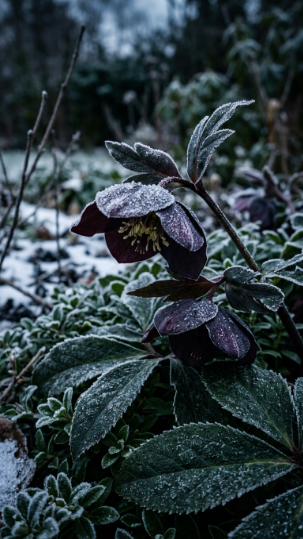
Hellebores — especially the darkest varieties in near-black, deep burgundy, and slate grey — are the witchy gardener’s most reliable and beloved plants. They bloom in the deepest, coldest months when everything else is bare and grey, producing nodding, mysterious flowers that face downward as if sharing secrets with the earth.
Look for named dark varieties for maximum impact: ‘Dark and Handsome’ produces near-black flowers, ‘Anna’s Red’ a deep wine crimson, ‘Onyx Odyssey’ near-black double flowers that look like small dark roses. These are perennials for winter garden interest that become more spectacular every year as clumps establish and multiply.
The gothic beauty of a dark hellebore covered in frost crystals in January is one of the most genuinely magical plant moments any garden offers — position them where you’ll encounter them up close on winter paths.
Find dark hellebore varieties in our perennials for winter interest guide.
Gardeners’ World has a stunning dark hellebore variety and growing guide.
Plant the darkest hellebores you can find and your witchy garden will bloom through the coldest nights!
9. Design a Herb Witch’s Garden With Magical and Medicinal Plants
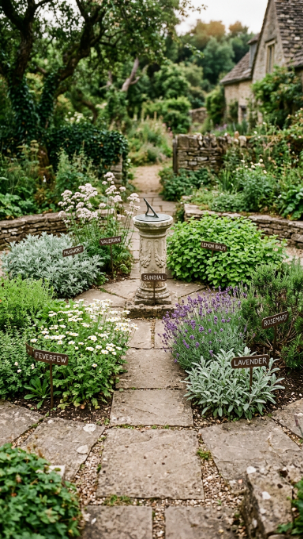
A dedicated witch’s herb garden — planted with historically significant magical and medicinal plants — is one of the most meaningful and beautiful witchy garden ideas because it combines genuine botanical knowledge with atmospheric garden design. This isn’t just a pretty herb garden; it’s a living apothecary with centuries of folklore behind every plant.
Plant a circular or square bed divided by stone paths and fill it with mugwort (for dreaming and protection), valerian (for calm and ancient medicine), lemon balm (for joy and healing), feverfew (for headaches and protection), lavender (for calm and purification), and rosemary (for memory and protection). Add iron herb labels with both common and Latin names for an alchemical, scholarly atmosphere.
Here’s the deal: these plants are all genuinely useful as well as symbolically significant — mugwort tea, lavender sachets, lemon balm tinctures — the witch’s herb garden is a garden you can actually use in multiple meaningful ways.
🌿 Pro Tip: Add a stone sundial or carved sphere at the center of your herb witch’s garden as a focal element — it grounds the space architecturally and adds a layer of celestial symbolism (the sun’s movement, the marking of time) that deepens the magical atmosphere considerably.
Explore herb garden design ideas in our indoor kitchen garden setup guide.
The RHS has a comprehensive herb garden design and plant guide for medicinal and culinary herbs.
Build your witch’s herb garden and create a space that nourishes body, spirit, and atmosphere simultaneously!
10. Use Dark Climbing Roses for Gothic Romantic Beauty
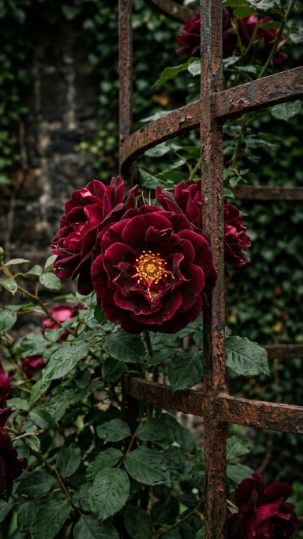
Dark climbing roses in deep crimson, burgundy, and near-black are the most romantically gothic plants in the entire witchy garden repertoire. Varieties like ‘Tuscany Superb’, ‘Souvenir du Docteur Jamain’, ‘William Shakespeare 2000’, and ‘The Dark Lady’ all produce flowers of extraordinary depth and richness — velvety, complex, and deeply evocative of the classic gothic rose aesthetic.
Train them over rusted iron arches, stone walls, or dark wooden pergolas for a combination of plant and structure that’s powerfully atmospheric and ages into something increasingly beautiful over years. The heavy, complex fragrance of dark old roses adds a sensory dimension that makes a witchy garden genuinely intoxicating on warm evenings.
The contrast of dark crimson blooms against silver artemisia or pale stone walls creates a colour tension that reads as simultaneously romantic and dramatic — the essence of the gothic garden aesthetic.
Discover climbing plant ideas in our year-round garden structure guide.
The RHS covers dark and gothic rose varieties with detailed growing guidance.
A dark climbing rose over an iron arch is gothic garden perfection — plant one and wait for the magic!
11. Add Twisted and Gnarled Trees for Atmospheric Structure
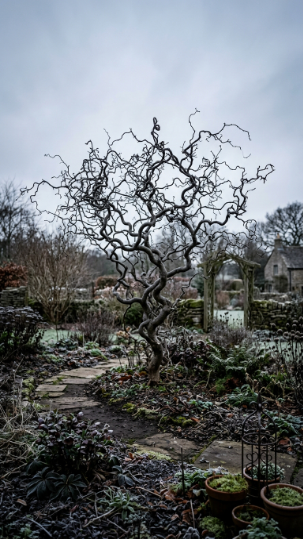
Twisted and gnarled trees are the atmospheric backbone of any serious witchy garden — their contorted forms create the visual language of old magic, fairy tale forests, and genuinely unsettling natural beauty that no other garden element replicates.
Corkscrew hazel (Corylus avellana ‘Contorta’) — also wonderfully called Harry Lauder’s Walking Stick — produces spectacularly twisted, corkscrew branches that are most dramatic and beautiful in winter when the leaves have fallen and the full grotesque elegance of the branch structure is revealed. Weeping mulberry, contorted willow, and twisted Japanese maple all deliver similar atmospheric drama in different scales.
Here’s the thing: the winter silhouette of a contorted tree against a grey January sky is one of the most genuinely witchy garden moments any plant can create — it looks alive in a way that upsets the usual visual expectations of a garden.
🌿 Pro Tip: Position twisted trees where they’re visible against a plain backdrop — a grey wall, pale sky, or light-colored fence — so the dramatic branch structure reads clearly as a silhouette. Against a busy dark background, the contorted form gets lost entirely.
Find atmospheric structural plants in our winter border planting guide.
Gardeners’ World features contorted and weeping trees for atmospheric gardens with variety guidance.
A twisted tree in winter is pure witchy garden magic that no decoration can replicate!
12. Build a Witchy Garden Room With Dark Hedging Walls
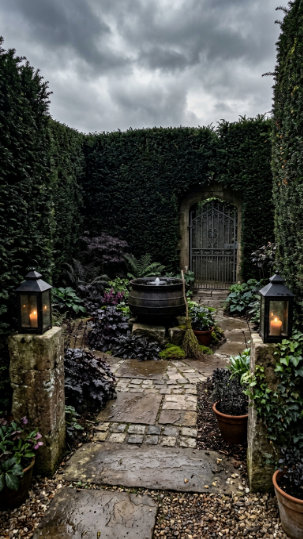
A garden room enclosed by dark hedging is the architectural achievement that transforms a witchy garden from a collection of atmospheric plants into a genuine enclosed magical space — a room with green walls that separates the outside world completely and creates its own interior atmosphere.
Dark yew (Taxus baccata) is the classic choice — deep, almost black-green, dense, and clippable into perfectly solid walls. It’s historically associated with churchyards, death, and magic across European traditions, making it symbolically loaded as well as visually perfect. Hornbeam and beech also create excellent garden room hedging with slightly lighter tones.
The enclosed garden room creates the sensation of entering a different world — which is precisely the experience a magical garden space should provide. Add a narrow gateway, a winding approach path, and the effect becomes genuinely theatrical.
Find garden room design ideas in our year-round garden structure guide.
The RHS covers yew hedge planting, growing, and clipping in excellent detail.
Enclose your magical space with dark hedging walls and step through into another world!
13. Plant Belladonna (Deadly Nightshade) as a Dramatic Conversation Piece
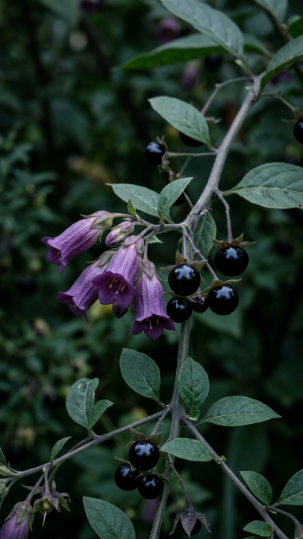
Belladonna (Atropa belladonna) — deadly nightshade — is the most legendarily witchy plant in the entire European herbalist tradition, and growing it in a dedicated witchy garden is a bold, dramatic, and completely legal choice in most regions. Those deep purple tubular flowers and the shining jet-black berries are genuinely beautiful and undeniably ominous simultaneously.
Plant it in a clearly labeled, dedicated section of your witchy garden away from areas used by children and pets — responsible growing of toxic plants is absolutely possible with proper placement and clear labeling. The dark folklore around belladonna — flying ointments, visions, ancient medicine — makes it the most symbolically loaded plant in the witchy garden repertoire.
It grows vigorously, reaches impressive height (up to 150cm), and the combination of beautiful flowers and menacing berries creates a plant that communicates complexity and danger in the most botanically authentic way possible.
⚠️ Safety Note: Belladonna is highly toxic — every part of the plant. Wear gloves when handling, never grow where children or pets have unsupervised access, and wash hands thoroughly after any contact.
Explore toxic but beautiful plants in our winter border planting guide.
Gardeners’ World covers growing potentially toxic plants responsibly with safety guidance.
Grow belladonna with knowledge and respect — the most authentic witchy garden plant there is!
14. Create Atmospheric Lighting With Iron Lanterns and Candles
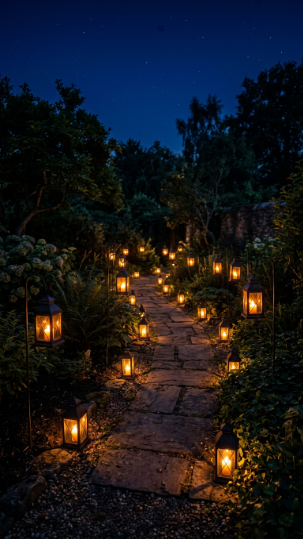
Iron lanterns with real or battery-operated candles are the single most transformative lighting element in a witchy garden — and they cost remarkably little relative to the atmospheric impact they create. The warm, flickering amber light against deep blue night sky and dark surrounding foliage creates a scene of such dramatic beauty that it genuinely looks like a film set.
Line a winding garden path with lanterns at varying heights — some directly on the ground, some on low iron pillars, some hung from tree branches — for a lighting scheme that creates depth, mystery, and a sense of a pathway leading toward something unknown.
Here’s the deal: real candles in glass-protected iron lanterns always outperform electric alternatives in atmospheric quality — the true flicker of a real flame creates an organic light movement that battery-operated options can approximate but never quite match.
Discover garden lighting ideas in our winter garden seating guide.
Apartment Therapy covers atmospheric garden lantern and candle styling with creative placement ideas.
Line your path with iron lanterns tonight and watch your garden become something genuinely magical!
15. Grow Mandrake for Ultimate Witchy Garden Authenticity
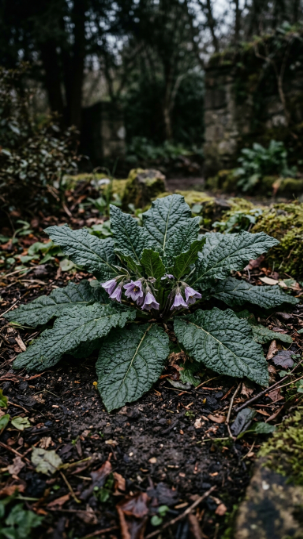
Mandrake (Mandragora officinarum) is perhaps the single most mythologically significant plant in the entire Western magical tradition — its forked root resembling a human figure has inspired centuries of folklore, from Shakespeare to Harry Potter, and growing one in your witchy garden is the ultimate authentic botanical statement.
The plant itself is genuinely beautiful — large, dark, deeply wrinkled leaves that spread dramatically low to the ground, with pale purple bell-shaped flowers in spring and yellow-orange berries in autumn. It’s a Mediterranean perennial that needs sharp drainage and shelter from hard frosts, but rewards careful cultivation with a plant of extraordinary symbolic resonance.
Growing mandrake requires patience and specific conditions — it’s slow, it’s fussy about drainage, and it sulks in cold wet winters. But for the committed witchy gardener, there’s simply no plant that communicates the same depth of botanical magic.
Explore rare and significant garden plants in our exotic terrarium plant guide.
The RHS covers Mandragora officinarum growing conditions in specialist detail.
Grow mandrake successfully and you’ve achieved something genuinely rare and remarkable in the witchy garden world!
16. Style a Dark Moss and Fern Woodland Corner
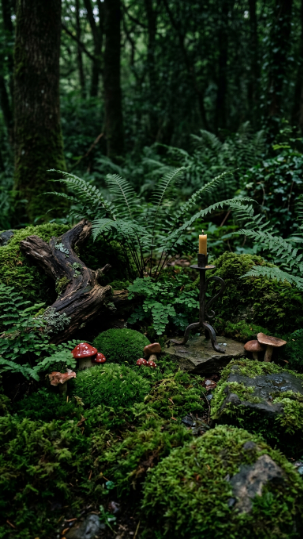
A dark moss and fern woodland corner creates the most atmospherically convincing piece of genuine wildwood you can achieve in a garden — the sensation of standing in a deep, old forest where magic feels entirely plausible. Cushion moss covering the ground and rocks, dark-stemmed ferns unfurling above, a gnarled fallen log, and a single iron candle holder placed among the foliage creates a scene of profound natural beauty.
Use shade-tolerant ferns — hart’s tongue, male fern, or the dark-stemmed Dryopteris varieties — alongside Marchantia liverwort and cushion moss for the ground layer. Add decorative mushroom ornaments and a carved stone face half-hidden among the fern fronds for the suggestion of something watching from the green depths.
Pretty cool, right? This corner practically creates its own mysterious microclimate — cooler, damper, darker than the rest of the garden — that reinforces the sense of entering genuinely different territory.
🌿 Pro Tip: Keep this corner consistently moist — water the moss and surrounding soil regularly and mulch deeply with leaf mold to maintain the cool, damp conditions that create the authentic deep-woodland atmosphere. Dry moss turns brown and loses all of its magical quality.
Create your woodland corner with ideas from our closed terrarium plant selection guide.
Gardeners’ World covers creating shaded woodland garden corners with plant and design guidance.
Build your woodland corner and create a space where magic feels genuinely present!
17. Add Crystal, Stone, and Mineral Garden Ornaments
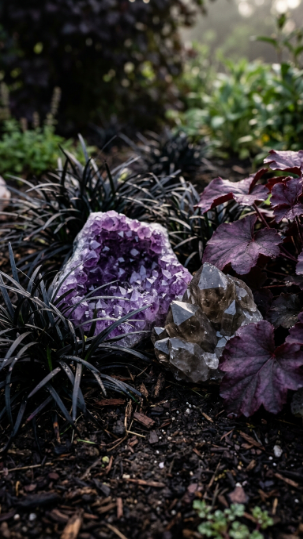
Crystal and mineral ornaments placed among dark garden plants create one of the most visually striking and symbolically resonant witchy garden ideas — the geological age and natural formation of crystals communicates a deep connection to earth and time that perfectly complements the magical garden aesthetic.
Large amethyst clusters, smoky quartz points, dark obsidian pieces, and moss agate stones placed among black mondo grass, dark heuchera, and low border plants create stunning moments of discovery as visitors move through the garden. The light-catching facets of larger crystals are especially beautiful in morning and evening light.
Here’s the thing: crystals are genuinely weather-resistant — most are harder than steel and completely unaffected by rain, frost, or UV. The only consideration is theft; use larger, heavier pieces that aren’t easily pocketed.
Find decorative ornament ideas in our creative indoor planter ideas guide.
Apartment Therapy covers incorporating crystals and minerals in garden design atmospherically.
Place your crystals among the dark plants and let morning light reveal their magic!
18. Plant a Witchy Halloween Fairy Garden Container Display
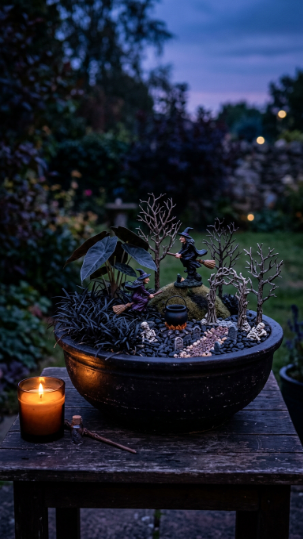
A witchy Halloween fairy garden container takes the miniature garden concept and pushes it into full dark magical territory — creating a completely contained, exquisitely detailed tiny world of gothic atmosphere. This is one of the most creative and photogenic witchy garden ideas in this entire list.
Plant a large dark container with black mondo grass as ground cover, a miniature dark-leafed plant for height, and then populate with tiny cauldron ornaments, miniature witch figurines on broomsticks, skeletal miniature trees made from twisted wire, dark pebble mulch, and tiny iron lanterns. Add a battery-operated fairy light wrapped through the skeletal trees for evening magic.
The miniature scale means every element is a tiny discovery — the details reward close inspection and the whole creates a world that feels genuinely complete and alive.
🌿 Pro Tip: Use a black or very dark container for maximum contrast with any lighter plant elements — the dark vessel grounds the whole display and makes the tiny figurines and ornaments read clearly rather than getting lost against a light ceramic background.
Build your witchy container display with ideas from our Halloween fairy garden setup guide.
Gardeners’ World features miniature container garden styling with detailed plant and accessory guidance.
Build your miniature witchy world and create the most enchanting container display on any street!
19. Plant Elder (Sambucus) for Folklore, Beauty, and Dark Drama
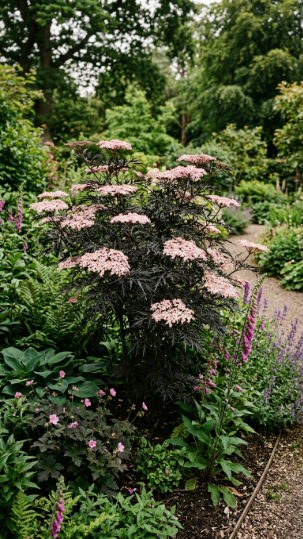
Elder (Sambucus nigra) is one of the most magically significant trees in Northern European folklore — associated with protection, spirits of the dead, healing, and the fairy world across dozens of cultural traditions. And in its ornamental form, ‘Black Lace’ elderberry is also one of the most strikingly beautiful garden shrubs available anywhere.
The deeply cut, near-black feathery foliage of ‘Black Lace’ looks like living black lace against a garden backdrop — extraordinarily elegant and genuinely dark — while the flat-topped pale pink flower heads in summer create a stunning light-versus-dark contrast that’s pure witchy garden gold. The black berries that follow are deeply atmospheric and wildlife-friendly.
Here’s the deal: ‘Black Lace’ elderberry is also fast-growing, fully hardy, and remarkably easy — one of the most rewarding dark shrubs you can plant for immediate and long-lasting impact in a magical garden space.
Explore dark shrub combinations in our winter border planting guide.
The RHS has a comprehensive ‘Black Lace’ elderberry growing guide with pruning and care advice.
Plant elder and invite one of the most folklore-rich plants in the world into your magical garden!
20. Incorporate Skulls, Bones, and Gothic Ornaments Thoughtfully

Gothic ornaments — stone skulls, carved gargoyles, weathered bone-like forms, iron crows, and stone faces — are the finishing details that fully commit a garden to the witchy aesthetic and transform it from “dark planting scheme” into a genuinely magical space with personality and intention.
The secret to using gothic ornaments beautifully rather than garishly is naturalistic placement and weathering. A stone skull half-hidden among hellebore leaves, colonized by moss and surrounded by black mondo grass, reads as a genuine garden discovery rather than a Halloween prop. Placement, context, and patina are everything.
Carved stone faces looking out from ivy-covered walls, iron crow silhouettes perched on gate posts, stone gargoyles anchoring garden corners — each element should feel as if it’s been there for decades rather than placed last weekend.
🌿 Pro Tip: Accelerate the aging and weathering of new stone ornaments using the yogurt painting technique — coat new stone skulls and carvings with diluted natural yogurt and place in a shaded, damp position for a summer to develop an authentic mossy, aged patina incredibly quickly.
Find ornament styling ideas in our miniature garden terrarium ideas post.
Apartment Therapy covers gothic and dark garden ornament styling with thoughtful placement advice.
Place your gothic ornaments with patience and naturalism — they’ll look like they’ve always belonged!
21. Design a Complete Witchy Garden Path Experience
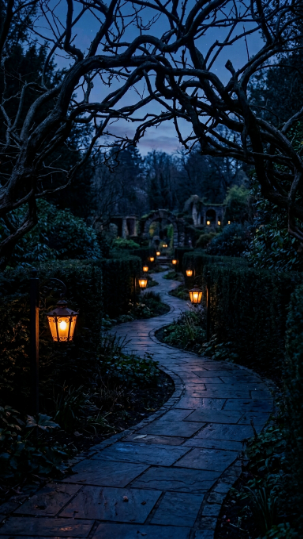
The witchy garden path is the experience that ties every other idea on this list together into a complete, immersive magical garden space — because a garden isn’t just a collection of plants and ornaments, it’s a journey through a curated sequence of atmospheric moments.
Design your path to wind rather than proceed in a straight line — curves create mystery and anticipation in a way straight paths completely prevent. Lay it in dark slate or worn stone pavers, edge with black mondo grass and low artemisia, press dark hedging in from both sides so the path feels enclosed and slightly pressured, and hang twisted branches overhead where possible to create a canopy effect.
Place iron lanterns at irregular intervals along the path — not evenly spaced, but clustered where the atmosphere requires focus and absent in darker stretches that need mystery. Lead the path to a destination — your cauldron water feature, a stone bench, the entrance to your hedge-enclosed garden room — that rewards the journey completely.
Talk about a game-changer! A thoughtfully designed witchy garden path turns your entire outdoor space into an immersive experience that visitors move through rather than simply observe — and that experiential quality is what separates a truly magical garden from a collection of atmospheric plants.
Build your path experience with ideas from our year-round garden structure guide.
Gardeners’ World covers garden path design and atmospheric planting with layout and plant guidance.
Design your path with intention and every step through your witchy garden becomes an experience to remember!
Frequently Asked Questions
What are the best plants for a witchy garden for beginners?
Black mondo grass, hellebores, artemisia ‘Powis Castle’, and smokebush are the four best starting points for beginner witchy gardeners — all are hardy, widely available, relatively low-maintenance, and deliver immediate and powerful atmospheric impact. Black mondo grass provides the dark ground-level foundation, hellebores give winter bloom drama, artemisia brings ghostly silver contrast, and smokebush creates a dark shrub anchor. Start with these four and build your magical garden outward from there.
Can I create a witchy garden in a small space or on a balcony?
Absolutely — and some of the most focused and atmospherically intense witchy garden ideas work best in small, enclosed spaces. A dark balcony with black containers, trailing dark ivy, a single twisted dwarf tree, iron lanterns, and a small cauldron-style water bowl creates a completely convincing magical space in twelve square feet. The enclosure of a small balcony actually enhances the witchy atmosphere by creating exactly the intimate, enclosed feeling that full garden rooms achieve with hedging.
Are witchy garden plants safe for children and pets?
Plant selection requires careful thought if children or pets use the garden space regularly. Many of the most atmospherically significant witchy plants — foxglove, belladonna, black nightshade, and mandrake — are toxic. In family gardens, focus the most dramatic toxic plants in clearly bounded, inaccessible sections, or substitute safer alternatives: dark heuchera instead of belladonna for dark foliage, dark snapdragons instead of foxgloves for tall spires. Always label any toxic plants clearly and educate older children about garden plant safety.
How do I make my witchy garden look atmospheric year-round, not just at Halloween?
The secret is building atmosphere through permanent structural and plant choices rather than seasonal decorations. Dark evergreen plants — black mondo grass, dark yew hedging, elder ‘Black Lace’, and evergreen dark heuchera — maintain the aesthetic year-round. Iron structures, stone ornaments, crystal placements, and atmospheric path design all contribute regardless of season. Plan your seasonal succession so something atmospheric is always happening: hellebores in winter, foxgloves in spring, dark roses and smokebush in summer, berries and seed heads in autumn.
What lighting works best for creating a witchy garden atmosphere at night?
Iron lanterns with real or battery-operated candles create the most authentic witchy garden lighting — the warm, flickering amber light against dark foliage is genuinely atmospheric in a way that modern LED lighting rarely matches. Supplement with warm white string lights woven through dark hedging or twisted trees for fairy-tale depth, and use uplighting on specimen trees to cast dramatic shadows upward. Avoid cool white or blue-toned lighting entirely — the warmth of amber and gold light is essential to the magical garden atmosphere after dark.
A Few Final Thoughts
Creating a witchy garden is one of the most personally expressive and genuinely exciting directions any gardener can take — because it draws on folklore, botanical history, atmospheric design, and a commitment to beauty that most conventional garden styles never quite reach. Whether you’re planting a dedicated witch’s herb garden with mugwort and valerian, building a cauldron water feature at the center of a dark garden room, training near-black climbing roses over a rusted iron arch, or simply beginning with a clump of black mondo grass and a single iron lantern, every element you add deepens the magic of your outdoor space in ways that grow more powerful with each passing season. The most magical gardens aren’t built overnight — they’re cultivated slowly, with intention and patience, accumulating atmosphere the way old places accumulate character. Start with one dark plant, one meaningful ornament, one atmospheric lighting moment, and let your magical garden grow from there. Your most enchanting outdoor space is waiting to be conjured — now go make it happen!