Your balcony is sitting there — empty, echoing, painfully under-used — while your neighbors have turned theirs into something that looks straight out of a lifestyle magazine. Sound frustratingly familiar? Here’s the thing: you don’t need a huge budget, a landscape designer, or even a full weekend to completely transform your outdoor space. With the right DIY plant arrangements for balconies, you can go from bare concrete to genuinely stunning in a few hours. Whether you’re working with a 4-foot juliet ledge or a sprawling wraparound terrace, there’s a setup here that’ll work perfectly for you. Ready to find out? Let’s dive in!
At a Glance
- Most balcony plant arrangements can be completed in 2–4 hours with materials costing $20–$60 total from garden centers and hardware stores.
- Vertical arrangements — wall grids, pallet systems, and hanging clusters — are the game-changing approach for small balconies with limited floor space.
- Mixing thriller, filler, and spiller plants in every container is the single design rule that separates stunning arrangements from forgettable ones.
- Weight distribution matters — always spread containers across the full balcony floor and favor lightweight materials like fabric grow bags and plastic liners over heavy ceramics.
- A well-planned balcony plant arrangement with layered heights, mixed textures, and a cohesive color palette creates the illusion of a much larger, professionally designed outdoor space.
1. The Classic Thriller-Filler-Spiller Container
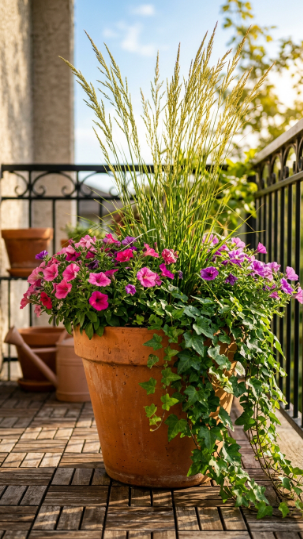
If you learn exactly one plant arrangement rule and forget everything else, make it this one. Thriller, filler, spiller — a tall dramatic centerpiece plant, compact mid-height filler blooms, and a trailing plant cascading over the pot’s edge — is the formula that makes every container look deliberately designed and lushly professional.
The thriller draws the eye upward (try ornamental grasses, tall salvias, or a single dramatic cordyline). The filler creates density and color (petunias, calibrachoa, compact marigolds). The spiller softens the container edges with movement and flow (ivy, bacopa, sweet potato vine, trailing nasturtium).
Pack plants more tightly than feels comfortable — professional container designers plant at roughly twice the spacing recommended on labels. The dense, abundant result is entirely worth it.
💡 Pro Tip: Choose your thriller first, then build the color story of filler and spiller around it. Starting with the star plant and supporting it with complementary choices always produces more cohesive results than selecting three plants independently and hoping they work together.
Get more ideas at thriller filler spiller balcony container arrangements and check out Gardeners’ World’s container planting combination guide.
Master this one formula and every container you ever plant will look stunning!
2. The Railing Rainbow — Graduated Color Planter Boxes
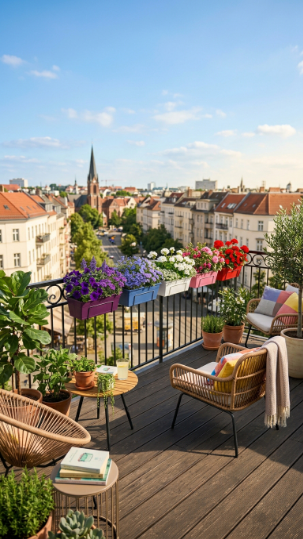
Here’s the deal: mounting five planter boxes along your railing and planting them in a deliberate color gradient — deep purple through lavender, white, blush pink, and vivid red — creates a visual impact so striking that people actually stop and photograph it from the street below. It’s one of the simplest and most breathtaking DIY plant arrangements for balconies imaginable.
The secret is committing fully to the color story rather than mixing randomly. Each box gets one dominant color family: deep purple lobelia, blue calibrachoa, white bacopa, blush pink petunia, red verbena. The gradient reads as a complete artwork from a distance and a beautifully detailed collection up close.
Use matching railing box hardware — same style, same color — so the containers disappear and the flowering gradient is all you see. Consistency in the vessels makes the plant colors sing even louder.
| Box Position | Color Family | Plant Suggestion |
| Far left | Deep purple | Lobelia, heliotrope |
| Center-left | Soft blue | Calibrachoa, ageratum |
| Center | Pure white | Bacopa, alyssum |
| Center-right | Blush pink | Petunia, diascia |
| Far right | Vivid red | Verbena, salvia |
Browse railing planter color gradient arrangement ideas and visit the RHS guide to color-themed container planting.
Five boxes, one color story, complete balcony transformation — done!
3. Hanging Lantern Plant Cluster
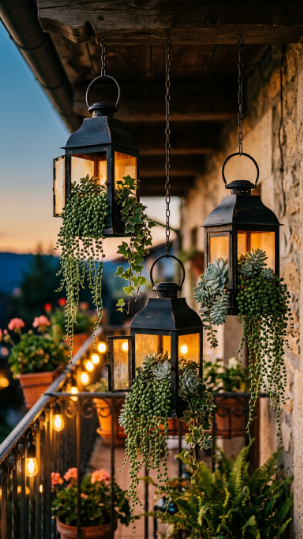
Repurposed lanterns as hanging planters are one of the most atmospheric and romantic balcony plant arrangement ideas on this entire list. Remove the candle holder, line the base with a small plastic saucer, and fill with a compact trailing plant — string of pearls, mini ivy, or a single trailing succulent — and suddenly functional outdoor lighting becomes living botanical art.
Hang three at staggered heights from the same ceiling hook point — long chain, medium chain, short chain — for a cascading cluster that fills vertical space beautifully and creates layers of visual interest at the same time. At dusk, add a small battery LED tea light inside each lantern alongside the plant for magical dual-function glow.
Source lanterns from thrift stores, craft shops, or dollar stores — you genuinely don’t need to spend much to make this arrangement look extraordinarily considered and beautiful.
Explore hanging lantern planter balcony arrangement ideas and read The Sill’s guide to creative hanging planter displays.
Romance, light, and living plants — the most magical balcony corner of all!
4. The Monochromatic White Garden Arrangement
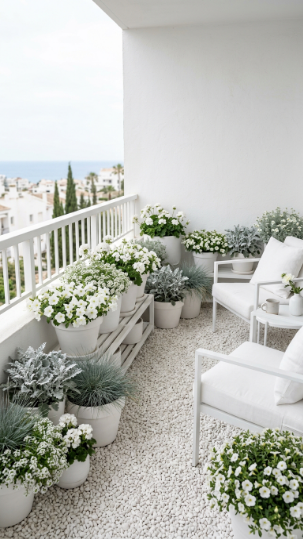
The all-white plant arrangement is the design secret of expensive boutique hotels and award-winning garden designers — and it costs no more than a colorful arrangement while looking infinitely more sophisticated. White petunias, white alyssum, white lobularia, and white verbena arranged across matching white or pale stone pots create a genuinely serene, luxurious atmosphere that transforms any balcony into a calm outdoor sanctuary.
The secret is using silver and grey-leaved plants — dusty miller, artemisia, stachys — as the tonal variation that keeps an all-white arrangement from feeling flat. Silver leaves catch light beautifully and create depth and dimension without introducing color.
This arrangement looks spectacular in the evening and at night when white flowers reflect available light and almost seem to glow. Pair with a single white candle or battery fairy lights for a balcony that’s genuinely breathtaking after dark.
💡 Pro Tip: Add one or two plants with white-variegated foliage — white-edged hostas or white-striped spider plants — to maintain visual interest even during any brief periods when the flowering plants aren’t in full bloom. Foliage keeps the white story going year-round.
Discover monochromatic white balcony plant arrangement ideas and check out Gardeners’ World’s white garden design inspiration.
White on white on white — the most quietly dramatic balcony of the street!
5. The Tropical Statement Corner
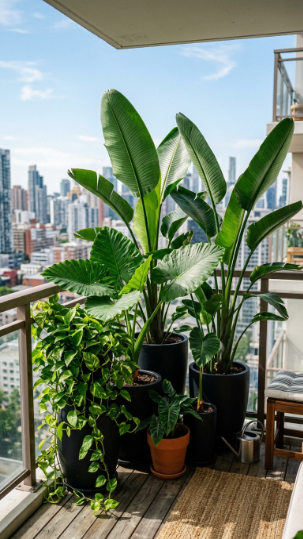
One large, dramatic, unapologetically tropical corner arrangement makes a bigger visual impact than ten small scattered pots ever will. This is the arrangement principle that professional garden designers call “bold massing” — and it works spectacularly on balconies.
Choose two or three large-leaved tropical plants — elephant ears (Colocasia), bird of paradise (Strelitzia), or a dwarf banana — as your architectural anchors. Surround them with lush, trailing pothos or tradescantia to fill the base, and add one tall ornamental grass or bamboo for movement and height contrast.
Plant everything in matching dark matte ceramic or plastic pots — the container consistency makes the tropical plants themselves the undisputed visual stars rather than a collection of mismatched vessels competing for attention.
Browse tropical corner balcony plant arrangement ideas and visit Gardeners’ World’s tropical balcony planting guide.
Go tropical, go bold, go big — and watch your balcony become a destination!
6. Wall Grid Hanging Planter Display
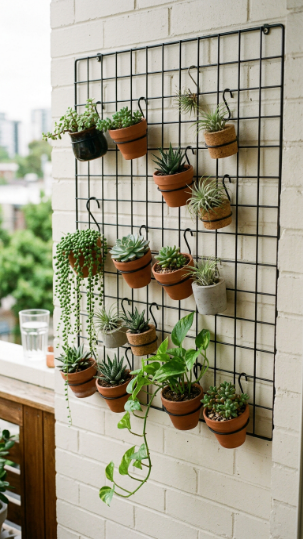
A black metal grid panel mounted on a blank balcony wall and loaded with small pots via S-hooks is one of the most versatile, rearrangeable, and visually striking quick DIY plant arrangements available. Every pot hangs independently, so you can constantly evolve and refresh the display without committing to any permanent structure.
Mix succulents, air plants, trailing ivy, compact herbs, and small flowering annuals across the grid at different heights and spacings. The deliberately varied arrangement of pot sizes, plant types, and heights creates a gallery-wall effect that looks curated and intentional without requiring any formal design training.
The grid format also makes it incredibly easy to rotate seasonal plants in and out — swap summer annuals for autumn pansies, swap pansies for winter evergreen foliage. The grid itself is a permanent fixture; the plants are the seasonal wardrobe.
💡 Pro Tip: Use S-hooks of three different sizes — small, medium, and large — to hang pots at genuinely varied depths from the grid face. The slight variation in how far each pot projects from the wall creates three-dimensional depth that makes the whole display look dramatically more considered than a flat arrangement.
Explore wall grid balcony plant display arrangement ideas and read The Sill’s guide to wall-mounted plant arrangements.
A living gallery wall — the coolest balcony feature you can build in an afternoon!
7. The Cottage Garden Balcony Arrangement
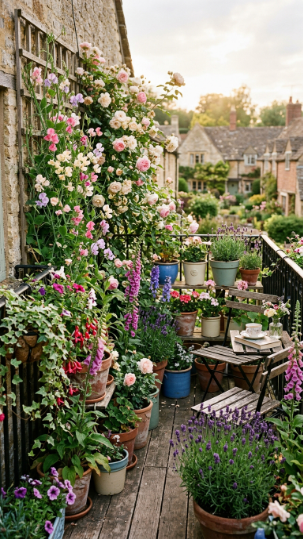
The cottage garden aesthetic is all about beautiful, organized chaos — a riot of color, texture, and fragrance that looks effortlessly natural and romantically abundant. On a balcony, this translates to mismatched terracotta pots, climbing sweet peas on a small trellis, compact lavender, and miniature roses all growing together in deliberate but seemingly accidental profusion.
The key to pulling this off is choosing plants from a restricted color palette — pinks, purples, creams, and whites — regardless of how varied the plant forms are. Color cohesion transforms what might otherwise look messy into something that feels beautifully curated and intentional.
Add a small obelisk or bamboo wigwam trellis to one corner for climbing sweet peas — they add height, extraordinary fragrance, and that most quintessential of cottage garden features: something reaching upward with romantic abandon.
Browse cottage garden balcony plant arrangement ideas and check out Gardeners’ World’s cottage garden container planting guide.
Romantic, fragrant, and utterly gorgeous — the balcony that makes people sigh!
8. The Zen Minimalist Arrangement
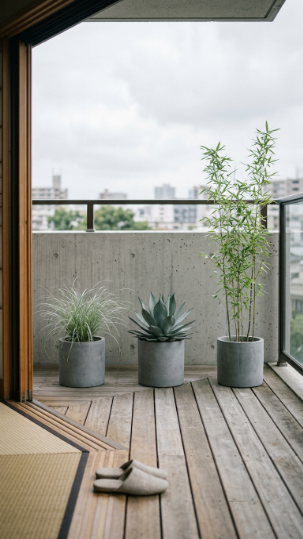
Here’s the thing: sometimes restraint is the most powerful design choice of all. Three plants, identical concrete pots, generous negative space between each — this is the balcony arrangement that communicates confidence, intention, and sophistication without a single unnecessary element.
Choose three architecturally interesting plants that look stunning in isolation: a tall, arching ornamental grass for movement; a bold succulent rosette for sculptural form; and a single bamboo for vertical drama and that characteristic soft rustling sound. Same pot style, same finish, three completely different plant forms — the contrast is perfect.
Lay pale wooden decking tiles beneath the arrangement to define the space as intentional rather than arbitrary, and resist the urge to add anything more. The empty space between the pots is as important as the plants themselves.
💡 Pro Tip: Add a single smooth river stone or small piece of driftwood beside the central pot as the only decorative element. That single natural object gives the arrangement a finishing point without breaking the minimalist discipline — it’s the horticultural equivalent of a well-placed full stop.
Discover zen minimalist balcony plant arrangement ideas and visit Gardeners’ World’s minimalist garden design guide.
Less is dramatically, breathtakingly more!
9. The Hanging Basket Ceiling Garden
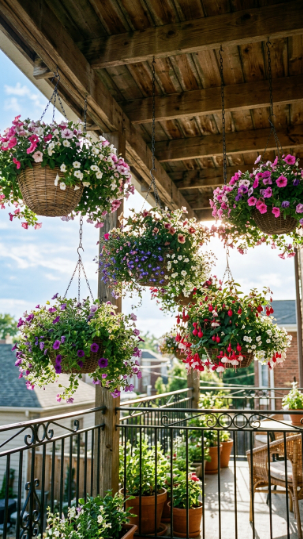
Filling your balcony ceiling with hanging baskets at staggered heights creates an overhead garden canopy that completely transforms the feeling of your outdoor space — suddenly you’re sitting inside a garden rather than beside one. It’s immersive, abundant, and genuinely magical.
The key is staggered heights — vary the chain lengths so baskets hang at 3 feet, 5 feet, and 7 feet below the ceiling. The layered effect creates genuine depth and makes the planting feel far more generous than the individual baskets suggest. Mix fuchsia, trailing petunia, lobelia, and bacopa for a classic hanging basket combination that blooms prolifically all summer.
Line every basket with coir fiber liner and mix water-retaining gel crystals into the potting mix — the improved moisture retention dramatically reduces watering frequency for overhead baskets that are famously awkward to keep consistently hydrated.
Browse hanging basket ceiling garden balcony ideas and read the RHS guide to planting hanging baskets.
Look up, look around — you’re inside a garden now!
10. The Upcycled Ladder Herb and Flower Display
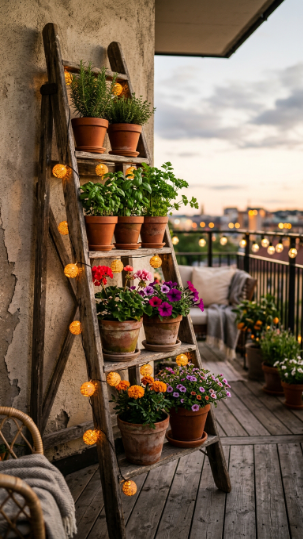
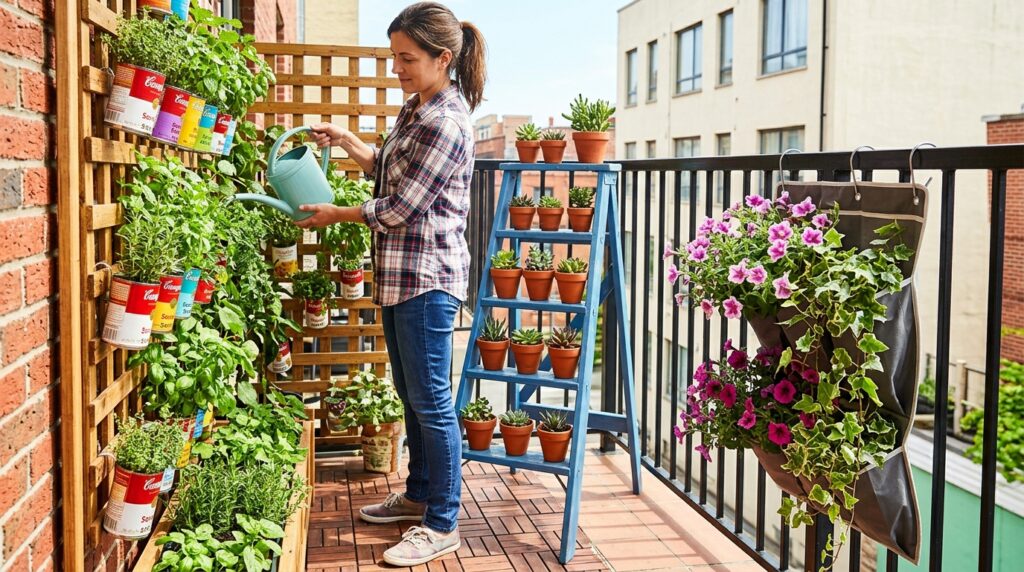
An old wooden ladder leaned against the balcony wall and loaded with a mix of herb pots and flowering annuals is one of those quick DIY balcony arrangements that takes 20 minutes to set up, looks like it took hours, and earns more compliments than almost any other approach.
The rungs provide natural shelf levels at perfectly graduated heights — place the tallest, most architectural plants on the upper rungs and the trailing, cascading plants lower down where their spilling habit is most visible and dramatic. Weave battery-powered string lights through the rungs for a balcony that looks equally gorgeous in daylight and at night.
The weathered patina of an old ladder adds texture and character that no new shop-bought shelf can replicate — authenticity is the quality that makes this arrangement feel genuinely designed rather than assembled.
💡 Pro Tip: Secure the top of the ladder to the wall with a single screw-in cup hook and a short length of jute twine — enough to stop it falling forward in wind without making it feel permanently fixed. Safety and style, sorted simultaneously.
Explore ladder plant display balcony arrangement ideas and check out Gardeners’ World’s ladder shelf balcony garden guide.
Rungs become shelves, shelves become a garden — pure balcony ingenuity!
11. Bold Geometric Pot Grouping
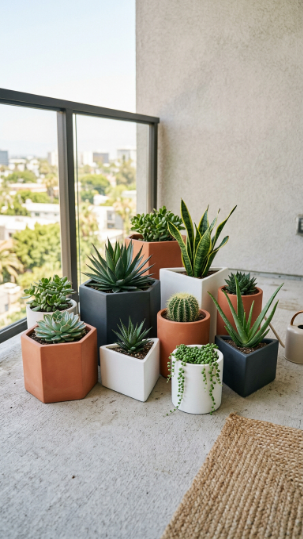
The container is part of the design — choosing pots with geometric forms and grouping them with deliberate asymmetry is a design move that elevates even the simplest plants into an arrangement that looks genuinely architectural.
Mix hexagonal, cylindrical, and low disc-shaped pots in a tight cluster of three to five. Use a restricted palette of two to three pot colors — terracotta and white, or charcoal and pale grey — and plant with succulents and architectural plants that complement the geometric aesthetic: agave, aloe, echeveria, ornamental grasses.
Group the pots in a triangular arrangement (one tall at the back, two shorter in front) rather than a straight line — triangles are inherently more dynamic and visually interesting than linear or symmetrical groupings.
Browse geometric pot grouping balcony arrangement ideas and visit The Sill’s guide to styling architectural plant arrangements.
Pots as sculptures, plants as art — modern balcony design perfected!
12. The Living Privacy Screen Arrangement
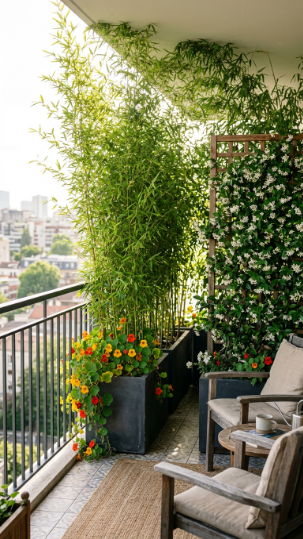
Talk about a game-changer — a living privacy screen made from tall bamboo planters, climbing jasmine on a trellis, and trailing plants at the base solves the overlooked-balcony problem while simultaneously creating the most beautiful, fragrant, and genuinely relaxing outdoor space imaginable.
Place a row of tall bamboo in large floor planters along the most exposed railing or wall. Supplement with a trellis panel draped in jasmine or climbing roses for fragrance and additional visual coverage. At the base, trailing nasturtiums and lobelia soften the transition between hard planters and balcony floor.
The result is a layered green wall that creates genuine privacy from neighboring balconies and the street below without the dead, static feeling of a solid privacy screen. This is a living, breathing, fragrant boundary that improves every week as plants grow.
💡 Pro Tip: Choose clumping bamboo varieties like Fargesia rather than running bamboo for container privacy screens — running bamboo spreads aggressively and is genuinely difficult to control in pots, while clumping varieties stay beautifully contained and actually look more graceful.
Discover living privacy screen balcony plant arrangement ideas and read Gardeners’ World’s guide to balcony privacy planting.
Privacy, beauty, fragrance — three problems solved in one brilliant arrangement!
13. The Edible Balcony Arrangement
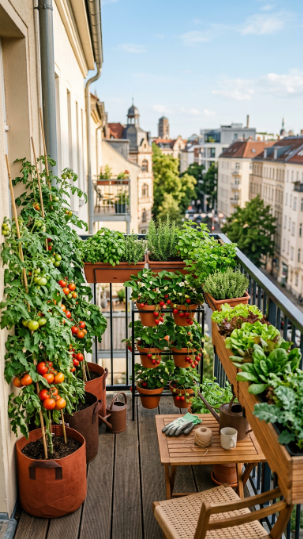
Here’s the most satisfying arrangement on this entire list — a fully edible balcony garden that feeds you all summer. Mix tomatoes in large grow bags, herbs in railing boxes, strawberries in tiered pocket planters, and compact lettuce in window boxes for a complete kitchen garden that uses every available space format simultaneously.
The design secret of the edible balcony is using height levels intentionally: tall tomatoes at the back against the wall, mid-height herbs in railing boxes, trailing strawberries in hanging planters, and compact salad leaves in low window boxes at the front. Every level is productive.
Add a single dramatic courgette or squash plant in a large floor planter as your statement piece — the huge tropical leaves and vivid yellow flowers make an edible plant that’s genuinely as ornamental as any purely decorative choice.
Browse edible balcony plant arrangement ideas and check out University of Minnesota Extension’s guide to container vegetable and herb gardening.
The most rewarding balcony arrangement of all — because you get to eat it!
14. Succulent Wall Art Arrangement
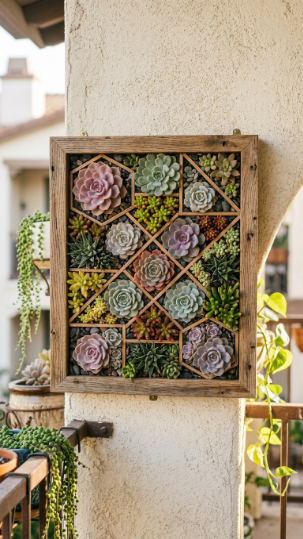
A succulent wall frame — a shallow wooden shadow box filled with a dense mosaic of different succulent varieties — is literally living wall art. Mounted on a blank balcony wall, it creates a botanical installation that looks like something from a gallery show and requires almost zero maintenance once established.
Build a simple shadow box from cedar planks, line with landscape fabric stapled to the back, fill with a mix of potting mix and coarse sand, and plant succulents tightly in a deliberate geometric color-block pattern: a section of dusty rose echeveria, a block of silver sedum, a row of deep green haworthia.
Let the succulents establish for 2–3 weeks flat before hanging vertically — this allows roots to anchor into the mix so plants don’t shift when the frame is mounted on the wall.
💡 Pro Tip: Tilt the mounted frame very slightly forward — about 5 degrees — using spacers behind the top mounting points. This slight forward lean directs rainwater away from the backing board, dramatically extending the life of the wooden frame in outdoor conditions.
Explore succulent wall art balcony arrangement ideas and visit The Sill’s guide to vertical succulent displays.
Where gardening meets gallery — the most artistic balcony wall you’ll ever make!
15. The Perfume Garden Arrangement
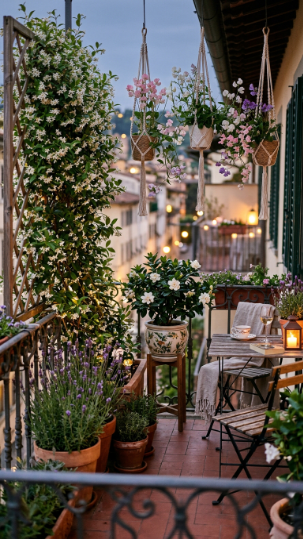
A fragrance-first balcony arrangement is one of the most sensory experiences you can create outdoors — step outside with your morning coffee and be immediately surrounded by the scent of jasmine, lavender, sweet peas, and gardenia. It’s a genuinely transformative way to experience your outdoor space.
Build the arrangement in layers of fragrance height: climbing jasmine on a wall trellis at head height, lavender in mid-height pots at seat level where you can brush the leaves with your hand, and sweet peas trailing from hanging baskets releasing their incomparable honey scent at nose level.
Plant evening-fragrant varieties — night-scented stock, nicotiana, and moonflower — specifically for those warm evenings when you’re sitting outside with a glass of wine. The fragrance intensifies after dark in a way that’s genuinely extraordinary.
Browse fragrance garden balcony arrangement ideas and read Gardeners’ World’s guide to scented balcony plants.
Step outside and breathe deeply — the most sensory balcony experience imaginable!
16. The Pollinator Balcony Arrangement
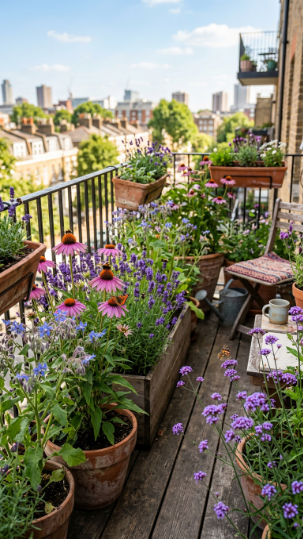
Here’s something genuinely meaningful: a pollinator-focused balcony arrangement connects your small urban outdoor space to the wider ecological story of urban wildlife. Plant echinacea, lavender, borage, and verbena and you’ll have bees, butterflies, and hoverflies visiting daily — turning your balcony into a functioning piece of urban biodiversity.
The great news is that pollinator-attractive plants are also visually spectacular — the blue star flowers of borage, purple spikes of verbena, and vivid cones of echinacea create a wildly colorful, naturalistic arrangement that looks gorgeous and does genuine good simultaneously.
Use unglazed terracotta and wooden containers to complement the naturalistic aesthetic — the organic materials suit the wild planting style perfectly and age beautifully alongside the planting.
💡 Pro Tip: Add a small shallow saucer of clean water with a few pebbles breaking the surface among your pollinator containers — visiting bees and butterflies need to drink, and providing water dramatically increases how frequently and how long pollinators visit your balcony garden.
Discover pollinator balcony plant arrangement ideas and check out the RHS guide to plants for pollinators in containers.
Beautiful, ecological, and genuinely alive with visitors — gardening that gives back!
17. The Terracotta Ombre Collection
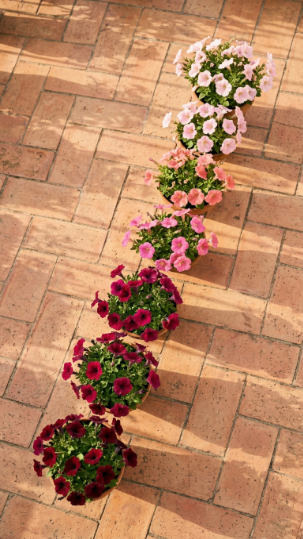
The ombre plant arrangement — same container style, same plant type, graduated colors from deep to pale — is a design concept so simple and so visually effective that it’s almost unfair how good it looks. Seven terracotta pots, seven petunia shades from deep burgundy through wine, rose, and blush to the palest barely-pink — arranged in a diagonal line across the balcony floor.
The diagonal orientation is crucial — it draws the eye across the full width of the balcony rather than straight back, making the space feel wider and more generous than its actual dimensions. That spatial trick is genuinely valuable on smaller balconies.
The uniform terracotta pots keep the focus entirely on the color gradient itself — the container consistency is what transforms a simple row of pots into an arrangement that looks deliberately designed.
Browse ombre plant arrangement balcony ideas and visit Gardeners’ World’s monochromatic container planting guide.
One plant, seven shades, one completely unforgettable arrangement!
18. The Boho Macramé and Trailing Plant Wall
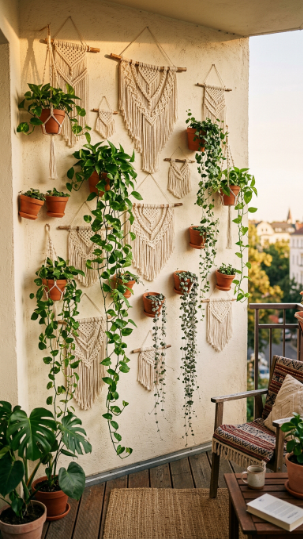
A full balcony wall of mixed macramé hangings and trailing plants at multiple heights creates the most lavishly bohemian outdoor space imaginable. This isn’t a neat, restrained arrangement — it’s a joyful, layered, abundantly alive wall of texture and cascading greenery.
Hang macramé wall pieces (framed, tasseled, or woven) between mounted pot brackets. Let pothos, string of hearts, and trailing ivy cascade downward from shelf-mounted pots, their long vines weaving loosely around the macramé. The organic interaction between woven fiber and living plants is genuinely beautiful.
Add a few air plant mounts on natural driftwood pieces among the macramé for additional botanical interest without additional watering commitment. The variety of textures — rope, wood, ceramic, living plant — is what gives this arrangement its extraordinary richness.
💡 Pro Tip: Use removable adhesive hooks rated for outdoor use to mount macramé pieces alongside screwed brackets — this lets you rearrange and evolve the wall display frequently without new drill holes, keeping the boho spirit of constant creative reinvention fully alive.
Explore boho macramé trailing plant wall balcony ideas and read The Sill’s guide to trailing plant display walls.
Layers, texture, trailing vines — the most soulful balcony wall you’ll ever create!
19. The Seasonal Swap Arrangement System
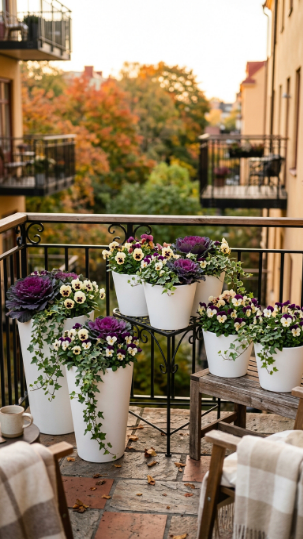
The smartest long-term investment in your balcony plant arrangement is building a framework of identical permanent pots in a fixed layout that you swap plants in and out of seasonally. The pots never move — the plants rotate through spring, summer, autumn, and winter palettes.
Invest in a set of identical white, terracotta, or concrete-effect lightweight pots in three sizes. Place them in a permanent asymmetric arrangement on your balcony floor. Then replant four times a year: spring bulbs and pansies, summer annuals, autumn kale and ornamental grasses, winter evergreens and cyclamen.
The fixed structural framework means the arrangement always looks considered and cohesive regardless of season — only the plants and colors change, but the architecture of the arrangement remains beautifully constant.
Browse seasonal swap balcony plant arrangement system ideas and check out Gardeners’ World’s year-round container planting guide.
One layout, four seasons, always stunning — the smartest balcony investment!
20. The Dramatic Black and Green Arrangement
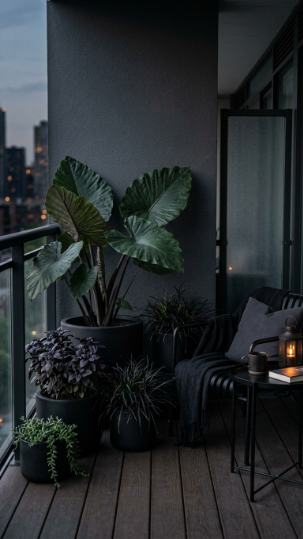
For the design-forward balcony owner who wants something genuinely unlike anything else in the neighborhood, a black and deep green arrangement is strikingly dramatic and sophisticated. Matte black ceramic pots, black-stemmed elephant ears, deep burgundy-black basil, and dark ornamental grasses create a moody, editorial aesthetic that belongs in a design magazine.
The key is leaning fully into the dark palette without apology — no bright accent colors, no relief pastels. The drama comes from the tonal depth of very dark greens and blacks contrasted with the subtle texture variation between matte ceramic, glossy leaves, and feathery grasses.
This arrangement works most powerfully against a dark grey or charcoal wall — if your balcony wall is white or pale, consider a single panel of dark outdoor fabric behind the arrangement to create the backdrop the plants deserve.
💡 Pro Tip: Add a single metallic gold or bronze element — a small gold tray under the central pot, or a bronze plant stake — as the one accent note that lifts the entire dark arrangement without disrupting its moody sophistication. One metallic touch is art; more than one becomes decoration.
Discover dramatic black and green balcony arrangement ideas and visit The Sill’s dark-toned plant display inspiration.
Dark, dramatic, and completely, magnificently unforgettable!
21. The Tiered Patio Display with Ground, Mid, and Sky Level Plants
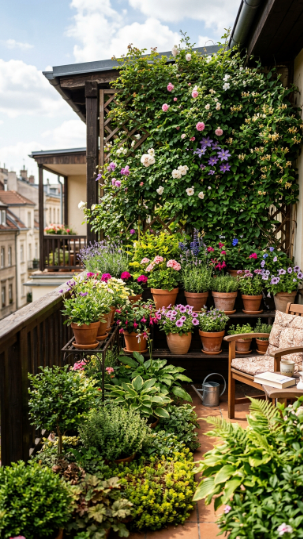
This is the arrangement approach that makes a balcony feel like an actual garden rather than a collection of pots — deliberately placing plants at three distinct height levels to create a complete, layered landscape in a very small space.
Ground level: low, spreading plants that hug the floor — creeping thyme, ajuga, or a lush bed of moss in a low trough. Mid level: flowering pots on stands or upturned crates at seat height — where you experience them most directly. Sky level: tall architectural plants, climbing roses on a trellis, or bamboo reaching toward the sky.
The three-level structure creates genuine spatial depth — your eye travels from floor to canopy just as it would in a full garden, creating an immersive experience completely disproportionate to the actual square footage involved.
Browse three-level tiered balcony plant arrangement ideas and read Gardeners’ World’s layered balcony planting design guide.
Floor, mid, sky — three levels, one complete garden world!
22. The Window Box Cascade Arrangement
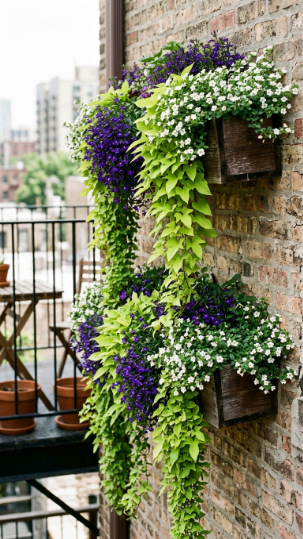
Stacked window boxes at two different heights — one row at railing level, one row above it at eye height — with dramatically trailing plants spilling downward in long cascading curtains creates one of the most visually spectacular quick DIY balcony arrangements possible.
Plant each box with an intentional cascade mix: upright bacopa or lobelia at the back of the box, then let sweet potato vine, trailing petunia, and strings of bacopa grow forward and downward in long flowing sweeps. Within 4–6 weeks of planting, the trails reach impressive lengths.
The double-height stacking means the upper box trails into and around the lower box’s level — creating a continuous curtain of living plant material down your entire balcony wall that’s genuinely breathtaking.
💡 Pro Tip: Mount your upper window boxes on adjustable bracket arms rather than fixed brackets — the extra inch or two of projection from the wall allows trailing plants to cascade freely without pressing against the wall surface, keeping the trails clean, healthy, and dramatically visible.
Explore window box cascade balcony arrangement ideas and check out the RHS guide to trailing plants for window boxes.
Two boxes, one waterfall of plants — sheer balcony drama!
23. The Fairy Light and Plant Evening Arrangement
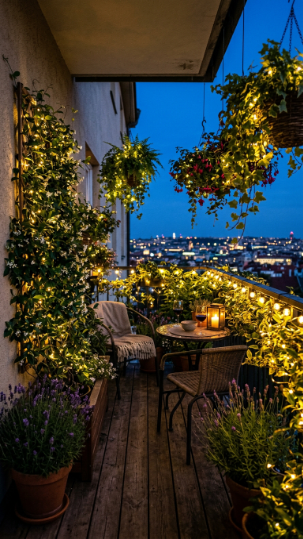
Here’s the deal: a balcony plant arrangement that looks beautiful in daylight but transforms into pure magic at night with fairy lights is an investment in your quality of outdoor life that pays back every single evening. Warm white LED fairy lights woven through climbing jasmine, hanging baskets, and potted lavender turn your balcony into an outdoor room you’ll never want to leave.
The trick is weaving lights through rather than around your plants — pushed gently between branches and leaves so the glow appears to come from within the plants themselves. The effect is organic and genuinely beautiful rather than the harsher, more decorative look of lights placed around the outside of plants.
Use warm white rather than cool white LEDs — the amber-warm tone works with plant green rather than against it, creating a glow that’s genuinely close to candlelight in its warmth and romance.
Browse fairy light balcony plant arrangement ideas and visit Gardeners’ World’s guide to evening balcony lighting and planting.
Day garden, night paradise — the balcony that works its hardest after dark!
24. The Repurposed Furniture Planter Arrangement
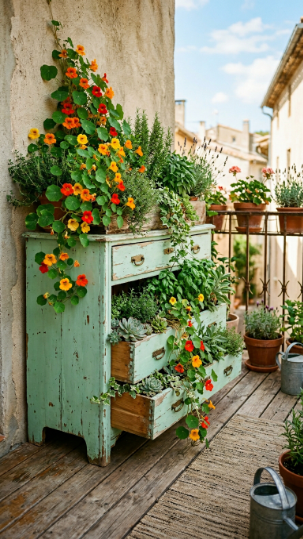
The most conversation-starting quick DIY balcony arrangement on this list — repurposing an old piece of furniture as a planter display structure. An old dresser with drawers at different depths, a vintage filing cabinet, or a wooden bookcase: lined, drilled, and planted up, these create arrangements with extraordinary character that no purpose-built planter can replicate.
An old chest of drawers works brilliantly — open each drawer to a different depth (some fully out, some halfway, some just cracked) and plant directly into each. The varied depths and heights create a naturally tiered arrangement with genuine architectural interest.
The furniture’s existing paint or finish becomes part of the design — peeling mint green, worn white, or faded teal patina adds a layer of charm and character that only genuinely old things possess.
💡 Pro Tip: Line all wooden drawer boxes with thick black plastic sheeting before planting — protecting the wood from constant soil moisture is what determines whether this arrangement lasts one season or five. The liner is invisible and completely transformative for longevity.
Discover repurposed furniture balcony plant arrangement ideas and read The Sill’s guide to creative upcycled planter displays.
Old furniture, new life, one completely unique balcony feature!
25. The Full Balcony Transformation Arrangement
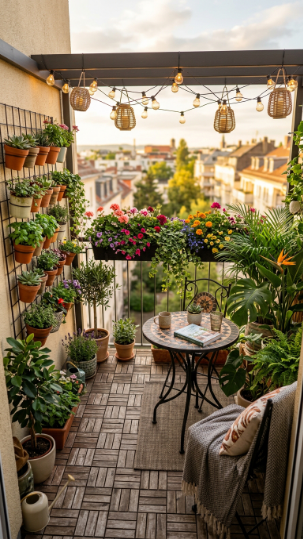
This is the grand finale — every element working together to create a complete, fully realized outdoor room rather than just a collection of individual plant arrangements. Floor decking tiles to define the space, a railing gradient of window boxes, a wall grid display, a lush corner cluster, overhead fairy lights, and a tiny café table at the center. The complete vision, executed together.
The secret to pulling off a full balcony transformation without it feeling overcrowded is respecting the central floor space — keep enough clear floor area around your café table or lounger that the space feels like a room you can move through rather than a greenhouse you navigate around.
Think of it as outdoor interior design: flooring defines the space, walls (railings and panels) frame it, plants are the soft furnishings, and lighting completes the atmosphere. Every element has a role. Every element is chosen with intention.
Browse full balcony transformation plant arrangement ideas and check out Gardeners’ World’s complete balcony garden design guide.
This is the balcony you always imagined — and now you know exactly how to build it!
Frequently Asked Questions
What are the best low-maintenance plants for DIY balcony arrangements?
The most reliable low-maintenance plants for balcony arrangements are lavender, sedum, calibrachoa, ornamental grasses, and trailing sweet potato vine. All handle variable watering well, tolerate wind exposure better than most, and deliver strong visual impact throughout the season. For truly minimal maintenance, succulents and sedums in mixed arrangements need watering just once or twice a week even in summer. Adding water-retaining gel crystals to all balcony container potting mix dramatically reduces watering frequency across every arrangement type.
How do I stop my balcony plant arrangements from blowing over in wind?
Wind management is the critical challenge for balcony plant arrangements above ground floor. Use heavy, wide-based pots or fill lightweight pots with gravel in the bottom third as ballast. Group containers together — clusters resist wind dramatically better than isolated individual pots. Mount railing boxes, wall grids, and vertical systems directly to fixed structures. For tall plants like bamboo or ornamental grasses in exposed positions, use a stake and soft tie to connect the plant stem to the pot rim. Always check your specific balcony’s wind exposure before choosing plant heights.
What’s the best way to water balcony plant arrangements when I’m away?
The most effective balcony watering solution for holidays and travel is a combination of approaches: self-watering reservoir pots for containers you can invest in upfront, water-retaining gel crystals mixed into all potting mix throughout the season, and a simple drip irrigation kit connected to an outdoor tap with a battery-powered timer. Budget drip systems cost $25–$40 and can water an entire balcony arrangement automatically for weeks. Grouping all containers close together also helps — clustered pots create a micro-humid environment that significantly slows moisture evaporation from individual containers.
How many plants do I actually need to transform a small balcony?
Far fewer than most people think — and this is the insight that changes everything. Three large, well-planted containers in a considered arrangement make a far greater visual impact than fifteen small scattered pots. A single large thriller-filler-spiller container in the corner, two generous railing boxes, and one hanging basket can genuinely transform a small balcony from bare to beautiful. Concentrate your budget on fewer, larger containers planted generously rather than spreading it across many small pots that individually lack the visual weight to make a real impact.
Which balcony plant arrangements work best for shaded or north-facing balconies?
Shaded balconies have a surprisingly rich plant palette available. The best shaded balcony arrangement plants include fuchsia (outstanding in hanging baskets), impatiens, begonias, hostas, ferns, astilbe, and most foliage plants including caladiums and coleus. For railing boxes in deep shade, a foliage-focused arrangement — mixing different leaf colors, textures, and forms rather than relying on flowers — often looks more sophisticated and requires less maintenance than attempting to force flowering plants in inadequate light. Add one or two shade-tolerant climbers like clematis or climbing hydrangea to your trellis for vertical interest.
A Few Final Thoughts
There you have it — 25 genuinely inspiring quick DIY plant arrangements for balconies that prove your outdoor space has been quietly, patiently waiting for its full potential to be unlocked. Whether you build the dramatic living privacy screen, go minimal with three architectural pots and a stone, or commit to the full transformation of every vertical and floor surface simultaneously, the process is the same: choose an idea that excites you, gather your materials, and just begin. The most beautiful balcony gardens aren’t the most expensive or the most elaborate — they’re the ones built with genuine care, a clear aesthetic vision, and the courage to commit fully to a direction. Your neighbors have no idea what’s coming. Your dream balcony arrangement is completely within reach — now pick up a trowel and make it happen!