
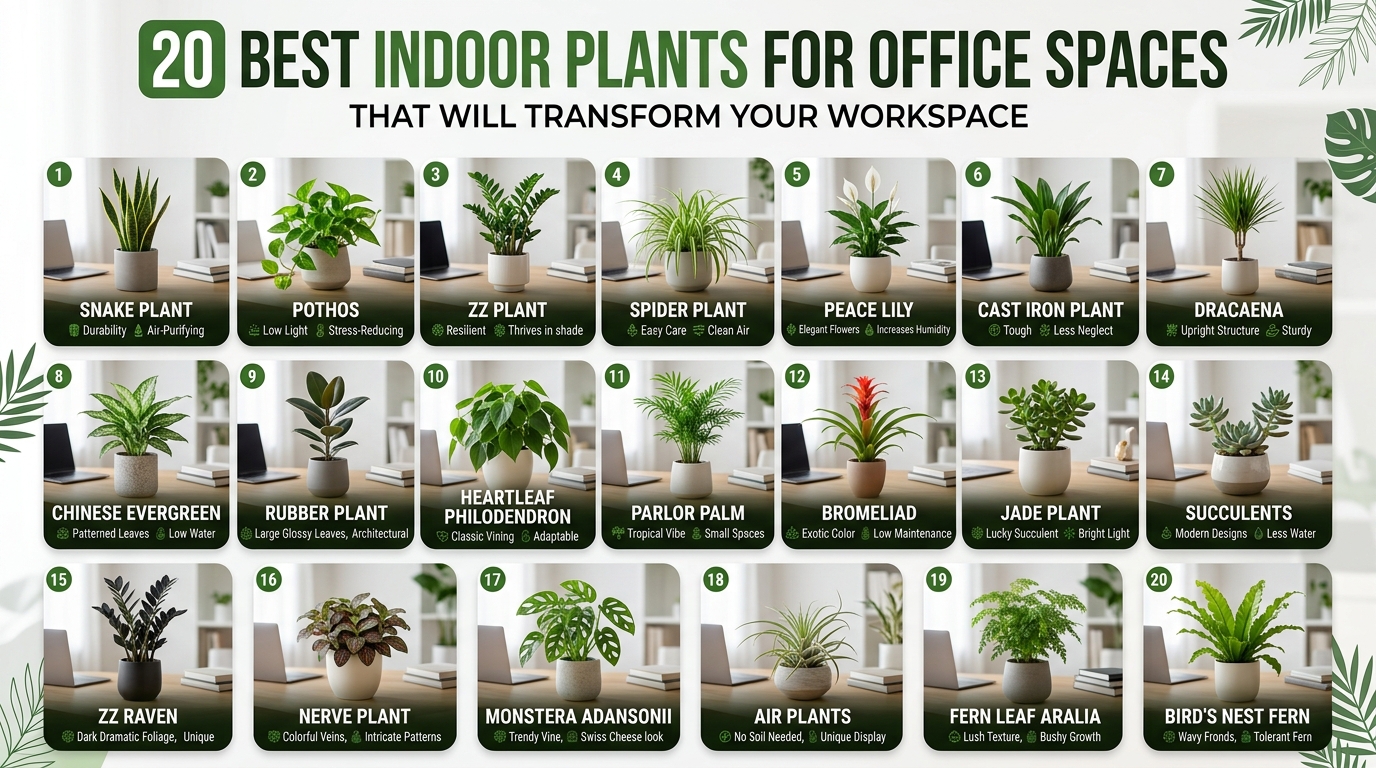
Did you know that adding plants to your office can boost productivity by up to 15% and dramatically reduce stress levels? If your desk feels like a grey, lifeless cubicle prison, the best indoor plants for office spaces are about to completely change your relationship with your workday. Whether you’re working from a corporate high-rise or a cozy home office, the right plants bring life, color, cleaner air, and a genuinely better mood to any workspace. Ready to find out which plants make the cut?
At a Glance
- The best indoor plants for office spaces are low-light tolerant, require infrequent watering, and thrive in the stable temperatures of air-conditioned or heated indoor environments.
- Snake plants, ZZ plants, and pothos are the top three choices for offices with little to no natural light near windows.
- Many office plants — including peace lilies, spider plants, and bamboo palms — actively improve indoor air quality by filtering common toxins found in office furniture and equipment.
- Grouping several small plants together on a desk or shelf creates a more impactful visual display and improves the local humidity, benefiting both you and the plants.
- Most office-friendly plants need watering only once every one to two weeks, making them completely manageable even for the most forgetful plant parent.
1. Pothos — The Ultimate Beginner Office Plant
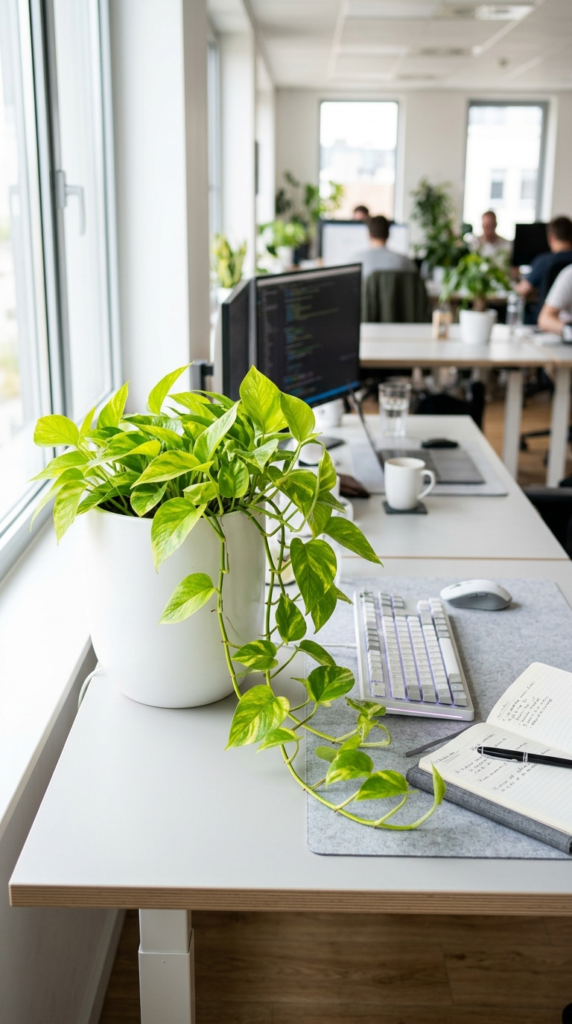
If there’s one plant that belongs on every single office desk on the planet, it’s pothos. This trailing beauty is virtually indestructible, tolerates almost any light condition, and looks absolutely gorgeous trailing from a shelf or cascading off a desk edge.
Golden pothos (Epipremnum aureum) is the most popular variety, with its heart-shaped leaves splashed in bright green and gold — but ‘Marble Queen’, ‘Neon’, and ‘Njoy’ are equally stunning options if you want something a little different.
💡 Here’s the deal: Pothos is one of the few plants that actually communicates its thirst — the leaves will start to droop and curl slightly when it needs water. Wait for that signal and you’ll never overwater it!
Pothos tolerates low light, fluorescent lighting, and irregular watering with remarkable grace. It can go one to two weeks between waterings, making it perfect for busy work schedules or weekend absences.
It’s also one of the best air-purifying office plants, filtering formaldehyde, benzene, and xylene — common pollutants from office furniture, carpets, and equipment.
Discover how to propagate pothos in water for more free plants on our blog. The NASA Clean Air Study identified pothos as one of the most effective indoor air-purifying plants.
Start with a pothos and you’ll be hooked on office plants for life!
2. Snake Plant — The No-Fuss Air Purifier
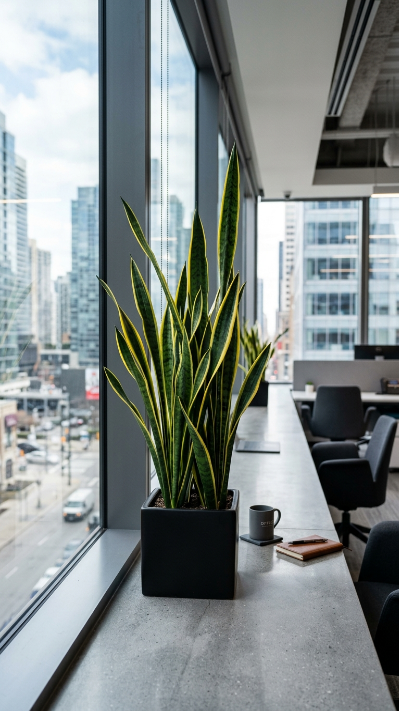
The snake plant (Sansevieria trifasciata) might just be the most perfect indoor office plant ever created by nature. It genuinely thrives on neglect, tolerates almost zero natural light, and has the most architectural, sculptural look of any desk or floor plant.
Those upright, sword-shaped leaves with their distinctive yellow margins and dark green banding look sharp and professional in any office environment — from sleek corporate spaces to eclectic creative studios.
The secret to snake plant success is watering less than you think you should. In a typical office environment, once every two to three weeks is plenty — once a month in winter. More snake plants die from overwatering than from any other cause, so when in doubt, hold off.
Snake plants are also extraordinary air purifiers, converting CO₂ to oxygen at night (unlike most plants), which makes them ideal for office bedrooms and closed spaces where air circulation is limited.
- Light needs: Low to bright indirect
- Watering: Every 2–3 weeks
- Ideal placement: Any desk, corner, or windowsill
- Bonus: Releases oxygen at night
Browse our complete snake plant care guide for all the details. The University of Georgia Extension has excellent indoor plant air quality research.
You’ve totally got this — the snake plant practically takes care of itself!
3. ZZ Plant — Built for Neglect and Low Light
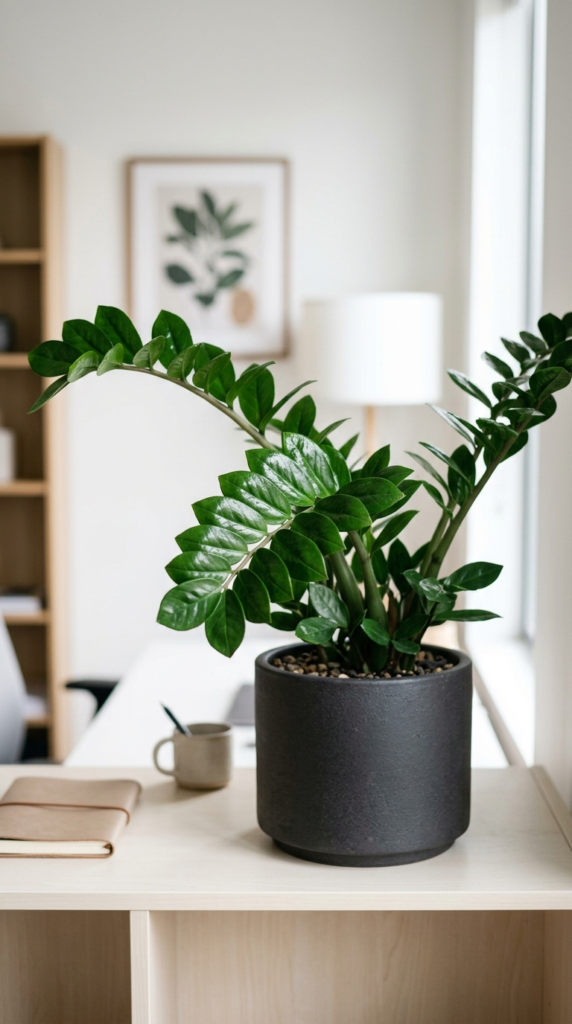
ZZ plant (Zamioculcas zamiifolia) is the plant for people who have killed every plant they’ve ever owned. Those thick, waxy, deep glossy green leaflets store water in their stems and roots, meaning this plant can survive weeks — even months — of neglect without missing a beat.
Here’s the thing: ZZ plants grow from thick underground rhizomes that act like water reservoirs. This means even if you completely forget about it over a long holiday break, you’ll come back to a perfectly happy plant. Talk about a game-changer for office life!
💡 The secret is placing your ZZ in any spot with any light level — it’s one of the only plants that handles truly dim office corners without struggling. Fluorescent lighting is perfectly sufficient.
The dark, lustrous foliage has a natural high-gloss sheen that requires no polishing — it simply looks expensive and architectural all on its own. The ‘Raven’ ZZ variety takes this even further with dramatic near-black foliage that’s genuinely jaw-dropping.
It’s also one of the most low-maintenance office plants in existence — fertilize just twice a year, repot every couple of years, and otherwise simply enjoy it.
Learn more in our ZZ plant ultimate care guide. The Missouri Botanical Garden has a thorough ZZ plant profile.
If you’ve struggled with plants before, the ZZ will restore your confidence completely!
4. Peace Lily — Elegant Blooms in Low Light
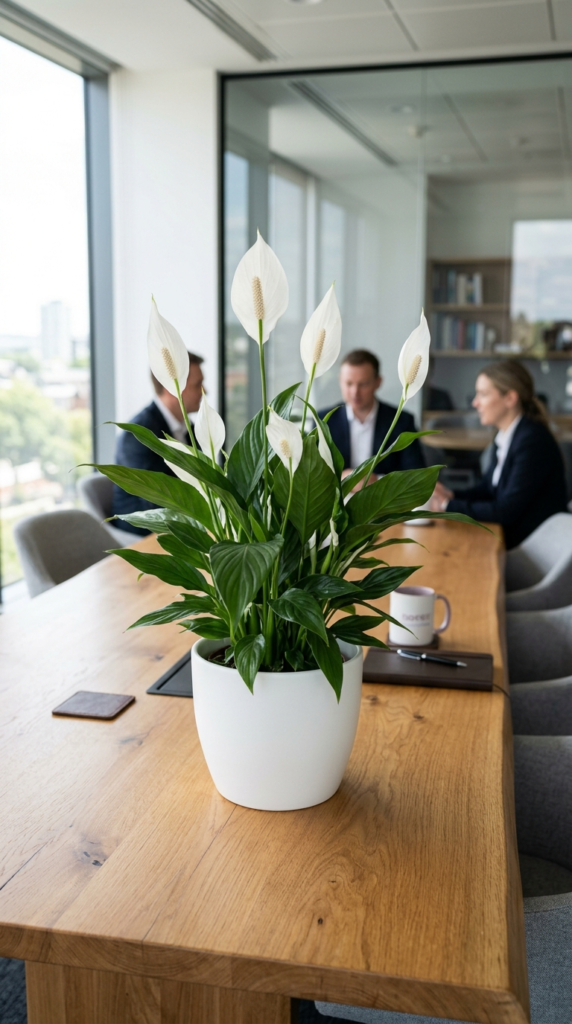
Want the only flowering office plant that thrives in low light and practically zero maintenance? Meet the peace lily — and yes, those gorgeous white spathes will actually bloom right there on your office desk without a drop of direct sunlight.
Peace lilies are one of the most studied plants for indoor air quality improvement, filtering ammonia, benzene, formaldehyde, and trichloroethylene — all chemicals commonly found in office cleaning products, adhesives, and furniture. You’re literally breathing better air just by having one on your desk.
The plant communicates beautifully — leaves droop gently when thirsty, then perk back up within hours of watering. This makes watering schedules completely intuitive even for total plant beginners.
Note that peace lilies are toxic to pets, so if your office is pet-friendly, place yours on a high shelf or counter where curious animals can’t reach the foliage.
Find our complete peace lily office care guide for everything you need. The NASA Clean Air Study rates peace lily as one of the top air-purifying indoor plants.
Elegant, effective, and effortless — peace lily is a desk plant superstar!
5. Spider Plant — The Cheerful, Fast-Growing Classic
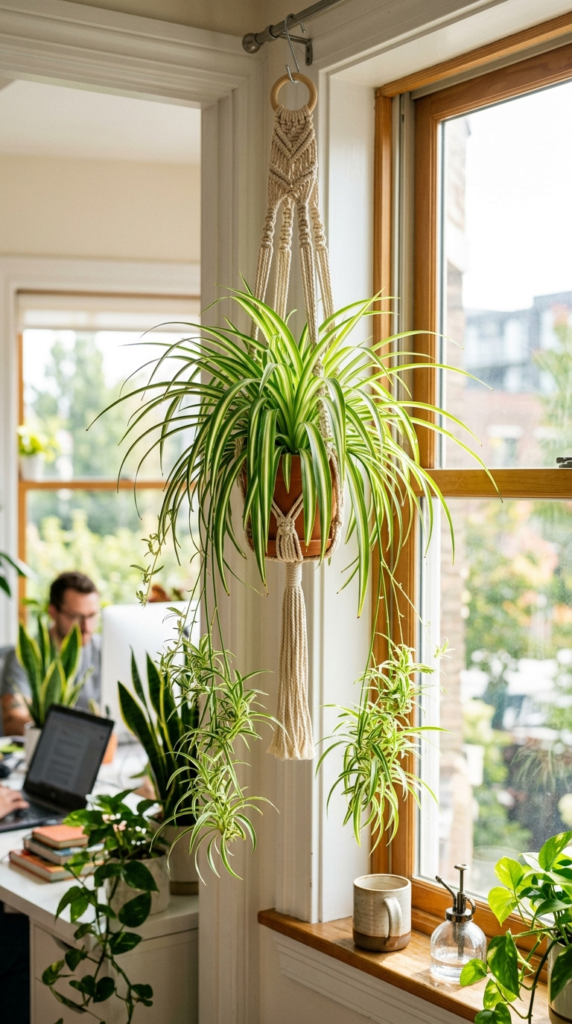
Spider plants are the plants that make everyone smile — there’s something genuinely delightful about those long arching leaves and the cascade of baby plantlets dangling like little green spiders on their runners. They bring instant personality and life to any office space.
The variegated green-and-white leaves look beautiful in hanging baskets, on high shelves where the runners can cascade freely, or simply in a standard pot on a windowsill. They grow quickly and produce those charming baby spider plants (called spiderettes) that you can easily propagate and share with colleagues — hello, instant office plant swap!
💡 Pro Tip: Spider plants are non-toxic to cats and dogs, making them one of the very best pet-safe office plants if your workplace allows furry visitors!
Spider plants thrive in bright to moderate indirect light and prefer to dry out slightly between waterings. They’re wonderfully forgiving of occasional missed waterings and will bounce back quickly.
They’re also excellent air purifiers, particularly effective at removing carbon monoxide and formaldehyde from indoor air — a genuine health benefit for any enclosed office environment.
Learn how to propagate spider plant babies into new pots on our blog!
Cheerful, generous, and practically indestructible — spider plant is an office legend!
6. Chinese Evergreen — Bold Color in Any Light
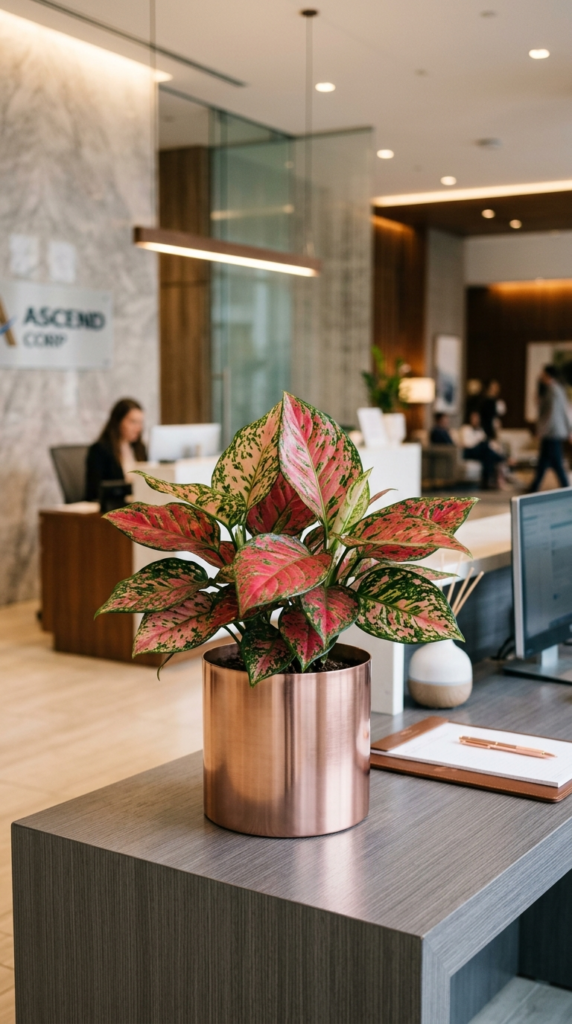
Here’s a plant that completely destroys the myth that low-light office plants have to be boring and green. Chinese evergreen (Aglaonema) comes in a dazzling range of leaf colors — deep red, hot pink, silver, chartreuse, and every combination in between — and it handles low light beautifully.
The bolder, more colorful varieties like ‘Red Siam’, ‘Pink Dalmatian’, and ‘Silver Bay’ bring genuine wow-factor to any desk or reception area, creating the kind of visual interest that makes colleagues stop and say “what IS that gorgeous plant?”
Note that the more colorful varieties prefer slightly brighter indirect light to maintain their vivid colors, while the darker green varieties are the most shade-tolerant. It’s a small trade-off worth understanding before you choose your spot.
Chinese evergreen is extremely drought-tolerant, prefers temperatures above 60°F (so keep it away from air conditioning vents!), and only needs watering every one to two weeks depending on pot size and light levels.
Check out our guide to colorful low-light houseplants for more vibrant options. The University of Florida IFAS Extension has excellent aglaonema growing research.
If your office needs a serious color injection, Chinese evergreen delivers every single time!
7. Rubber Plant — A Statement-Making Desk Tree
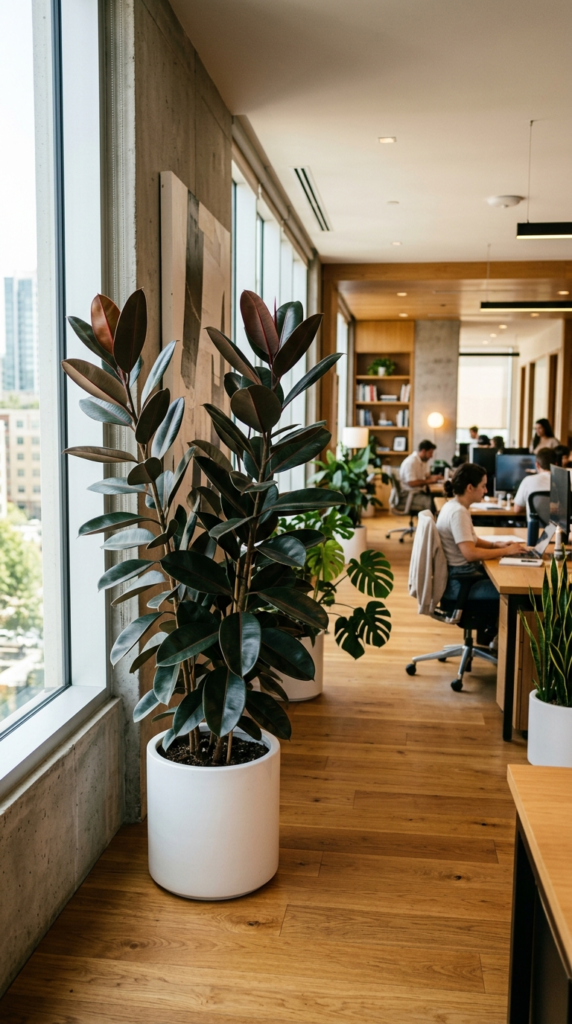
Want to make a genuine design statement in your office with a plant? The rubber plant (Ficus elastica) is your answer. Those enormous, glossy leaves in deep burgundy, forest green, or dramatic near-black make this plant look like expensive living art — not a supermarket houseplant.
The ‘Burgundy’ variety is particularly stunning in office environments — the rich, wine-dark leaves command attention and pair beautifully with neutral office color palettes of white, grey, and natural wood. Large specimens at 4–6 feet become genuine room focal points.
💡 Here’s the deal: Rubber plants hate being moved once they’re settled. Find the right spot with bright indirect light, get it established, and then leave it alone — it will reward your patience with vigorous, beautiful growth.
Rubber plants prefer to dry out between waterings — check the top two inches of soil and water only when completely dry. Wipe the large leaves occasionally with a damp cloth to keep them glossy and clear for photosynthesis.
They’re fast growers in good light, which means you’ll have an impressive floor plant within a year or two of starting with a small pot — incredible value for a relatively modest investment.
Get all the details in our rubber plant care and styling guide. The Royal Horticultural Society has a thorough ficus growing guide.
A rubber plant in the corner of your office will genuinely transform the entire feel of the room!
8. Philodendron — Lush Tropical Vibes for Any Office
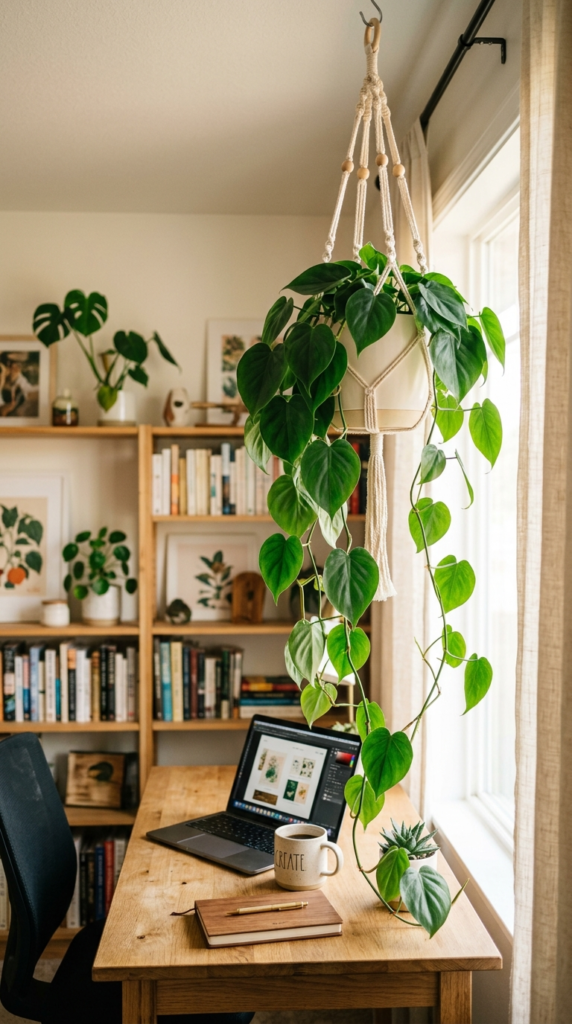
Philodendrons are the plant world’s gift to office workers everywhere — fast-growing, incredibly lush, ridiculously easy to care for, and available in dozens of varieties to suit any aesthetic from minimal to tropical maximalist.
The heartleaf philodendron (P. hederaceum) is the classic office choice — those glossy, heart-shaped deep green leaves are cheerful and beautiful, and the plant tolerates low light and irregular watering with remarkable ease. It grows quickly enough that you’ll see new leaves unfurling regularly, which is genuinely exciting on a dull work day!
For something more dramatic, ‘Brasil’ philodendron features leaves striped in bright yellow and green, while the increasingly popular philodendron ‘Pink Princess’ sports stunning dark leaves with pink variegation — though that one wants bright indirect light to maintain its color.
All philodendrons prefer well-draining soil, moderate to bright indirect light for best growth, and watering when the top inch of soil dries out. They’re also easy to propagate in water — a single stem cutting becomes a new plant within weeks.
Explore our philodendron variety comparison guide for help choosing your perfect match. Houseplant411 has excellent philodendron care charts.
Lush, tropical, and effortlessly cool — philodendrons make every office feel like a creative sanctuary!
9. Aloe Vera — The Practical and Pretty Desk Plant
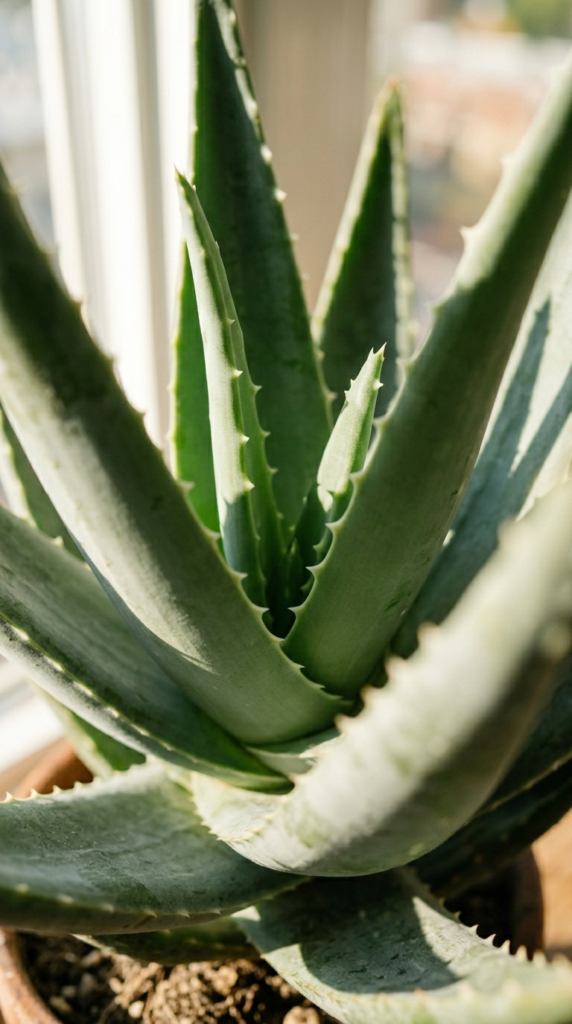
Aloe vera might be the most useful plant on this entire list — it’s beautiful on your desk AND provides instant first aid for minor burns, dry skin, and sunburn. Having one arm’s reach away at all times is genuinely one of life’s small luxuries!
Those thick, architectural grey-green succulent leaves look fantastic on a bright windowsill, and aloe is one of the very few office desk plants that actually appreciates some direct sun. A south or east-facing window where it gets two to three hours of morning sun is its sweet spot.
💡 The secret is letting aloe dry out completely between waterings — this plant is drought-adapted and will rot quickly if overwatered. In a typical office environment, watering every three to four weeks is plenty in winter.
Aloe grows slowly and stays compact and manageable on a desk for years, only needing repotting when it becomes noticeably root-bound or starts producing offsets (baby aloe plants!) around the base.
It’s also a proven air purifier, removing formaldehyde and benzene from indoor air — common off-gassing products from office paint, cleaning supplies, and electronics.
Get our full aloe vera desk care guide for watering schedules and light tips. The University of Maryland Medical Center has interesting research on aloe’s well-documented skin benefits.
Practical, pretty, and genuinely useful — aloe vera earns its desk space ten times over!
10. Cast Iron Plant — The Toughest Plant You’ll Ever Own
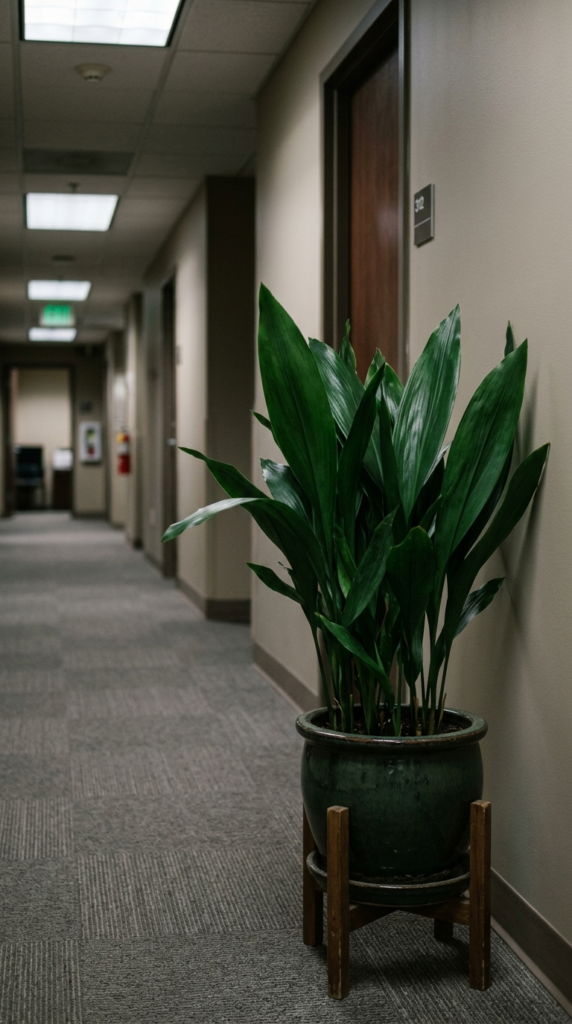
The name says it all. Cast iron plant (Aspidistra elatior) is virtually indestructible — it tolerates deep shade, temperature fluctuations, irregular watering, dust, neglect, and almost every difficult condition an office can throw at it. Pretty cool, right?
Those long, upright lance-shaped leaves in deep, glossy forest green have an almost architectural quality that looks sophisticated in any professional environment. A large specimen in a beautiful pot becomes an impressive statement in a dim office corner, lobby, or corridor where nothing else would survive.
Cast iron plant grows slowly, which means no repotting hassle for years at a time. Water it roughly every two to three weeks, wipe the leaves occasionally to remove dust, and that’s genuinely the extent of its care requirements.
It’s one of the only truly deep-shade tolerant plants that can survive far from any natural light source — making it invaluable for interior offices, windowless rooms, and dark hallways where better-known plants would simply give up.
Discover more plants that survive dark offices and windowless rooms on our blog. The American Horticultural Society rates aspidistra highly for challenging indoor conditions.
If you’ve killed every plant you’ve ever owned, the cast iron plant will finally change your story!
11. Lucky Bamboo — Feng Shui and Low Maintenance Combined
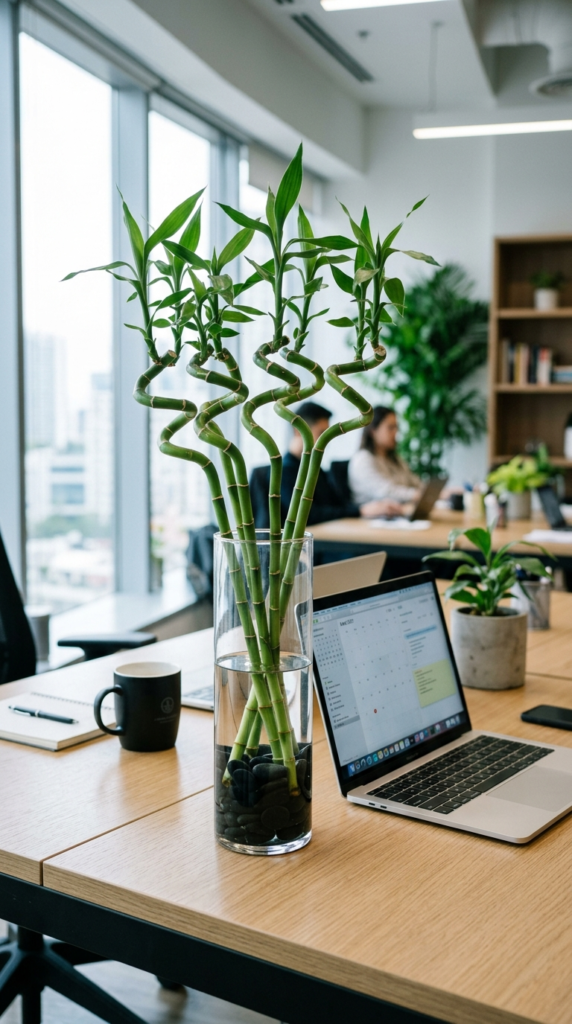
Lucky bamboo (Dracaena sanderiana — not actually bamboo!) is the ultimate desk plant for office spaces that want zero fuss and maximum zen energy. Those elegant green stalks arranged in spirals or bundles in a glass vase of water look effortlessly stylish and require almost no care whatsoever.
It grows in water or soil, though the classic water-growing arrangement in a clear glass vase with pebbles is the most popular for desks — it’s clean, modern, and you can see exactly how much water is left. Just top up the water every one to two weeks and add a drop of liquid fertilizer monthly.
💡 Here’s the thing: Lucky bamboo is sensitive to fluoride and chlorine in tap water, which can cause brown leaf tips. Use filtered water or leave tap water out overnight before using it and you’ll never have this problem.
In feng shui tradition, lucky bamboo is believed to bring good fortune, positive energy, and prosperity — the number of stalks carries specific meaning (three for happiness, five for wealth, seven for health). Whether or not you follow feng shui, it makes a genuinely lovely desk companion!
It tolerates low to moderate indirect light and stays compact and manageable, making it one of the easiest small office plants you can own.
Read our lucky bamboo growing and styling guide for arrangement ideas. The Sill has an excellent lucky bamboo care overview.
Stylish, symbolic, and supremely easy — lucky bamboo belongs on every office desk!
12. Succulents — Tiny, Adorable, and Almost Impossible to Kill
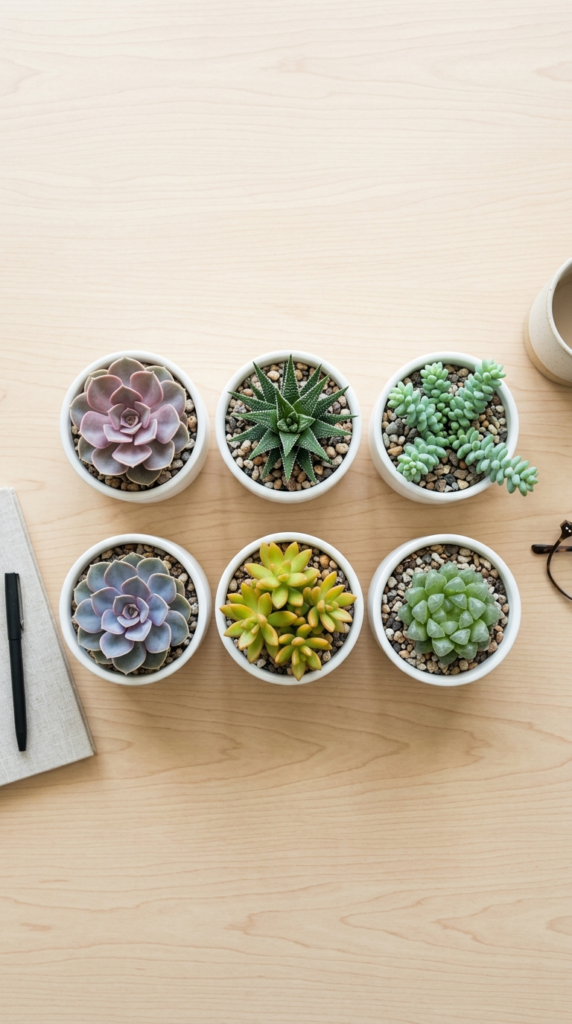
Succulents are basically the MVPs of the best indoor plants for office spaces conversation — tiny, adorable, insanely varied, and so forgiving that forgetting to water them is actually the correct care approach.
A collection of small succulents on a windowsill or desk creates an instantly charming, personalized display that costs very little and requires almost no effort. Echeveria rosettes, geometric haworthia, trailing sedums, and sculptural aloes all mix beautifully together in matching pots for a cohesive, designer look.
The absolute non-negotiable for succulent success is bright light — they need at least three to four hours of direct or bright indirect sunlight per day. A south or east-facing windowsill is ideal. Without adequate light, they’ll etiolate (stretch toward the light) and lose their compact, beautiful shape.
- Water: Every 2–3 weeks in summer, monthly in winter
- Light: Bright direct or indirect — no dark corners!
- Pot: Always use pots with drainage holes
- Soil: Cactus and succulent mix
Browse our beginner’s guide to desk succulent collections for arrangement inspiration. The Cactus and Succulent Society of America has outstanding variety identification resources.
A row of tiny succulents on your windowsill will make your office the most charming workspace in the building!
13. Boston Fern — Lush Green Drama for the Office
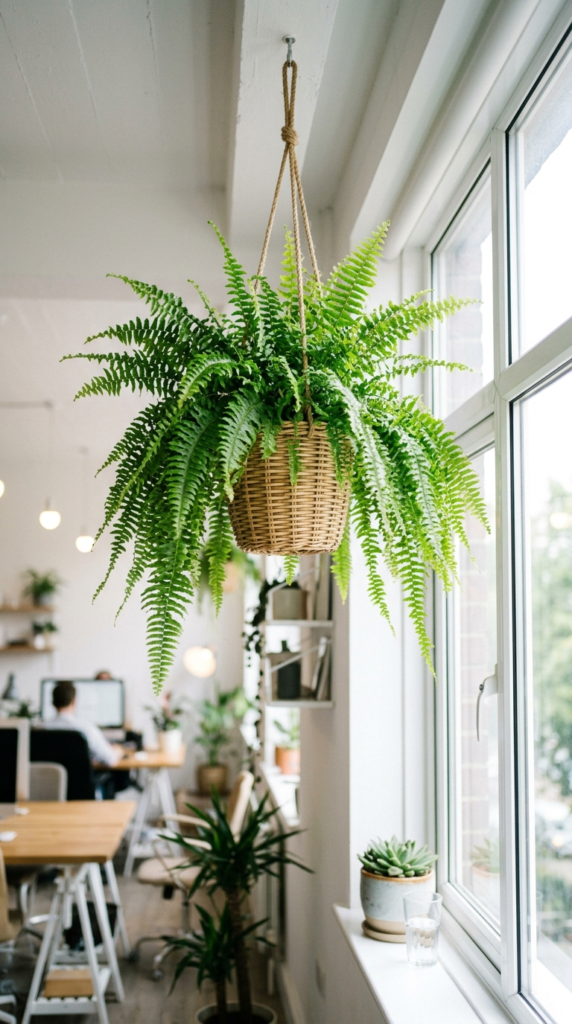
If your office has good natural light and some humidity, a Boston fern will reward you with the most gloriously lush, dramatic display of any plant on this list. Those long, arching fronds of bright green create an almost jungle-like visual effect that’s genuinely stunning.
Boston ferns (Nephrolepis exaltata) are also exceptional air purifiers — among the most effective of all indoor plants at removing formaldehyde and xylene from the air. In a well-lit office with air conditioning (which dries the air significantly), having a Boston fern nearby is a genuine air quality upgrade.
💡 The secret is humidity. Boston ferns struggle in dry office air and will reward you with brown, crispy frond tips if the humidity drops too low. Mist the fronds a few times a week or place the pot on a pebble tray with water to boost local moisture.
Water your fern consistently — the soil should stay evenly moist but never waterlogged. Check it every few days rather than on a fixed schedule since ferns don’t do well with drought the way succulents do.
In the right conditions, a Boston fern becomes an absolute showstopper — the kind of plant that makes the whole office feel like a tropical retreat.
Find our Boston fern humidity and care guide for tips on keeping fronds gorgeous. The Old Farmer’s Almanac has reliable Boston fern growing advice.
Give it the moisture it craves and a Boston fern will absolutely blow your mind with its beauty!
14. Dracaena — The Tall, Sculptural Office Statement Plant
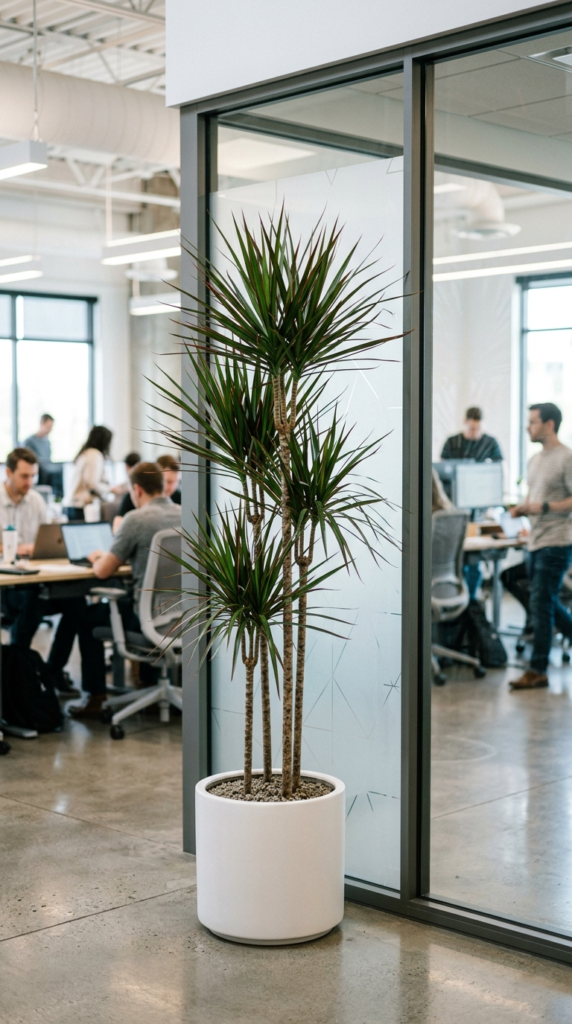
Dracaena is the go-to tall indoor office plant for good reason — it fills vertical space beautifully, tolerates office conditions with ease, and has a naturally sculptural quality that looks designed rather than simply planted. The cane-like stems and spiky leaf clusters give it a genuinely architectural character.
Dracaena marginata (dragon tree) with its slender red-edged leaves is the most popular office variety, while D. fragrans (corn plant) offers broader, more tropical-looking foliage with a yellow-green center stripe. Both are excellent, and both handle low to moderate indirect light extremely well.
Dracaenas are remarkably drought-tolerant and prefer to dry out between waterings — every two to three weeks is usually plenty. They’re also sensitive to fluoride, so use filtered or rainwater if you notice brown leaf tips developing.
These plants can grow to impressive heights of 4–6 feet indoors over several years, making them ideal floor plants for office lobbies, beside reception desks, or in the corners of conference rooms where their dramatic silhouette can really shine.
Explore our tall indoor plants for office lobbies and reception areas guide for more ideas. The University of Florida IFAS has thorough dracaena variety and care research.
Tall, dramatic, and effortlessly architectural — dracaena brings instant gravitas to any office!
15. English Ivy — The Elegant Trailing Office Classic
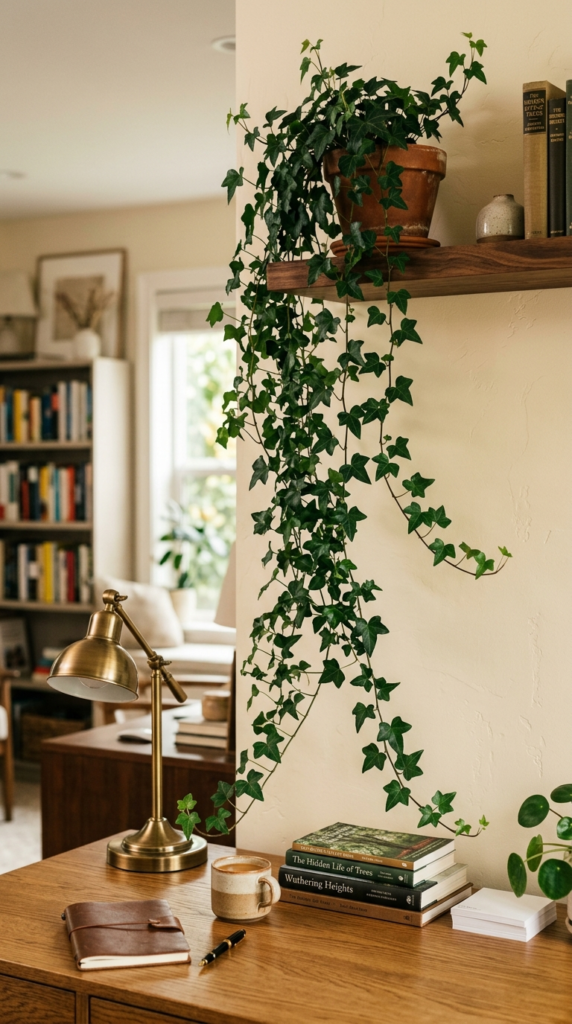
English ivy brings an air of timeless elegance and Old World sophistication to any office space — those classic, deeply lobed leaves trailing from a high shelf or bookcase look like something from a historic library, and we are absolutely here for it.
Hedera helix tolerates a wide range of light conditions from low to bright indirect, making it adaptable to most office placements. It also performs beautifully in cooler office temperatures that other tropical plants find uncomfortable.
💡 Pro Tip: English ivy is one of the best plants for hanging planters and high shelves — let it trail freely for maximum visual impact, or train it up a small moss pole for an upright topiary effect on a desk.
Keep the soil consistently moist but not waterlogged and mist the foliage regularly — ivy appreciates humidity and will develop spider mites in very dry office air if you don’t keep the foliage fresh. Check leaves periodically for any tiny mites and treat quickly with a neem oil spray.
Note that ivy is toxic to pets, so place it high where office dogs and cats — if your workplace allows them — can’t reach the trailing vines.
See our ivy styling ideas for office shelves and walls for creative display inspiration!
Classic, refined, and endlessly elegant — English ivy never goes out of style!
16. Monstera Deliciosa — The Iconic Jungle Statement Plant
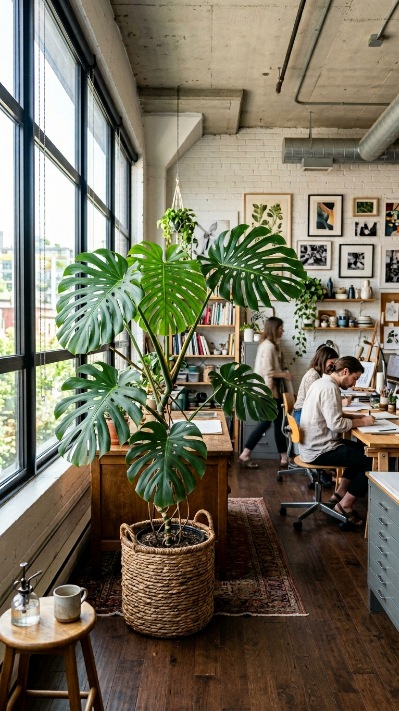
Is there a more instantly recognizable, Instagram-worthy office plant on the planet than the monstera? Those dramatic, split leaves with their distinctive natural holes (called fenestrations) have become the universal symbol of stylish, plant-loving workspaces everywhere.
Monstera deliciosa grows surprisingly quickly in the right conditions — bright to medium indirect light and regular watering — and those fenestrated leaves get larger and more dramatically split as the plant matures and grows. Starting with even a small plant, you’ll have a genuinely impressive specimen within a year or two.
Give your monstera something to climb — a moss pole or bamboo stake encourages it to grow upward and produce larger, more fenestrated leaves. Without support it tends to spread outward and take up more floor space than most offices can accommodate.
Water when the top two inches of soil dry out, wipe the large leaves occasionally to keep them glossy and clean, and fertilize monthly through spring and summer. This is genuinely one of the most rewarding large office plants you can grow.
Get the full treatment in our monstera care and propagation guide. The Royal Horticultural Society has an excellent monstera growing profile.
A monstera in your office makes a statement that says you take both your work AND your plants seriously!
17. Jade Plant — A Long-Lived Desk Companion
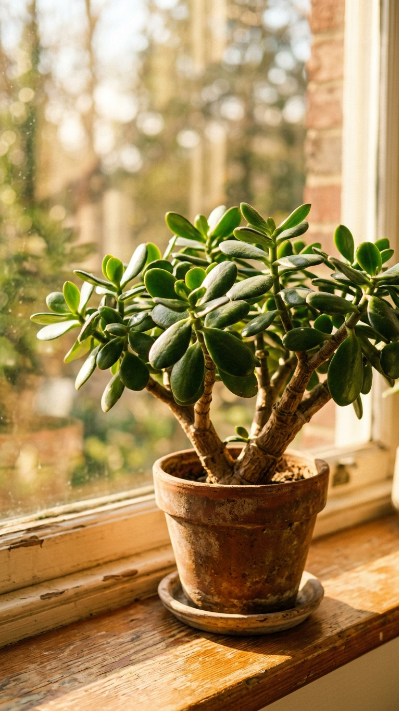
Jade plants (Crassula ovata) are the office plants that become office legends — slow-growing, incredibly long-lived succulents that sit on desks for years, even decades, and become beloved, meaningful companions in a workplace.
Those thick, fleshy oval leaves in deep glossy green (sometimes edged in red when grown in bright light) and the increasingly woody, tree-like structure give mature jade plants an almost bonsai-like appearance that’s genuinely beautiful.
💡 Here’s the deal: Jade plants need bright light — ideally three to four hours of direct sun — to stay compact, bushy, and healthy. In insufficient light they’ll get leggy and sparse. A south-facing windowsill is genuinely their perfect home.
Water thoroughly when the soil is completely dry, then ignore it for another two to three weeks. Jade plants store water in their leaves and hate wet feet — a simple terracotta pot with drainage holes in a bright window is all they need to thrive for decades.
They even bloom occasionally in winter, producing tiny star-shaped pink or white flowers that are an absolute delight when they appear.
See our jade plant care and long-term growing guide for tips on keeping yours thriving for years. The Cactus and Succulent Society of America has great jade plant resources.
Plant a jade plant on your desk today and it might still be there when you retire!
18. Air Plants — Zero Soil, Maximum Cool Factor
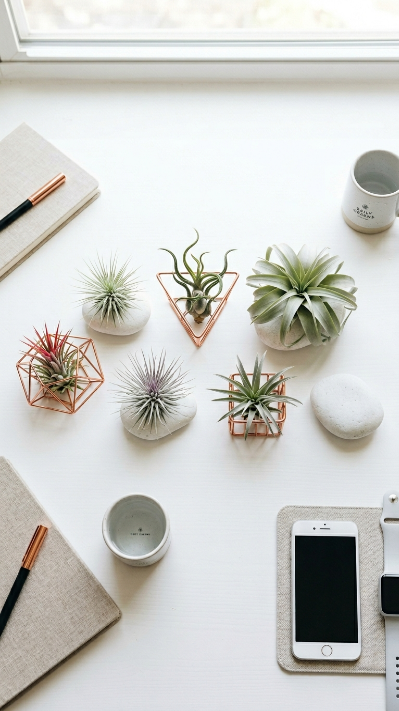
Air plants (Tillandsia) are genuinely one of the most fascinating and conversation-starting indoor plants for office spaces — they require no soil whatsoever, grow on almost any surface, and have a truly alien, sculptural beauty that makes everyone who sees them ask questions.
Display them in geometric terrariums, copper wire holders, seashells, driftwood, or on decorative stones — the styling possibilities are completely limitless and the effect is always modern, unique, and genuinely impressive.
Care is simple: mist them two to three times per week or soak them in water for 20–30 minutes once a week, then shake off excess water and allow to dry completely before placing back in their display. That’s it — no soil, no repotting, no drainage holes needed.
They need bright indirect light and good air circulation, both of which are typically available near office windows. Avoid placing them in sealed glass containers without airflow or in the direct stream of air conditioning vents.
- Watering method: Misting 2–3x/week OR weekly soaking
- Light: Bright indirect
- Display: Wire holders, terrariums, driftwood, stones
- Soil: None needed whatsoever
Discover creative air plant display ideas for desks and shelves. The Air Plant Supply Co. has excellent care guidance for all tillandsia types.
Air plants are the conversation piece your office has been waiting for — guaranteed!
19. Nerve Plant — Tiny, Colorful, and Endlessly Fascinating
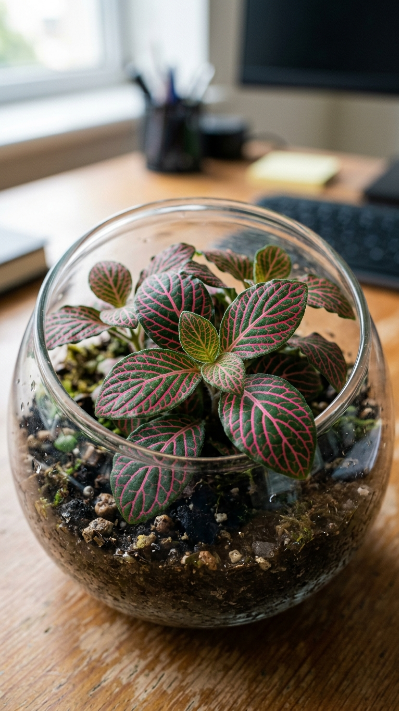
Nerve plant (Fittonia albivenis) is proof that big visual impact can come in a very small package. Those intricately patterned leaves with their vivid network of pink, red, white, or silver veins against deep green are genuinely one of nature’s most extraordinary designs — and they sit perfectly on a desk in a small pot or terrarium.
The secret to happy nerve plants in an office is high humidity — they’re tropical plants that genuinely thrive in glass terrariums and enclosed containers where moisture is trapped. Planting one in a simple glass bowl or bottle terrarium creates an essentially self-sustaining miniature ecosystem that’s perfect for an office desk.
💡 Here’s the thing: Nerve plants are dramatic about thirst — they’ll dramatically wilt and collapse when dry, then perk back up completely within an hour of watering. Don’t panic when this happens; just water them and watch the magic!
In a terrarium setup, nerve plants need very little watering — perhaps once every few weeks — since the glass retains moisture naturally. They prefer low to medium indirect light and actually struggle in bright direct sunlight, making them genuinely good for dim office spots.
These are the best indoor plants for office spaces where you want a tiny burst of extraordinary color without taking up any real estate.
Build your own in our mini desk terrarium planting guide. The Missouri Botanical Garden has a detailed fittonia plant profile.
Tiny but absolutely mighty — the nerve plant will steal the show on any desk!
20. Bamboo Palm — The Best Indoor Plant for Office Air Quality
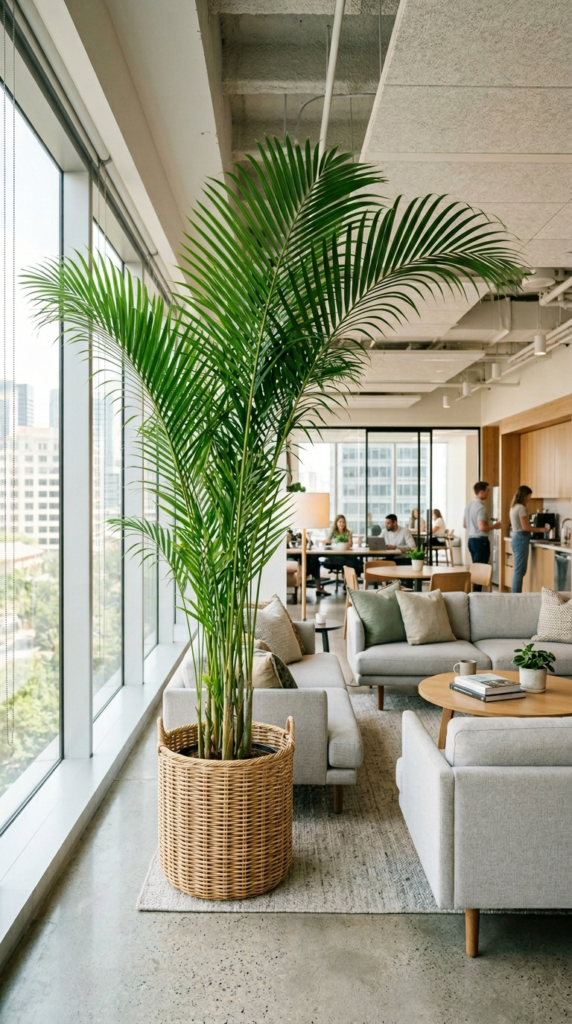
Saving the best air purifier for last — the bamboo palm (Chamaedorea seifrizii) was one of NASA’s top-rated plants for indoor air quality improvement, particularly effective at removing benzene, trichloroethylene, and formaldehyde from office air. In a large office environment, the impact of a few well-placed bamboo palms is genuinely significant.
Beyond the air quality benefits, bamboo palm is simply beautiful — those graceful, arching fronds of deep green give any office the feel of a tropical resort, and a large specimen creates an instant sense of lush, living abundance that energizes the whole space.
It’s one of the most low-light tolerant palms available, tolerating the kind of bright indirect light that most office environments provide near windows. Keep the soil evenly moist, maintain temperatures above 60°F, and avoid cold drafts from air conditioning.
Bamboo palm also adds meaningful humidity to dry office air — a cluster of large palms can measurably increase local humidity levels, making the environment more comfortable for both you and your other office plants.
At maturity it reaches 4–12 feet tall depending on conditions, making it ideal as a floor plant for large office spaces, conference rooms, and corporate lobbies where you want a genuine tropical impact.
Explore our best large floor plants for corporate offices for companion plant ideas. The NASA Clean Air Study provides the original research on bamboo palm’s air-purifying properties.
For clean air, tropical beauty, and effortless elegance, bamboo palm is the ultimate office plant!
Frequently Asked Questions
What are the best indoor plants for offices with no windows?
For truly windowless offices, your best options are snake plants, ZZ plants, cast iron plants, and pothos — these are the most genuinely low-light tolerant plants available. Supplement with a small grow light (even a basic LED desk lamp designed for plants) placed a foot or two above your plant, and you’ll dramatically expand your options. Run the grow light for 12–14 hours per day to simulate natural daylight and most common office plants will do surprisingly well.
How often should I water my office plants?
Most low-maintenance office plants need watering only every one to two weeks, and many — including succulents, ZZ plants, snake plants, and jade plants — prefer even less frequent watering. The golden rule is always to check the soil before watering: stick your finger an inch or two into the soil and water only when it feels dry at that depth. Overwatering is far more common than underwatering and is the number one cause of office plant death.
Which indoor plants for office spaces are safe for pets?
If your office is pet-friendly, choose spider plants, Boston ferns, bamboo palms, air plants, and succulents like echeveria and haworthia — these are all non-toxic to cats and dogs. Avoid peace lilies, pothos, philodendrons, dracaena, rubber plants, and English ivy, which range from mildly to severely toxic to pets. Always verify any plant on the ASPCA toxic plant database before bringing it into a pet-friendly workplace.
Can office plants really improve productivity and wellbeing?
Yes — and the research backs it up! Studies from the University of Exeter found that adding plants to offices increased worker productivity by up to 15% and improved employee wellbeing scores significantly. The mechanisms include reduced stress, lower cortisol levels, improved air quality, reduced noise levels (larger plants can absorb sound), and the psychological comfort of being near living things — a concept called biophilia. Even a single plant on your desk makes a measurable difference.
What are the best low-maintenance indoor plants for office spaces where nobody remembers to water?
For truly forgetful plant owners, the top five are: ZZ plant, snake plant, cast iron plant, pothos, and succulents. All of these prefer infrequent watering and will tolerate being forgotten for weeks at a time without permanent damage. Another smart strategy is to use self-watering pots with built-in reservoirs — these extend the time between waterings dramatically and take all the guesswork out of office plant care.
A Few Final Thoughts
Transforming your workspace with the best indoor plants for office spaces isn’t just about aesthetics — it’s genuinely one of the most impactful things you can do for your daily wellbeing, focus, and enjoyment of your working environment. Whether you start with a single low-maintenance pothos on your desk or go all-in with a lush collection of statement plants throughout your office, every plant you add is an investment in a healthier, happier, more productive workday. The twenty plants on this list cover every light level, care style, budget, and design aesthetic imaginable — so there really is no excuse not to start greening up your workspace today. Pick one plant that excites you, get it settled into your office, and watch how quickly it changes the entire energy of your space. Your dream office garden is closer than you think — now go make it happen!