
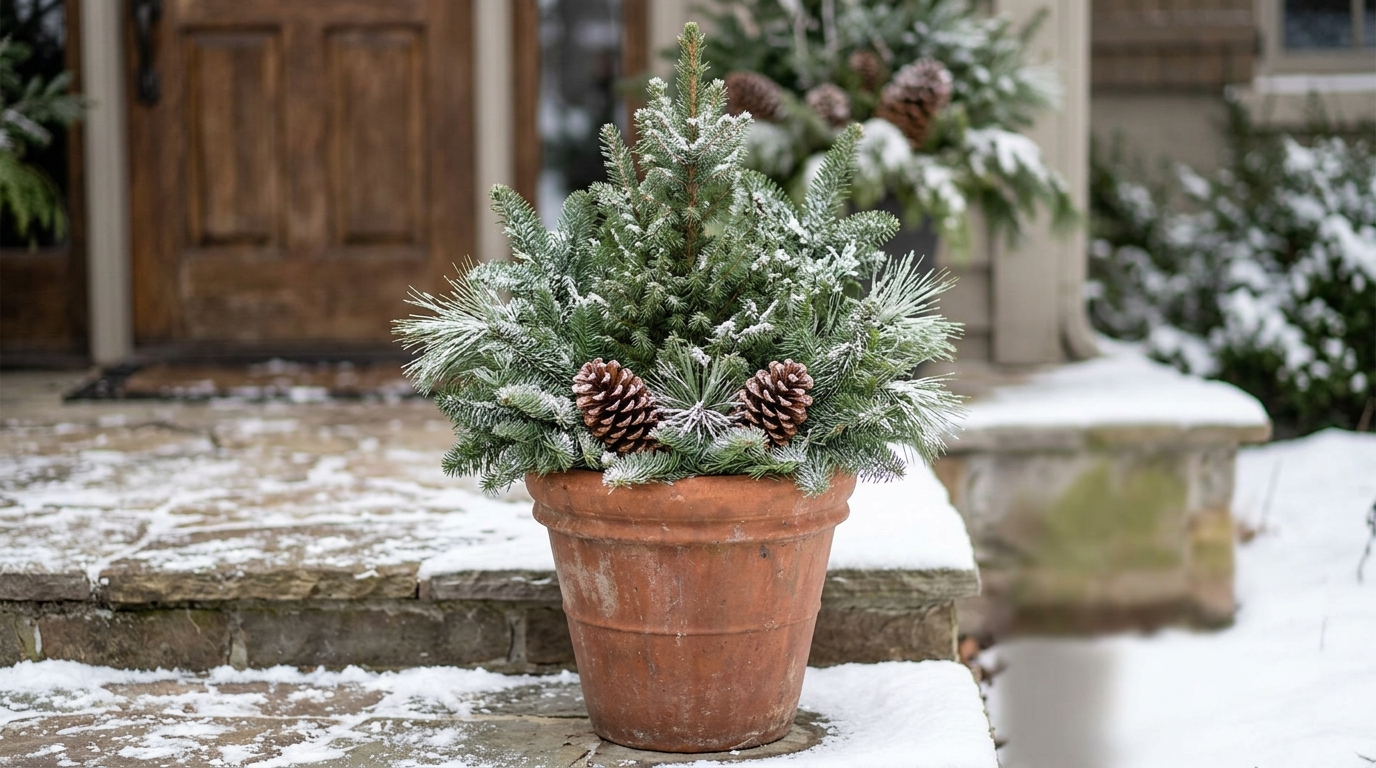
Does your front porch look absolutely spectacular in summer and then completely fall apart the moment the first frost hits? You are so not alone — but here’s the exciting truth: winter porch pots with evergreens can actually look more impressive than your summer displays, delivering rich texture, deep color, and architectural drama that sun-scorched petunias could never dream of achieving. We’re talking glossy-leaved statement shrubs, sculptural conifers, berry-laden beauties, and cascading silver trailers — all frost-hardy, all gorgeous, and all completely achievable whether you’ve got a grand front porch or a modest apartment stoop. Ready to make your porch the most envied on the street this winter? Let’s dive in!
At a Glance
- Winter porch pots with evergreens work best when you combine plants with different textures, heights, and seasonal interest — berries, variegated foliage, and structural form all playing equal roles in the final display.
- The thriller-filler-spiller formula is your secret weapon for professional-looking porch pots — one tall structural plant, two or three mid-height fillers, and at least one trailing evergreen spiller transforms any container into something extraordinary.
- Pot material and color matter as much as the plants themselves — dark glazed ceramic, weathered zinc, and aged terracotta all create very different moods and should be chosen to complement both your planting palette and your home’s exterior.
- Most evergreen porch pot plants are frost-hardy to at least -10°C when properly potted in free-draining compost with insulated containers, making them genuinely reliable through the harshest winter months.
- Grouping porch pots in odd numbers at varying heights — using pot risers, upturned pots, or purpose-built plant stands — creates the kind of layered, abundant display that makes passers-by stop and look twice.
1. The Classic Blue Spruce Statement Pot
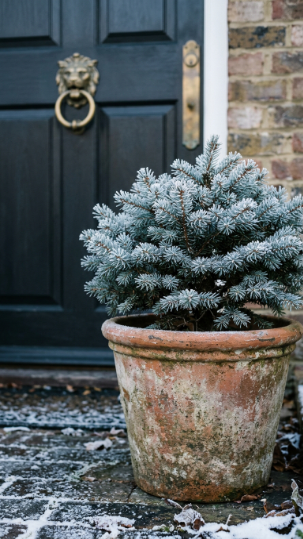
Here’s the deal: dwarf blue spruce is the porch pot plant that stops people in their tracks — that extraordinary silver-blue foliage color is unlike anything else in the winter plant palette and it photographs absolutely beautifully against a dark front door. It’s the conifer that makes people ask what it is every single time.
Picea pungens ‘Glauca Globosa’ stays naturally compact and rounded — no clipping required — and its dense, horizontally layered branch structure collects frost in a way that looks almost deliberately decorative. Picea glauca ‘Conica’ is the narrower, more conical alternative if you want a classic Christmas-tree shape in miniature.
The secret to blue spruce porch pots is giving them excellent drainage and full sun — they thrive in cold, bright positions and actually develop their most intense blue coloring in response to cold and strong light. A frost-dusted blue spruce on a sunny winter morning is genuinely one of the most beautiful sights in cold-season gardening.
💡 Pro Tip: Underplant your blue spruce with white-berried Gaultheria and trailing silver Dichondra for a cool, frosty-toned display that amplifies the blue-silver color story of the spruce itself. The monochromatic palette is far more sophisticated than mixing in warm tones — commit to the cool and it looks absolutely stunning.
- Hardy to -20°C — one of the most cold-tolerant porch pot plants available
- Grows approximately 5–8cm per year — stays porch-friendly for many years
- No deadheading, no feeding, minimal watering in winter — truly fuss-free
- Develops its most intense blue color in cold, sunny positions — perfect for exposed porches
Check out our dwarf conifers for winter porch pots — the complete guide for variety comparisons and pot sizing. The American Conifer Society has brilliant species profiles at conifersociety.org.
A blue spruce porch pot is the kind of thing that becomes a permanent fixture — you’ll never want to be without one once you’ve grown it!
2. Skimmia Japonica — Berries, Buds & Beauty
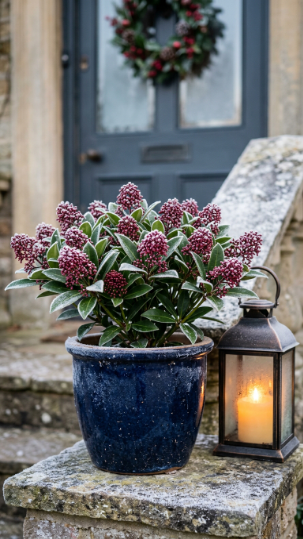
Skimmia japonica is the porch pot plant that quietly does everything — it’s evergreen, it produces gorgeous deep red or white berries (or on male varieties like ‘Rubella’, spectacularly ornamental deep red flower buds through the entire winter), it’s completely frost-hardy, it handles shade brilliantly, and it asks almost nothing from you in return. Pretty cool, right?
‘Rubella’ (male) gives you the most dramatic winter display — those deep crimson-red bud clusters form in autumn and last through the entire winter, opening into fragrant white flowers in spring. ‘Temptation’ and ‘Reevesiana’ are self-fertile varieties that produce both flowers and berries on the same plant, meaning you only need one plant for the full show.
Skimmia genuinely prefers shade and damp conditions — making it the perfect choice for north-facing porches and covered entrances where most other winter plants struggle. It’s one of the very few plants that actually performs better in the challenging conditions of a covered, shaded porch.
💡 Pro Tip: Skimmia is an acid-loving plant — use ericaceous compost rather than standard multipurpose mix and your plant will stay healthier, produce richer bud color, and last far longer in its pot. Signs of iron deficiency (yellowing leaves with green veins) are almost always a sign that the compost isn’t acidic enough.
Explore our Skimmia japonica porch pot growing guide for variety selection, compost advice, and companion planting combinations.
Skimmia is the porch pot plant that rewards you all winter and surprises you every spring — once you grow it, it earns a permanent place in your display!
3. The Symmetrical Bay Tree Entrance Pair
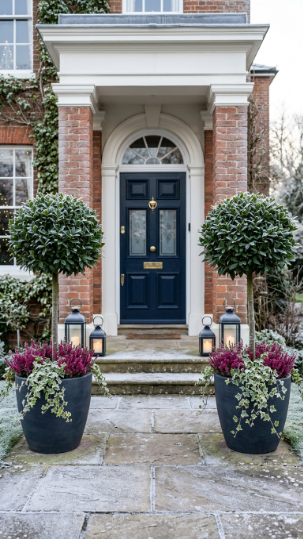
Nothing signals considered, confident exterior styling quite like a perfectly matched pair of bay tree standards flanking a front entrance — it’s the classic move that works on every architectural style from Georgian townhouse to modern new-build, and it never, ever goes out of fashion.
Laurus nobilis trained as a lollipop standard gives you a clear stem with a clipped spherical head — the geometry is formal, architectural, and deeply satisfying. The glossy, deep green leaves are beautifully evergreen through the coldest winters, they smell wonderful when brushed in passing (that warm, herby bay scent on a cold morning is genuinely delightful), and of course, you can harvest the leaves for cooking any time you need them.
The underplanting around the base of the standard stem is what elevates this classic display from good to extraordinary — vivid pink or white winter heather for color, trailing variegated ivy to cascade over the pot edge, and perhaps a few white-berried Gaultheria for festive interest. The underplanting connects the plant visually to the container and softens the geometric formality beautifully.
Matching pots are non-negotiable for a symmetrical entrance display — even a small difference in pot shape, color, or size destroys the visual impact immediately. Invest in identical vessels and your entrance will look like it was professionally designed, because it essentially was.
| Bay Standard Size | Stem Height | Head Diameter | Pot Size Needed |
| Small standard | 40–50cm | 25–30cm | 30cm diameter |
| Medium standard | 60–80cm | 35–40cm | 40cm diameter |
| Large standard | 90–120cm | 45–55cm | 50cm diameter |
| Extra large | 120cm+ | 60cm+ | 60cm+ diameter |
Read our bay tree standard porch entrance styling guide for sizing, pot selection, and winter care advice.
A pair of bay standards at your entrance is a genuine long-term investment in your home’s curb appeal — and they get more beautiful every single year!
4. Trailing Variegated Ivy — The Ultimate Spiller
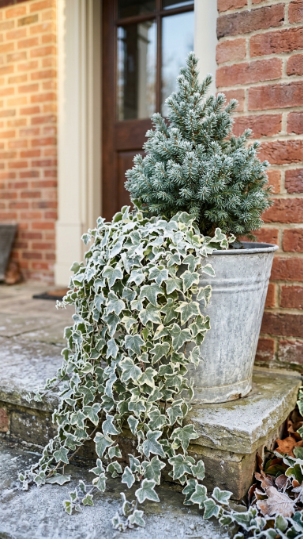
Here’s the thing: trailing ivy is the ingredient that most home gardeners forget in their winter porch pots — and its absence is exactly what makes the difference between a display that looks planted and one that looks styled. A generous, cascading spill of variegated ivy over a pot edge is pure visual magic.
Hedera helix ‘Glacier’ (silver-grey and white variegation), ‘Goldheart’ (deep green with a bold yellow center splash), and ‘Buttercup’ (fresh lime-yellow in sun, greener in shade) are three of the most beautiful variegated ivy varieties for porch pots — each creates a completely different mood while delivering the same reliable, frost-proof trailing performance.
The secret is planting ivy as close to the edge of the pot as possible — ideally right at the rim — so the trailing stems immediately cascade outward and downward rather than growing inward over the other plants. Train a few stems deliberately over the edge in the first weeks and the plant will follow that direction naturally thereafter.
Ivy is genuinely indestructible in cold weather — it’s hardy to around -20°C, handles deep shade, tolerates drought once established, and actually develops richer leaf color and more pronounced variegation in cold conditions. It’s the most reliable frost-proof trailing plant in existence.
💡 Pro Tip: Cut your ivy back hard every spring to prevent it from overwhelming your other porch pot plants — a single plant can produce meters of new growth in a season. Hard pruning in March keeps it bushy, restores the variegation on older stems, and sets you up with a fresh, well-shaped spiller for the following winter season.
Check out our best trailing ivy varieties for winter containers for the full variety guide with color profiles and growth rates.
Never plant a winter porch pot without a trailing ivy spiller — it’s the finishing touch that makes everything look professionally designed!
5. Gaultheria — Vivid Berry Colour in a Compact Package
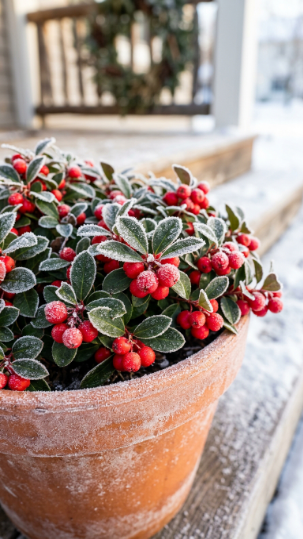
Gaultheria procumbens (Wintergreen or Checkerberry) is the compact little berry plant that punches way above its weight in winter porch pots — those vivid, jewel-bright berries in red, white, pink, or deep magenta persist from October right through to March, and the small, dark, glossy evergreen leaves turn wonderfully bronze-red in cold temperatures.
The color range is extraordinary — ‘Veitchii’ produces the classic brilliant red berries; ‘Winter Pearls’ gives pristine white berries with an almost luminous quality; ‘Magical Marachino’ delivers deep cherry-red in profusion; and ‘Patio Mix’ combines multiple berry colors in a single plant for a rainbow effect. Mix them together in one container for an extravagant berry display.
Gaultheria stays beautifully compact at 15–20cm, making it ideal as a dense filler-spiller at the base of taller porch pot plants — it carpets the compost surface, suppresses weeds, and adds that critical low-level color interest that taller evergreens simply can’t provide.
Like Skimmia, Gaultheria is acid-loving — ericaceous compost is essential for long-term health and best berry production. It also prefers partial shade rather than full sun, making it another great choice for covered or north-facing porch positions.
Read our Gaultheria in winter container displays — planting and care guide for variety comparisons and combination planting ideas. The RHS has excellent Gaultheria profiles at rhs.org.uk.
Gaultheria is winter’s most underrated porch pot plant — those berries are so vivid they barely look real, and that’s exactly what makes them so spectacular!
6. The Festive Conifer & Berry Winter Porch Pot
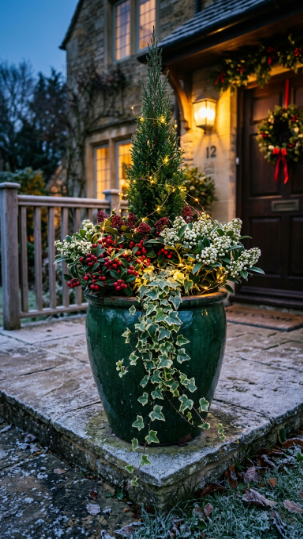
Talk about a game-changer — this living festive porch pot is essentially a Christmas decoration built entirely from frost-hardy evergreen plants rather than cut material, meaning it looks magnificent from November to March and every plant can be repotted and reused once the season ends. Zero waste, maximum impact!
The formula is beautifully simple: a slim upright Juniper (Juniperus communis ‘Compressa’ is perfect — narrow, architectural, and naturally Christmas-tree shaped) as your thriller gives you that classic festive silhouette. Deep red Gaultheria and white-berried Skimmia as fillers deliver the red-and-white color story. Trailing variegated ivy as your spiller completes the composition with flowing green-and-silver foliage.
The finishing touch that elevates this from beautiful to breathtaking? Wrap a string of warm white battery-operated fairy lights loosely through the entire arrangement — the lights threading through the juniper, the berries, and the trailing ivy create an effect at dusk that is genuinely magical and makes your porch the most photographed entrance on the street.
💡 Pro Tip: Use battery-operated LED fairy lights with a timer function rather than mains-powered lights for porch pots — they’re safer in wet outdoor conditions, require no wiring, and the timer means they automatically glow from dusk to a set time every evening without you needing to remember to switch them on or off. Set them and forget them!
Explore our festive living porch pot planting guide for plant combinations, pot sizing, and fairy light recommendations.
This living festive porch pot is the display that will have your neighbours asking where you bought it — and the answer is “I made it myself” which is genuinely the best part!
7. Euonymus — Variegated Gold & Green Year-Round Colour
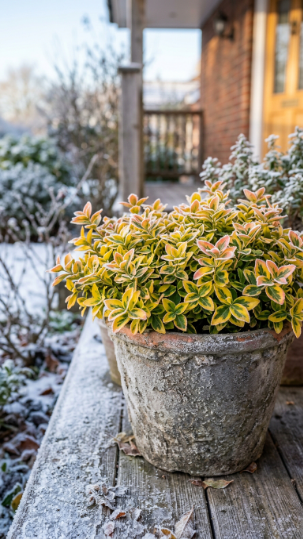
Here’s the deal: Euonymus fortunei varieties are one of the most reliably colorful and completely fuss-free evergreen plants for winter porch pots — and they’re wildly underused considering how much visual work they do. Those vivid variegated leaves in gold-and-green, silver-and-green, or pure gold hold their color right through the coldest winters and develop beautiful additional tones in cold weather.
‘Emerald ‘n’ Gold’ is the classic — brilliant gold and green variegation that takes on warm pink-bronze tints at the leaf edges in hard frost, giving you an ever-changing winter color show. ‘Emerald Gaiety’ offers the silver-and-green alternative with white margins that look incredibly beautiful dusted with frost. ‘Sunspot’ delivers a bold central gold splash on each leaf for a more dramatic, almost tropical-looking effect.
Euonymus works brilliantly as a mid-height filler plant in larger porch pot compositions, or as a standalone compact display in a smaller pot where its naturally mounding, dense form fills the container beautifully without any other plants needed.
It’s genuinely one of the toughest evergreens in cultivation — hardy to -15°C, tolerant of wind exposure, happy in sun or partial shade, drought-tolerant once established, and completely unfazed by the temperature fluctuations that damage more delicate winter plants.
| Euonymus Variety | Variegation | Winter Bonus | Height |
| ‘Emerald ‘n’ Gold’ | Gold + green | Pink-bronze tints in cold | 60cm |
| ‘Emerald Gaiety’ | White + green | White margins frost beautifully | 60cm |
| ‘Sunspot’ | Gold center splash | Intense gold in winter sun | 50cm |
| ‘Silver Queen’ | Cream + green | Creamy tones deepen in cold | 80cm |
Read our Euonymus varieties for winter porch pots for color combination ideas and companion planting suggestions.
Euonymus is the hardworking, colorful backbone of the winter porch pot display — it never lets you down and it always earns its place!
8. Architectural Phormium as a Dramatic Thriller
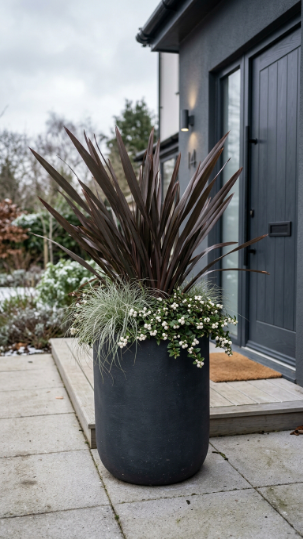
For a contemporary, boldly architectural porch display, nothing delivers quite like a well-chosen Phormium as the thriller plant in a large statement pot. Those dramatic, sword-like leaves in deep burgundy, bronze, or striking cream-and-green variegation are genuinely sculptural — more like living art than conventional evergreen planting.
Phormium ‘Platt’s Black’ is one of the darkest, most dramatic plants in the entire winter palette — the near-black leaves are extraordinary against a light-colored porch or a white rendered wall. ‘Bronze Baby’ is the more compact option with warm copper-bronze coloring that glows in low winter sunlight. ‘Sundowner’ gives you a striking combination of pink, bronze, and green striping.
Phormium needs winter root protection in hard freezes — the plant itself is cold-hardy to around -5°C to -8°C (depending on variety) but the roots in an above-ground container are more vulnerable. Wrap the pot in horticultural fleece or bubble wrap during the coldest spells and mulch the compost surface with bark chippings.
💡 Pro Tip: Remove any browning or damaged leaves from your Phormium promptly throughout winter — cut cleanly with scissors right at the base of the leaf. Dead leaves left in the fan look messy and detract from the architectural impact of the plant. Five minutes of grooming every few weeks keeps your Phormium looking razor-sharp all season.
Explore our Phormium as a thriller in winter containers for variety selection and cold protection techniques.
A Phormium porch pot makes a statement that nothing else in the winter plant palette can match — it’s bold, beautiful, and completely unforgettable!
9. Winter Heather — Months of Colour in One Plant
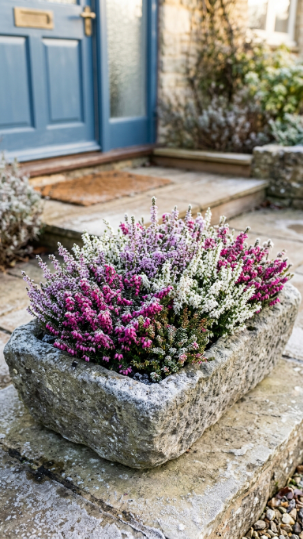
Winter heather (Erica carnea) is one of the most extraordinary value plants in the entire winter porch pot toolkit — it flowers continuously from November right through to April, handles frost, snow, and freezing rain with complete indifference, requires zero deadheading to keep blooming, and costs almost nothing at the garden center. It’s the winter porch pot workhorse and it deserves far more credit than it gets.
The secret to a truly spectacular heather display is planting multiple varieties together in a tapestry — mix deep pink ‘Myretoun Ruby’, pure white ‘Springwood White’, and rosy-lilac ‘King George’ in the same container for a jewel-bright patchwork effect that’s genuinely beautiful from across the street.
Erica carnea specifically (rather than other heather species) is the key variety to look for — it’s the most frost-tolerant heather available, it tolerates slightly less acidic soil than other types (making it more forgiving in standard multipurpose compost), and it produces the most reliable and long-lasting winter flowers.
Wide, shallow stone troughs or window boxes are perfect for heather displays — plant them densely (closer than the label suggests) for an immediately full, lush look, and they’ll grow together into a seamless carpet of color within weeks.
Read our winter heather porch pot planting guide for variety combinations and the tapestry planting technique. The Heather Society has brilliant growing resources at heathersociety.org.
Four months of continuous bloom, zero fuss, and extraordinary color — winter heather is the best value plant in the cold-season garden, full stop!
10. Boxwood Balls — Timeless Evergreen Geometry
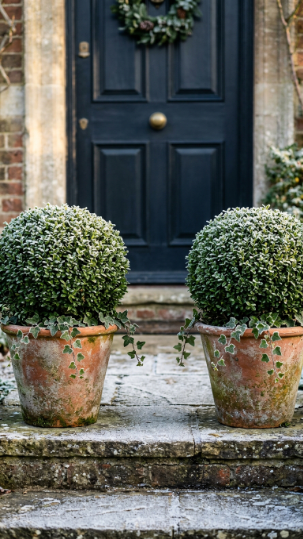
Here’s the thing: a perfectly clipped boxwood ball in a beautiful pot is one of those timeless, endlessly elegant things that never looks dated and never fails to make a porch look considered, cared for, and stylish. It’s the little black dress of porch pot planting — always appropriate, always beautiful.
Buxus sempervirens (common box) is the classic species — dense, slow-growing, and it clips to an extraordinarily precise, almost artificial-looking sphere that holds its shape through all weathers. Buxus microphylla ‘Faulkner’ is an excellent alternative if you’re in an area affected by box blight — it shows better disease resistance while delivering the same geometric precision.
The clip timing is important for maintaining pristine shape through winter — give your box balls a final clip in late September or early October so the shape is sharp going into the cold season. Avoid clipping in hard frost or when temperatures are forecast to drop below freezing within 24 hours — clipping exposes fresh tissue that’s vulnerable to frost damage.
💡 Pro Tip: If box blight is a concern in your area, consider substituting Ilex crenata (Japanese holly) which can be clipped to identical boxwood-like precision, is completely blight-resistant, and provides the same deep green evergreen geometry. Once clipped, the two plants are nearly indistinguishable from a distance.
Explore our boxwood ball porch pots — clipping, care and alternatives guide for shaping techniques and blight-resistant alternatives.
Boxwood balls are the porch pot classic for a reason — that perfect geometric evergreen form is pure, enduring beauty that improves with every passing year!
11. Nandina — Fiery Winter Foliage & Persistent Berries
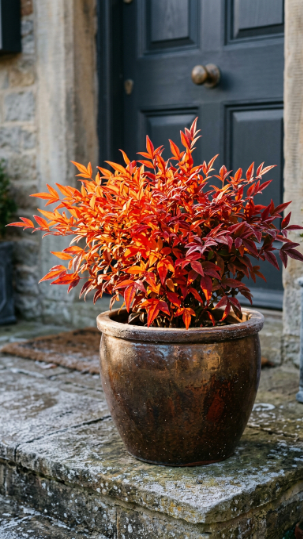
Nandina domestica — Heavenly Bamboo — is the winter foliage revelation that most gardeners completely overlook, and that is a genuine shame because the winter color it delivers is unlike anything else in the evergreen porch pot world. Those fiery, flame-bright leaf tones in burnt orange, scarlet, and deep crimson in winter are so vivid they look almost artificial against a frosty porch.
‘Firepower’ is the compact variety bred specifically for container growing — it stays at around 60–80cm, produces an extraordinary display of fiery foliage from autumn through winter, and then transitions back to fresh green-bronze in spring. ‘Gulf Stream’ is the slightly larger version with the same spectacular winter coloring and the addition of white flower clusters in summer.
Nandina also produces clusters of persistent red berries on mature plants that add to the winter interest, and the fine, almost bamboo-like texture of the foliage gives it an elegant, slightly exotic quality that stands out dramatically in a traditional porch pot display.
It needs a sheltered position and appreciates some winter sun to develop the most intense foliage coloring — a south or west-facing porch is ideal. Protect the roots in hard freezes below -10°C and it will reward you with a spectacular winter show year after year.
Read our Nandina in winter porch pots — growing and styling guide for variety selection and companion planting ideas.
Nandina is the porch pot plant that makes people do a double-take — that fiery winter foliage is genuinely one of the most surprising and beautiful things in the cold-season garden!
12. The Zinc & Silver Frosty Tonal Porch Display
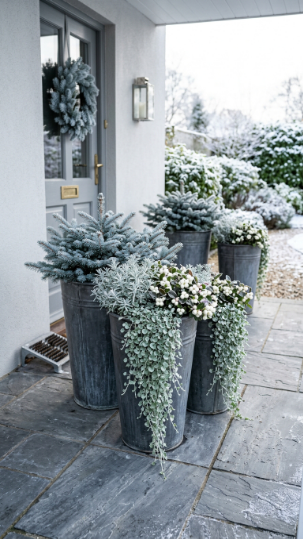
Here’s the deal: a monochromatic porch display built entirely around silver, blue, and white tones is one of the most sophisticated and visually striking winter styling approaches available — and it works precisely because it leans into the frosty, cool quality of the season rather than trying to fight it with warm colors.
The zinc container is the anchor of this whole scheme — that cool grey metallic tone is the perfect vessel for a silver-and-blue plant palette and it weathers beautifully over time, developing a soft, slightly mottled patina that adds character. Tall cylinder zinc planters from florist suppliers or garden centers are the most architectural option for a porch display.
Build your silver display around dwarf blue spruce as the thriller, silver-leaved Artemisia ‘Powis Castle’ and Stachys byzantina (Lamb’s Ears) as fillers, and the extraordinary Dichondra argentea ‘Silver Falls’ as your spiller — those cascading silver coin-shaped leaves are one of the most beautiful trailing plants in existence and the silvery shimmer in winter sunlight is genuinely mesmerizing.
💡 Pro Tip: Add white battery fairy lights threaded through the silver display for evenings — warm white lights against a silver-and-blue plant palette create a genuinely extraordinary effect, especially when frost is on the plants and the light catches every crystal. It’s one of the most beautiful things you can create on a front porch.
Explore our silver and blue winter porch pot display guide for the full plant list and container sourcing advice.
A tonal silver-and-blue porch display is the kind of thing that genuinely stops people mid-stride — it’s so cohesive and so unexpected that it looks like something from a magazine!
13. Holly Standards for Classic Winter Curb Appeal
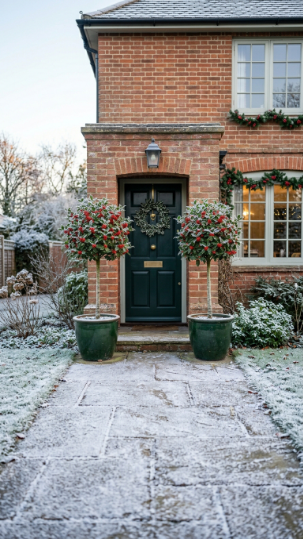
Holly standards are the quintessential British winter porch pot — those glossy, dark green spiny leaves and vivid red berry clusters are so deeply associated with winter that placing a pair at your entrance immediately gives your whole home that perfectly festive, properly seasonal quality.
Ilex aquifolium (English holly) trained as a compact standard gives you a clear stem topped with a dense, clipped head that produces berries prolifically on female plants. The key detail: you need both a male and female plant for berry production — or choose a self-fertile variety. ‘J.C. van Tol’ is the best self-fertile variety for container growing — it produces heavy crops of bright red berries without needing a pollinator and has smoother-edged leaves that are less prickly to handle.
For maximum berry impact, choose plants that are already berrying heavily when you buy them in autumn — the berries you see at purchase are the ones you’ll have all winter, and berry production on holly in a pot can vary significantly between plants even of the same variety.
Variegated holly varieties add another dimension — ‘Golden King’ (confusingly a female berry-producer despite the name) with its gold-margined leaves, or ‘Silver Queen’ (also actually male — holly naming is wonderfully chaotic) with cream-white leaf margins both create spectacular container standards.
Check out our holly standards for winter porch pots — the complete guide for male/female variety pairing, berry production tips, and pruning schedules.
A pair of berrying holly standards at your front entrance is pure, unimprovable winter magic — classic for a reason and beautiful every single year!
14. Ornamental Grasses as Textural Thriller Plants
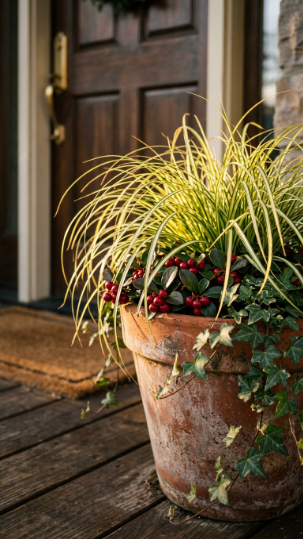
Here’s the thing: ornamental grasses are one of the most underused elements in winter porch pot design — and the gap they fill (movement, fine texture, warm color, and graceful form) is one that no broad-leaved evergreen can replicate. A grass-centred porch pot has a completely different, more naturalistic energy that balances beautifully against the formal geometry of clipped shrubs and architectural conifers.
Carex oshimensis ‘Evergold’ is the standout variety for winter porch pots — that creamy-gold central stripe on each arching leaf catches low winter sunlight in the most extraordinary way, and it stays fully evergreen and beautifully colored right through the harshest weather. Carex morrowii ‘Ice Dance’ gives you a bolder white-and-green variegation with a slightly more upright habit. Hakonechloa macra ‘Aureola’ turns warm copper-gold in autumn and holds those tones through winter.
The key to using grasses well as porch pot thrillers is pairing them with companions that contrast in texture — the fine, flowing grass lines look most beautiful against the round, glossy berries of Gaultheria, the bold flat leaves of Skimmia, or the sharp structure of a small conifer.
💡 Pro Tip: Don’t cut your ornamental grasses back in autumn — the dried and weathered foliage of many grass varieties is part of their winter beauty. Leave them through the season and cut back to just above the crown in late February or early March to make way for fresh new spring growth.
Explore our ornamental grasses in winter porch pots — variety and styling guide for companion planting combinations and care advice.
A grass-centred porch pot brings movement, texture, and warmth to your winter display that no other plant can provide — it’s the ingredient that makes everything around it look better!
15. The Complete Layered Porch Pot Trio Display
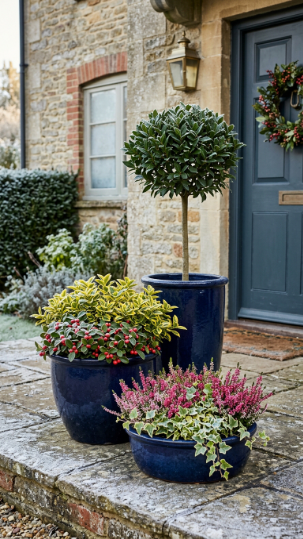
We’re finishing with the complete picture — a fully layered porch pot trio display that combines everything we’ve covered into one cohesive, professionally styled winter entrance that works from the street, from the path, and up close at the door. This is the whole strategy in one display.
The formula is built on three containers at three distinct heights — tall at the back, medium in the middle, low at the front — so the display reads as one abundant, layered composition rather than three separate pots that happen to share a porch. Use matching pot material and color across all three containers to tie the whole composition together into a single design statement.
Back container (tallest): Your most architectural thriller plant — a bay standard, a slim upright conifer, or a dramatic Phormium — gives height and structure that anchors the entire display visually from the street. This is the plant people see first and remember longest.
Middle container (medium): Your richest, most colorful combination — a mounding Euonymus or Skimmia as the filler, underplanted with Gaultheria for berry interest and a trailing ivy spiller beginning to cascade. This container does the most detailed planting work and rewards close inspection.
Front container (lowest): Your densest, most colorful ground-level display — a wide shallow trough of winter heather in mixed varieties, perhaps with a few Cyclamen coum flowers and trailing ivy spilling forward onto the porch step. This is the display that people see as they approach the door and it needs to look lush and full from above.
💡 Pro Tip: Use pot risers or upturned saucers beneath your back and middle containers to achieve the height differential between your three pots — you don’t need to buy three different sizes of container. Matching pots at different heights on risers looks more intentional and cohesive than three different-sized pots at ground level.
| Display Position | Container | Plant Role | Key Plants |
| Back (tallest) | Large statement pot | Thriller anchor | Bay standard, Juniper, Phormium |
| Middle | Wide medium pot | Filler + spiller | Euonymus + Gaultheria + ivy |
| Front (lowest) | Wide shallow trough | Color carpet | Heather mix + Cyclamen + ivy |
Read our how to style a layered winter porch pot trio display for the complete formula including pot sizing, plant quantities, and seasonal refresh schedules. Gardeners’ World has excellent winter container inspiration at gardenersworld.com.
Master this three-container trio formula and your front porch will look extraordinary all winter long — it’s the complete system that brings every idea in this article together into one stunning, cohesive display. You’ve totally got this!
Frequently Asked Questions
How do I keep evergreens in porch pots healthy through hard frosts?
The most important thing is protecting the roots rather than the top growth — roots in above-ground containers are far more vulnerable to freezing than roots in the ground. Wrap your pots in bubble wrap, hessian, or horticultural fleece before hard frosts arrive, and mulch the compost surface thickly with bark chippings to add another insulating layer. Group your pots together against the most sheltered wall of your porch to create a beneficial microclimate. Most of the evergreen plants in this article are hardy to at least -10°C when their roots are properly insulated, so a little preparation goes a long way.
When is the best time to plant up winter porch pots with evergreens?
September through to November is the ideal planting window for winter porch pots. Planting in early to mid-autumn gives your evergreens time to settle into their containers and establish some new root growth before the coldest weather arrives — a well-established plant handles frost far better than one that was planted just before a hard freeze. That said, you can plant right up to December with good results as long as the compost isn’t frozen solid at planting time. Avoid planting into frozen or waterlogged compost.
What compost should I use for winter porch pots with evergreens?
Use a good-quality peat-free multipurpose or loam-based compost mixed with approximately 20–30% horticultural grit or perlite for improved drainage. Waterlogging is the biggest killer of winter container plants — free-draining compost that never becomes saturated is far more important than richness or nutrient content in winter. For acid-loving evergreens like Skimmia, Gaultheria, and heather, use a specialist ericaceous compost mix rather than standard multipurpose to prevent iron deficiency and maintain the best foliage and flower color.
Can I reuse my winter porch pot evergreens in the garden after the season ends?
Absolutely — and this is one of the best things about planting with genuine evergreen shrubs and structural plants rather than seasonal bedding. Once your display has run its course in spring, most of the plants can be moved out of their containers and planted directly into the garden border where they’ll establish and grow for years. Bay trees, Skimmia, Euonymus, hollies, Nandina, and Phormium all transplant well from containers into garden soil in spring. Trailing ivies can be propagated further from cuttings. Only the most compact plants like heather and Gaultheria are best replaced annually.
How many plants do I need per container for a full, lush-looking display?
For a standard 35–40cm diameter container, you typically need one thriller plant, two to three filler plants, and one to two spiller plants for a full, professional-looking display — that’s roughly four to six plants total per pot. Plant more densely than feels natural — porch pot plants don’t need the spacing of garden border plants since they’re not expected to grow to full size. The denser you plant, the more immediately abundant and lush your display looks. You can always thin slightly in spring if the plants are crowding each other after a season of growth.
A Few Final Thoughts
Winter porch pots with evergreens are one of the most rewarding and genuinely achievable garden projects you can take on — the ingredients are accessible, the skills required are minimal, and the impact on your home’s curb appeal from October through to March is absolutely extraordinary. Whether you start with a simple symmetrical bay tree pair, experiment with a living festive pot wrapped in fairy lights, or go all-in on the three-container trio display that brings the whole strategy together, every single idea in this article is within reach regardless of your experience level or budget. The secret is always the same: choose plants that genuinely love the cold, pot them beautifully, and style with intention. Your front porch is the first thing the world sees of your home — and with these frost-proof evergreen porch pots, what it sees this winter will be truly something special. Now go make it happen! 🌿