
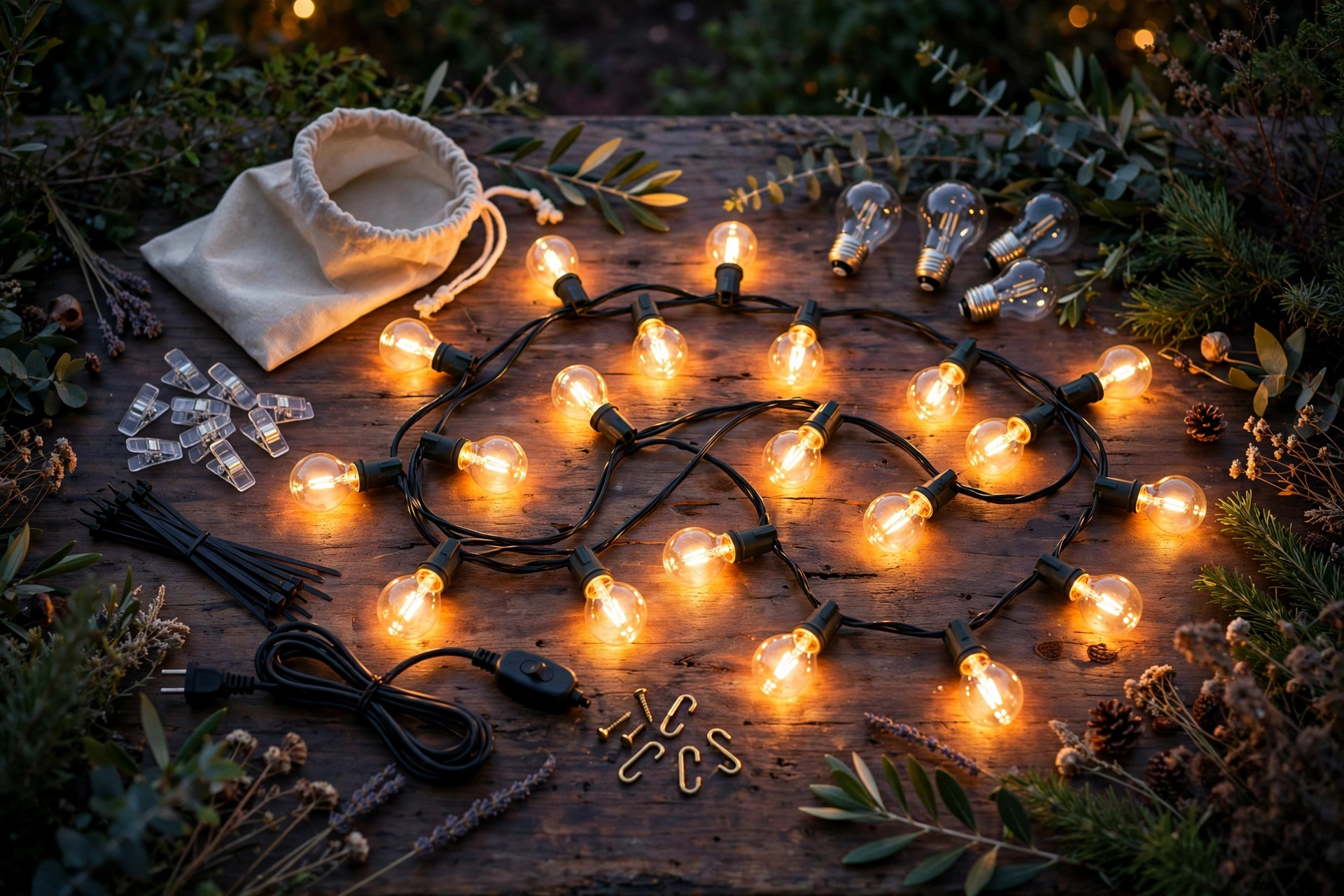
Nothing transforms a backyard faster than string lights. One evening you are eating dinner under a bare bulb on the patio, and the next you are lingering outside until midnight because the whole yard glows like a cozy cafe. The difference between those two evenings is not talent or luck. It is simply having the right gear on hand before you start.
That is what this guide is for. Think of it as the complete shopping and planning checklist for outdoor string lights: every strand, bulb, cord, timer, and piece of hardware you need, what to look for when you buy each one, and roughly what it all costs. Buy the kit once, and you will be able to light a patio, a pergola, a fence line, or a whole backyard without a second trip to the store.
Whether you are starting from zero or upgrading a tangled box of old holiday lights, work through this list in order and you will end up with a setup that looks intentional, stays up through the season, and does not trip a breaker.
1. Outdoor-Rated String Light Strands
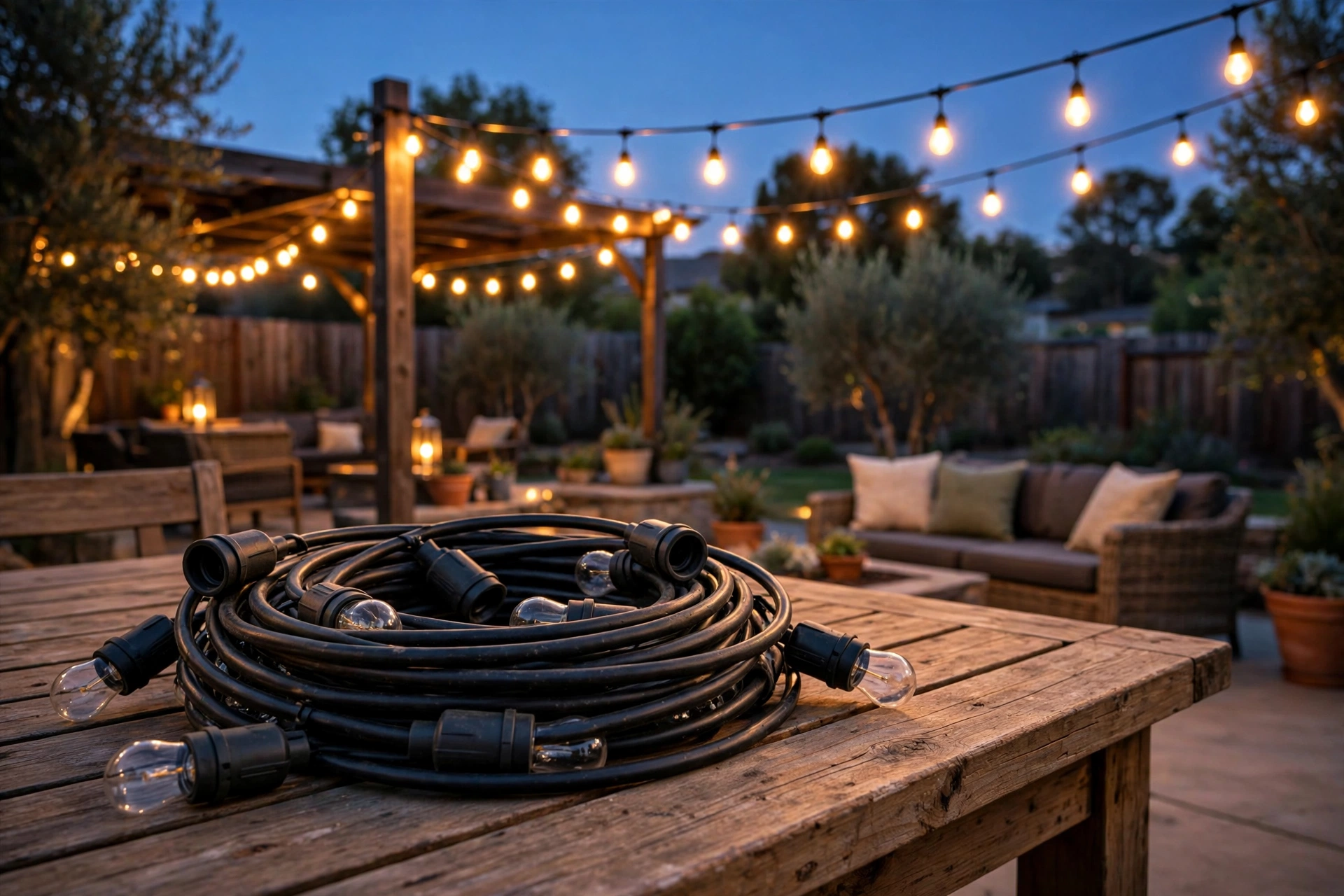
This is the foundation of the whole kit, so buy it first and buy it right. Look for strands explicitly rated for outdoor or wet-location use, with heavy-duty insulated wire and weather-sealed sockets. Indoor strands will work for a weekend party, but the sockets corrode and the wire cracks after a season outside.
For most backyards, 48 to 100 feet per strand is the sweet spot, and you will want two or three strands total. Measure your space first: run a tape measure (or pace it off) along the path your lights will follow, then add about 10 percent for swag and slack. Lights that are pulled drum-tight look harsh and strain the sockets; a gentle droop between anchor points is what gives that relaxed bistro look.
2. LED Bulbs: Edison, Globe, and Fairy Styles
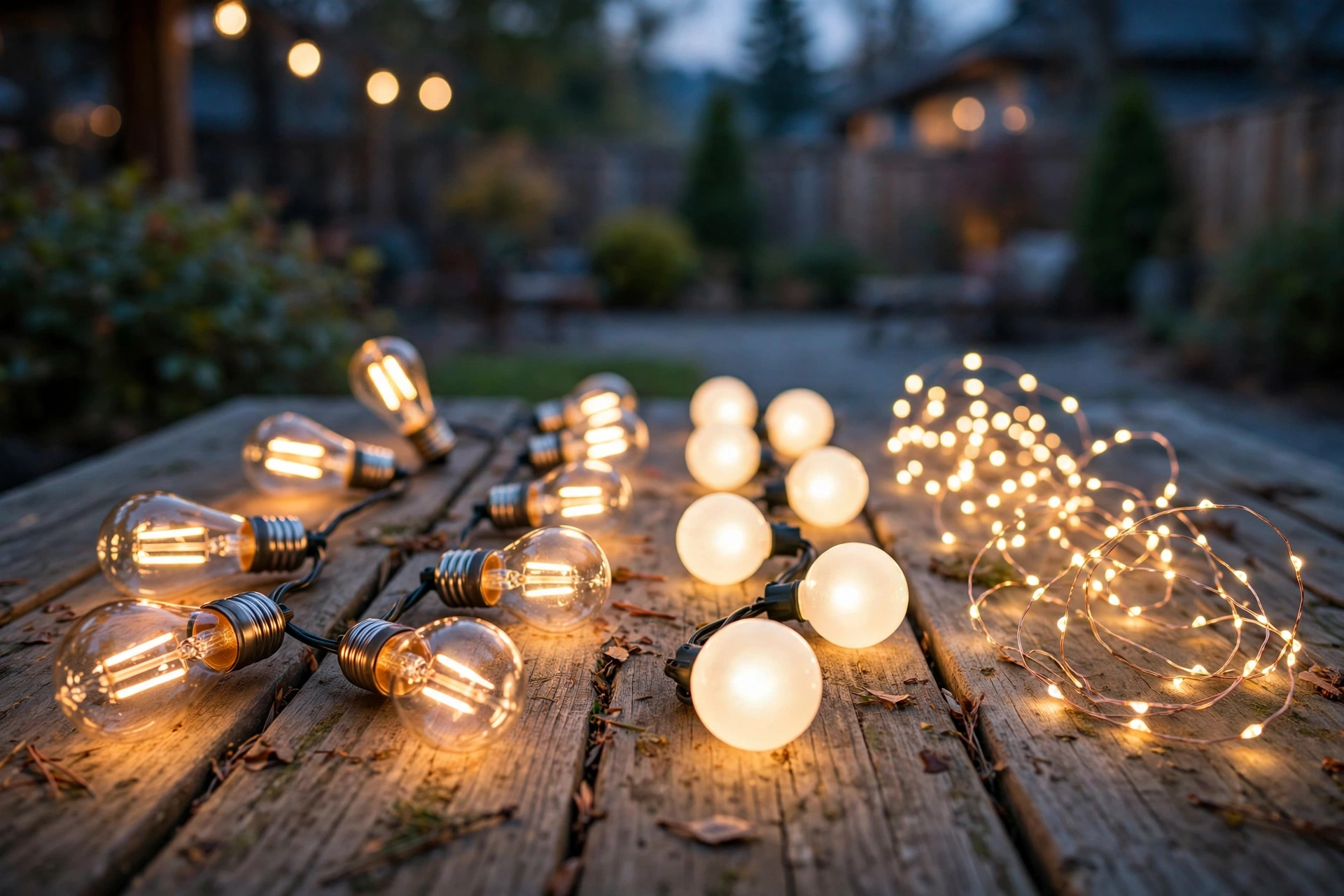
Almost all modern outdoor strands use replaceable LED bulbs, which is good news: they sip electricity, stay cool to the touch, and last for tens of thousands of hours. When choosing a style, match the bulb to the mood you want.
Edison-style filament bulbs give that warm vintage cafe glow and are the most popular choice for patios and pergolas. Globe bulbs (the round G40 type) throw a softer, more even light and suit family yards. Tiny fairy-light bulbs on thin wire disappear during the day and look magical at night, which makes them ideal for wrapping trees, shrubs, and railings. Whichever style you pick, choose warm white (around 2200K to 2700K) for that golden-hour feeling; cool white reads as security lighting and kills the cozy vibe.
Buy a few spare bulbs with your kit. They are cheap, and nothing ruins the look faster than one dark socket in a glowing strand.
3. Heavy-Duty Outdoor Extension Cords
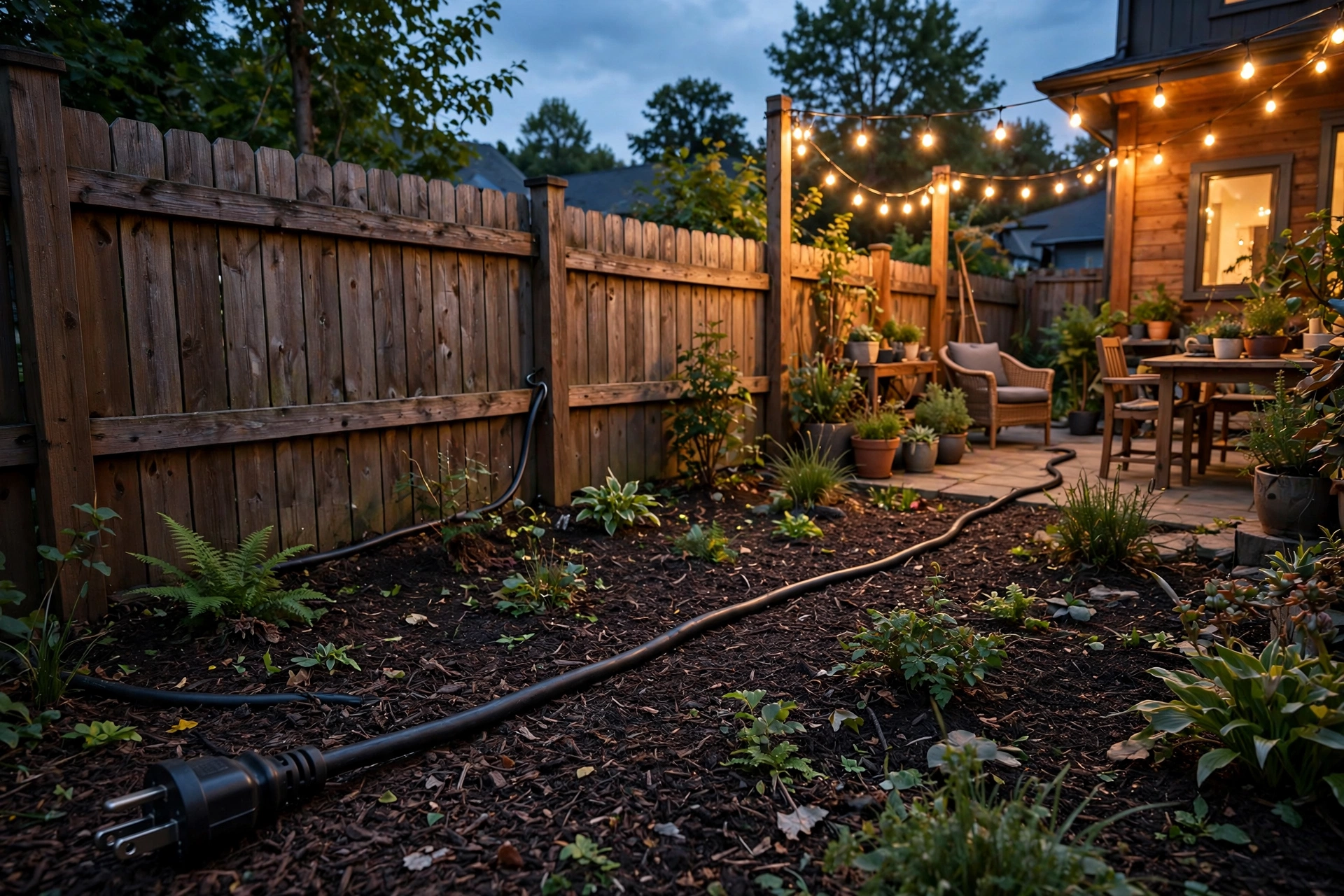
Your lights need power, and the thin brown indoor cord from the junk drawer will not cut it. Buy outdoor-rated extension cords with a thick insulated jacket, ideally 12 or 14 gauge for longer runs, with grounded three-prong plugs. A 25-foot and a 50-foot cord cover nearly every residential layout.
Run cords along fence lines, under mulch, or behind planters rather than across walkways. Where a cord must cross a path, cover it with a low-profile cord ramp so nobody trips and lawn equipment does not chew it up. And always plug outdoor cords into a GFCI-protected outlet, which shuts off power instantly if water gets into a connection.
4. An Outdoor Timer or Smart Plug
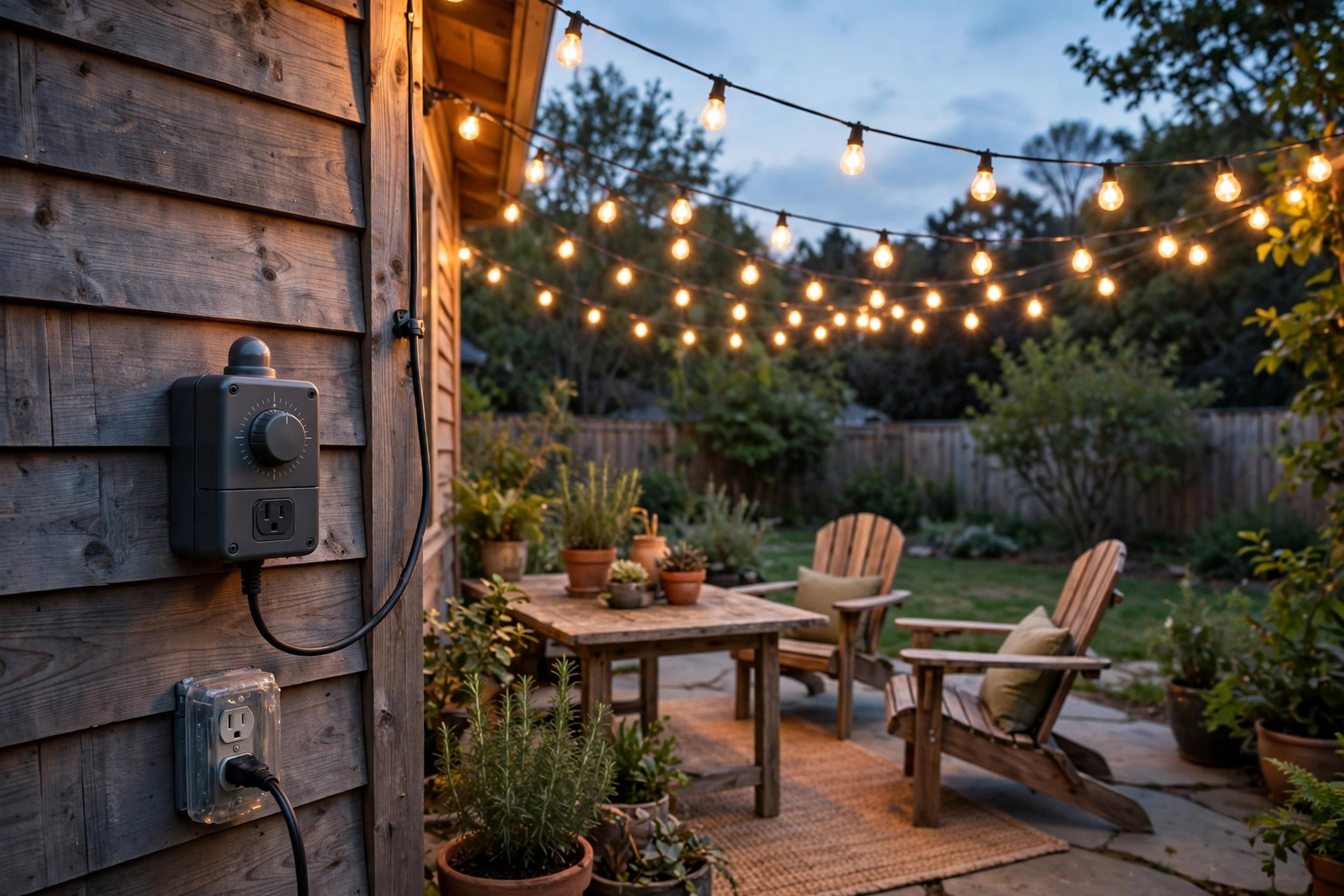
A timer is the single most underrated item in a string light kit. It turns your lights on at dusk and off at bedtime automatically, which means you actually use them every night instead of only when you remember to flip a switch.
A simple mechanical outdoor timer with a photocell costs very little and works reliably: it senses darkness and handles the schedule itself. If you want more control, an outdoor-rated smart plug lets you set schedules, dim compatible bulbs, and turn everything on from your phone when guests are on their way. Either way, put every strand in your yard on the same timer so the whole space lights up together like one designed scene.
5. A Solar String Light Set for Cord-Free Zones
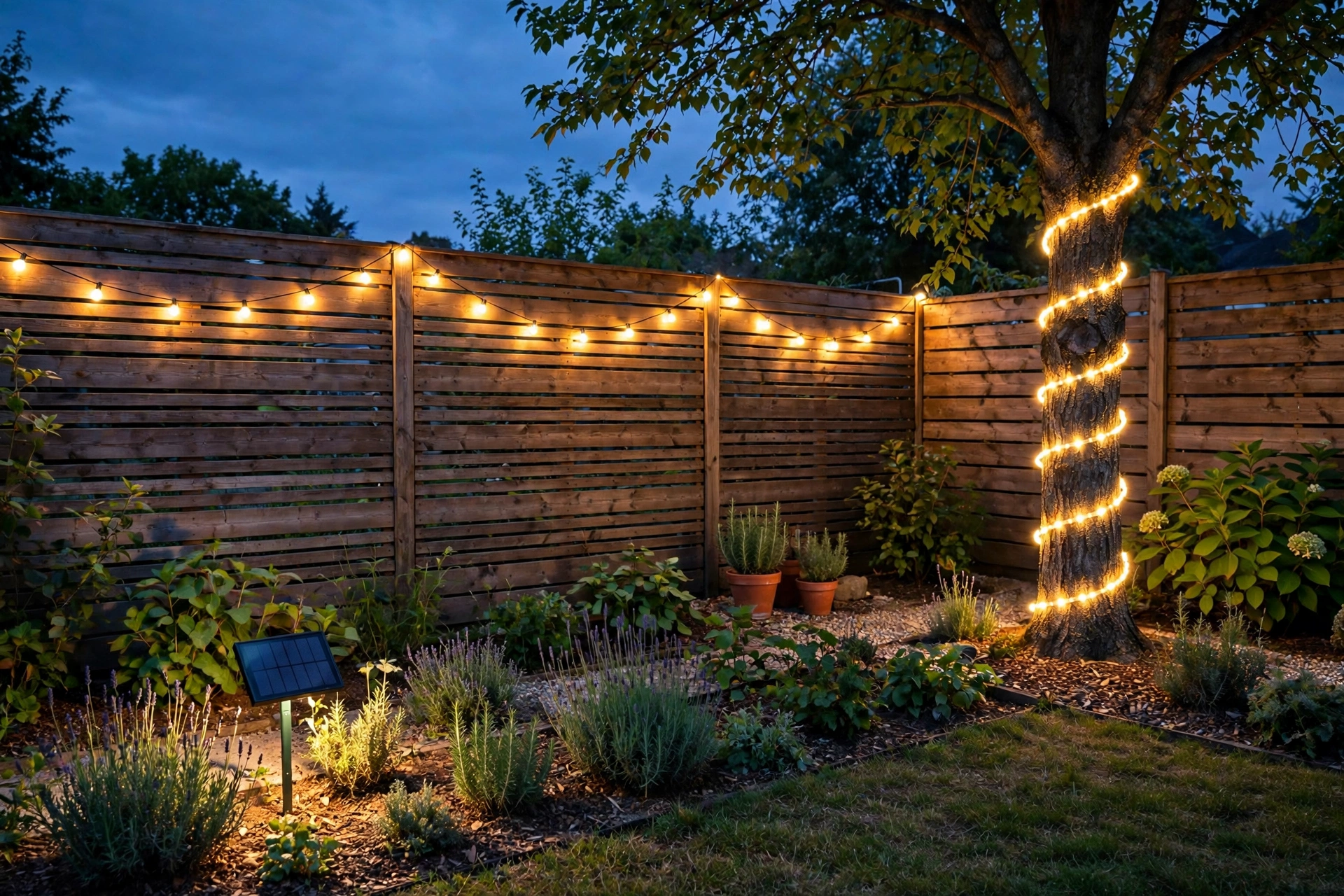
Every yard has that one spot too far from an outlet: the back fence, the far side of the garden, the tree in the corner. A solar string light set solves it with zero wiring. The small panel charges by day and the lights switch on automatically at dusk.
Solar strands are dimmer than plug-in ones, so use them as accent lighting rather than your main glow: along a fence top, around a raised bed, or spiraled up a tree trunk. Look for sets with a separate stake-mounted panel (not one built into the strand) so you can place the panel in full sun while the lights go exactly where you want them. Expect six to eight hours of light on a full charge in summer, less in deep winter.
6. Freestanding Light-Hanging Poles
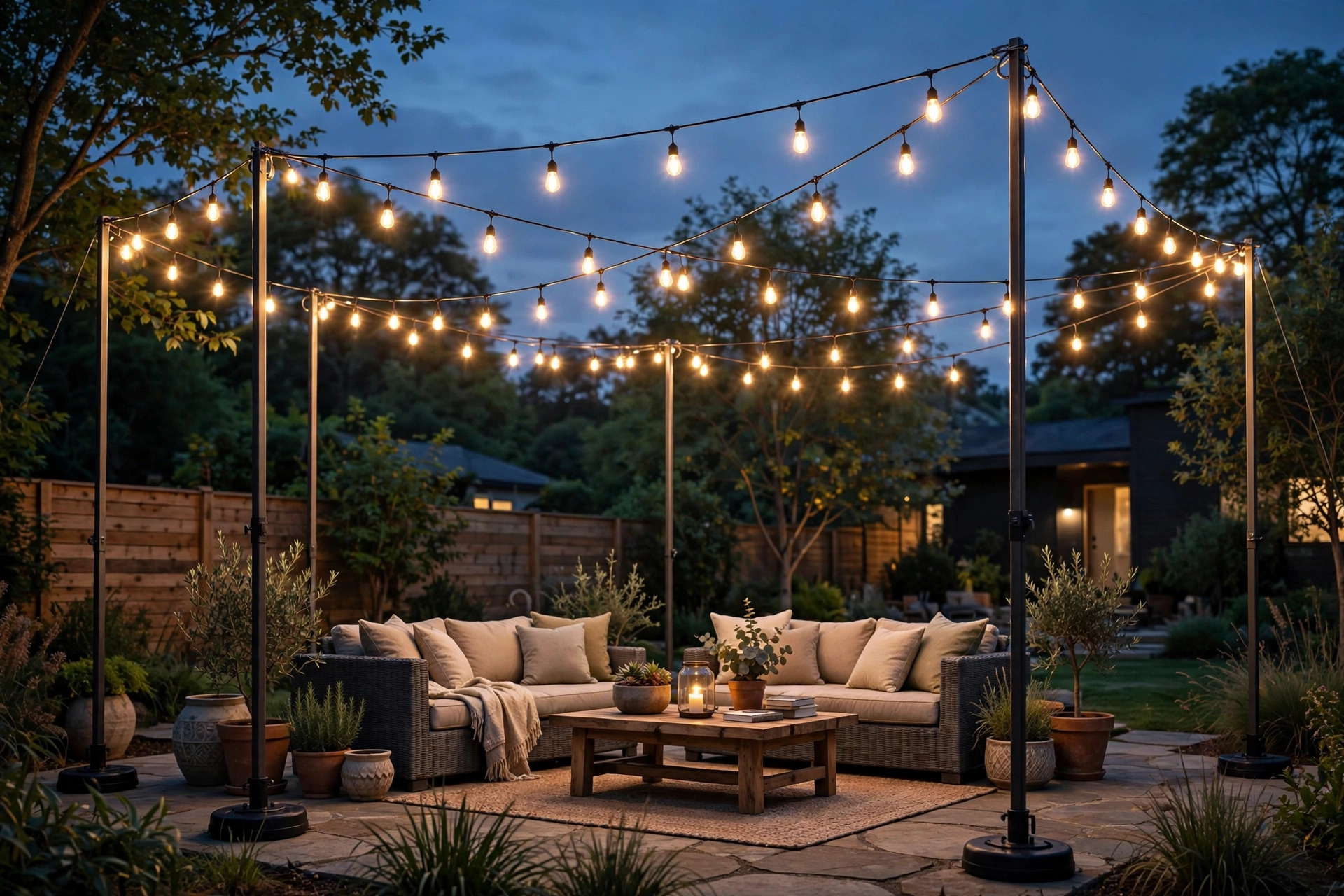
No pergola? No trees in the right spots? Freestanding poles are the answer, and they are the secret behind those dreamy open-yard light canopies you see in photos. Metal poles with a ground stake or a weighted umbrella-style base go up in minutes and come back down at the end of the season.
Place poles around the perimeter of your seating area, roughly 8 to 12 feet apart, and run strands between them in a fan, zigzag, or crisscross pattern. Two poles plus the side of the house is enough for a small patio; four poles make a full floating canopy over a dining set. Get poles at least 9 feet tall so the lights hang above head height even with a deep swag in the middle.
7. Screw-In Hooks and Cup Hooks
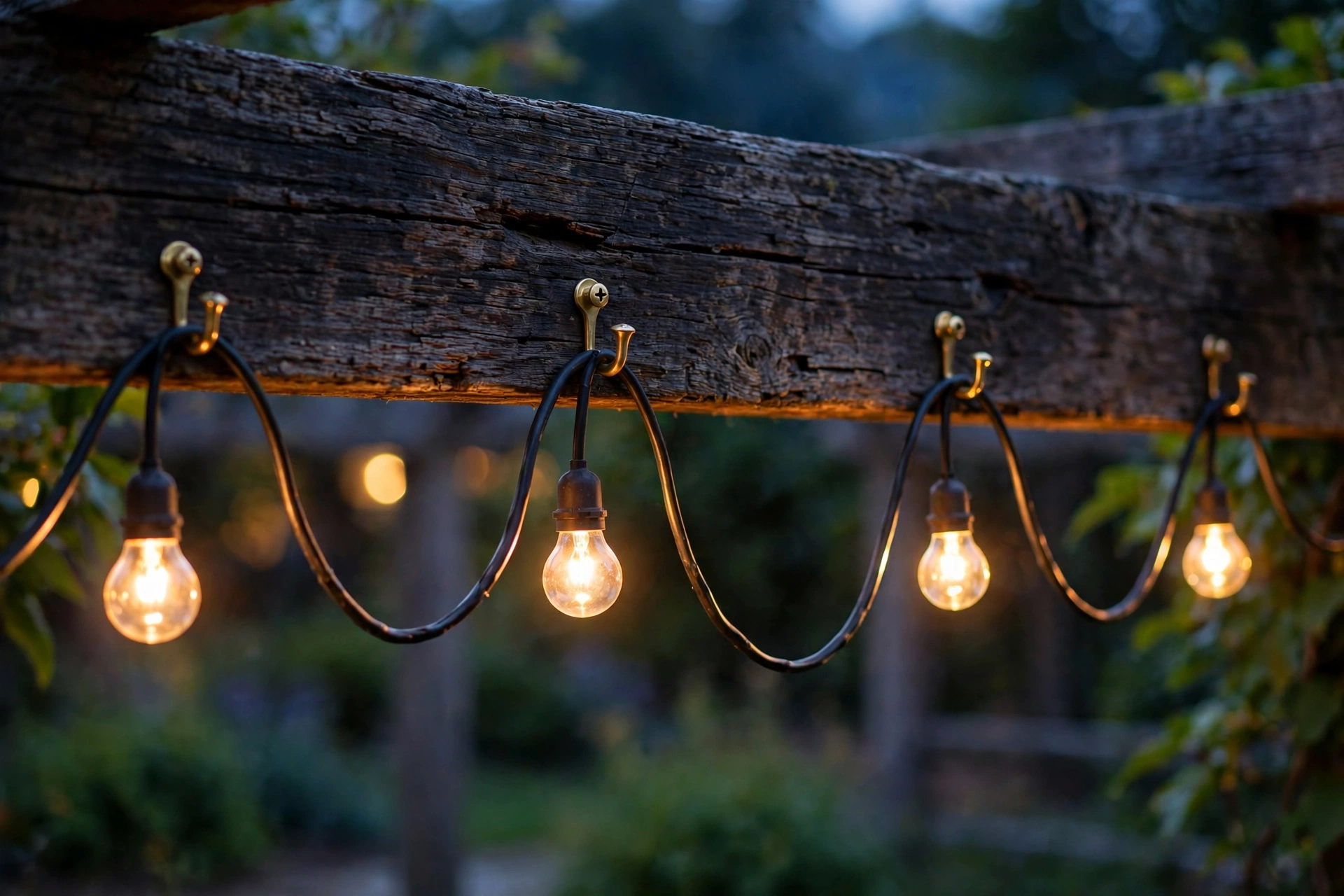
For any wooden structure — a pergola beam, a fence post, a deck railing, the eaves of the house — screw-in cup hooks are the cheapest and most reliable anchors you will ever buy. They cost pennies apiece, install with a few turns by hand (or a quick pilot hole in hardwood), and hold a strand securely for years.
Space hooks 8 to 12 feet apart along the run, and add one wherever the strand changes direction. A small bag of brass or stainless cup hooks belongs in every string light kit; you will reach for them constantly, not just for lights but for hanging lanterns, planters, and wind chimes too.
8. Cable Clips, Gutter Hooks, and Siding Clips
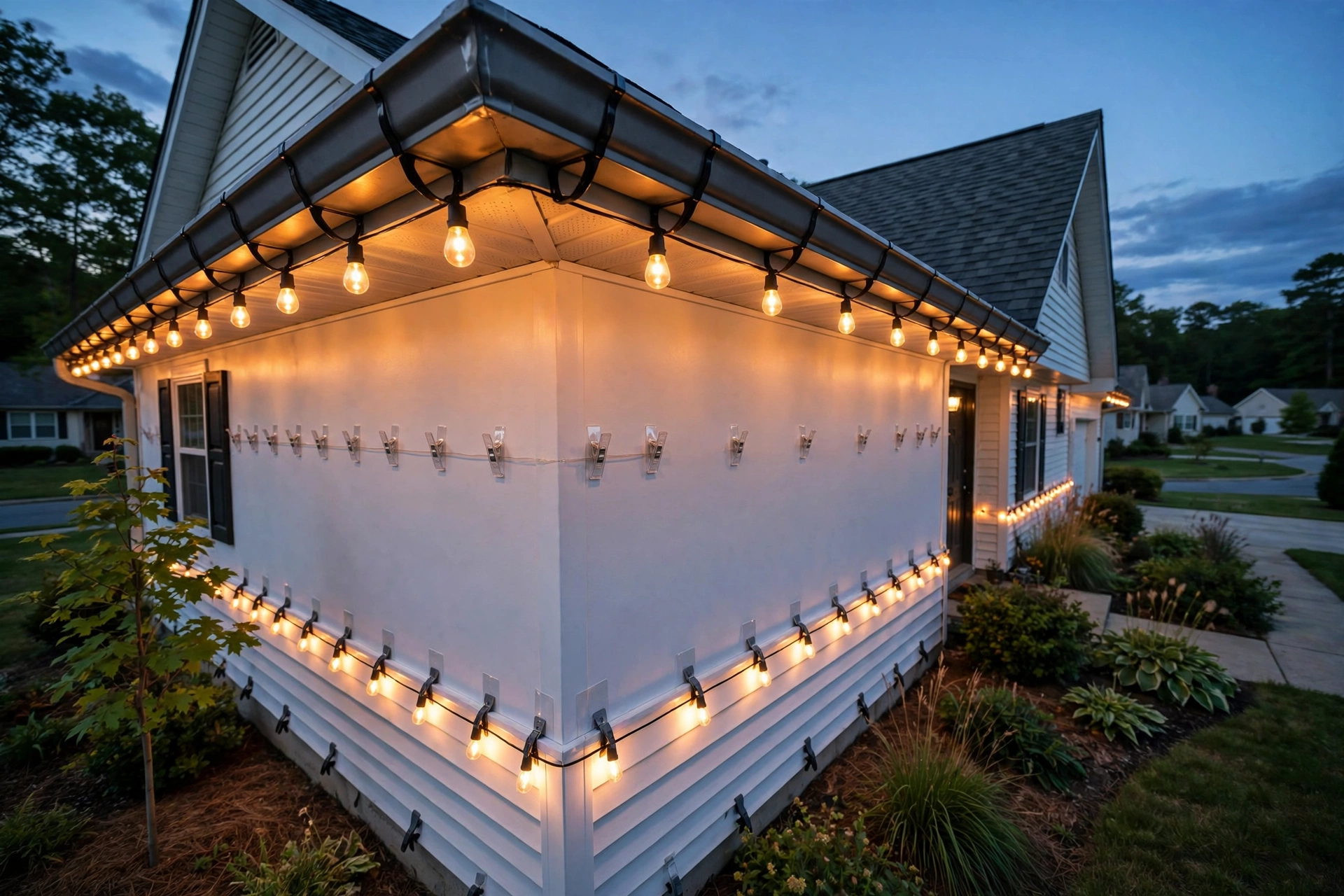
Drilling is not always an option, especially on rentals, vinyl siding, or gutters. That is where clip-style hangers earn their place. Adhesive-backed outdoor cable clips stick to clean, dry surfaces and hold lightweight fairy strands beautifully. Gutter hooks slide under the gutter lip with no tools at all. Siding clips wedge under vinyl siding panels without a single hole.
These are best for lighter strands rather than heavy Edison-bulb runs, so match the hanger to the weight. Clean the surface with rubbing alcohol before sticking anything adhesive, and give it 24 hours to cure before hanging the lights. In hot climates, check adhesive clips each spring; heat and UV are their main enemies.
9. Galvanized Support Wire
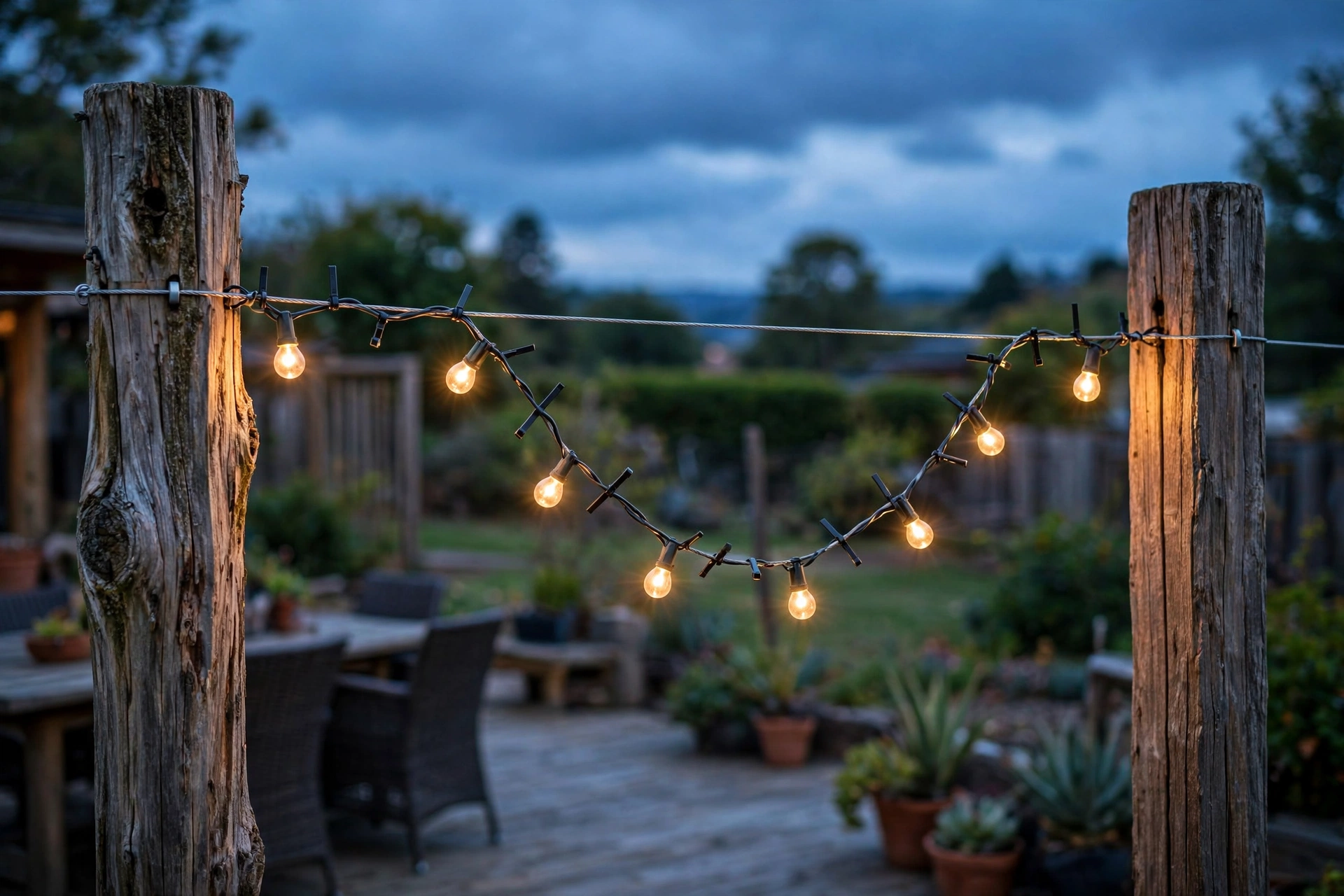
For long spans — say, 20 feet or more between anchor points — do not let the light strand carry its own weight. Run a length of thin galvanized steel cable (often sold as guide wire or aircraft cable) between the anchors first, pull it taut with a turnbuckle, then drape or zip-tie the light strand along it.
The support wire takes the tension, the lights just ride along, and nothing sags or strains a socket over time. This is also the professional trick for keeping long runs perfectly straight along a fence line or across a wide patio. A small coil of wire plus two turnbuckles handles most residential spans.
10. Outdoor-Rated Zip Ties
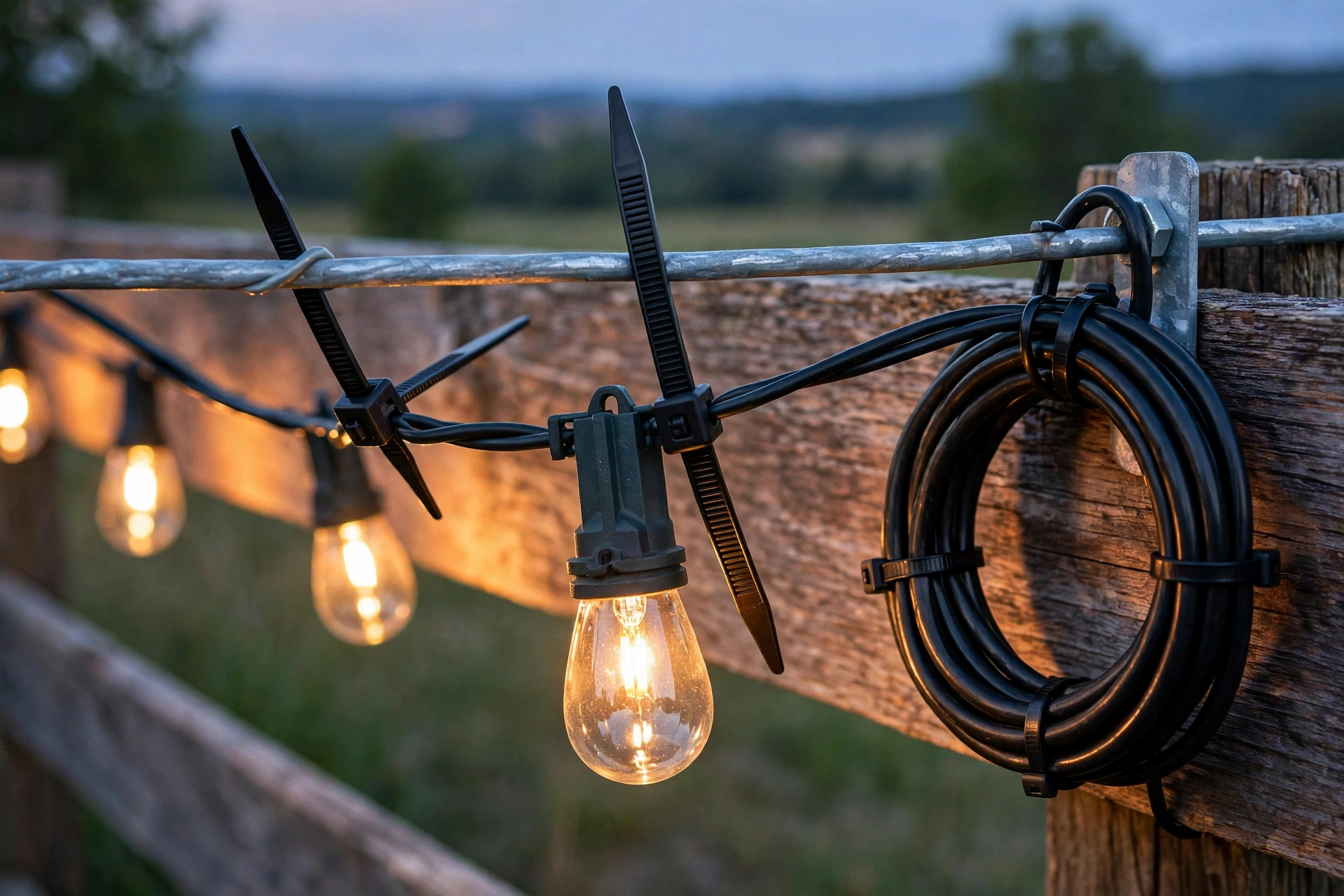
Zip ties are the duct tape of string lighting: they lash strands to support wire, bundle excess cord at the anchor points, and secure plugs to posts so connections do not dangle. Buy black UV-resistant outdoor ties, not the white indoor kind, which turn brittle and snap after a summer in the sun.
Trim the tails flush with snips after tightening so they do not catch the eye in daylight. Keep a mixed bag of 8-inch and 12-inch ties in your kit; you will use more of these than you expect.
11. A GFCI Outlet Adapter or Outdoor Surge Protector
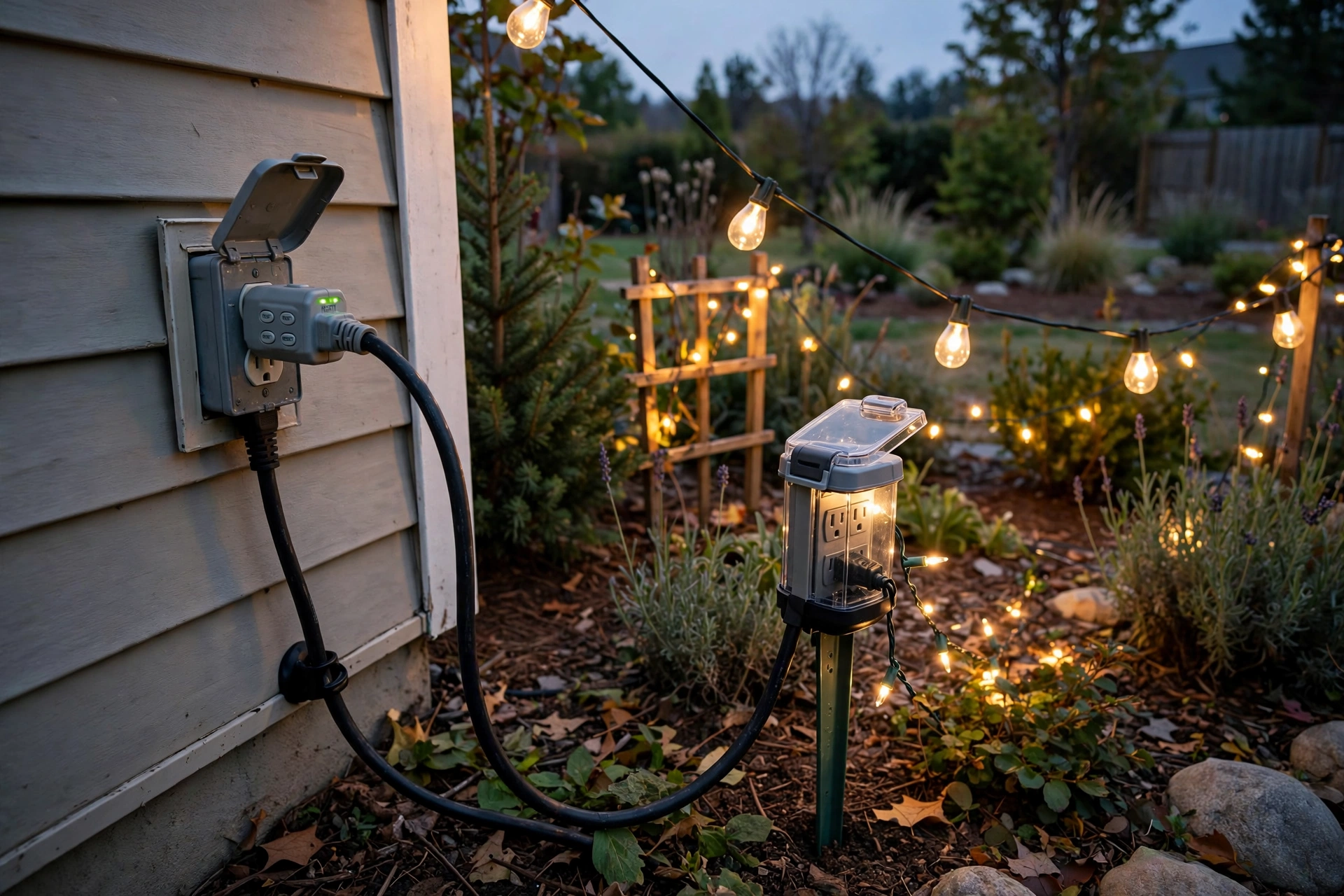
Outdoor electricity and water are a bad combination, which is why this unglamorous item matters more than any decorative one. If your exterior outlets are not already GFCI-protected (most modern ones are, but older homes may not be), a plug-in GFCI adapter adds that life-saving shutoff for a few dollars.
An outdoor-rated power stake or surge protector with a weatherproof cover also gives you multiple outlets right where you need them in the yard, instead of daisy-chaining extension cords back to the house. Keep all plug connections off the ground and under the cover; standing water in a connection is the most common cause of nuisance tripping.
12. A Cord Reel or Light Winder for Storage
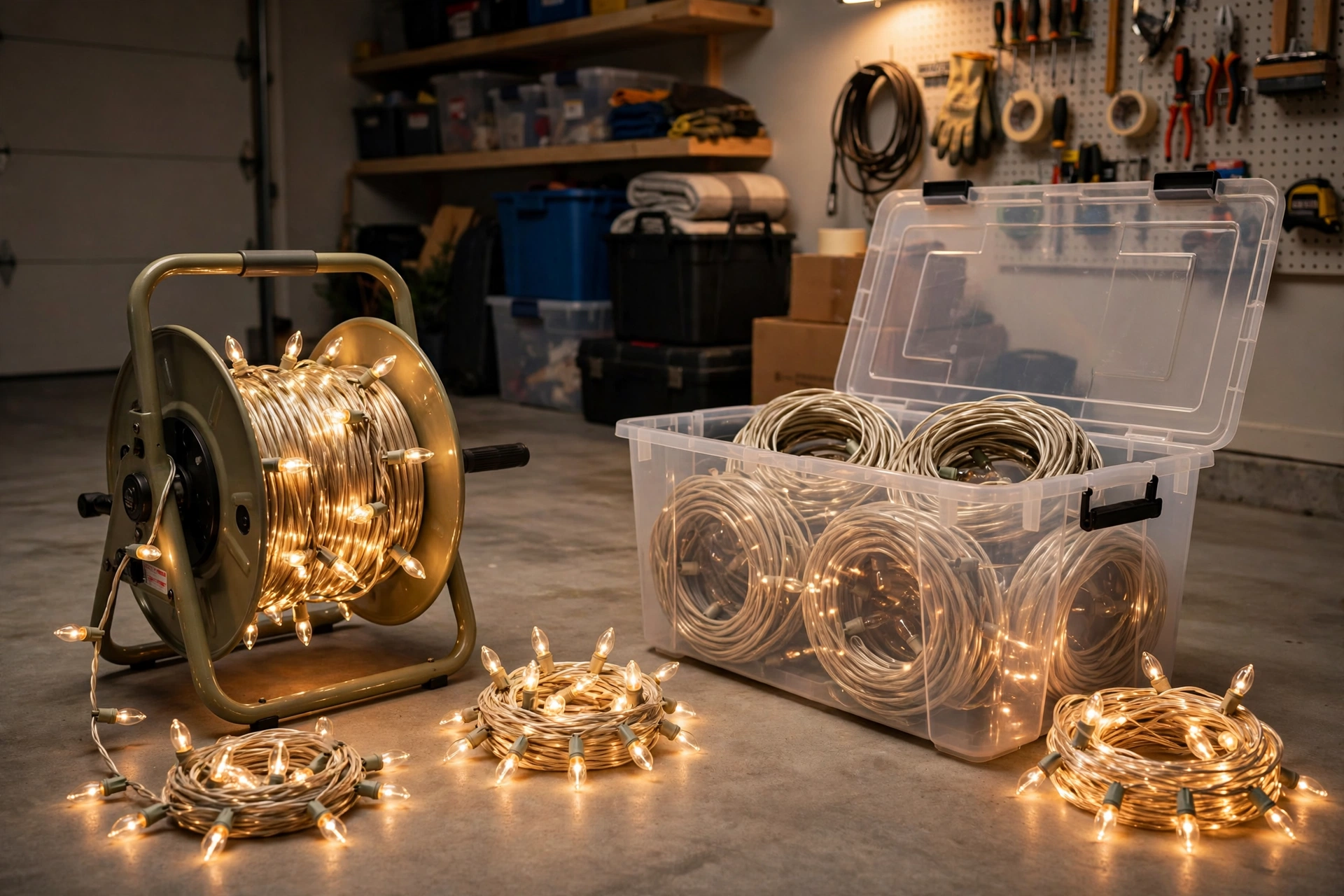
How you store string lights determines whether they survive to next season. The classic tangled ball of lights in a box is how strands go to die: sockets crack, bulbs break, and untangling takes longer than hanging them did.
A simple cord reel, or even a flat piece of cardboard with notches cut in the ends, lets you wind each strand neatly as you take it down. Remove the bulbs first if they are the fragile glass type, coil the strand without kinks, and store everything in a dry bin off the concrete floor. Label each coil with its length and where it hung. Future you will be grateful every single spring.
How Much Does an Outdoor String Light Kit Cost?
Prices vary by brand and length, but here are honest ballparks for a complete kit covering a typical patio or small backyard:
Budget kit (about $60 to $100): Two 48-foot LED strands, one outdoor extension cord, a mechanical timer, a bag of cup hooks, and zip ties. Enough to light a small patio beautifully.
Mid-range kit (about $120 to $200): Everything above, plus a smart plug, two hanging poles, a solar accent set, support wire with turnbuckles, spare bulbs, and a storage reel. This handles a full backyard with a real canopy effect.
Premium kit (about $250 and up): Commercial-grade strands with shatterproof bulbs, four or more poles, multiple smart plugs or a full smart system with dimming and color, heavy-gauge cords, and professional anchors. The restaurant-patio look, built to last a decade.
Start with the budget tier if you are unsure. You can add poles, smart controls, and extra strands one season at a time, and every piece in this list works with every other piece.
Frequently Asked Questions
How many feet of string lights do I need for my backyard?
Measure the actual path the lights will follow, not the straight-line distance. For a patio seating area, most people need 50 to 100 feet. For a full canopy over a dining set, plan on 100 to 200 feet across two or three strands. Always add 10 percent extra for swag.
Can I leave outdoor string lights up all year?
Yes, if they are rated for outdoor or wet-location use. Quality LED strands handle rain, snow, and sun for years. Take down lightweight fairy strands and solar sets in harsh winters to extend their life, and check connections each spring for corrosion.
Are solar string lights as bright as plug-in ones?
No, and that is fine. Solar strands are accent lights, not task lighting. Use plug-in strands for your main seating area where you want real glow, and solar sets for fence lines, trees, and garden beds where running a cord would be a hassle.
How do I stop my string lights from sagging?
Three fixes: shorten the span between anchor points to under 12 feet, run a taut galvanized support wire and hang the strand from it, or add a pole or hook in the middle of a long run. Sagging almost always means the span is too long for the strand to carry alone.
The Bottom Line
A great backyard lighting setup is not about buying the most expensive strands. It is about having the complete kit: the right lights, the power to run them, the hardware to hang them, and the timer to make them effortless. Assemble this list once, and every summer evening from now on starts with the flip of a switch — or better yet, happens automatically while you are still inside pouring the lemonade.