
The difference between a nice staircase and one that looks like it belongs in a shelter magazine spread usually comes down to three things: material quality, plant maturity, and restraint at scale — none of which require the budget most people assume. I consulted on a friend’s entryway redesign last year where swapping her plastic urns for cast stone and her annuals for mature boxwood cost more upfront but transformed the whole approach from “decorated” to “designed” in a single afternoon. This list covers 31 luxury staircase garden ideas that deliver that same editorial polish, each with the specific container material, plant maturity, and placement details that separate high-end from merely tidy. Ready? Let’s explore all 31 of them.
Quick Answer: For instant luxury impact, cast stone or lead-look urns planted with mature boxwood or standard roses outperform anything budget or trendy. If you want color, stick to a single refined palette (white, cream, or deep burgundy) rather than mixed brights, and always choose the largest plant your budget allows over more, smaller ones.
Why Luxury Staircase Gardens Are Worth Your Time
A luxury staircase garden reads as expensive largely because of scale and maturity, not necessarily total spend — one substantial, well-grown specimen in a quality container consistently outperforms five small nursery starts in plastic pots. In practice, the editorial look comes from choosing fewer, better elements and giving them real presence.
The practical payoff extends past first impressions. Mature plants and quality containers, properly maintained, last for years rather than a single season, which means the higher upfront investment often costs less annually than repeatedly replacing budget annuals. The lesser-known fact most people miss: symmetry does most of the visual work in high-end design — a matched, mirrored pair of urns reads as significantly more polished than the same plants arranged asymmetrically.
This approach is ideal for formal entrances, period or classical architecture, and anyone hosting frequently who wants the entrance itself to set an elevated tone before a guest even reaches the door.
At a Glance
- Cast stone and lead-look urns cost more upfront but read as timeless rather than trendy.
- Standard (tree-form) roses and clipped boxwood deliver the most instantly “finished” look.
- Symmetrical, mirrored pairs of containers outperform asymmetric arrangements for formal entrances.
- A single restrained color palette photographs far more editorial than mixed bright colors.
- Mature, established plants cost more initially but eliminate the “newly planted” look entirely.
31 Luxury Staircase Garden Ideas Compared
| Idea | Light Needs | Container Style | Difficulty | Est. Cost |
| Cast Stone Urn Pair | Any | Cast stone | Easy | $150-300 |
| Standard Rose Topiaries | Full sun | Lead-look | Moderate | $200-350 |
| Clipped Boxwood Pyramids | Full sun | Cast stone | Moderate | $150-250 |
| Marble-Look Planter Row | Any | Faux marble | Easy | $180-280 |
| White Hydrangea Standards | Part shade | Cast stone | Moderate | $150-250 |
| Formal Bay Laurel Pair | Full sun | Terracotta | Moderate | $120-200 |
| Antique Lead Trough | Part shade | Antique lead | Easy | $300-600 |
| Sculpted Ivy Topiary | Part shade | Cast stone | Advanced | $100-180 |
| Weeping Standard Roses | Full sun | Lead-look | Moderate | $180-300 |
| Espaliered Fruit Tree | Full sun | Wood/stone | Advanced | $150-250 |
| Matched Citrus Standards | Full sun | Terracotta | Moderate | $150-280 |
| Formal Herb Parterre | Full sun | Stone edging | Advanced | $100-200 |
| White Gardenia Urns | Part sun | Cast stone | Moderate | $120-200 |
| Weathered Copper Planters | Any | Copper | Easy | $200-400 |
| Formal Yew Cones | Part shade | Cast stone | Moderate | $130-220 |
| Marble Chip Gravel Beds | Any | Stone edging | Easy | $80-150 |
| Antique Urn With Trailing Vine | Part shade | Antique stone | Easy | $200-500 |
| Champagne Rose Standards | Full sun | Lead-look | Moderate | $180-300 |
| Formal Fern Symmetry | Shade | Cast stone | Easy | $80-140 |
| Gilded Accent Planters | Any | Gilded metal | Easy | $150-250 |
| Clipped Privet Columns | Full sun | Terracotta | Moderate | $120-200 |
| Silver-Leaf Dusty Miller Border | Full sun | Cast stone | Easy | $60-100 |
| Formal Camellia Pair | Part shade | Cast stone | Moderate | $150-250 |
| Wisteria-Draped Archway | Full sun | Ground/trellis | Advanced | $100-200 |
| Statuary Accent Planting | Any | Stone/bronze | Easy | $200-500 |
| White Orchid Display Urns | Bright indirect | Ceramic | Moderate | $150-250 |
| Antique Stone Trough Herbs | Full sun | Antique stone | Easy | $250-450 |
| Formal Magnolia Standard | Part sun | Cast stone | Moderate | $180-300 |
| Silver Birch Multi-Stem Pair | Full sun | Cast stone | Moderate | $200-350 |
| Clipped Holly Sentinels | Part shade | Cast stone | Moderate | $150-250 |
| Grand Entrance Palm Pair | Bright indirect | Cast stone | Easy | $200-400 |
1. Cast Stone Urn Pair for Timeless Formal Anchoring
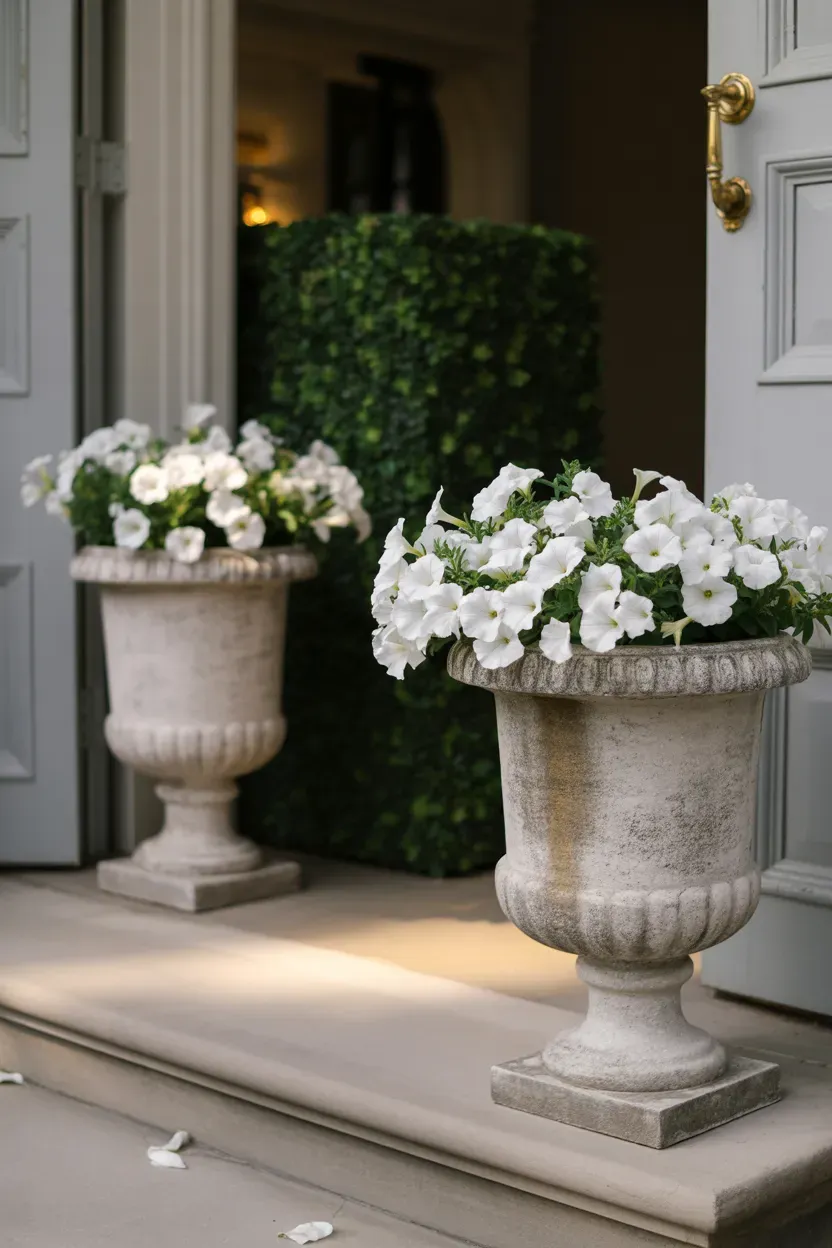
Cast stone urns, cast to mimic centuries-old carved limestone, deliver instant gravitas at a fraction of the cost of genuine antique stone, and they only look better as they weather over the years.
Choose a matched pair, at least 18-20 inches in diameter, and plant with white trailing petunias or ivy geranium for a classic, restrained look. Cast stone is heavy and genuinely weatherproof, needing no winter protection in most climates, and its porous surface develops a soft patina within a single season that reads as established rather than new.
Pro Tip: Buy the largest urns your entrance can visually support — undersized urns are the single most common mistake in formal entrance design, since they read as an afterthought rather than an architectural feature.
Internal link: choosing the right scale for formal entrance containers External link: RHS guide to stone container weathering and care
2. Standard Rose Topiaries for Instant Romantic Elegance
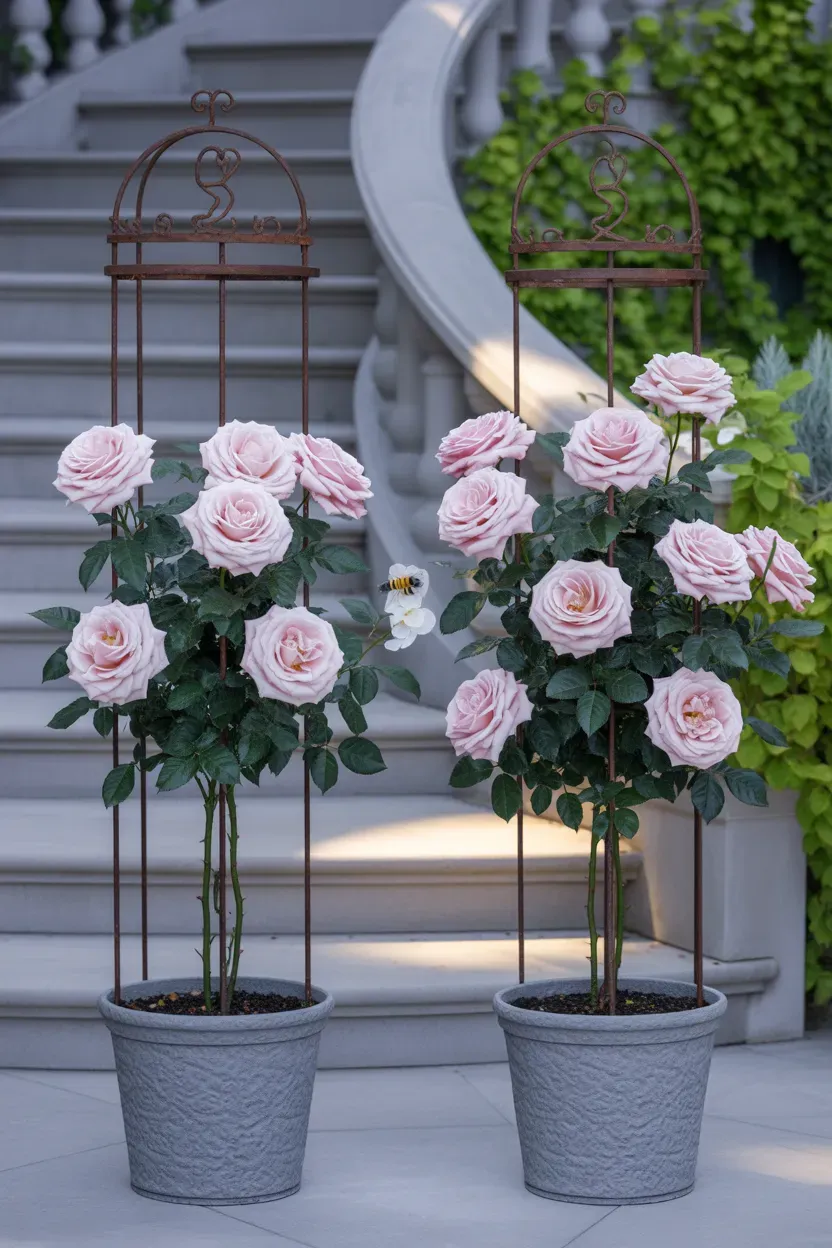
A standard, or tree-form, rose — grafted onto a bare 3-4 foot stem with a rounded flowering head — brings a level of formal polish that a regular shrub rose simply can’t match, and a mature specimen instantly signals a considered, high-end design.
They need full sun (6+ hours) and consistent feeding every 4-6 weeks during the growing season with a rose-specific fertilizer. Stake the main stem securely, since the top-heavy flowering head is vulnerable to wind damage, and deadhead weekly to maintain continuous bloom through summer.
Internal link: growing and staking standard roses successfully External link: Gardeners’ World’s guide to standard rose training and care
Few single plants elevate an entrance as immediately as a well-grown standard rose.
3. Clipped Boxwood Pyramids for Architectural Precision
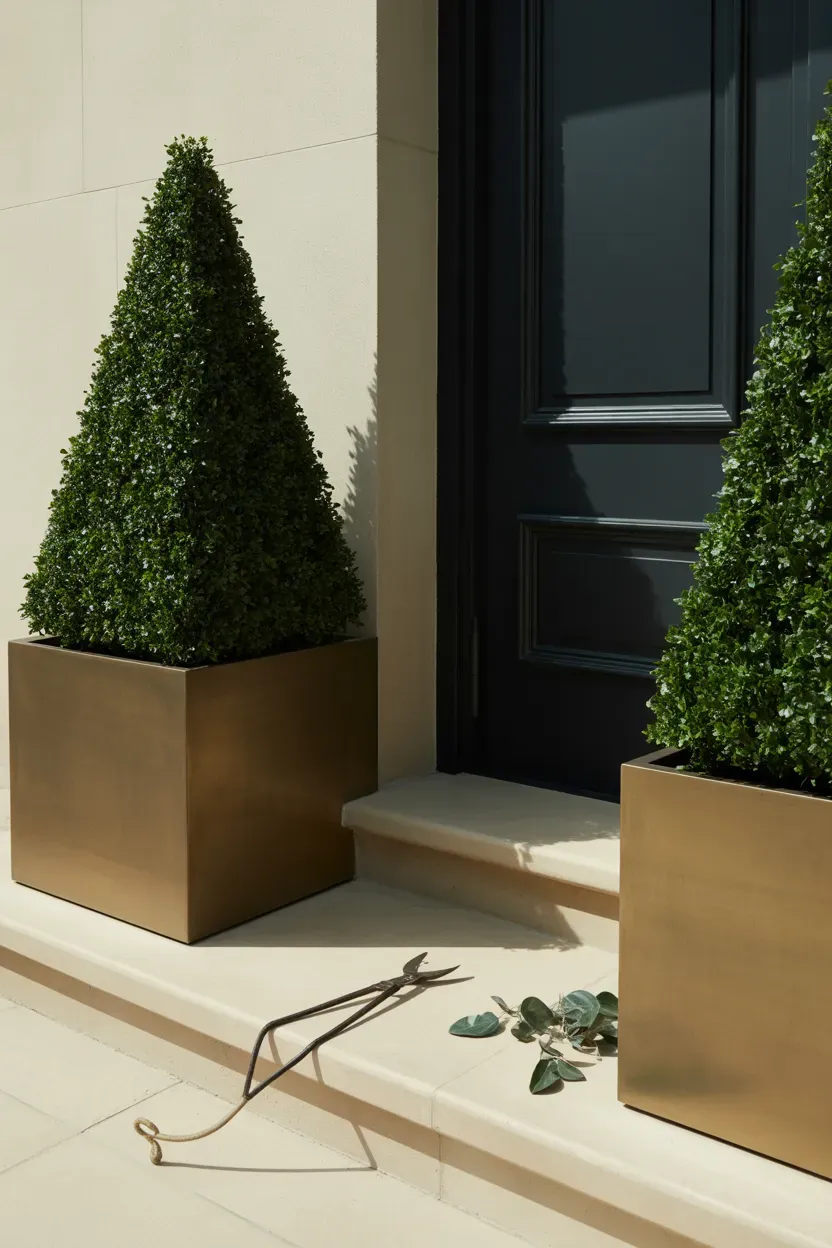
A precisely clipped boxwood pyramid brings the kind of geometric formality found at historic estates, and unlike a ball or cube shape, the pyramid’s tapered form draws the eye upward toward the entrance itself.
They need full sun to part shade and trimming every 5-6 weeks in growing season to maintain crisp edges, ideally with a wire pyramid frame as a shaping guide for the first 2-3 years. Choose a slow-growing variety like ‘Green Mountain,’ which holds its shape longer between trimmings than faster-growing cultivars.
What works vs. what to avoid:
- Works: wire frame guides for the first few seasons, slow-growing cultivars, consistent trimming schedule
- Avoid: fast-growing boxwood varieties, skipping the frame and shaping freehand as a beginner
Internal link: shaping boxwood into precise geometric forms External link: Missouri Botanical Garden’s boxwood cultivar comparison
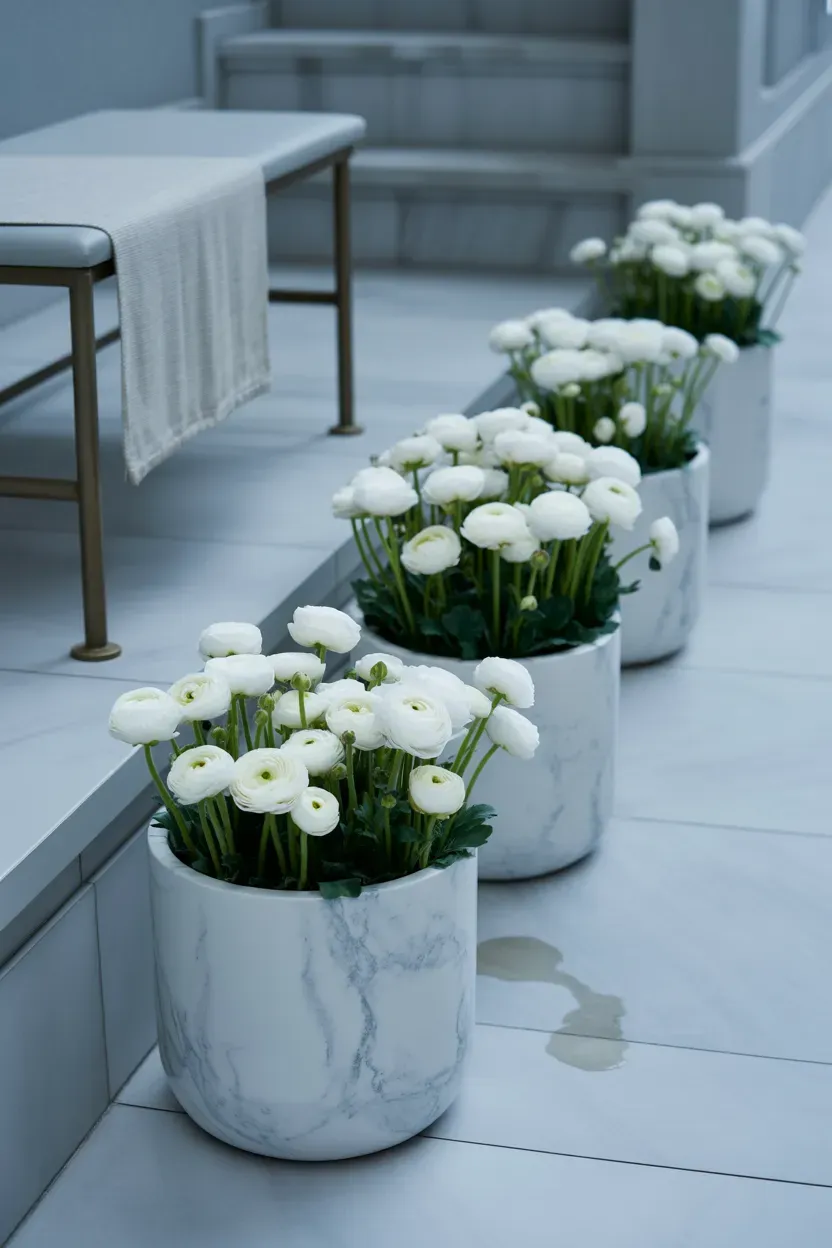
4. Marble-Look Planter Row for Cool Elegant Continuity
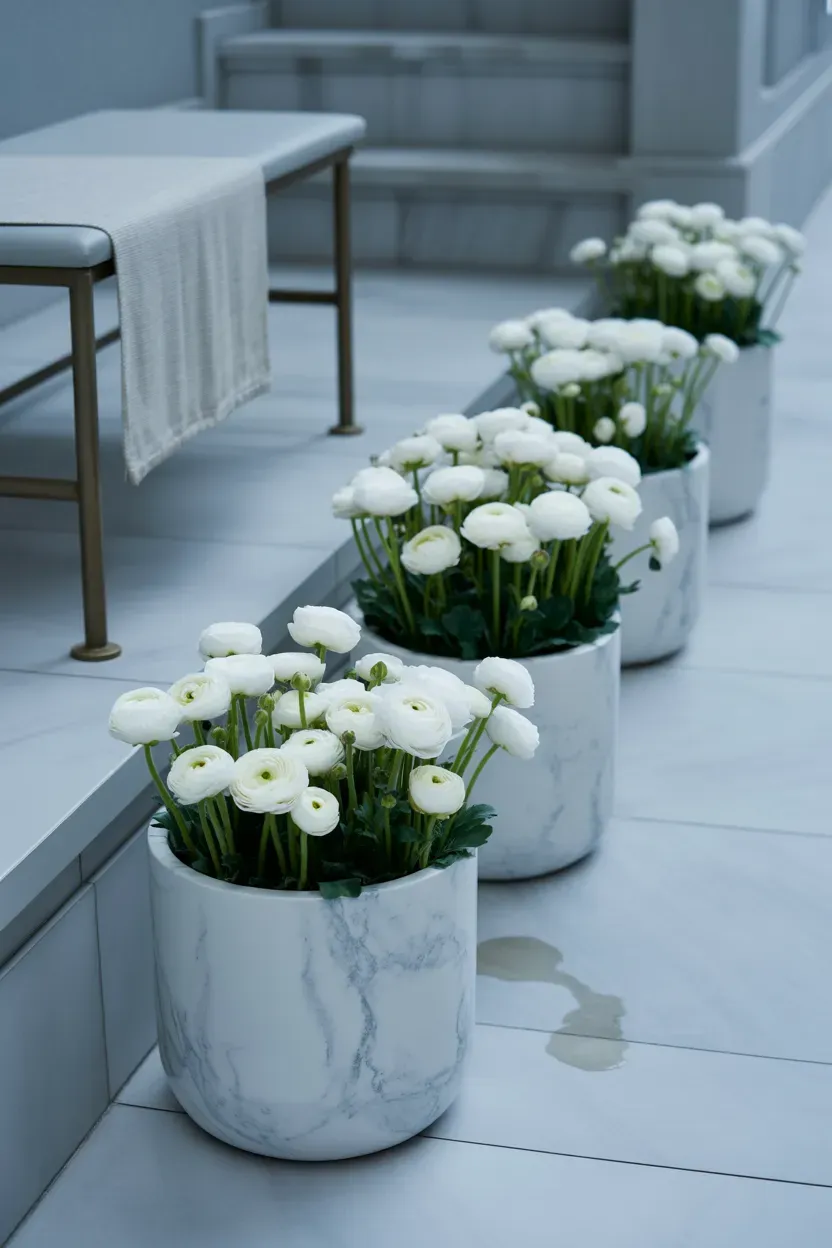
Faux marble-finish planters deliver the visual coolness and polish of genuine marble at a fraction of the weight and cost, and modern finishes are convincing enough that the difference is rarely noticeable from a normal viewing distance.
Choose lightweight fiberglass or resin planters with a marble-effect finish, and plant with white ranunculus or white tulips for a similarly cool, refined palette. They need full sun to part shade depending on the chosen flower, and the lighter weight compared to real stone makes this a practical choice for elevated staircases or balconies.
Internal link: faux stone and marble finishes for container gardens External link: BHG’s guide to ranunculus growing in containers
5. White Hydrangea Standards for Lush Romantic Volume
A standard hydrangea, trained onto a single trunk with a full, rounded flowering canopy, delivers enormous volumes of white bloom that reads as lush and abundant without ever looking cluttered.
It needs part shade (morning sun, afternoon protection) and consistently moist soil, watering every 2-3 days in summer heat since hydrangeas wilt noticeably when dry. Choose a mophead variety like ‘Annabelle’ for the fullest, most rounded flower heads, and stake the trunk securely given the substantial weight of a mature bloom canopy.
Pro Tip: Cut spent blooms for indoor drying rather than deadheading them away entirely — dried hydrangea heads retain their shape for months and extend the plant’s decorative value well past the growing season.
Internal link: training and staking standard hydrangeas External link: University of Florida Extension’s hydrangea growing and light requirements
6. Formal Bay Laurel Pair for Old-World Sophistication
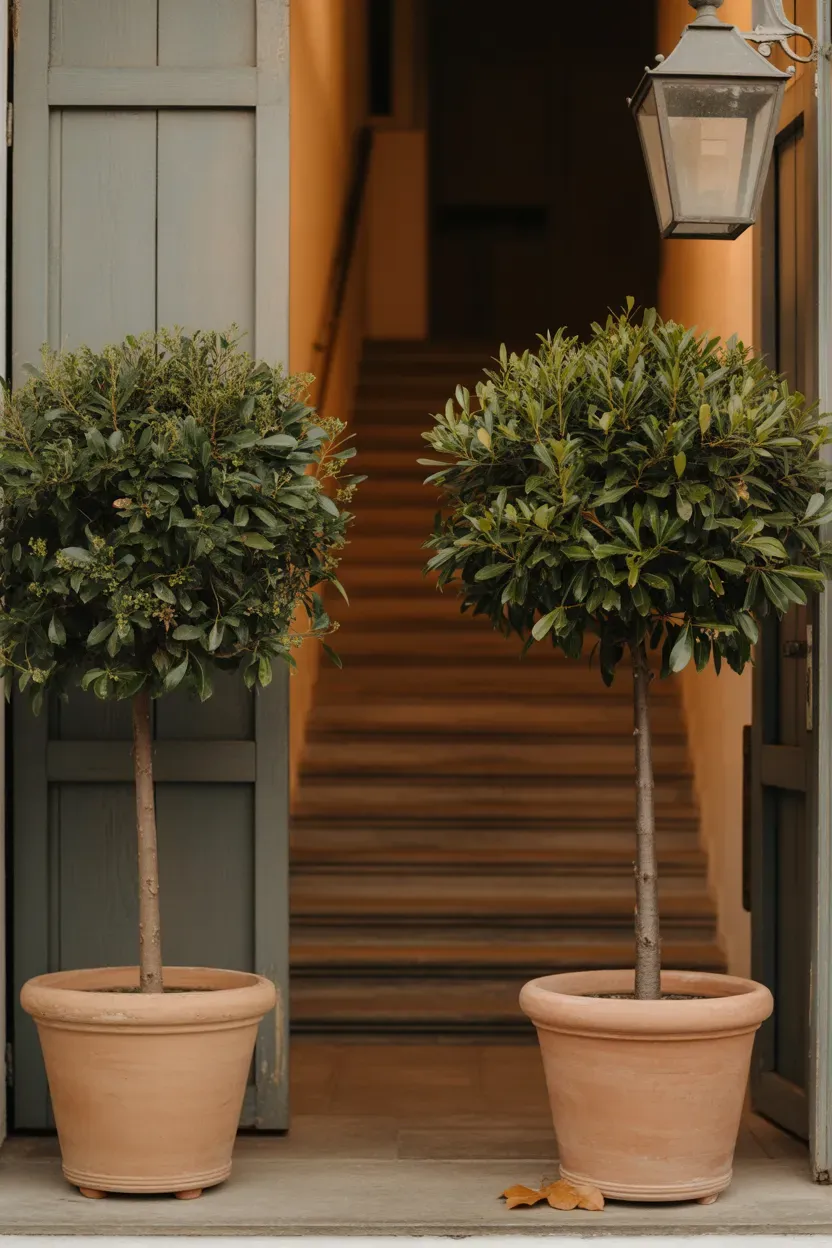
Bay laurel standards have flanked grand entrances for centuries, and their glossy, aromatic foliage brings genuine old-world character that newer trend plants simply can’t replicate.
They need full sun and well-drained soil in classic terracotta pots, and trimming every 6-8 weeks maintains the rounded lollipop head shape. Bay laurel tolerates being container-bound for years, actually preferring a slightly snug pot, and it’s notably cold-hardy down to about 20°F, though colder climates should bring it into an unheated space for winter.
Internal link: classic Mediterranean standards for formal entrances External link: RHS growing guide for Laurus nobilis
A well-shaped bay laurel pair looks like it’s been there for decades within just a season or two.
7. Antique Lead Trough for Genuine Heirloom Character
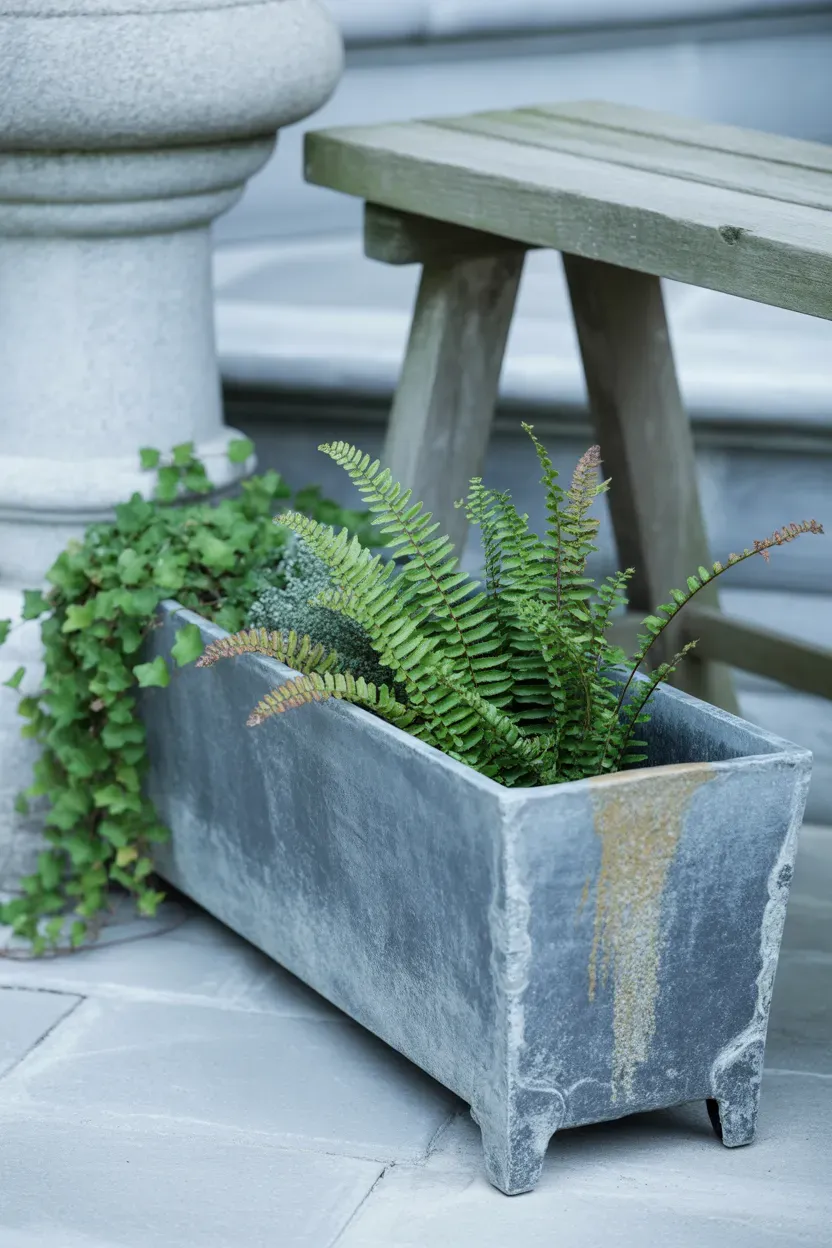
A genuine antique lead trough, sourced from architectural salvage or estate sales, carries irreplaceable authentic character that no reproduction can fully match, and its soft gray patina only deepens with age.
Expect to pay $300-600 for a genuine piece depending on size and condition, considerably more than a lead-look reproduction, but the material itself is essentially indestructible outdoors. Plant with delicate ferns or hostas suited to the trough’s typically shallow depth, and place it somewhere it can be appreciated up close, since much of its value is in the tactile, aged surface detail.
Internal link: sourcing genuine antique garden containers External link: Almanac’s guide to identifying and caring for antique lead planters
8. Sculpted Ivy Topiary for Living Architectural Detail
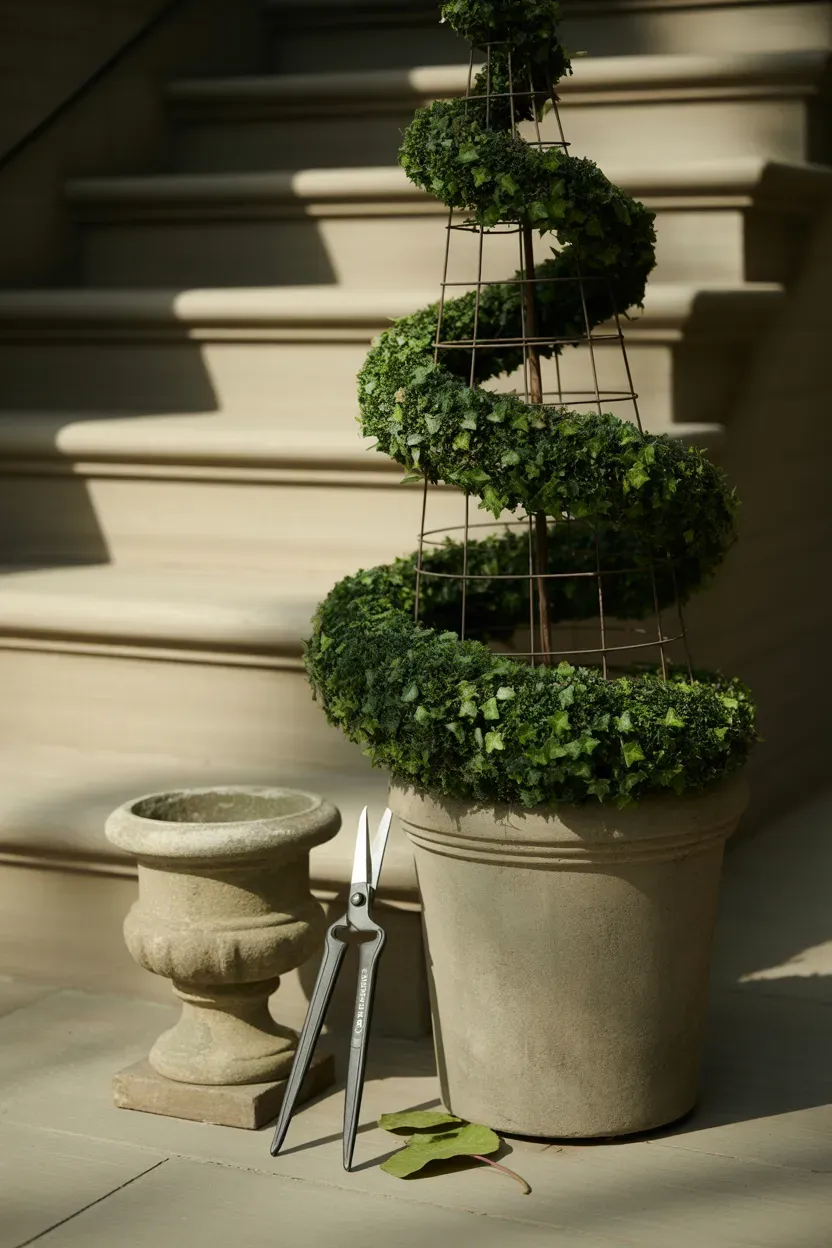
English ivy trained over a wire spiral or geometric frame creates living sculpture that develops more character each year as the growth thickens and fills the form completely.
It needs part shade to part sun and consistent trimming every 2-3 weeks during the growing season to maintain the frame’s precise shape, since ivy grows fast enough to lose definition quickly if neglected. Full coverage of a wire frame typically takes one to two full growing seasons, so patience in the early stages pays off with a genuinely impressive mature specimen.
Pro Tip: Tie new growth to the frame with soft garden twine rather than letting it wrap the wire on its own — self-wrapped stems often grow in the wrong direction and are difficult to redirect later without damaging the shape.
Internal link: training ivy into architectural topiary forms External link: Missouri Botanical Garden’s English ivy growing profile
9. Weeping Standard Roses for Cascading Drama
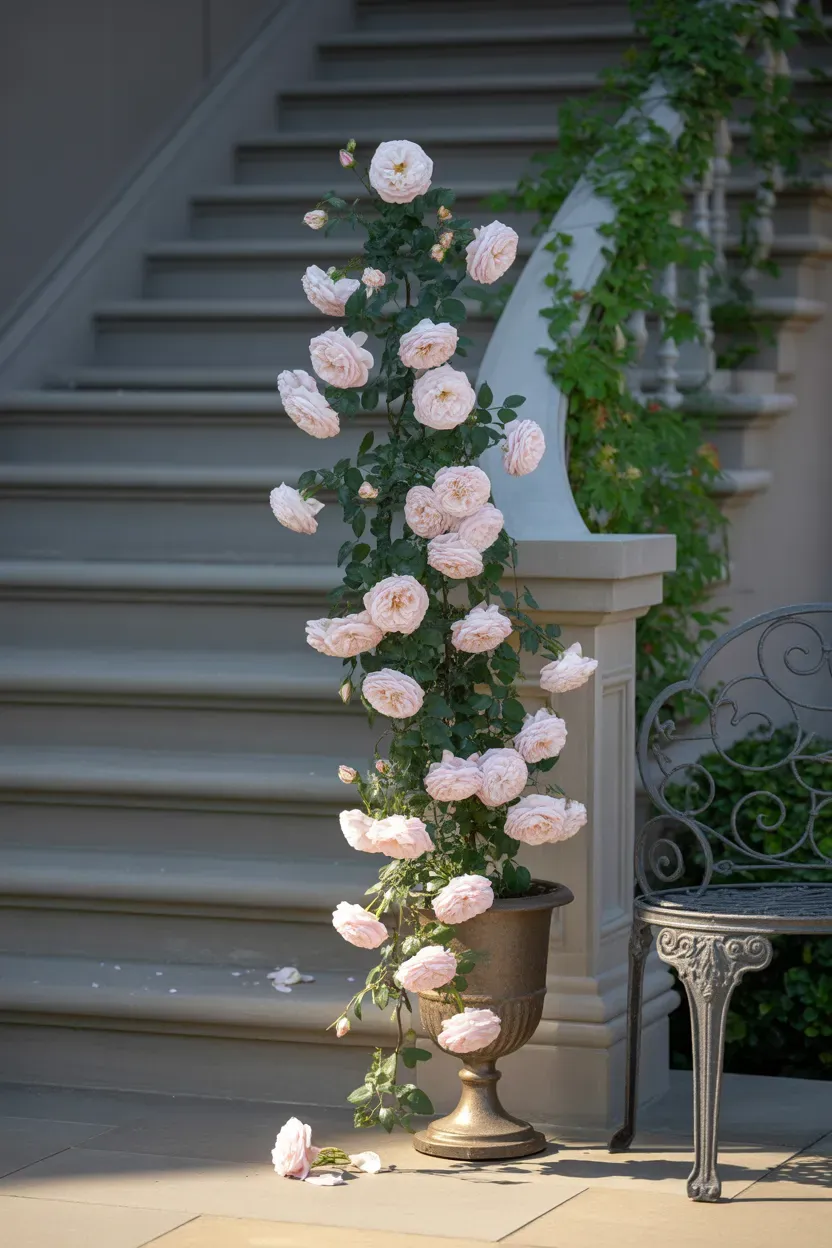
A weeping standard rose, grafted so its blooming canes cascade downward from a tall central stem, creates a genuinely dramatic fountain effect that a regular standard rose’s rounded head can’t achieve.
It needs full sun and regular feeding every 4-6 weeks through the growing season, with deadheading essential to maintain continuous bloom along the cascading canes. Position it where the full cascade height (often 4-5 feet from graft to cane tip) has room to be appreciated, ideally beside a landing rather than a narrow single step.
Internal link: choosing between standard and weeping rose forms External link: Gardeners’ World’s guide to weeping standard rose care
10. Espaliered Fruit Tree for Sculptural Living Wall Art
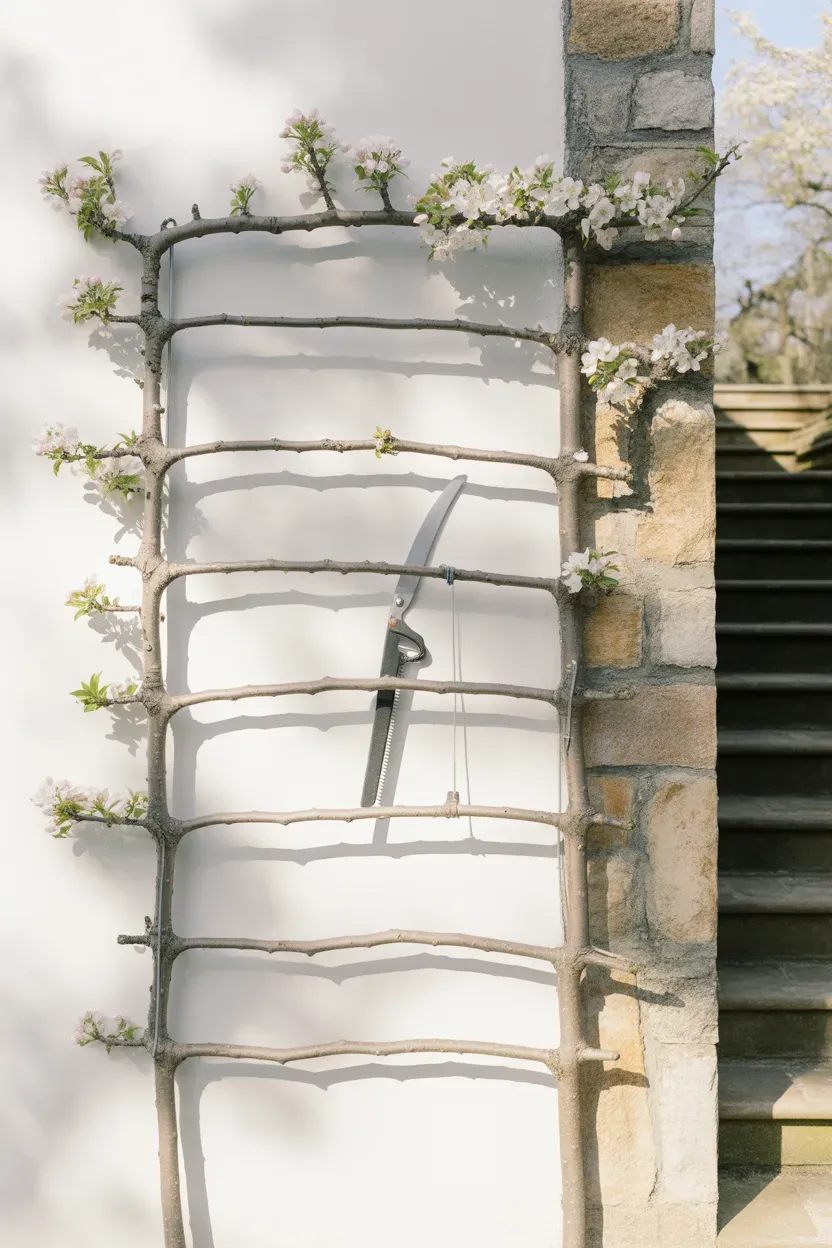
An espaliered fruit tree, trained flat against a wall in a precise geometric pattern, functions as living wall art beside a staircase, and the technique itself signals a level of horticultural investment few other choices can match.
Choose apple or pear varieties suited to espalier training, which need full sun and a sturdy wall-mounted wire framework to guide branch growth over several years. Prune twice yearly, in winter for structure and summer for maintaining the pattern, and expect the full mature form to take 4-6 years to develop completely.
Internal link: training fruit trees into espalier patterns External link: RHS guide to espalier training techniques
This is a genuine long-term investment, but nothing else on this list offers quite the same living artwork effect.
11. Matched Citrus Standards for Fragrant Formal Symmetry
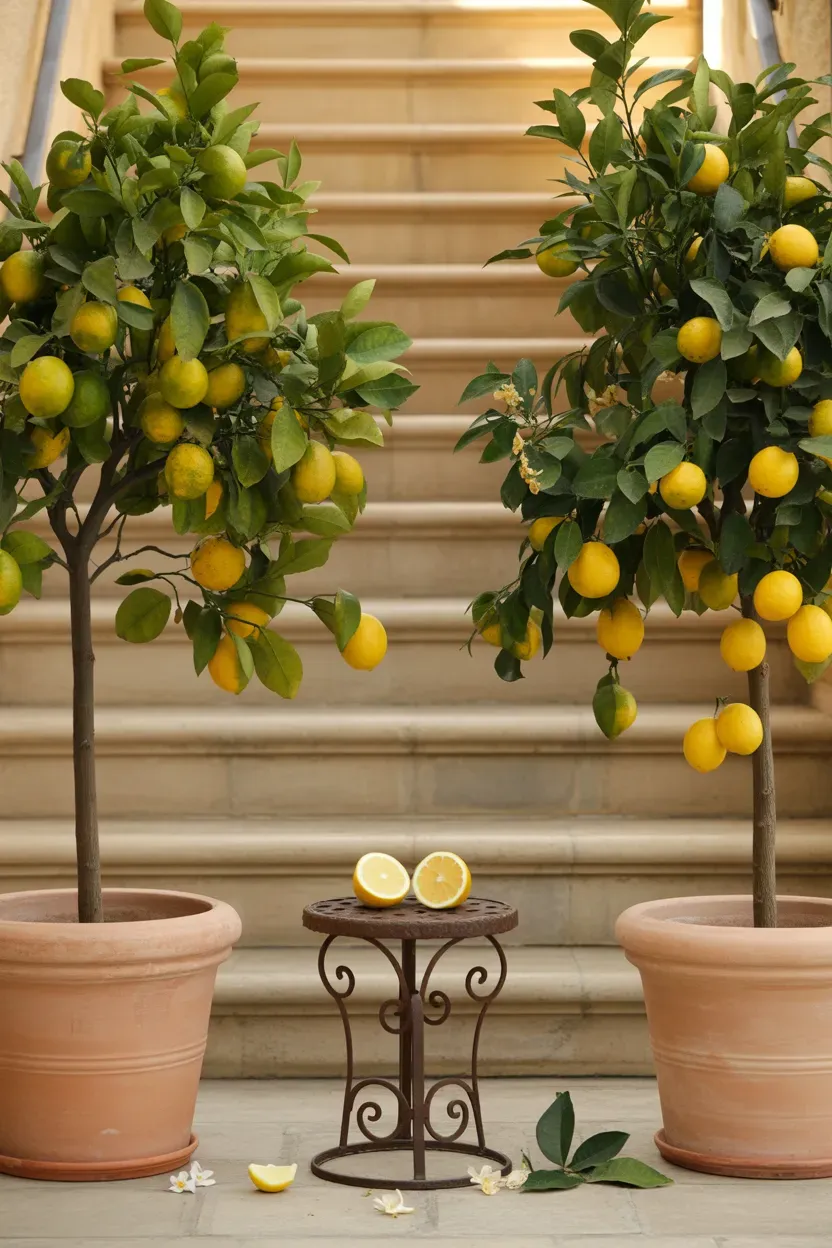
Matched standard citrus trees bring genuine fragrance to a staircase entrance during bloom, and visible fruit adds a decorative, almost estate-garden quality that flowering plants alone can’t provide.
They need full sun (6+ hours) and protection below 30°F, so climates outside citrus-friendly zones should plan to move them indoors or to a greenhouse for winter. Feed monthly during the growing season with a citrus-specific fertilizer, and expect a mature standard to take 2-3 years to establish full fruiting.
Internal link: growing citrus trees as container standards External link: University of Florida Extension’s citrus container growing notes
12. Formal Herb Parterre for a Fragrant Geometric Base
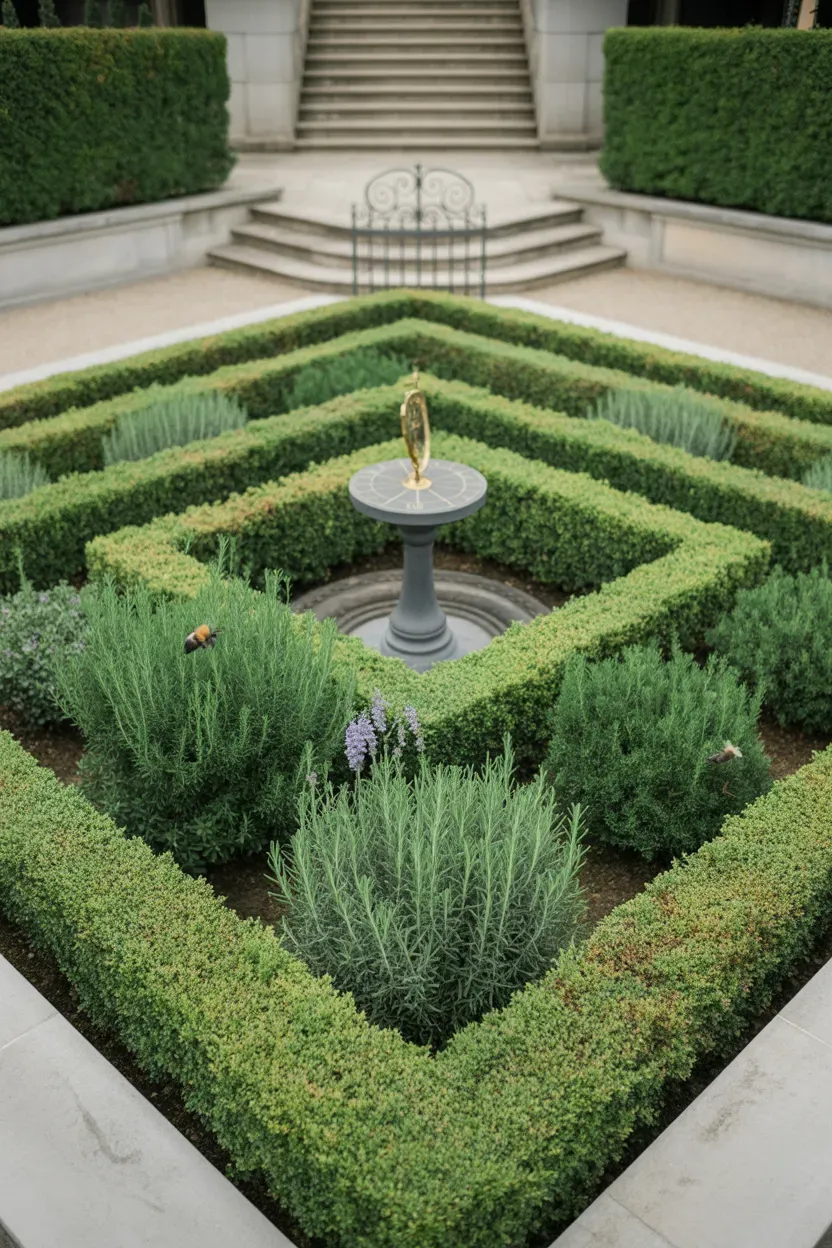
A formal parterre, a geometric bed outlined in clipped boxwood and filled with fragrant herbs, brings a historic estate-garden quality to the base of a grand staircase.
Design a simple geometric pattern (a square divided into quadrants works well for beginners) using dwarf boxwood as the structural edging, and fill the interior sections with lavender, rosemary, or santolina. It needs full sun and well-drained soil, with the boxwood edging trimmed every 5-6 weeks to maintain crisp lines.
What works vs. what to avoid:
- Works: simple symmetrical patterns, drought-tolerant Mediterranean herb fillings
- Avoid: overly intricate patterns for a first attempt, moisture-loving plants that clash with boxwood’s drainage needs
Internal link: designing a formal parterre garden layout External link: Gardeners’ World’s guide to parterre garden design
13. White Gardenia Urns for Intoxicating Evening Fragrance
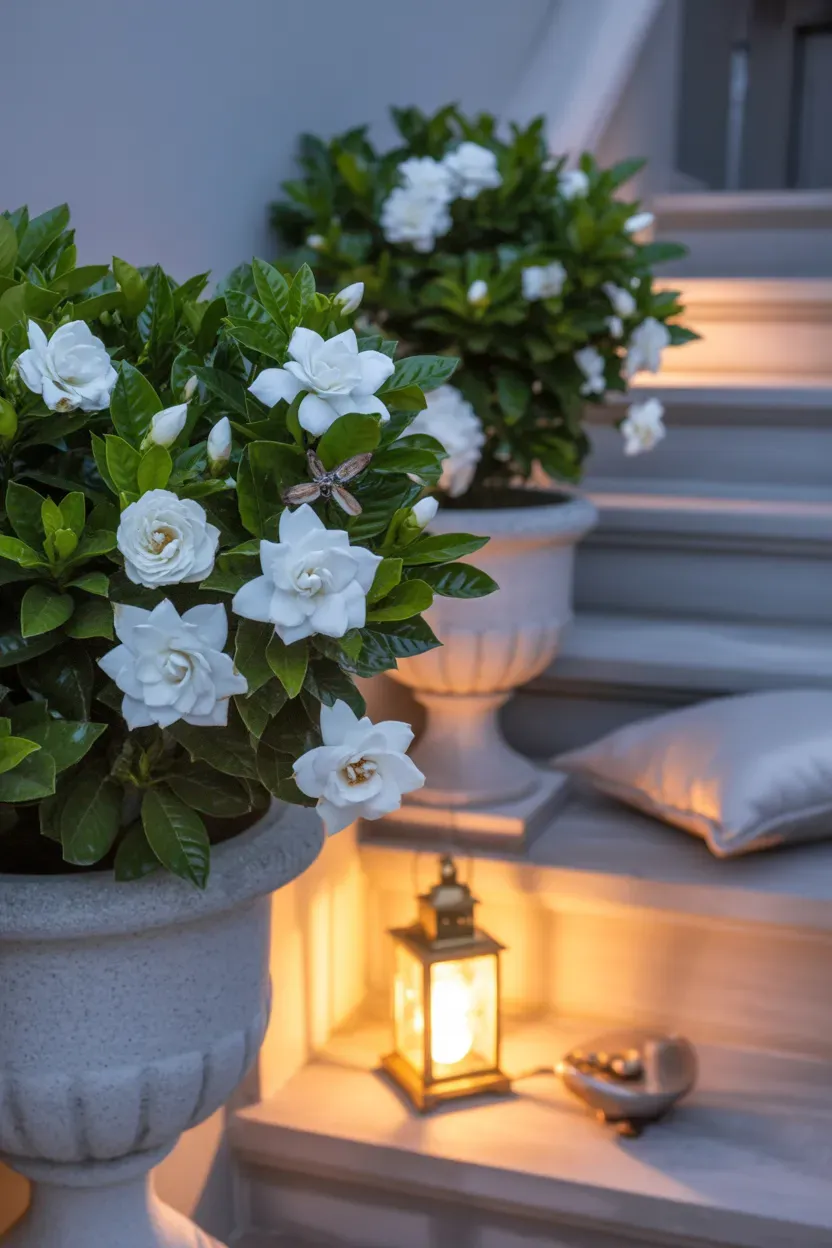
Gardenia’s famously intense evening fragrance makes it a favorite for entrances used at dusk or for evening entertaining, though it’s genuinely one of the more demanding plants on this list.
It needs part sun (morning direct, afternoon protection) and consistently moist, acidic soil (pH 5.0-6.0), watering every 2-3 days and feeding with an acid-loving plant fertilizer monthly during the growing season. It’s notoriously finicky about temperature swings and struggles below 60°F, so most climates outside the Deep South need to treat it as a seasonal container plant brought indoors for winter.
The limitation worth stating plainly: gardenias drop buds readily in response to stress (temperature swings, inconsistent watering, low humidity), so this plant rewards genuine attention rather than a set-and-forget approach.
Internal link: growing gardenias successfully in containers External link: SF Gate Home Guide’s gardenia troubleshooting tips
14. Weathered Copper Planters for Rich Patina Warmth
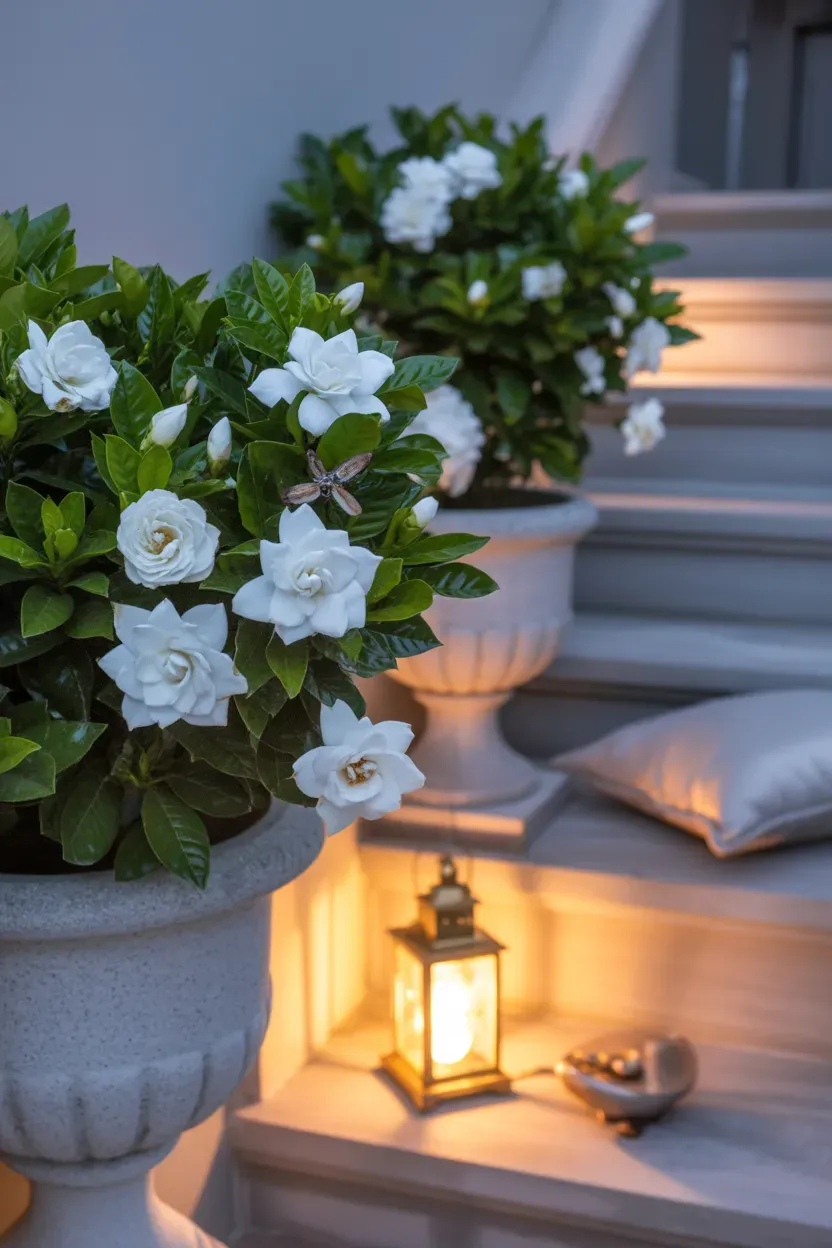
Copper planters develop a rich verdigris patina over several years outdoors, shifting from bright metallic to a soft blue-green that many high-end gardens specifically cultivate for its aged, established appearance.
Choose genuine copper (not copper-look coated steel) for the authentic patina development, and plant with shade-tolerant ferns or hostas, since copper containers heat up considerably in direct sun. Speed up the natural aging process with a vinegar-and-salt patina solution if you don’t want to wait the 3-5 years it takes to develop naturally outdoors.
Internal link: aging copper containers for an established garden look External link: BHG’s guide to copper garden container care
15. Formal Yew Cones for Dark, Dramatic Structure
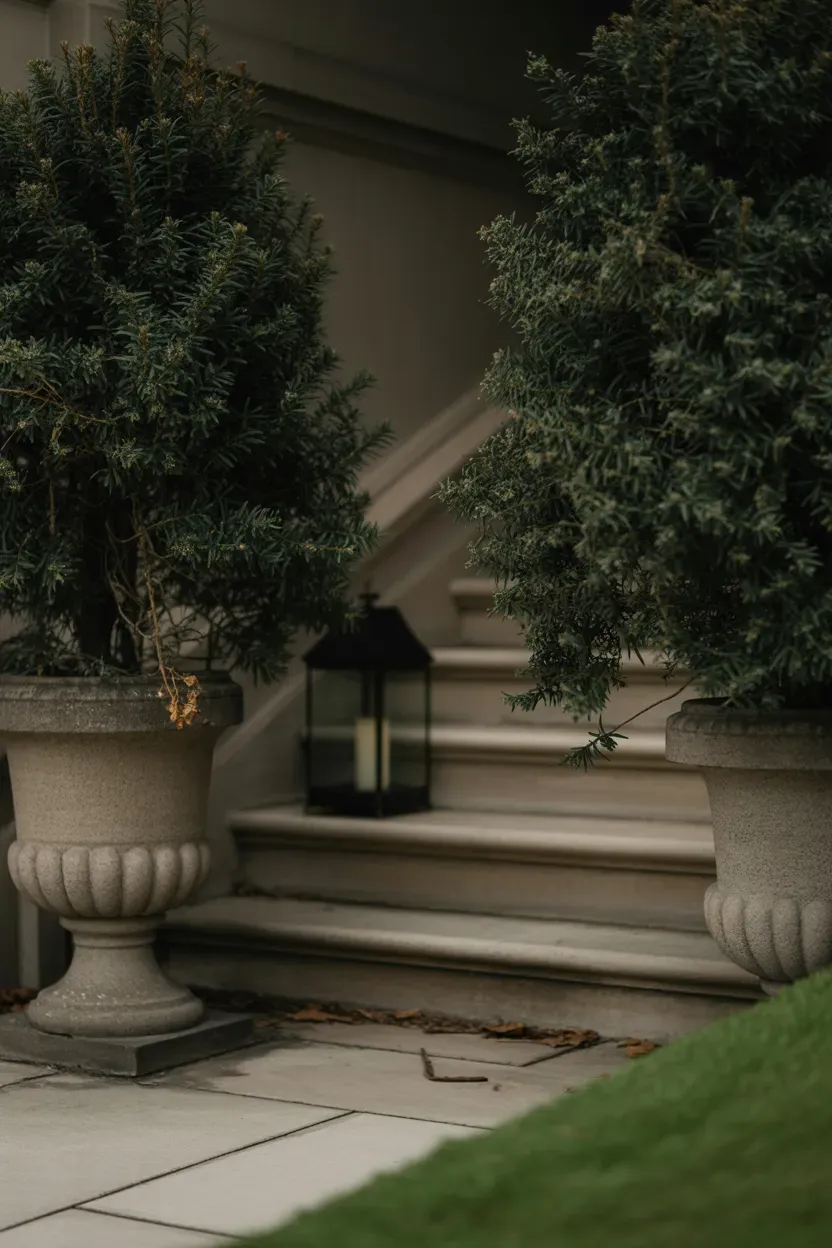
Yew’s exceptionally dark, dense foliage creates dramatic contrast against light stone or pale home exteriors, and its slow growth means a well-shaped cone holds its form for years between major trimmings.
It needs part shade to part sun and trimming just once or twice yearly, considerably less maintenance than boxwood requires for a comparably crisp shape. Yew tolerates genuine cold well, down to -20°F in many varieties, making it a more reliable choice than boxwood or bay laurel in harsh winter climates.
Pro Tip: All parts of yew are toxic if ingested, including by pets, so this is a better choice for entrances without regular animal visitors, or position containers where curious pets genuinely can’t reach.
Internal link: dark foliage evergreens for dramatic formal contrast External link: RHS growing guide for Taxus baccata
16. Marble Chip Gravel Beds for Refined Ground-Level Texture
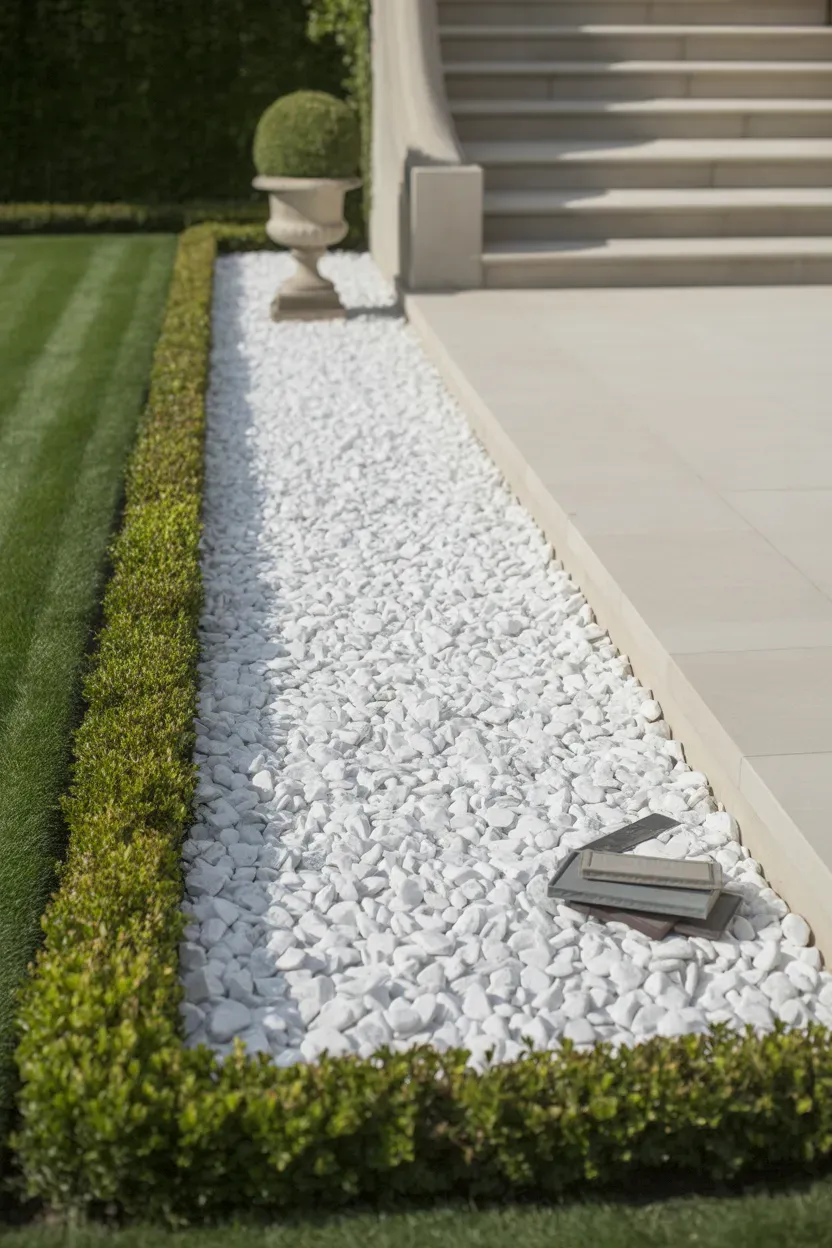
White marble chip gravel, bordered with crisp boxwood edging, creates a refined ground-level texture at the base of a staircase that reads as considerably more polished than standard mulch or bark.
Lay landscape fabric first, then a 2-3 inch layer of marble chips within a boxwood or stone-edged border. This is essentially a maintenance-reduction feature rather than a planting one, though it pairs beautifully with a single statement plant or urn as a centerpiece within the gravel field.
Internal link: refined gravel and hardscape edging for formal gardens External link: Almanac’s guide to decorative gravel bed installation
17. Antique Urn With Trailing Vine for Weathered Grandeur
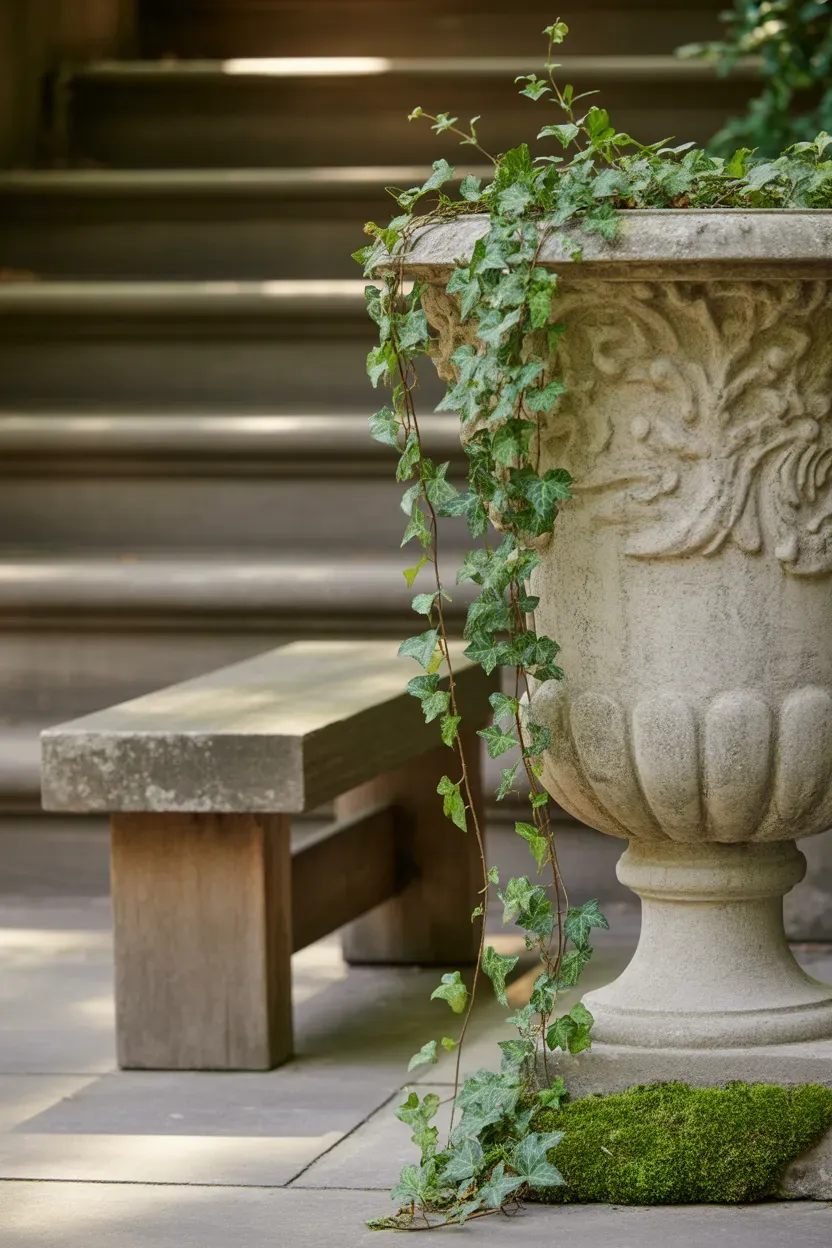
A single genuine antique stone urn, positioned as a standalone centerpiece rather than part of a matched pair, carries the kind of weathered grandeur that reproduction pieces take decades to approximate.
Source from architectural salvage yards or estate sales, expecting to pay $200-500 depending on size, carving detail, and provenance. Plant with trailing English ivy, which cascades naturally over the carved surface and softens the stone’s formality without hiding its detail entirely.
Internal link: sourcing genuine antique garden containers External link: Missouri Botanical Garden’s English ivy growing profile
One genuinely old piece, positioned thoughtfully, often outperforms an entire matched set of new containers.
18. Champagne Rose Standards for Warm, Understated Romance
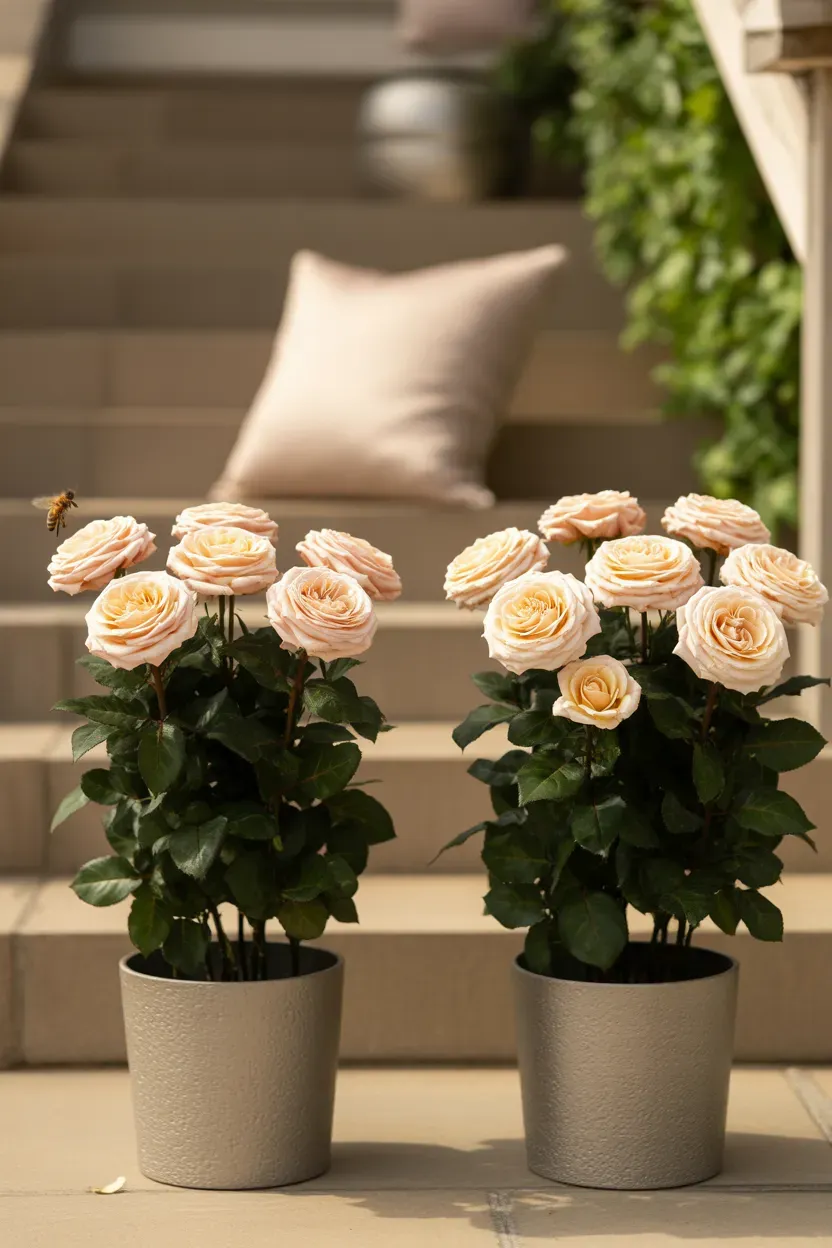
Champagne and warm-cream toned roses offer a softer, more understated alternative to classic red or pink, and the warm neutral tone pairs especially well with stone, lead, and other muted container materials.
Choose a variety like ‘Koko Loko’ or ‘Julia Child’ trained as a standard, needing full sun and feeding every 4-6 weeks. Deadhead weekly to maintain continuous bloom, and expect the warm champagne tone to shift subtly with temperature, appearing more golden in cooler weather and paler in summer heat.
Internal link: warm-tone rose varieties for refined color palettes External link: Almanac’s guide to rose color and temperature effects
19. Formal Fern Symmetry for Cool Shaded Elegance
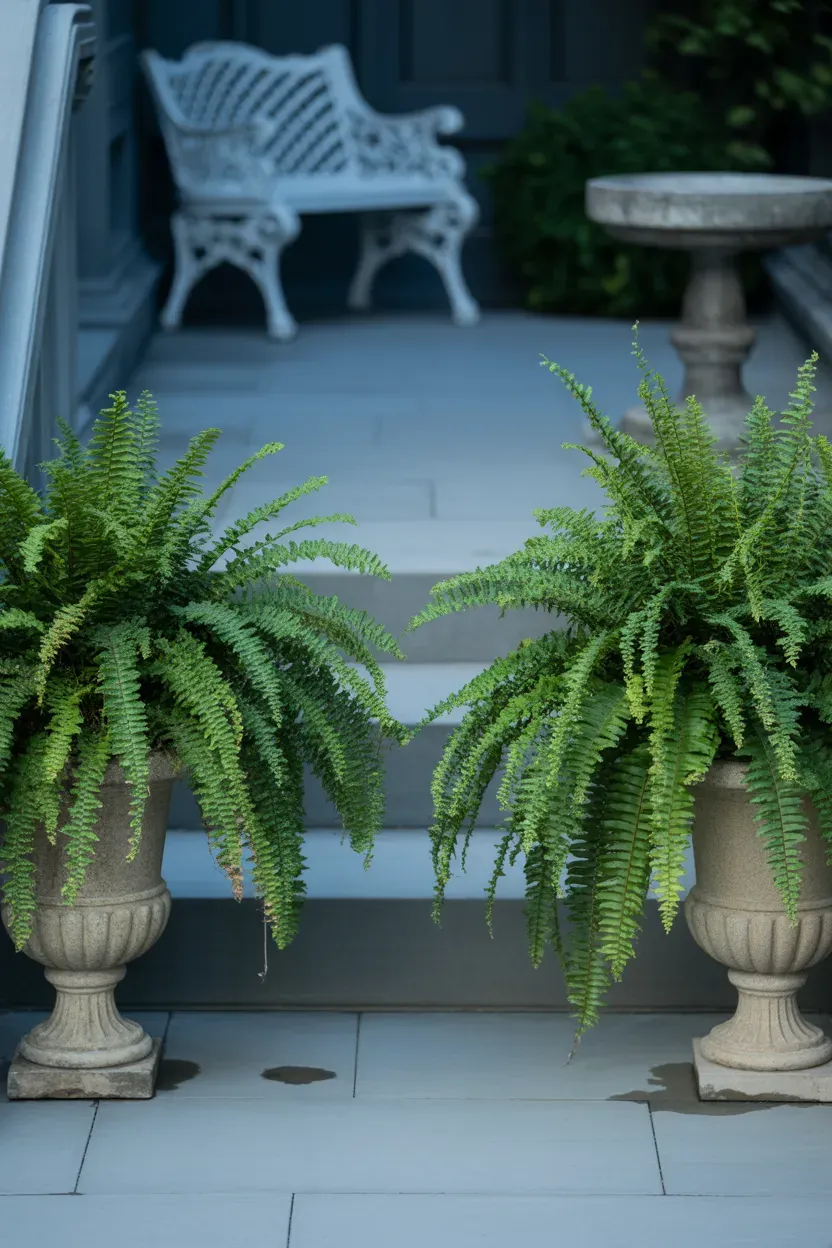
A matched pair of large, full ferns in cast stone urns brings cool, lush elegance to a shaded staircase, and unlike many luxury plant choices, ferns need genuinely minimal maintenance beyond consistent moisture.
They need indirect to full shade and consistently moist soil, watering every 2-3 days in warm weather. Choose the largest specimen ferns your budget allows, since fern fullness (rather than height) is what reads as established and generous in this application.
Internal link: large statement ferns for shaded formal entrances External link: Missouri Botanical Garden’s Boston fern growing profile
This is one of the most affordable ideas on the list for the visual payoff it delivers.
20. Gilded Accent Planters for a Touch of Metallic Glamour
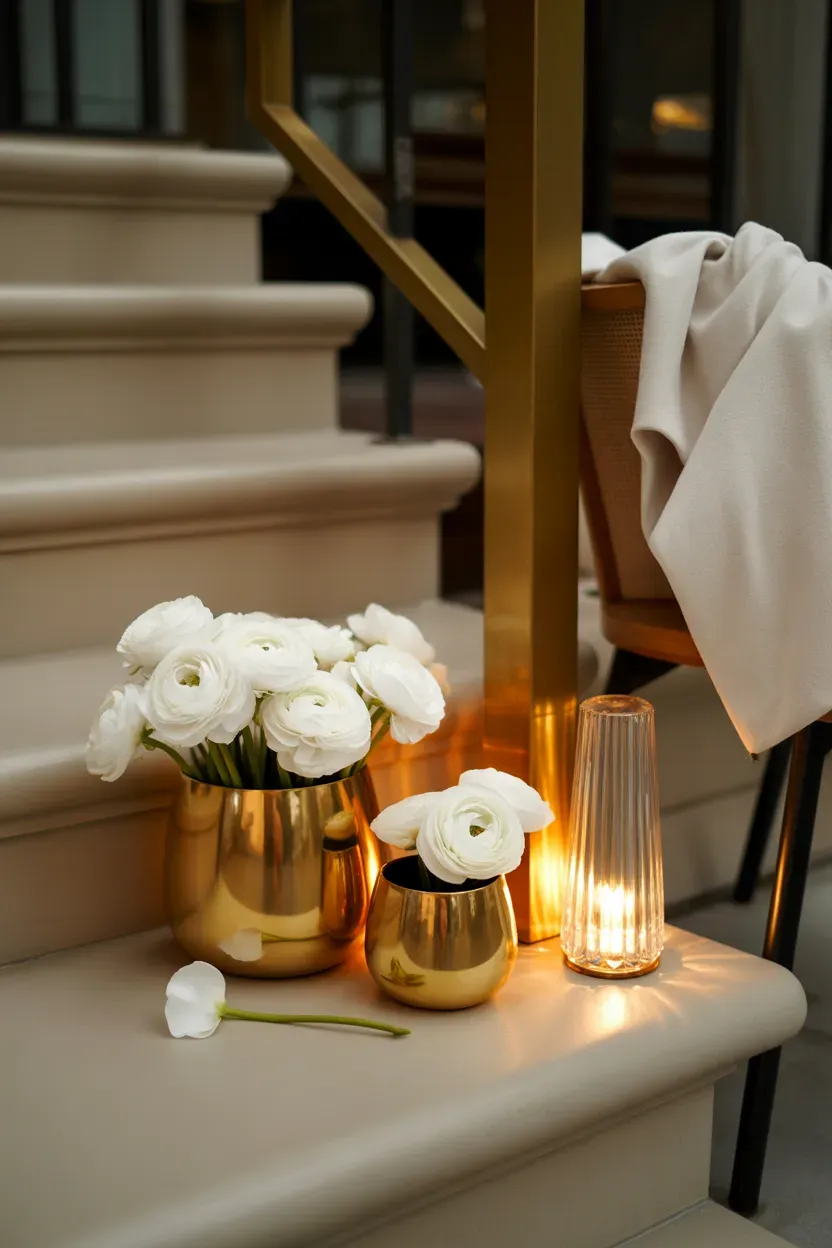
Small gilded or gold-leaf finished planters used as accents, rather than the primary containers, add a touch of glamour without tipping the overall design into excess.
Use gilded planters sparingly, as a secondary detail alongside larger stone or lead containers rather than the main feature, and fill with simple white flowers like ranunculus to keep the gold finish as the visual focus. They work best in a covered or partially sheltered spot, since prolonged direct weather exposure dulls gilded finishes faster than other materials on this list.
Internal link: metallic and gilded accents in formal garden design External link: BHG’s guide to ranunculus growing in containers
21. Clipped Privet Columns for Formal Vertical Rhythm
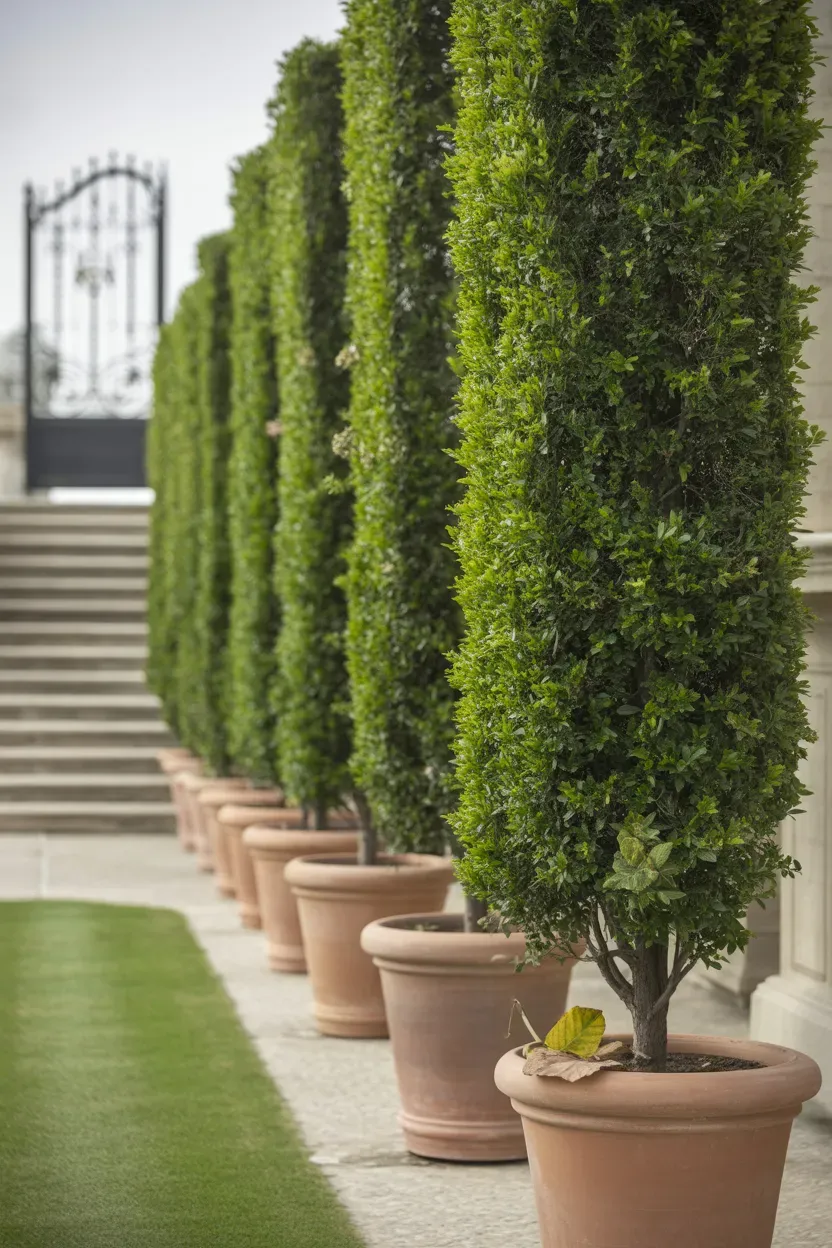
Tall, columnar privet trimmed into precise vertical shapes creates a formal rhythm down a staircase, functioning almost like living architectural columns flanking the ascent.
It needs full sun and trimming every 4-5 weeks during the growing season to maintain crisp columnar lines, considerably more frequent than yew but faster-growing to fill out initially. Plant in matched terracotta pots and space evenly for the strongest rhythmic effect, treating each column as a repeated architectural element rather than an individual specimen.
Internal link: columnar and vertical topiary forms for formal gardens External link: Gardeners’ World’s guide to privet hedging and shaping
22. Silver-Leaf Dusty Miller Border for Cool Contrast Edging
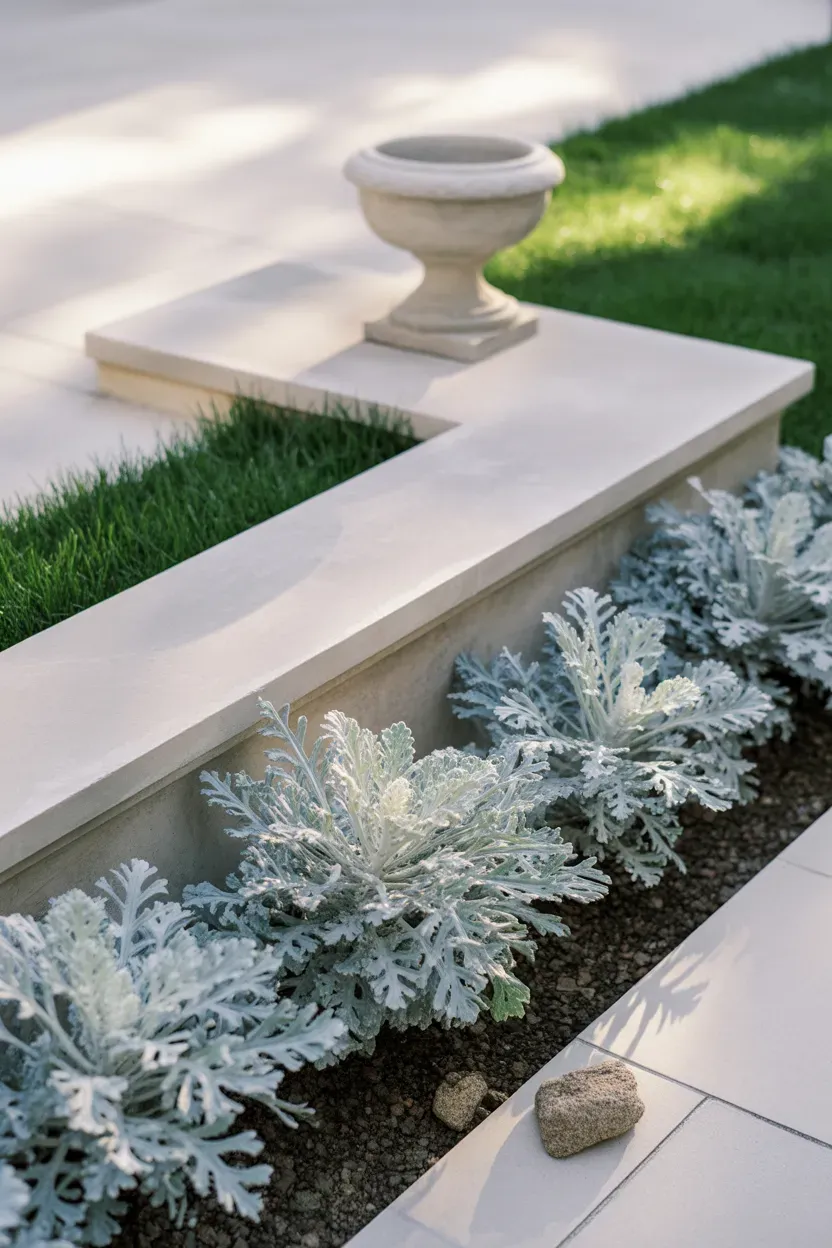
Dusty miller’s silvery, felted foliage provides a cool, understated border that ties together warmer stone or terracotta elements without competing for attention with any bloom color.
It needs full sun and well-drained soil, tolerating drought well once established and needing only occasional trimming to maintain a tidy, compact border shape. Its silver tone photographs particularly well against warm stone, making it a favorite low-cost detail in otherwise expensive formal designs.
Internal link: silver-foliage plants for refined garden edging External link: University of Florida Extension’s dusty miller growing notes
23. Formal Camellia Pair for Glossy Winter-to-Spring Elegance
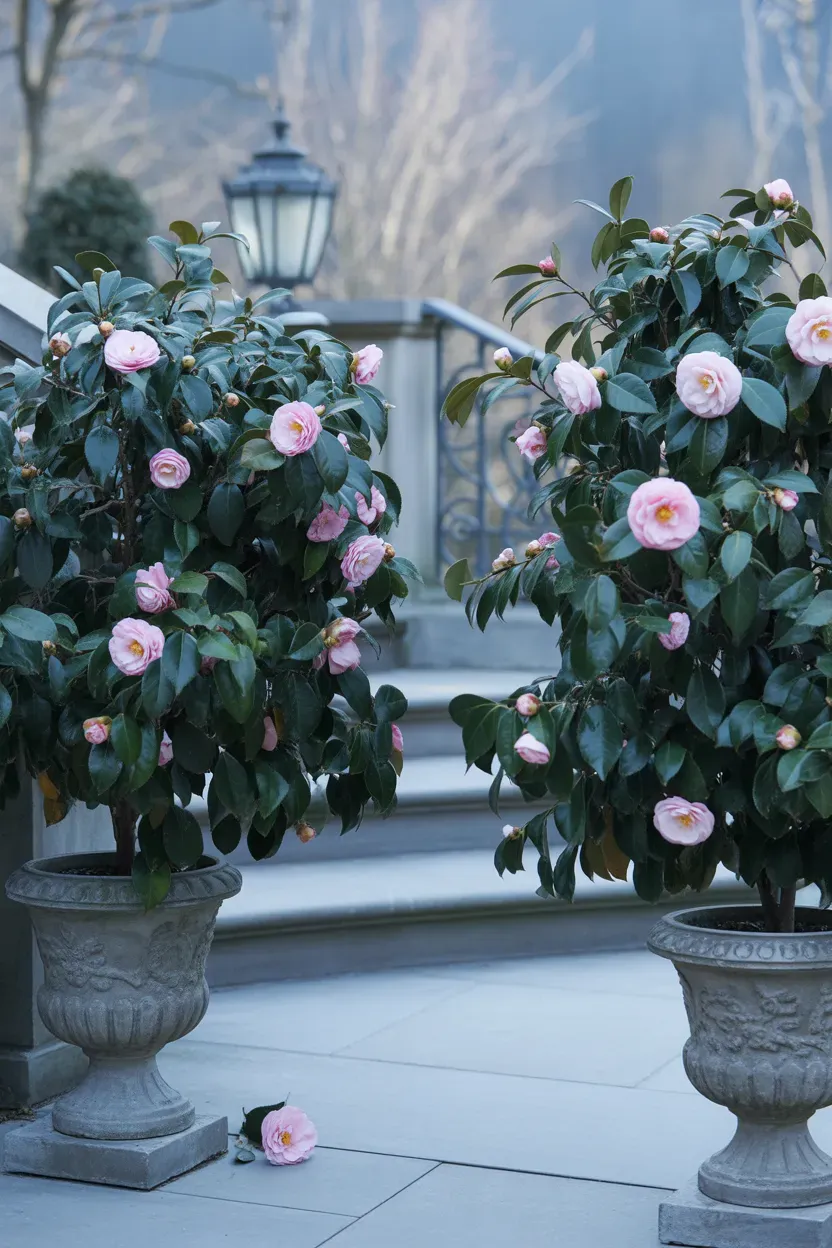
Camellias bloom during the winter-to-early-spring window when most other flowering plants are dormant, filling a seasonal gap with glossy evergreen foliage and elegant blooms when the rest of the garden offers little else.
They need part shade (protection from harsh afternoon sun and winter wind) and consistently moist, acidic soil, similar to gardenia’s requirements. Choose a cold-hardy variety like Camellia japonica for climates with real winter chill, and mulch the root zone heavily to protect against freeze-thaw damage.
Internal link: winter and early-spring blooming shrubs for containers External link: RHS growing guide for Camellia japonica
24. Wisteria-Draped Archway for Breathtaking Seasonal Drama
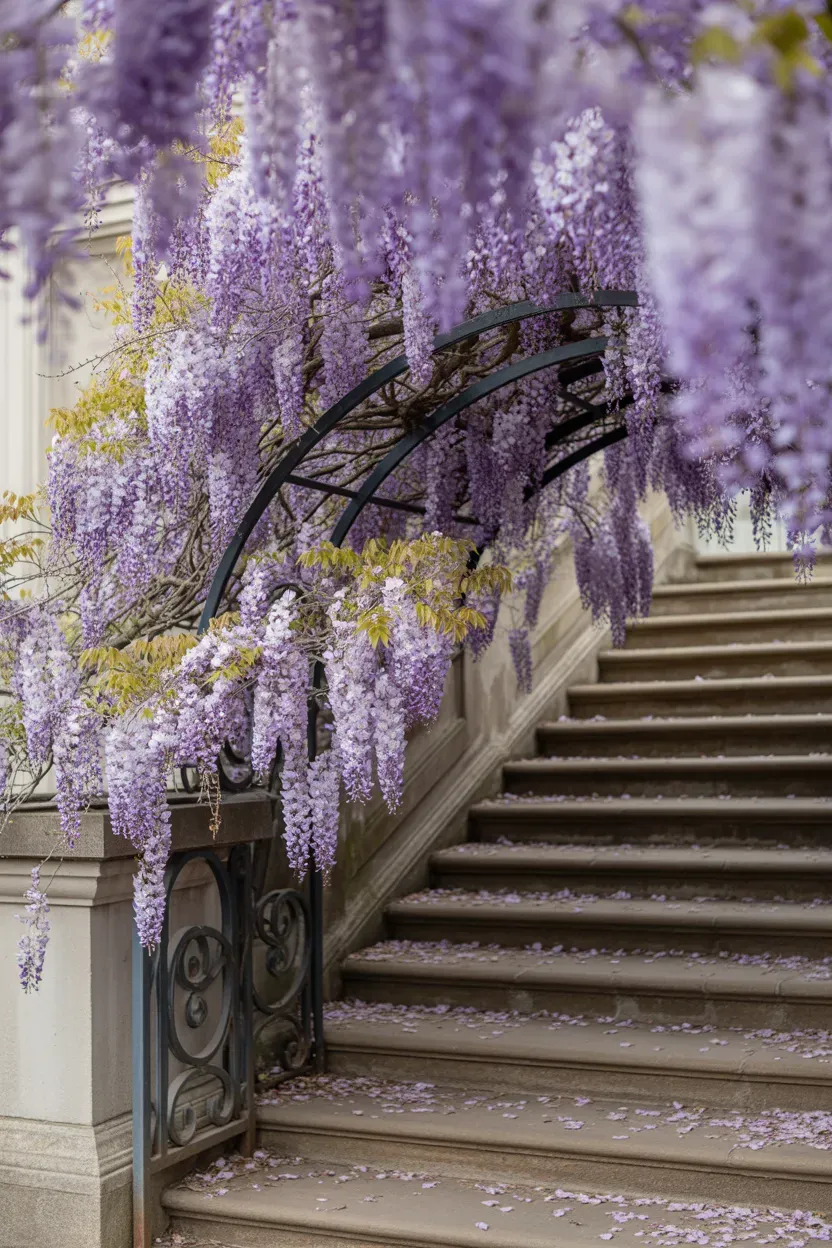
A mature wisteria trained over an archway at the top of a staircase creates one of the most dramatic seasonal displays possible, though it demands real patience and firm structural support to achieve.
It needs full sun and a genuinely sturdy structure, since mature wisteria vines become remarkably heavy and can damage flimsy supports over time. Prune twice yearly, hard in winter and lightly in summer, to control its famously vigorous growth and encourage the fullest bloom the following spring. Expect 3-5 years before a young wisteria produces a truly dramatic bloom display.
Pro Tip: Choose Wisteria floribunda (Japanese) over Wisteria sinensis (Chinese) in regions where the latter is considered invasive — check with your local extension office, since regulations vary significantly by state.
Internal link: training wisteria over structures and archways External link: Penn State Extension’s wisteria species and invasiveness notes
25. Statuary Accent Planting for Classical Focal Interest
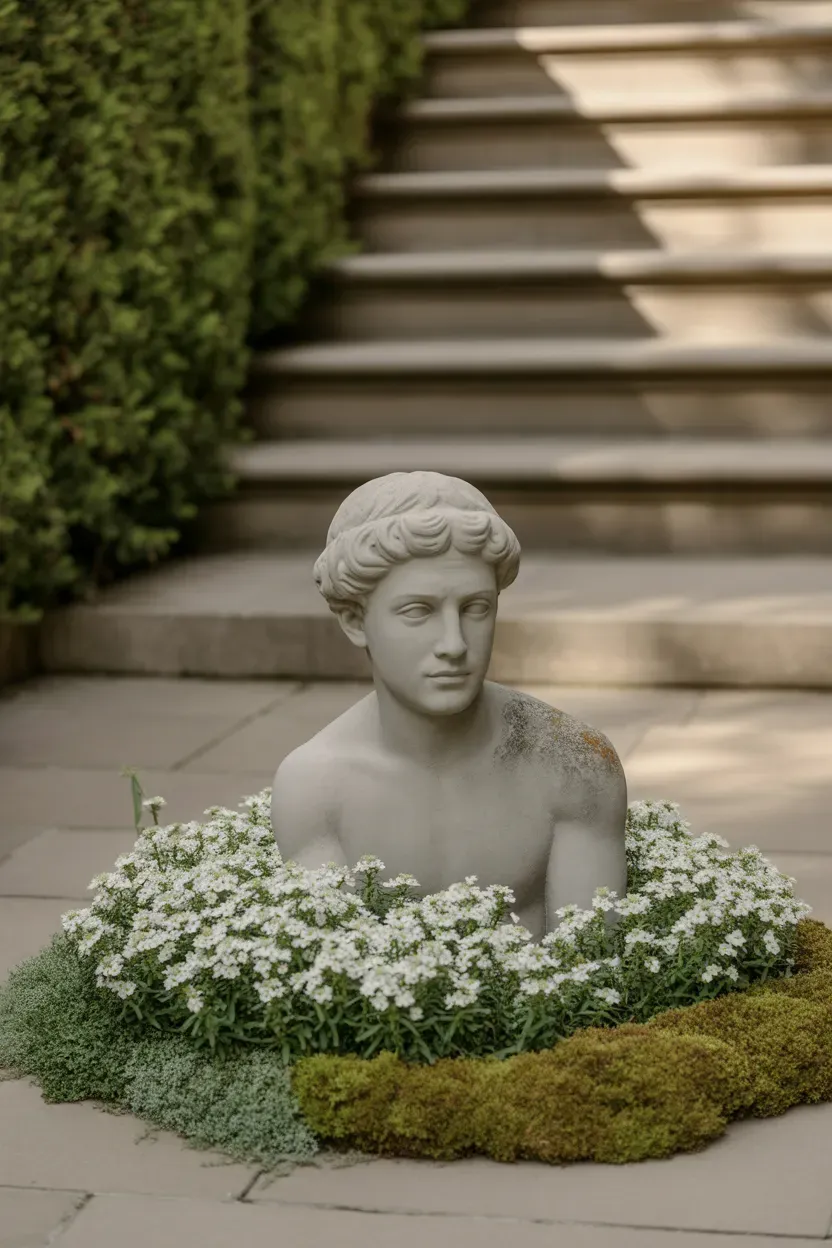
A classical statue, whether cast stone or bronze, positioned as a focal point at a staircase’s base or landing, brings a museum-garden quality that plants alone can’t achieve regardless of how carefully chosen.
Surround the statue with a low, simple planting like white alyssum or sweet woodruff, so the greenery frames rather than competes with the sculptural piece. Cast stone statuary runs $200-400 depending on size and detail, while genuine bronze pieces cost significantly more but develop an even richer patina over decades.
Internal link: incorporating garden statuary into planting design External link: Almanac’s guide to placing and maintaining garden statuary
26. White Orchid Display Urns for Gallery-Level Refinement
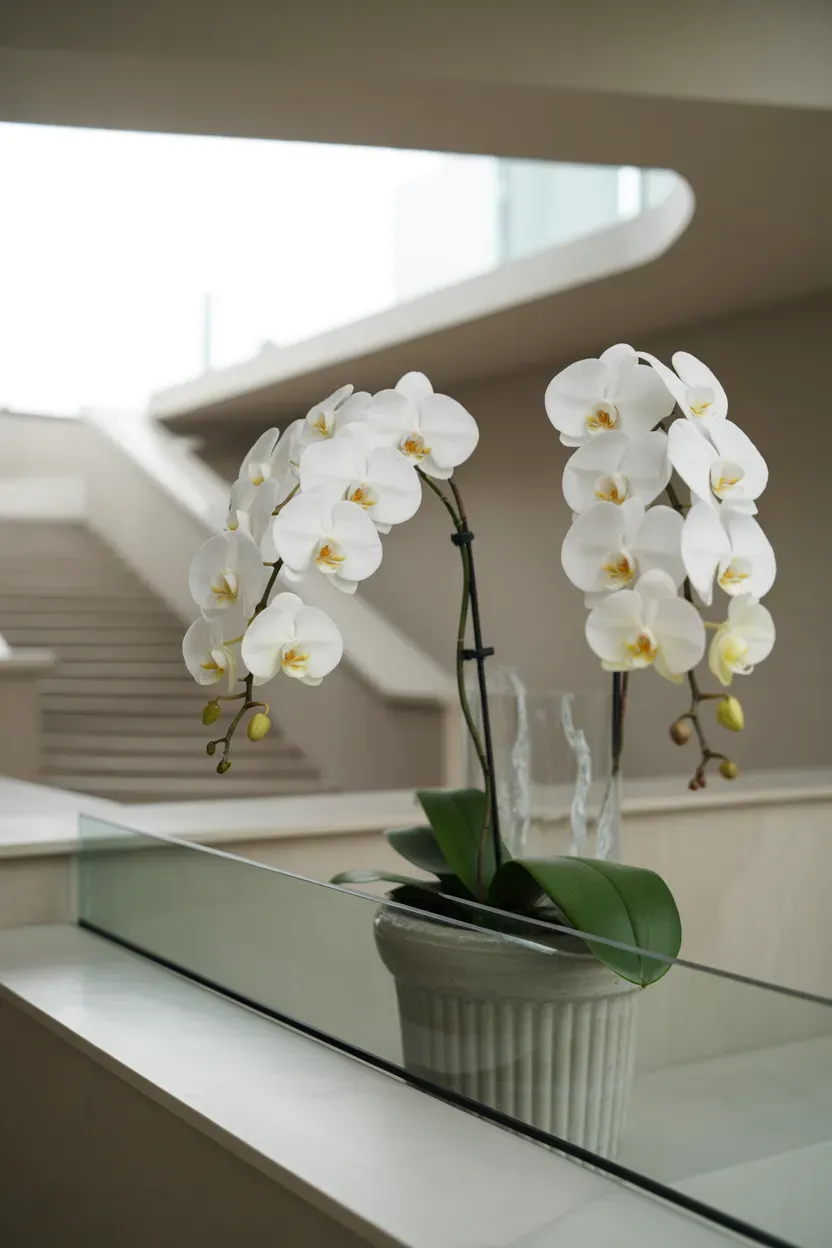
White orchids in matched ceramic display urns bring a gallery-level refinement to a sheltered staircase landing, their sculptural bloom form reading as almost artistic rather than simply decorative.
They need bright indirect light (never direct outdoor sun) and watering once weekly by soaking the roots briefly. This idea genuinely requires a covered or substantially sheltered location, since orchids don’t tolerate rain exposure or temperature swings, making it best suited to a covered entrance portico rather than fully exposed steps.
Internal link: orchid care for covered outdoor and entrance spaces External link: RHS growing guide for Phalaenopsis orchids
27. Antique Stone Trough Herbs for Rustic-Meets-Refined Character
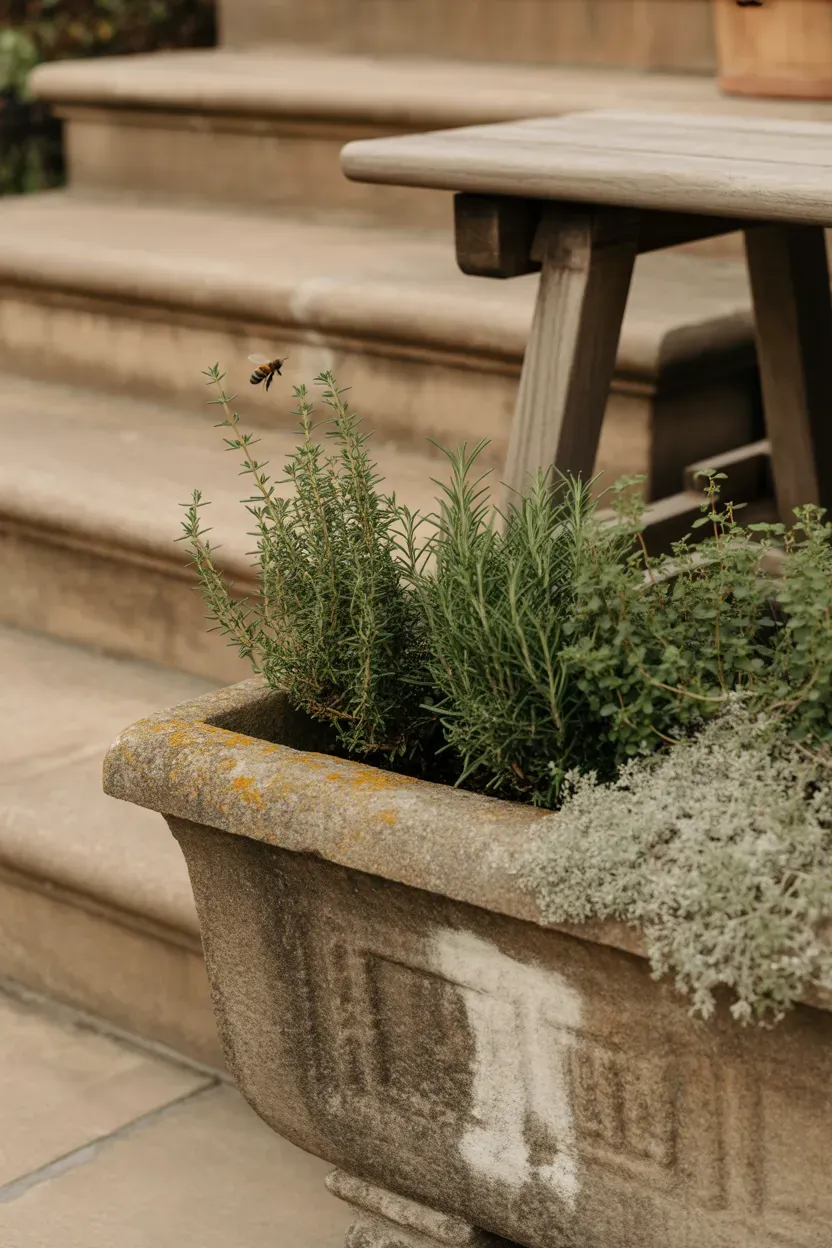
A genuine antique stone trough, originally used as agricultural livestock feeding troughs, brings an authentic weathered texture that pairs surprisingly well with refined Mediterranean herbs for a rustic-meets-formal effect.
Expect to pay $250-450 for a genuine salvaged piece, and plant with rosemary and thyme, both full-sun, drought-tolerant herbs that suit the trough’s typically shallow, wide profile. The stone’s natural weathering and any visible chips or wear only add to its authentic character rather than detracting from it.
Internal link: sourcing genuine antique garden containers External link: Almanac’s guide to growing herbs in containers
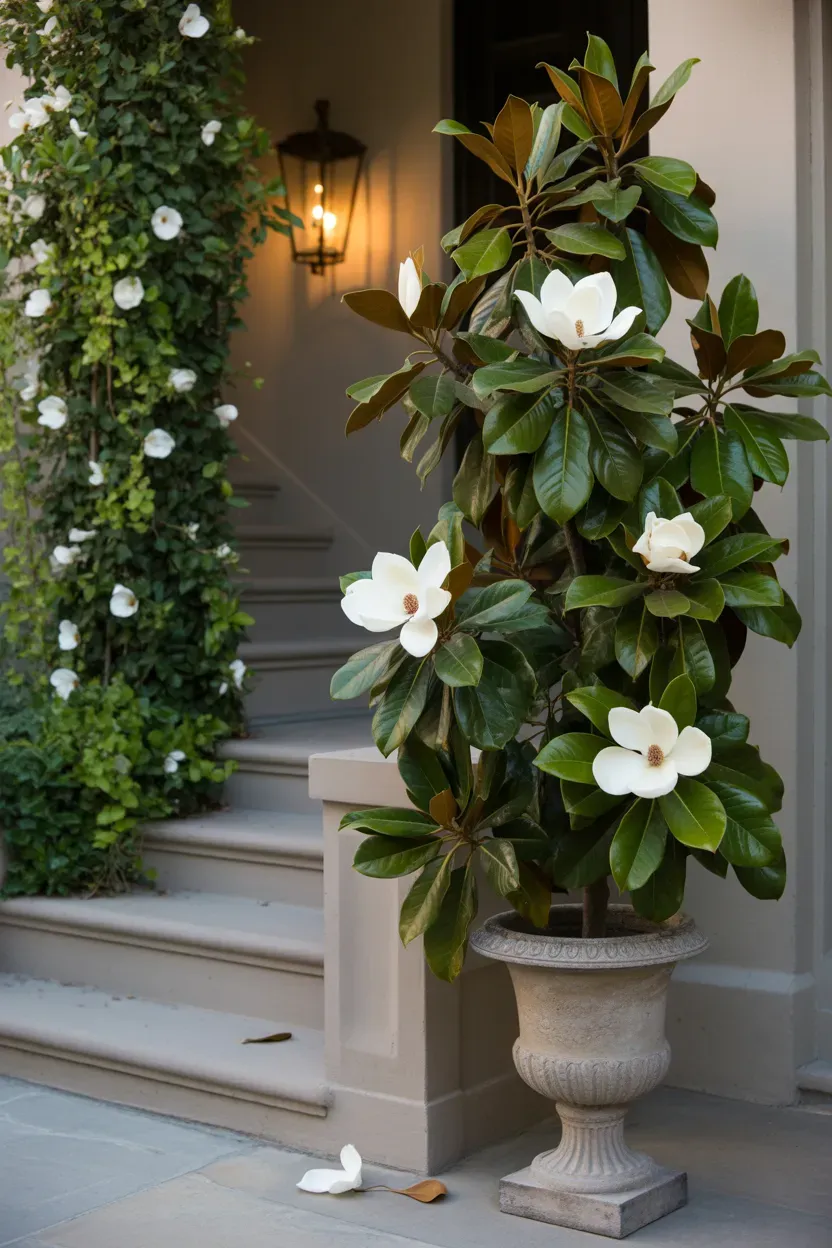
28. Formal Magnolia Standard for Bold Southern Elegance
A single standard magnolia brings bold Southern estate garden character, its enormous glossy leaves and dramatic creamy blooms carrying more visual weight than nearly anything else on this list.
It needs part sun to full sun and a substantial container, at least 24 inches wide, since magnolias develop significant root mass even as container specimens. Water deeply but infrequently, roughly every 7-10 days, and expect a container-grown magnolia to need eventual transplanting to the ground or a considerably larger container as it matures over several years.
Internal link: growing magnolia trees as container standards External link: Missouri Botanical Garden’s magnolia growing profile
29. Silver Birch Multi-Stem Pair for Elegant Height and Movement
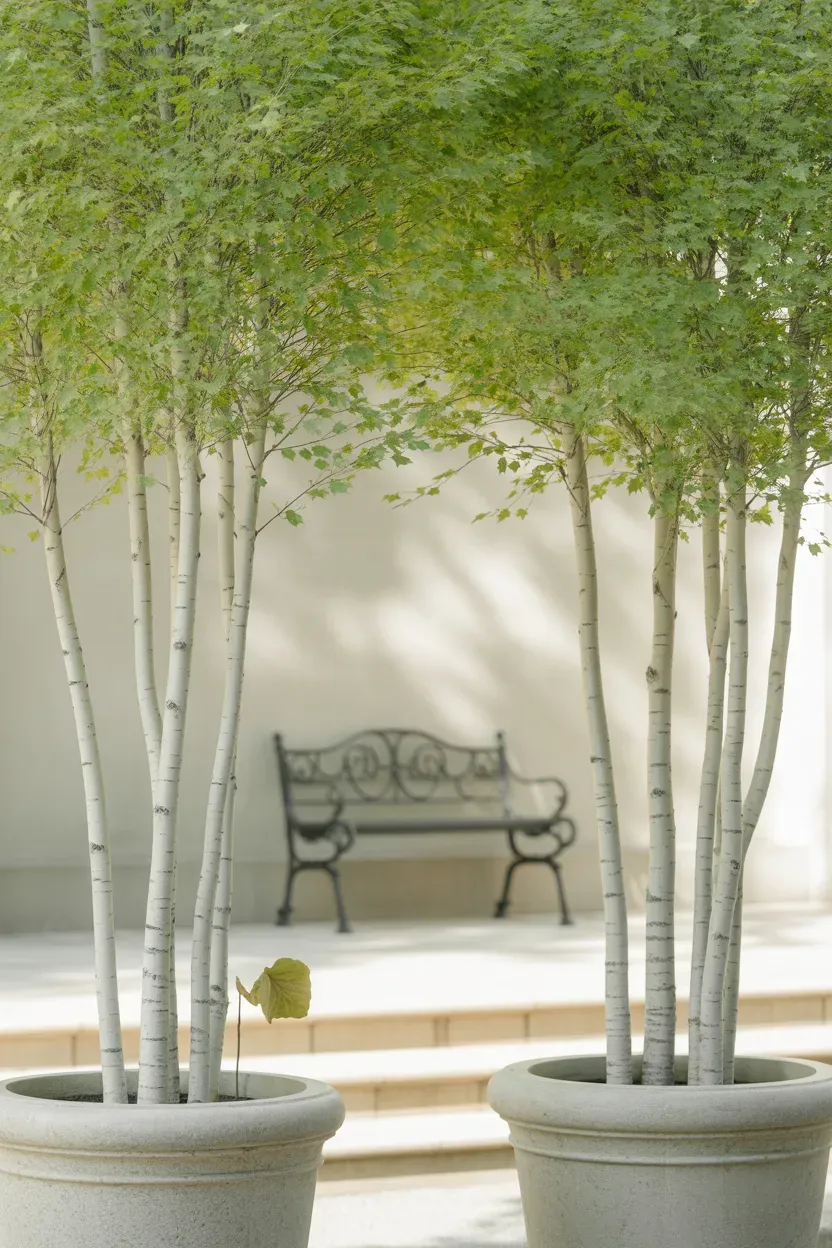
Multi-stem silver birch trees bring genuine height and delicate movement to a staircase entrance, their pale, papery bark creating striking visual contrast against dark stone or metal containers.
They need full sun and consistently moist soil in a large container, at least 24-30 inches wide given their eventual root mass, watering every 3-4 days in summer heat. Birch is notably shallow-rooted and thirsty, so consistent moisture matters more here than with most other trees on this list, and the pale bark itself needs no special care to maintain its striking appearance.
Internal link: multi-stem trees for elegant container height External link: RHS growing guide for Betula (birch) in containers
30. Clipped Holly Sentinels for Glossy Winter-Proof Structure
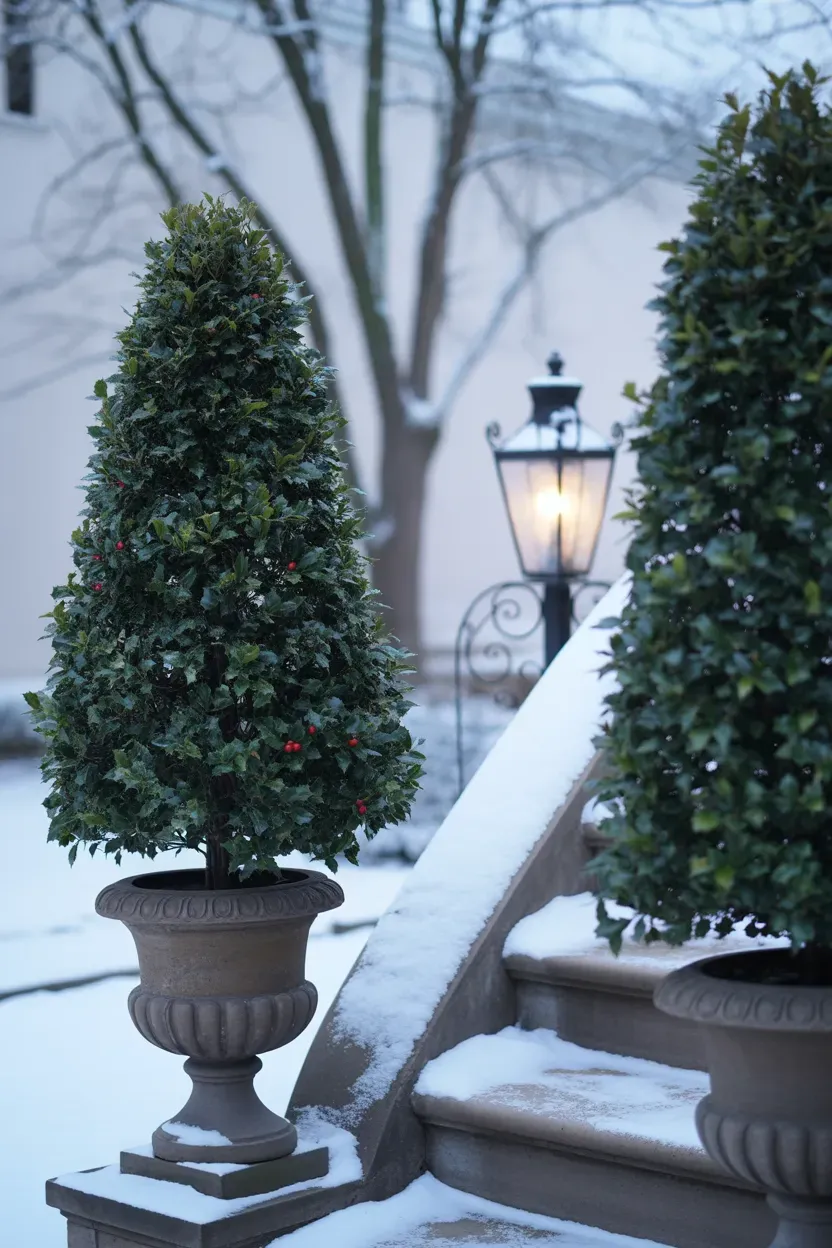
Clipped conical holly trees deliver year-round structure, including through winter when most other plants on this list have gone dormant or need protection, making them one of the most reliably four-season options available.
They need part shade to full sun and trimming just once or twice yearly to maintain the conical shape, considerably less demanding than boxwood or privet. Female varieties produce decorative red berries in winter (given a nearby male pollinator plant), adding seasonal interest exactly when the rest of the entrance needs it most.
Pro Tip: Plant holly where its cheerful red winter berries can be seen from indoors as well as from the staircase itself — this is one of the few luxury plants that peaks in visual interest during the darkest months of the year.
Internal link: year-round structural evergreens for formal entrances External link: Almanac’s holly growing and pollination guide
31. Grand Entrance Palm Pair for Resort-Level Drama
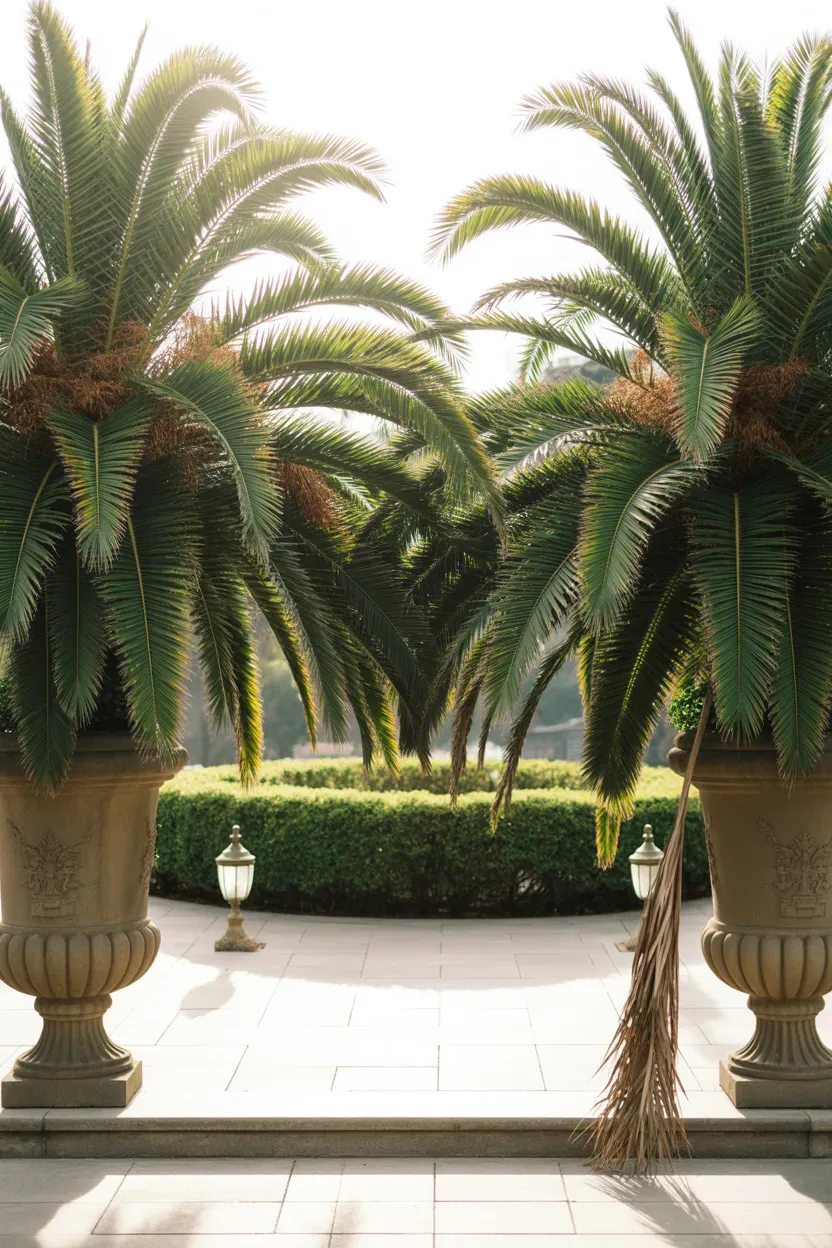
A matched pair of large, mature palms brings genuine resort-level drama to a grand entrance, their sweeping fronds creating movement and scale that few other plants can match at this size.
They need bright indirect light to full sun depending on species and climate, and a substantial cast stone urn, at least 24 inches wide, to properly anchor their visual weight and prevent tipping. Water deeply every 7-10 days once established, and in climates below 40°F, plan for winter protection or treat as a warm-season seasonal display brought under cover for colder months.
Internal link: statement palms for grand entrance container design External link: Missouri Botanical Garden’s kentia palm growing profile
Closing a grand staircase with a genuinely mature palm pair delivers the single most photograph-ready finish on this entire list.
Getting Started With Luxury Staircase Gardens
The easiest first step is choosing one high-quality container pair and one mature statement plant rather than trying to fill every step at once — luxury design depends on getting a few elements genuinely right before expanding. The most common beginner mistake is buying undersized containers or young, immature plants to save money upfront, which undermines the established, high-end look this whole approach depends on.
For your first purchase, get one matched pair of cast stone or lead-look urns in the largest size your entrance can visually support, one mature plant (a standard rose, boxwood, or fern) rather than several small ones, and quality potting soil formulated for the plant you’ve chosen.
Realistically, expect the mature plants to look finished immediately, since you’re paying for that maturity upfront, while trained forms like topiary or espalier continue developing their full character over 1-3 additional years.
Frequently Asked Questions
What makes a staircase garden look luxury versus just tidy?
Scale, maturity, and material quality do most of the work — a single large, well-grown plant in a quality stone or lead-look container reads as far more luxury than several small plants in plastic pots. Symmetry also matters significantly, since matched pairs consistently photograph and read as more formal than asymmetric arrangements.
How much does a luxury staircase garden typically cost?
A single matched pair of cast stone urns with mature plants typically runs $150-350, while investment pieces like genuine antique containers or standard rose topiaries can reach $300-600. Most luxury looks come from getting two or three elements right rather than filling every available step with expensive plantings.
What plants are best for a formal, high-end entrance?
Standard (tree-form) roses, clipped boxwood, and mature ferns deliver the most immediate high-end impact with relatively manageable maintenance. Bay laurel and yew offer similar formality with less frequent trimming than boxwood requires, making them good choices for a lower-maintenance luxury look.
Do luxury garden containers need special winter care?
Cast stone, corten steel, and genuine lead containers are generally frost-hardy and need no winter protection in most climates, while ceramic and ornate finishes can crack in freeze-thaw cycles. Plants themselves matter more than the container in most cases — citrus, gardenia, and palms typically need winter protection regardless of container material.
How do I choose between matched pairs and a single statement piece?
Matched pairs suit symmetrical, formal entrances and read as the most traditionally “designed,” while a single statement piece (a large urn, statue, or specimen tree) works well for asymmetric or more contemporary formal spaces. Both approaches rely on scale and quality over quantity, so choose based on your entrance’s existing architectural symmetry.
A Few Final Thoughts
Any handful of these 31 luxury staircase garden ideas proves that an editorial-ready entrance depends far more on scale, maturity, and material quality than on filling every available surface. Choosing one matched pair of substantial containers and committing to mature, well-grown plants will outperform a dozen smaller, budget elements every time. Lean into symmetry where your entrance allows it, since matched pairs do more visual work toward that magazine-ready look than almost any other single design choice. Start with one investment piece — a genuine urn, a standard rose, a mature fern pair — and you’ll likely find the whole entrance reads as considerably more elevated before you’ve touched a second step.